
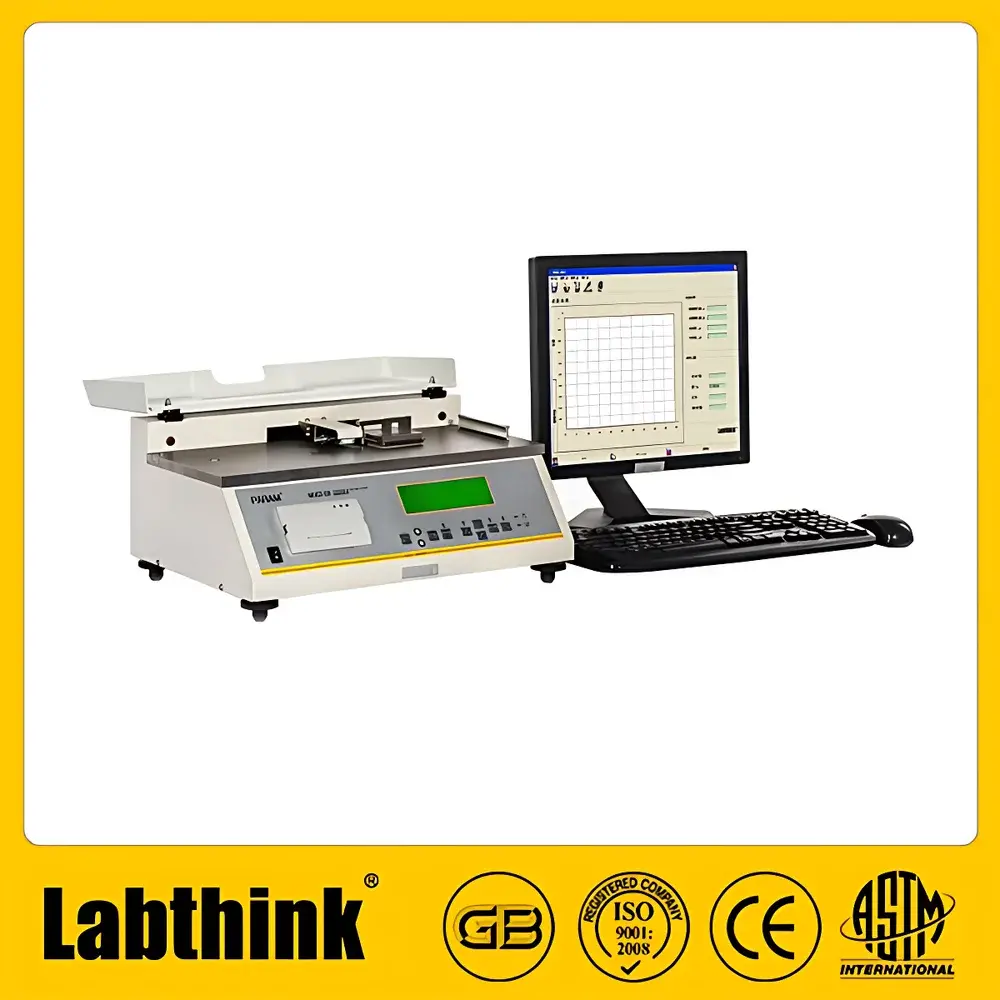
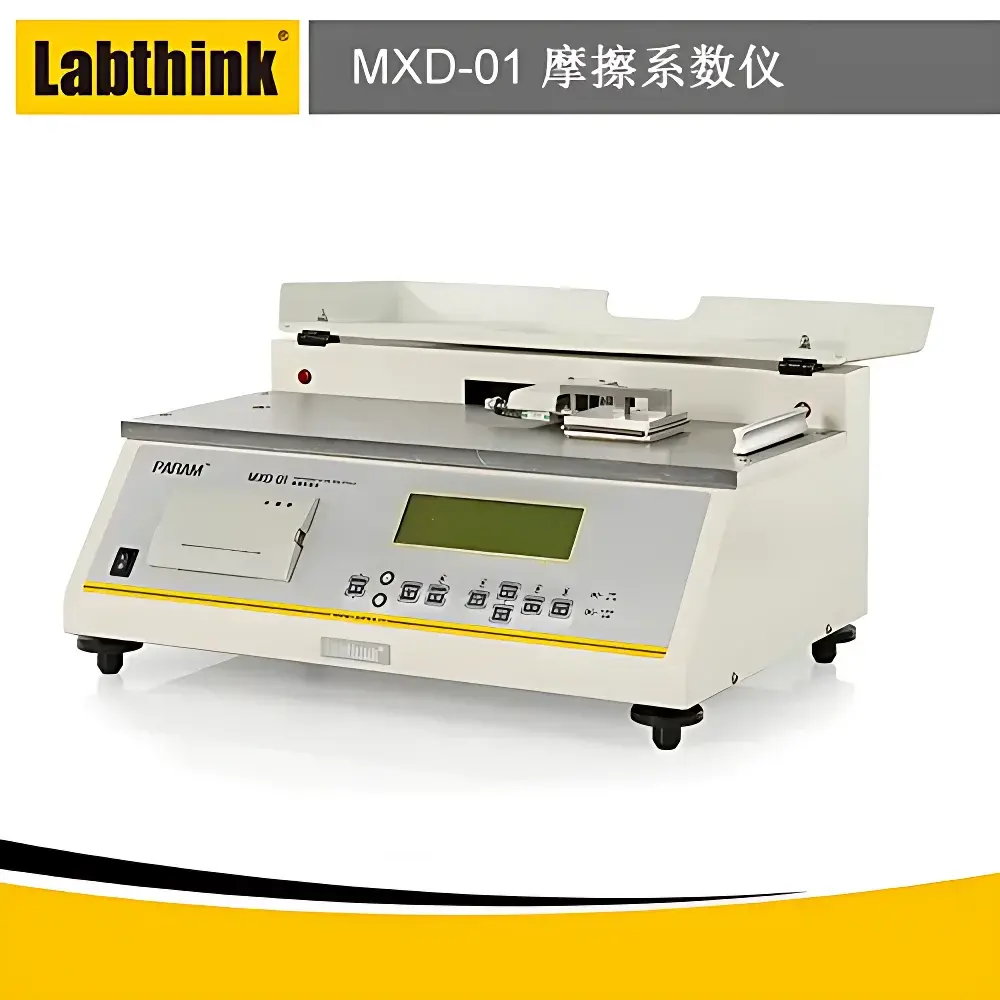
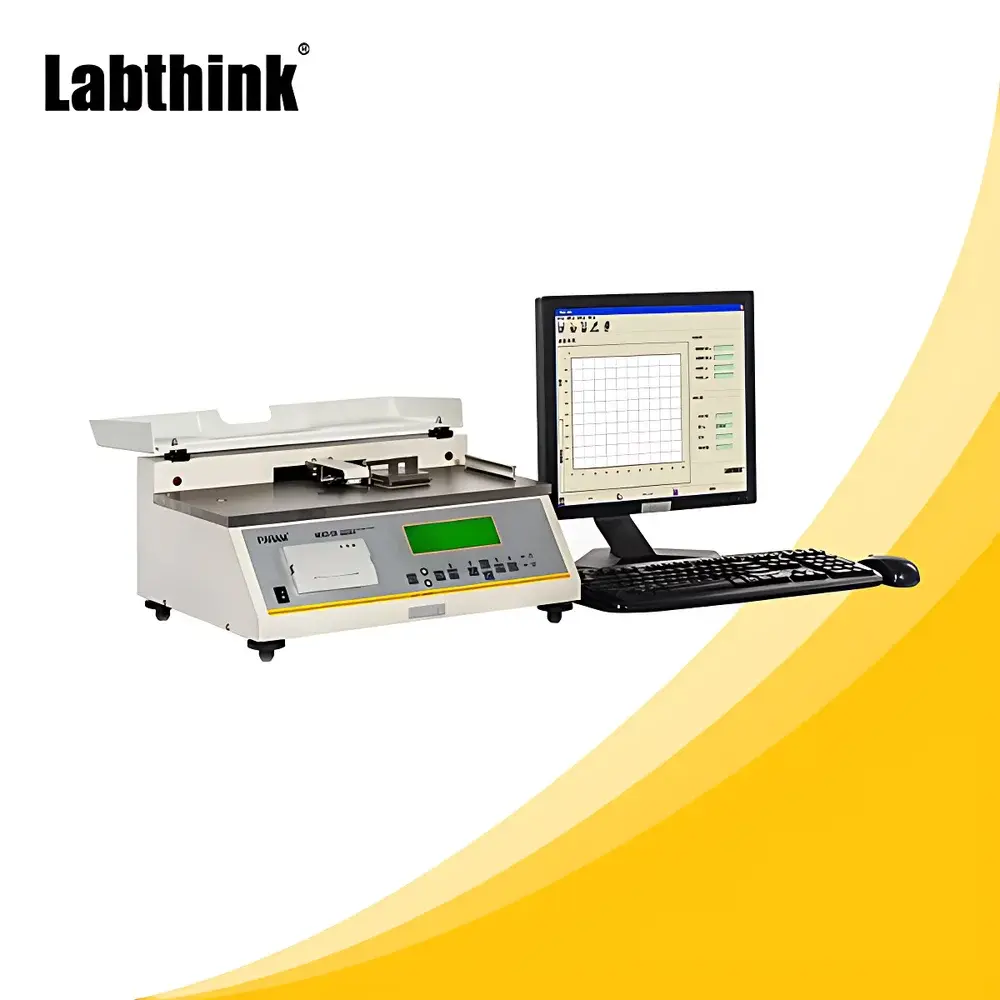
Labthink MXD-01 Coefficient of Friction Tester for Touchscreen Protective Films and Packaging Materials
| Brand | Labthink |
|---|---|
| Origin | Shandong, China |
| Manufacturer Type | Direct Manufacturer |
| Country of Origin | China |
| Model | MXD-01 |
| Price Range | USD 1,400 – 7,000 |
| Standards Compliance | GB 10006, ISO 8295 |
| Load Range | 0–5 N |
| Accuracy Class | Class 1 |
| Travel Distance | 10 mm + 60 mm |
| Slider Mass Options | 200 g, 500 g (1000 g optional) |
| Test Speed | 100 mm/min |
| Ambient Temperature | 10–40 °C |
| Relative Humidity | 20–70 %RH |
| Power Supply | AC 220 V, 50 Hz |
| Dimensions (L×W×H) | 470 × 310 × 200 mm |
| Net Weight | 31 kg |
Overview
The Labthink MXD-01 Coefficient of Friction (COF) Tester is an electromechanical instrument engineered for precision measurement of static and kinetic coefficients of friction in thin, flexible materials—particularly relevant to touchscreen protective films, packaging substrates, polymer sheets, and functional coatings. It operates on the fundamental principle of horizontal pull testing: a standardized slider (e.g., 200 g or 500 g) is placed atop a stationary sample surface; the instrument applies controlled horizontal force until motion initiates (static COF) and continues at constant velocity (kinetic COF), recording peak and plateau forces via high-fidelity load cell transduction. This methodology aligns strictly with ASTM D1894 and ISO 8295 methodologies, while its mechanical architecture—including demagnetized test platens and calibrated slider masses—minimizes parasitic torque and magnetic interference, ensuring traceable repeatability across laboratory and production QC environments.
Key Features
- Simultaneous static and kinetic COF determination with automatic zeroing before each test cycle, eliminating operator-induced baseline drift
- Dual-range travel mechanism (10 mm pre-load engagement + 60 mm dynamic measurement) ensures consistent contact establishment and stable sliding phase capture
- Demagnetized stainless-steel test platform and aluminum alloy sliders, verified by residual magnetism detection (<0.2 mT), reducing electromagnetic artifacts in low-force measurements
- Microprocessor-based control system with intuitive PVC membrane keypad and backlit LCD display enables stand-alone operation without external PC dependency
- Integrated thermal-stabilized load cell (0–5 N, Class 1 accuracy per JJG 391) with real-time digital filtering for noise suppression during transient force events
- RS232 serial interface compliant with EIA/TIA-232-F standards for bidirectional communication with Lystem™ Laboratory Data Management System (LDMS)
Sample Compatibility & Compliance
The MXD-01 accommodates a broad spectrum of planar specimens up to 100 mm wide and 300 mm long—including PET/AR-coated touchscreen films, BOPP laminates, metallized paperboard, silicone-treated release liners, polyurethane shoe soles, rubber brake pads, and hydrophilic ophthalmic gel coatings. Its design satisfies regulatory expectations for method validation under GLP and GMP frameworks: all firmware operations log timestamped audit trails, and test parameters (slider mass, speed, dwell time) are immutable during execution unless reconfigured via password-protected admin mode. The instrument’s conformance to GB 10006 (Chinese national standard equivalent to ISO 8295) and compatibility with ASTM D1894 test protocols support data acceptance in global supply chain audits, including those mandated by IATF 16949 for automotive interior components and ISO 15378 for pharmaceutical packaging qualification.
Software & Data Management
Optional Lystem™ software provides full traceability and statistical rigor: it automatically classifies “stick-slip” behavior based on force waveform slope thresholds, computes 95% confidence intervals for COF means across n ≥ 5 replicates, and generates ISO/IEC 17025-compliant calibration certificates when paired with accredited external force verification. All raw force-vs.-displacement curves are stored in HDF5 format with embedded metadata (operator ID, environmental logs, equipment ID). The system supports 21 CFR Part 11-compliant electronic signatures, role-based access control, and automated report generation in PDF/A-1b and CSV formats—enabling seamless integration into enterprise quality management systems (QMS) such as TrackWise or MasterControl.
Applications
- Optimization of anti-fingerprint and oleophobic coating formulations on smartphone screen protectors
- Validation of slip additive concentration (e.g., erucamide, silicones) in blown polyethylene film extrusion lines
- Comparative evaluation of tactile response in medical device packaging pouches (ISO 11607-1 Annex C)
- QC release testing for cosmetic applicator wands, lip balm tubes, and dropper assemblies
- Frictional stability assessment of coated optical cables under temperature-humidity cycling (IEC 60794-1-2 E11)
- Pre-compliance screening of tire tread compounds against wet-road grip benchmarks (SAE J2452)
FAQ
What standards does the MXD-01 directly support?
It is factory-configured and validated for GB 10006 and ISO 8295. With appropriate slider mass selection and procedural adaptation, it also meets ASTM D1894, TAPPI T815, and JIS Z0237 requirements.
Can the instrument measure both static and kinetic COF in a single test run?
Yes—the system captures the maximum force prior to motion onset (μs) and the average force over the stabilized sliding interval (μk) without manual intervention.
Is calibration traceable to national metrology institutes?
Load cell calibration is performed using NIST-traceable deadweight standards; annual recalibration services include certificate of conformity with uncertainty budgets.
Are custom slider masses supported beyond 200 g and 500 g?
Yes—Labthink offers CNC-machined stainless-steel sliders from 100 g to 2000 g, with dimensional tolerances held to ±0.1 g and surface roughness Ra ≤ 0.4 µm.
Does the system comply with FDA 21 CFR Part 11 for electronic records?
When used with Lystem™ v4.2+ and configured with Windows domain authentication, it fulfills Part 11 requirements for audit trail, electronic signature, and record retention integrity.




