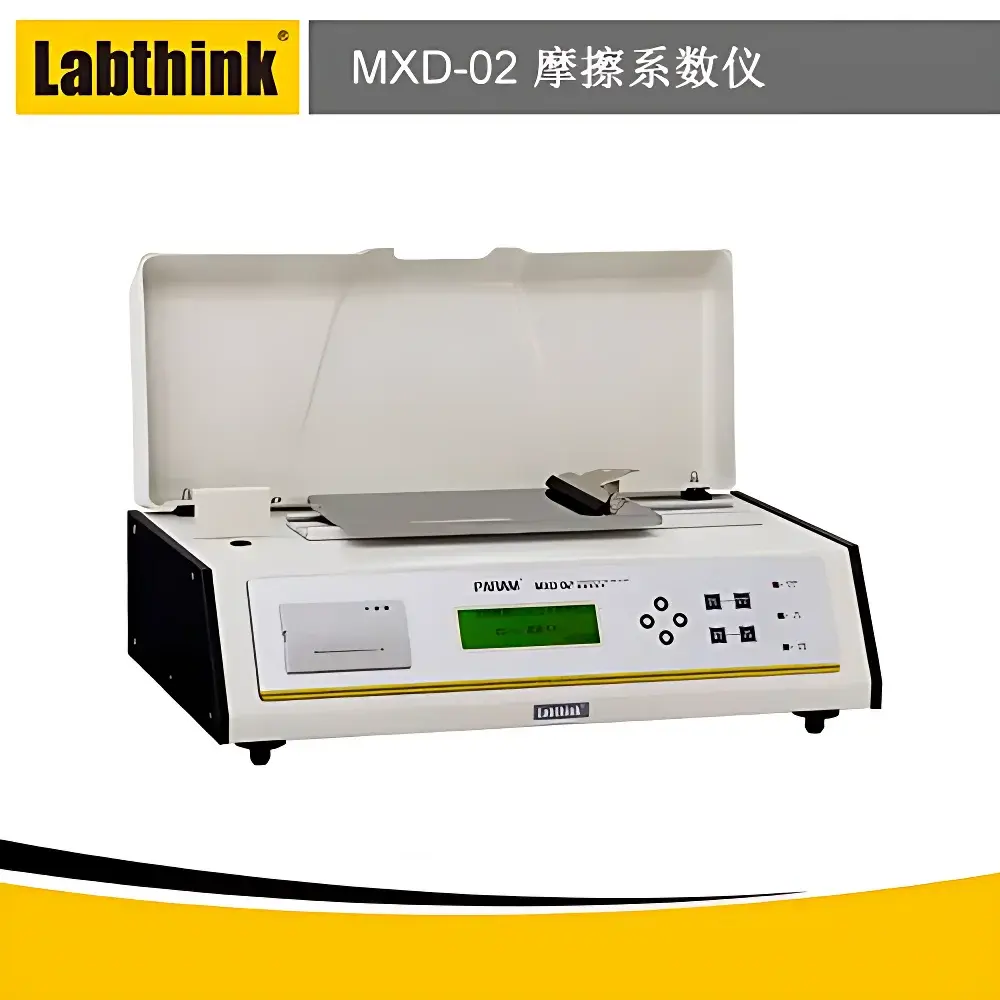
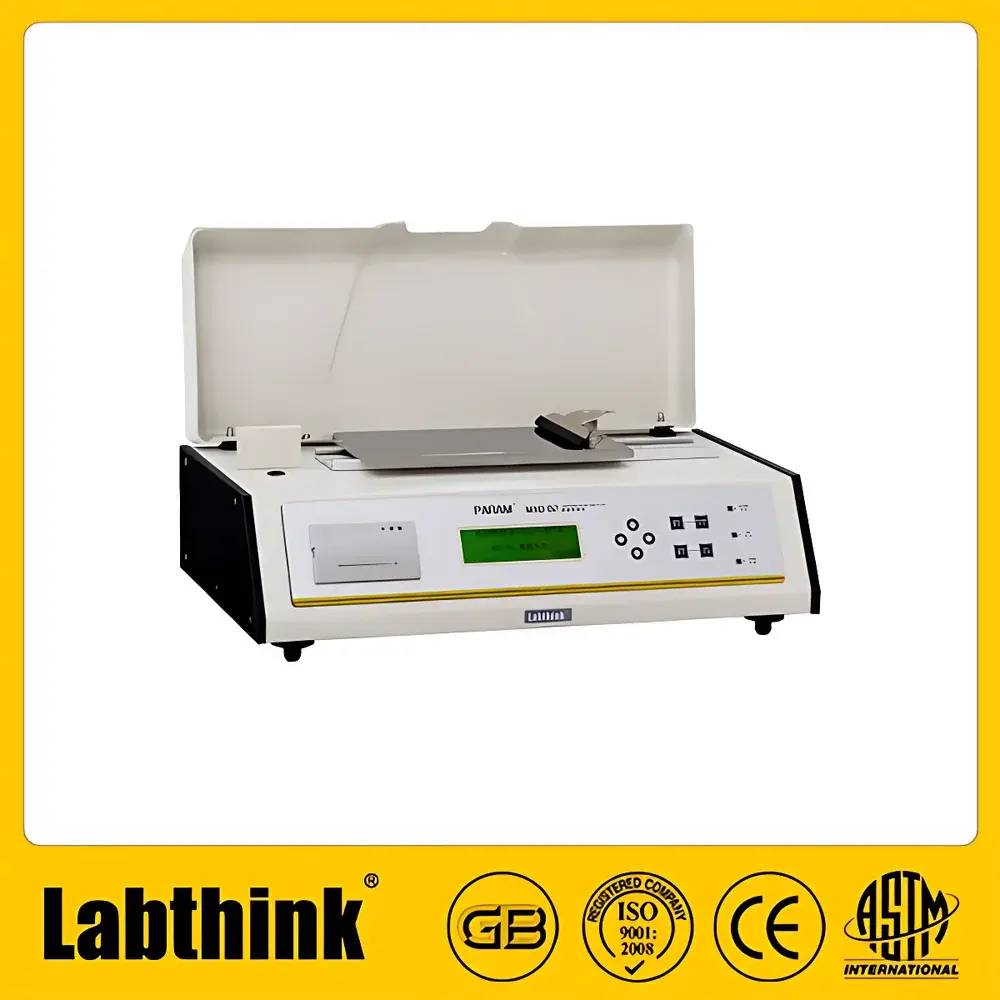
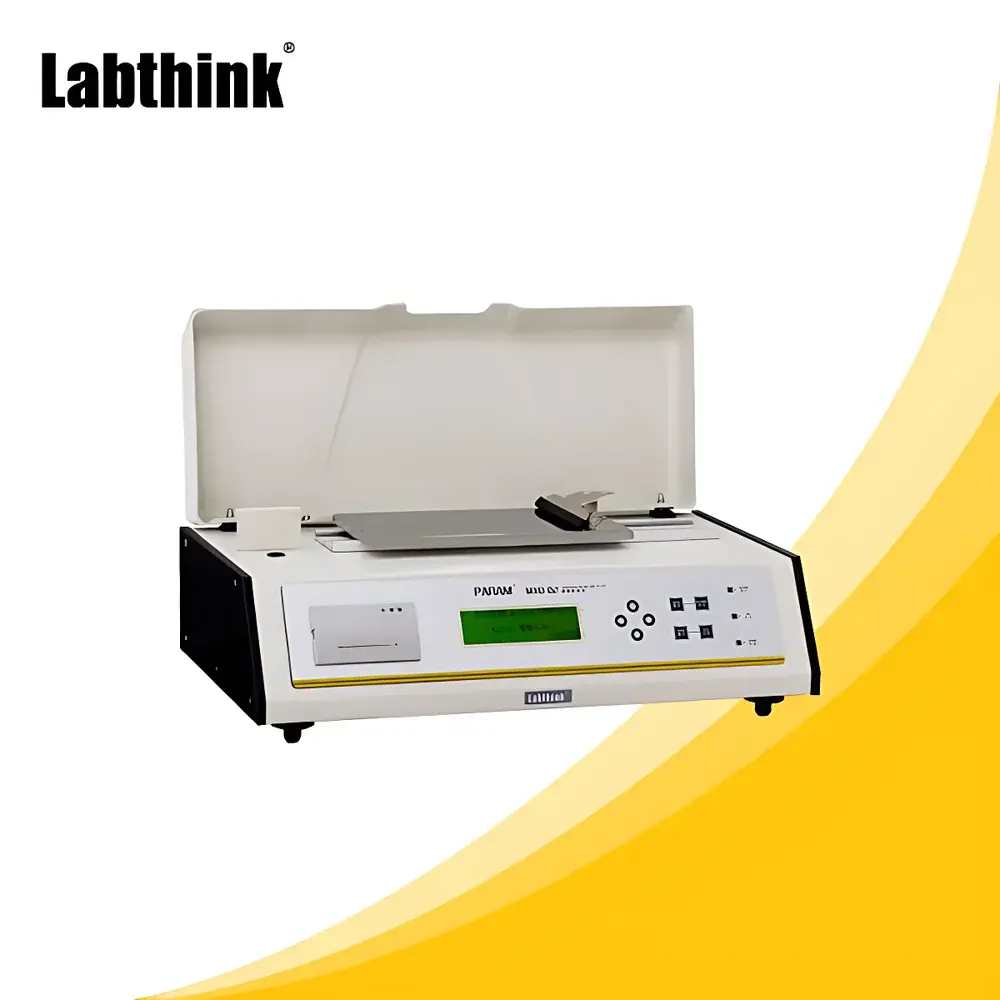
Labthink MXD-02 Coefficient of Friction Tester for Films, Paper, Rubber Sheets, and Packaging Materials
| Brand | Labthink |
|---|---|
| Origin | Shandong, China |
| Manufacturer | Jinan Labthink Electromechanical Technology Co., Ltd. |
| Model | MXD-02 |
| Load Range | 0–5 N |
| Accuracy Class | 0.5 |
| Travel Distance | 70 mm / 150 mm |
| Standard Slider Mass | 200 g (customizable) |
| Test Speeds | 100 mm/min, 150 mm/min (adjustable) |
| Operating Environment | 23 ± 2 °C, 20–70 %RH |
| Power Supply | 220 VAC 50 Hz / 120 VAC 60 Hz |
| Dimensions (L×W×H) | 630 × 360 × 230 mm |
| Net Weight | 33 kg |
| Compliance | ISO 8295, GB 10006, ASTM D1894, TAPPI T816 |
Overview
The Labthink MXD-02 Coefficient of Friction Tester is a precision-engineered instrument designed for the quantitative determination of static and kinetic coefficients of friction (COF) across a broad spectrum of flexible and semi-rigid materials used in packaging, paper, rubber, automotive, and consumer goods industries. It operates on the fundamental principle of horizontal sliding friction measurement: two flat surfaces—typically a stationary test specimen mounted on the base plate and a standardized slider—are brought into defined contact under controlled normal force; the system then measures the peak force required to initiate motion (static friction) and the sustained force during steady-state sliding (kinetic friction). These forces are normalized against the applied normal load to yield dimensionless COF values—μs and μk, respectively. The instrument employs a high-stability load cell with 0.5-class accuracy and a microprocessor-controlled drive mechanism to ensure repeatable displacement at user-selectable speeds (100 or 150 mm/min, with extended range available), enabling compliance with internationally recognized test protocols including ISO 8295, ASTM D1894, GB 10006, and TAPPI T816.
Key Features
- Simultaneous dual-mode measurement: single-test acquisition of both static (μs) and kinetic (μk) coefficients without manual intervention or reconfiguration.
- Programmable test parameters: adjustable travel distance (70 mm or 150 mm), selectable test speed, and configurable normal load application via calibrated slider mass (standard 200 g; optional 500 g or custom masses available).
- Electromagnetically neutralized test platform: both the base plate and slider undergo rigorous demagnetization and residual magnetism verification to eliminate interference from magnetic hysteresis—a critical requirement for high-precision low-force measurements.
- Dedicated microcomputer control architecture with intuitive PVC membrane keypad and backlit LCD display, supporting real-time force curve visualization and on-device data review.
- Modular hardware design: all core components—including load transducer, stepper motor driver, and signal conditioning circuitry—are sourced from certified international suppliers to guarantee long-term metrological stability and operational reliability.
Sample Compatibility & Compliance
The MXD-02 accommodates a wide range of planar materials up to 150 mm in width and 10 mm in thickness, including but not limited to: biaxially oriented polypropylene (BOPP), PET, PE, and laminated films; corrugated board, kraft paper, coated paperboard, and newsprint; vulcanized rubber sheets, EPDM gaskets, and silicone elastomers; woven and nonwoven textiles; metalized composite foils used in cable shielding; conveyor belt compounds; and finished components such as brake pad linings, wiper blades, and footwear outsoles. All testing procedures adhere strictly to the mechanical and environmental constraints specified in ISO 8295 (plastics), ASTM D1894 (plastic film and sheeting), GB 10006 (Chinese national standard for plastic films), and TAPPI T816 (paper and paperboard). The instrument’s thermal and humidity conditioning envelope (23 ± 2 °C, 20–70 %RH) aligns with standard laboratory accreditation requirements for physical testing per ISO/IEC 17025.
Software & Data Management
Optional Lystem™ Laboratory Data Sharing System software enables comprehensive digital workflow integration. It supports automated statistical analysis—including mean, standard deviation, confidence intervals, and outlier detection—for both individual and grouped test sets. Raw force-time datasets are exportable in CSV and XML formats for traceable archival and third-party analysis. The software implements full audit trail functionality compliant with FDA 21 CFR Part 11 requirements, logging all user actions, parameter changes, and result modifications with timestamped digital signatures. Integrated report generation includes customizable templates aligned with GLP/GMP documentation standards, supporting PDF, Excel, and printed output via the built-in thermal printer. RS232 serial interface ensures seamless connectivity with LIMS environments and enterprise QA databases.
Applications
This tester serves as a critical quality assurance tool in R&D laboratories and production QC departments where surface interaction behavior directly impacts functional performance. Typical use cases include: optimizing slip additive concentration in extruded polymer films to prevent jamming in high-speed packaging lines; evaluating coefficient consistency across roll-to-roll converted paper grades to ensure reliable feeding in printing presses; validating frictional match between rubber conveyor belt surfaces and bulk material handling systems; assessing tactile glide characteristics of cosmetic packaging substrates and applicator components; and verifying regulatory conformance of medical device packaging films under USP and ISO 10993-5 biocompatibility guidelines. Its versatility extends to academic research in tribology, surface science, and polymer physics.
FAQ
What standards does the MXD-02 support?
ISO 8295, ASTM D1894, GB 10006, and TAPPI T816 — all implemented via hardware-level calibration and software-configurable test profiles.
Can the instrument measure both static and kinetic COF in one test cycle?
Yes. The system automatically captures the maximum breakaway force (static) and the average sliding force over the defined travel distance (kinetic) without operator intervention.
Is calibration traceable to national metrology institutes?
Yes. Load cell calibration is performed using NIST-traceable deadweight standards, and certificate documentation is provided upon request.
Does the MXD-02 meet regulatory requirements for pharmaceutical packaging testing?
It complies with the mechanical test methodology referenced in USP and supports data integrity features required for FDA-regulated environments when paired with Lystem™ software and 21 CFR Part 11 configuration.
What maintenance is required for long-term accuracy?
Annual recalibration of the load cell and velocity encoder is recommended; routine cleaning of the slider and base plate with isopropyl alcohol is sufficient for daily operation.