
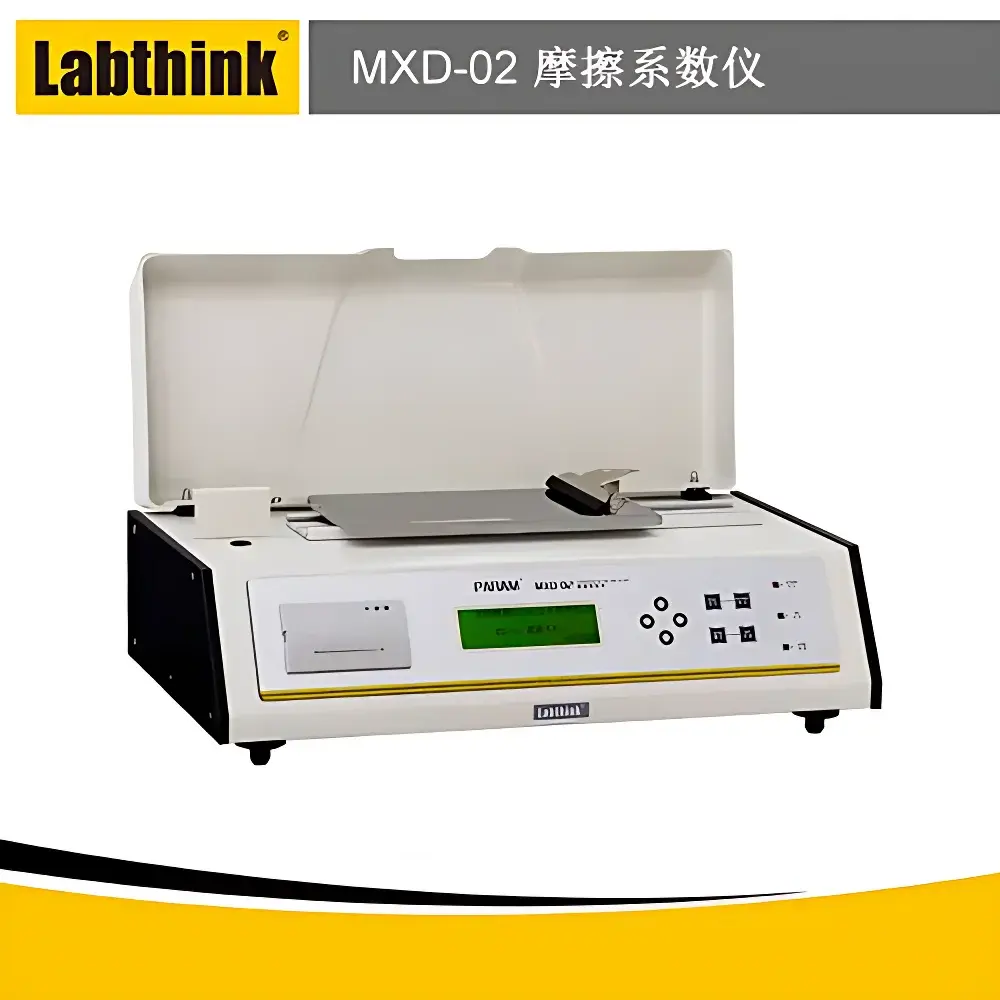
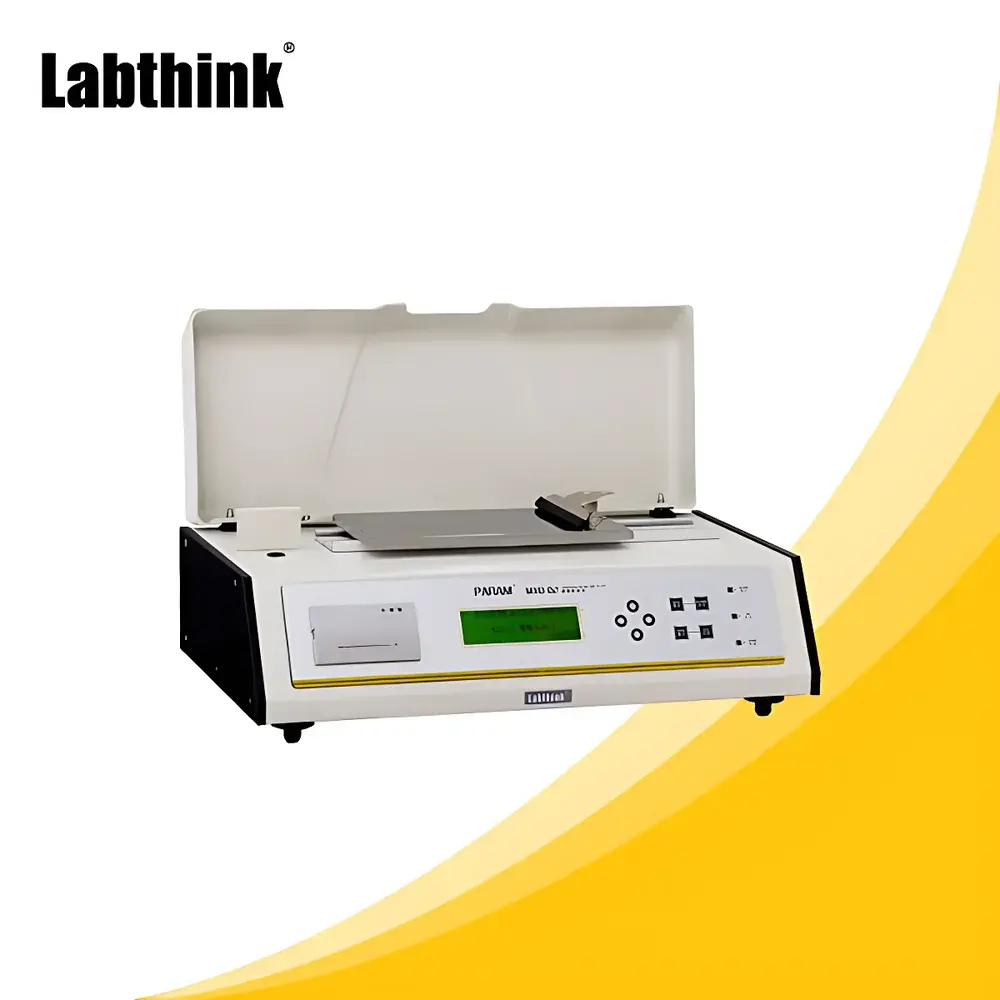
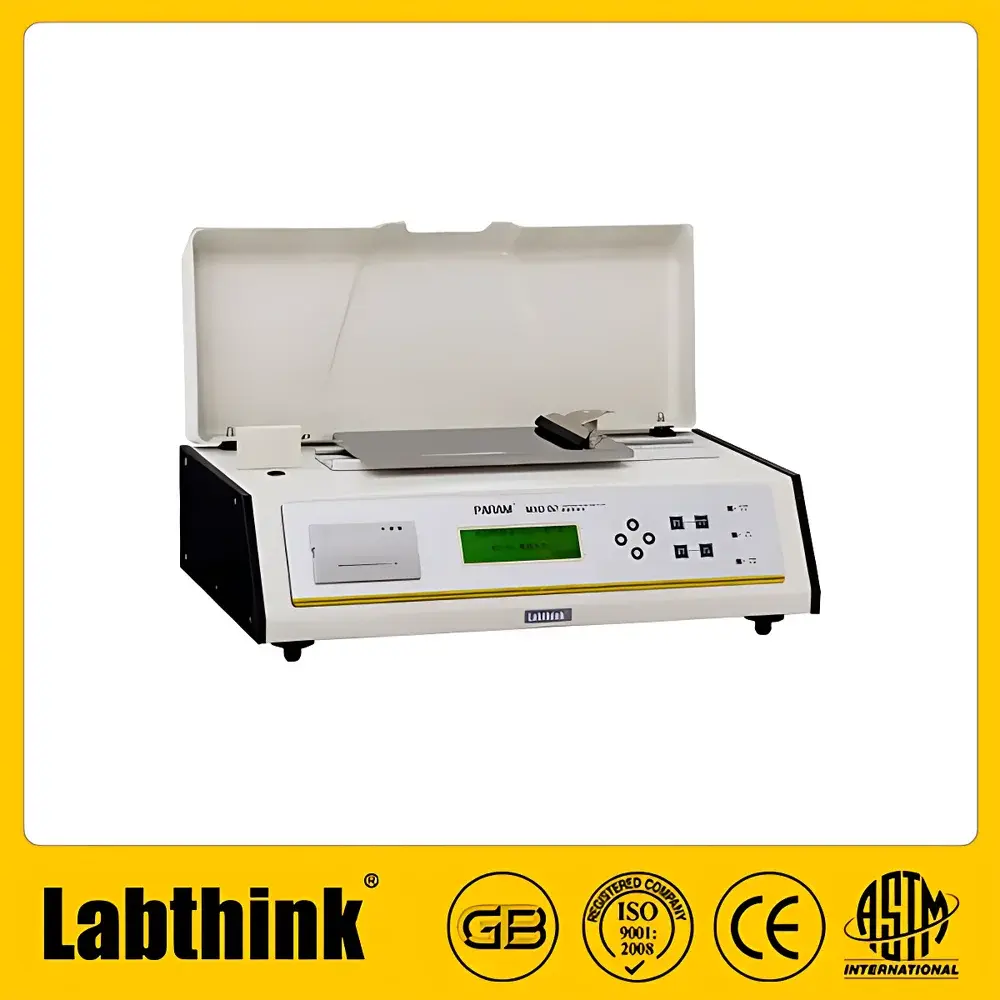
Labthink MXD-02 Coefficient of Friction Tester for Packaging Materials
| Brand | Labthink |
|---|---|
| Origin | Shandong, China |
| Manufacturer Type | Direct Manufacturer |
| Country of Origin | China |
| Model | MXD-02 |
| Price Range | USD 1,400 – 8,500 |
| Compliance | GB 10006, ISO 8295, ASTM D1894, TAPPI T816 |
| Load Range | 0–5 N |
| Accuracy Class | 0.5 |
| Travel Distance | 70 mm / 150 mm |
| Standard Sled Mass | 200 g (customizable) |
| Test Speeds | 100 mm/min, 150 mm/min (adjustable) |
| Environmental Requirements | 23 ± 2 °C, 20–70 %RH |
| Power Supply | 220 VAC 50 Hz / 120 VAC 60 Hz |
| Dimensions (L×W×H) | 630 × 360 × 230 mm |
| Net Weight | 33 kg |
Overview
The Labthink MXD-02 Coefficient of Friction Tester is an electromechanical instrument engineered for precise and repeatable measurement of static and kinetic coefficients of friction (COF) across a broad spectrum of flexible and semi-rigid packaging and industrial materials. It operates on the fundamental principle of interfacial shear mechanics: two flat surfaces—typically a test specimen and a standardized sled—are brought into controlled contact under a defined normal force; the system then measures the maximum tangential resistance at the onset of motion (static friction) and the sustained resistance during steady-state sliding (kinetic friction). The resulting COF values—calculated as the ratio of measured frictional force to applied normal load—are critical parameters for evaluating surface slip resistance, processability in high-speed packaging lines, seal integrity, stack stability, and tactile performance in end-user applications.
Key Features
- Simultaneous dual-mode measurement: single-test acquisition of both static (μs) and kinetic (μk) coefficients without manual reconfiguration.
- Programmable test speed: factory-configured default speeds of 100 mm/min and 150 mm/min, with firmware-supported customization for non-standard velocities to align with application-specific tribological conditions.
- Modular sled design: standard 200 g stainless-steel sled included; optional 500 g and other mass variants available to simulate varied line tensions or real-world loading scenarios.
- Zero-magnetic interference architecture: both test bed surface and sled undergo rigorous demagnetization and residual magnetism verification, minimizing electromagnetic artifacts that could distort low-force transducer readings.
- Microprocessor-based control system: intuitive PVC membrane keypad interface paired with backlit LCD display enables full local operation—including parameter setup, real-time force curve visualization, and pass/fail threshold evaluation—without external computing hardware.
- High-stability sensor subsystem: load cell calibrated to Class 0.5 accuracy per ISO 376, with full-scale range of 0–5 N and resolution sufficient to resolve sub-mN variations typical in polymer film and coated substrate testing.
Sample Compatibility & Compliance
The MXD-02 accommodates specimens up to 80 mm wide × 200 mm long, supporting diverse material classes including but not limited to: biaxially oriented polypropylene (BOPP), polyethylene terephthalate (PET), aluminum foil laminates, kraft paperboard, woven polypropylene sacks, elastomeric gaskets, rubber conveyor belts, automotive brake pad composites, textile upholstery fabrics, and cosmetic packaging substrates. Its mechanical and software architecture conforms to internationally recognized standards governing coefficient of friction determination: GB 10006 (China), ISO 8295 (Plastics — Film and sheeting — Determination of coefficient of friction), ASTM D1894 (Standard Test Method for Static and Kinetic Coefficients of Friction of Plastic Film and Sheeting), and TAPPI T816 (Horizontal Surface Method for Static COF of Corrugated and Solid Fiberboard). All test methods are implemented with traceable calibration protocols and documented uncertainty budgets compliant with ISO/IEC 17025 requirements for accredited laboratories.
Software & Data Management
Optional Lystem™ Laboratory Data Sharing System provides comprehensive digital workflow integration. It supports automated statistical analysis—including mean, standard deviation, confidence intervals, and outlier detection—for individual tests or grouped datasets. Raw force–displacement time-series data is exportable in CSV and XML formats for secondary analysis in MATLAB, Python (NumPy/Pandas), or industry-standard QC platforms. The software enforces audit-trail functionality per FDA 21 CFR Part 11: all user actions, parameter changes, and result modifications are timestamped, attributed, and non-erasable. Integrated RS232 serial interface ensures compatibility with legacy lab infrastructure, while optional USB-to-RS232 adapters enable connectivity with modern Windows/Linux workstations. Reports comply with GLP/GMP documentation standards and include instrument ID, operator credentials, environmental monitoring logs, calibration certificate references, and graphical overlay of μs/μk curves.
Applications
- Quality assurance of roll-fed packaging films to prevent web slippage or misregistration during printing, lamination, or form-fill-seal operations.
- Development of anti-block or slip-additive formulations in polymer extrusion processes.
- Evaluation of surface treatment efficacy (e.g., corona, plasma, or chemical priming) on metallized or barrier-coated substrates.
- Validation of tactile performance in consumer-facing products such as skincare tubes, lipstick casings, and pharmaceutical blister packs.
- Comparative assessment of wear-resistant coatings on medical device housings and diagnostic cartridge trays.
- Regulatory submission support for packaging components requiring frictional compliance under USP , ISO 11607-1, or EU Annex 15 guidelines.
FAQ
What standards does the MXD-02 support out-of-the-box?
The instrument includes preloaded test methods for GB 10006, ISO 8295, ASTM D1894, and TAPPI T816. Custom method templates can be imported via Lystem™ software for internal SOPs or regional regulatory requirements.
Can the MXD-02 measure friction on curved or textured surfaces?
No—it is designed exclusively for flat, planar specimens in accordance with standardized test geometries. Curved, embossed, or highly irregular topographies require alternative tribometers with conformal contact mechanisms.
Is calibration certification provided with shipment?
Yes—a NIST-traceable calibration certificate covering load cell, displacement encoder, and environmental sensors is supplied with each unit, valid for 12 months under normal operating conditions.
Does the system meet cybersecurity requirements for networked labs?
The base configuration operates as a standalone embedded device with no wireless interfaces or internet connectivity. When integrated with Lystem™ via wired RS232, it complies with IEC 62443-3-3 segmentation guidelines when deployed behind enterprise firewalls.
What maintenance intervals are recommended?
Biannual inspection of guide rails, belt tension, and sled contact surfaces is advised; annual recalibration by an ISO/IEC 17025-accredited service provider is strongly recommended to maintain metrological integrity.





