
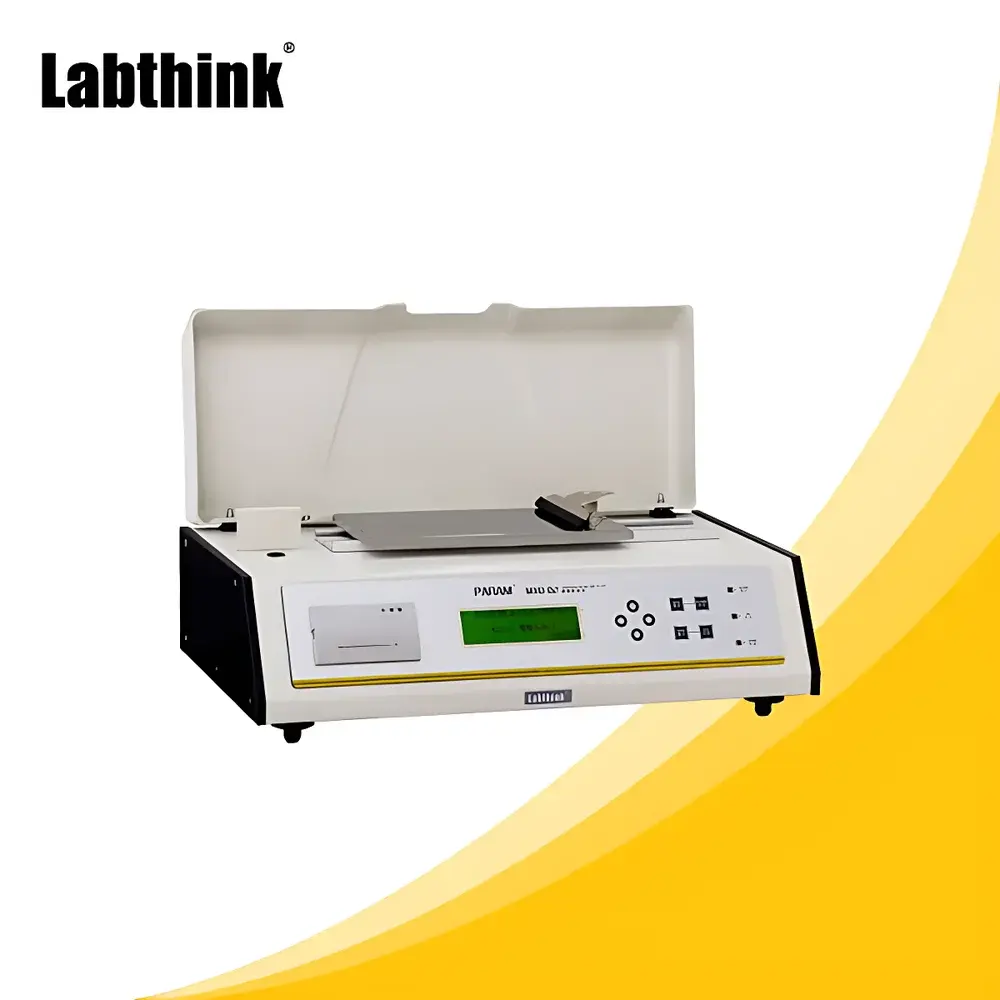
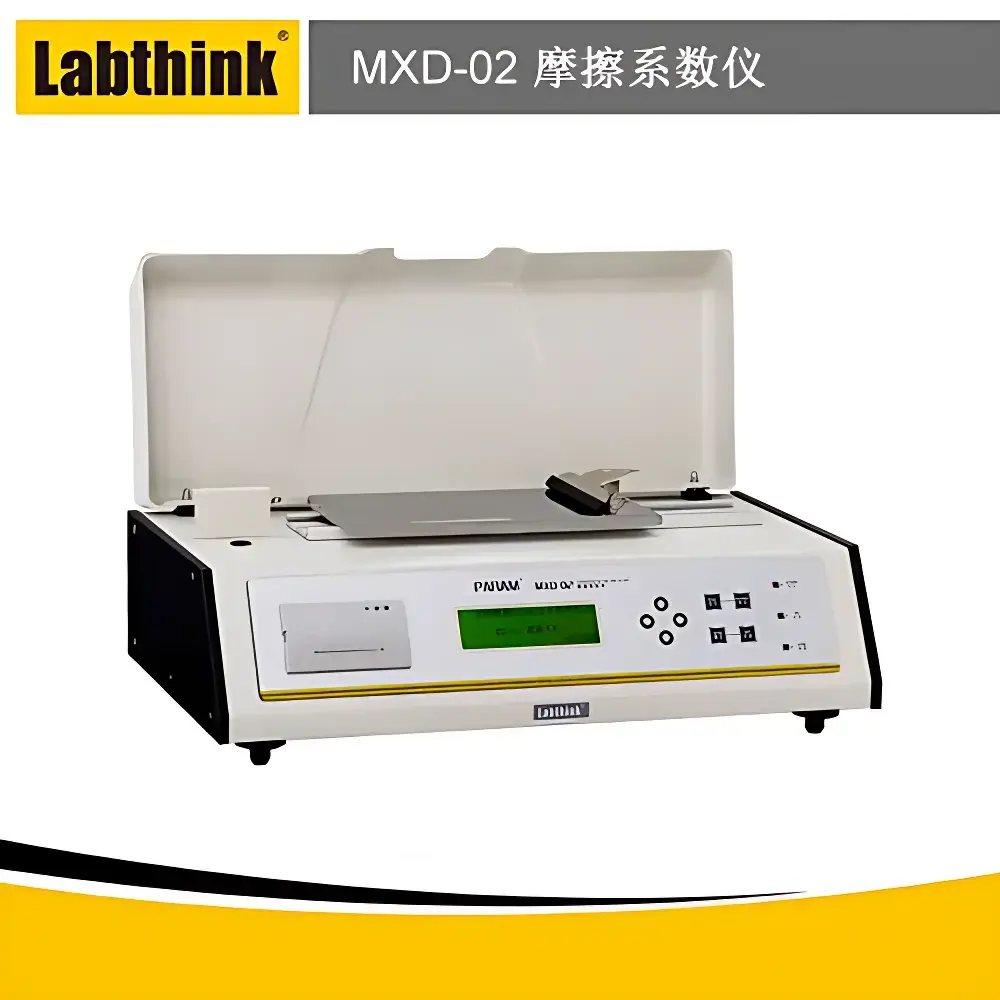
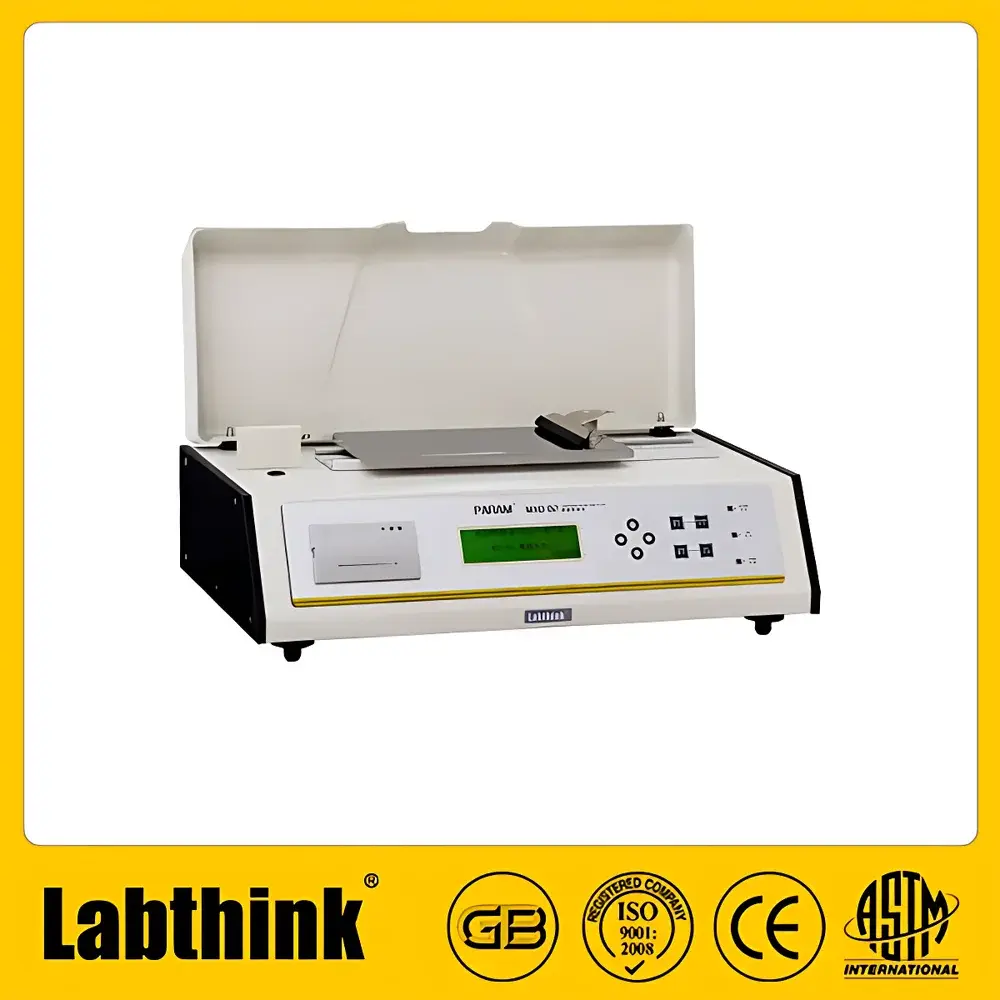
Labthink MXD-02 Coefficient of Friction Tester for Plastic Films, Thin Sheets, and Packaging Materials
| Brand | Labthink |
|---|---|
| Origin | Shandong, China |
| Manufacturer Type | Direct Manufacturer |
| Country of Origin | China |
| Model | Labthink MXD-02 |
| Price Range | USD 1,400 – 8,500 |
| Standards Compliance | GB 10006, ISO 8295, ASTM D1894, TAPPI T816 |
| Load Range | 0–5 N |
| Accuracy Class | 0.5 |
| Travel Distance | 70 mm / 150 mm |
| Standard Sled Mass | 200 g (customizable) |
| Test Speeds | 100 mm/min, 150 mm/min (adjustable) |
| Environmental Conditions | 23 ± 2 °C, 20–70 %RH |
| Power Supply | 220 VAC 50 Hz / 120 VAC 60 Hz |
| Dimensions (L×W×H) | 630 × 360 × 230 mm |
| Net Weight | 33 kg |
Overview
The Labthink MXD-02 Coefficient of Friction (COF) Tester is an electromechanical instrument engineered for precision measurement of static and kinetic coefficients of friction across a broad spectrum of flexible and semi-rigid packaging and industrial materials. It operates on the fundamental principle of horizontal pull testing: a standardized sled—loaded with a defined mass—is drawn at controlled velocity across a stationary sample surface mounted on a leveled test bed. The force required to initiate motion (static COF) and maintain steady sliding (kinetic COF) is captured via a high-stability load cell, digitized in real time, and processed to yield dimensionless frictional ratios (μs and μk). This method conforms rigorously to the physical definitions outlined in ASTM D1894 and ISO 8295, ensuring metrological traceability and interlaboratory comparability. Designed specifically for quality control laboratories in packaging, film extrusion, converting, and regulatory compliance environments, the MXD-02 delivers repeatable, operator-independent results essential for process validation, material qualification, and specification conformance.
Key Features
- Simultaneous dual-mode measurement: single-test acquisition of both static (μs) and kinetic (μk) coefficients without manual reconfiguration
- Programmable test velocity: factory-calibrated speeds of 100 mm/min and 150 mm/min; additional rates available via firmware configuration under engineering supervision
- Modular sled system: standard 200 g stainless-steel sled included; optional calibrated masses (e.g., 500 g) available for application-specific normal-force requirements
- Zero-residual-magnetism test platform: all metallic contact surfaces—including sled base and test bed—are subjected to full demagnetization and residual flux verification per IEC 61000-4-8, minimizing electromagnetic interference with load cell signal integrity
- Microprocessor-based control architecture: embedded ARM Cortex-M4 controller with real-time OS ensures deterministic timing, closed-loop speed regulation, and fault-tolerant operation
- Dual-output interface: integrated thermal mini-printer for immediate hardcopy reporting + RS232 serial port compliant with EIA/TIA-232-F for external data logging and SCADA integration
Sample Compatibility & Compliance
The MXD-02 accommodates specimens up to 150 mm wide × 300 mm long, supporting flat, non-porous, and moderately textured substrates including biaxially oriented polypropylene (BOPP), polyester (PET), polyethylene (PE), aluminum foil laminates, coated paperboard, rubber compounds, textile composites, and metalized films. Its mechanical design and force range (0–5 N) are optimized for low-friction polymer interfaces typical in high-speed packaging lines—where values commonly fall between 0.15 and 0.60. Regulatory alignment includes full adherence to GB 10006 (China), ISO 8295 (international), ASTM D1894 (U.S.), and TAPPI T816 (fiber-based substrates). All calibration protocols follow ISO/IEC 17025 guidelines, and system-level uncertainty budgets are documented per GUM (JCGM 100:2008). For GLP/GMP environments, optional audit-trail-enabled software modules support 21 CFR Part 11-compliant electronic records.
Software & Data Management
The optional Lystem™ Laboratory Data Management System (LDMS) provides centralized control over instrument fleets, enabling remote parameter setting, batch job scheduling, and cross-instrument statistical analysis. Raw force-vs.-time datasets are stored in IEEE 754 double-precision format with embedded metadata (operator ID, timestamp, environmental log, calibration certificate ID). Statistical outputs include mean, SD, CV%, confidence intervals (95%), and outlier detection per Grubbs’ test. Multi-curve overlay functionality allows comparative trend analysis across material lots, supplier batches, or aging conditions. Report templates comply with ISO/IEC 17025 clause 7.8.2 and may be exported as PDF/A-1b, CSV, or XML for ERP/LIMS ingestion. All software binaries undergo annual penetration testing and are signed with SHA-256 digital certificates.
Applications
- Optimization of slip additive concentration (e.g., erucamide, oleamide) in blown and cast films
- Verification of anti-block performance in sealant layers prior to lamination
- Validation of corona treatment efficacy on PE and PP substrates
- Assessment of coefficient consistency across roll width for web-guiding stability
- Regulatory submission support for FDA 21 CFR 177.1520 (olefin polymers) and EU 10/2011 compliance dossiers
- Friction benchmarking of medical device packaging (e.g., Tyvek®/foil pouches) per ISO 11607-1
FAQ
What standards does the MXD-02 natively support?
The instrument implements test logic and reporting templates for GB 10006, ISO 8295, ASTM D1894, and TAPPI T816. Custom protocol scripting is possible via LDMS SDK for proprietary or regional methods.
Can the MXD-02 measure friction on curved or three-dimensional samples?
No—it is designed exclusively for planar, macroscopically flat specimens. Curved surfaces require alternative techniques such as pin-on-disk or tribometer-based micro-COF mapping.
Is temperature and humidity control integrated into the instrument?
The MXD-02 does not include active climate control. Users must conduct tests within the specified ambient envelope (23 ± 2 °C, 20–70 %RH) using externally conditioned laboratory space per ISO 291 and ASTM D618.
How is calibration maintained over time?
Load cell calibration is traceable to NIM (China National Institute of Metrology) via accredited third-party providers. Annual recalibration is recommended; internal zero-point verification and span checks can be performed daily using certified deadweight sets.




