
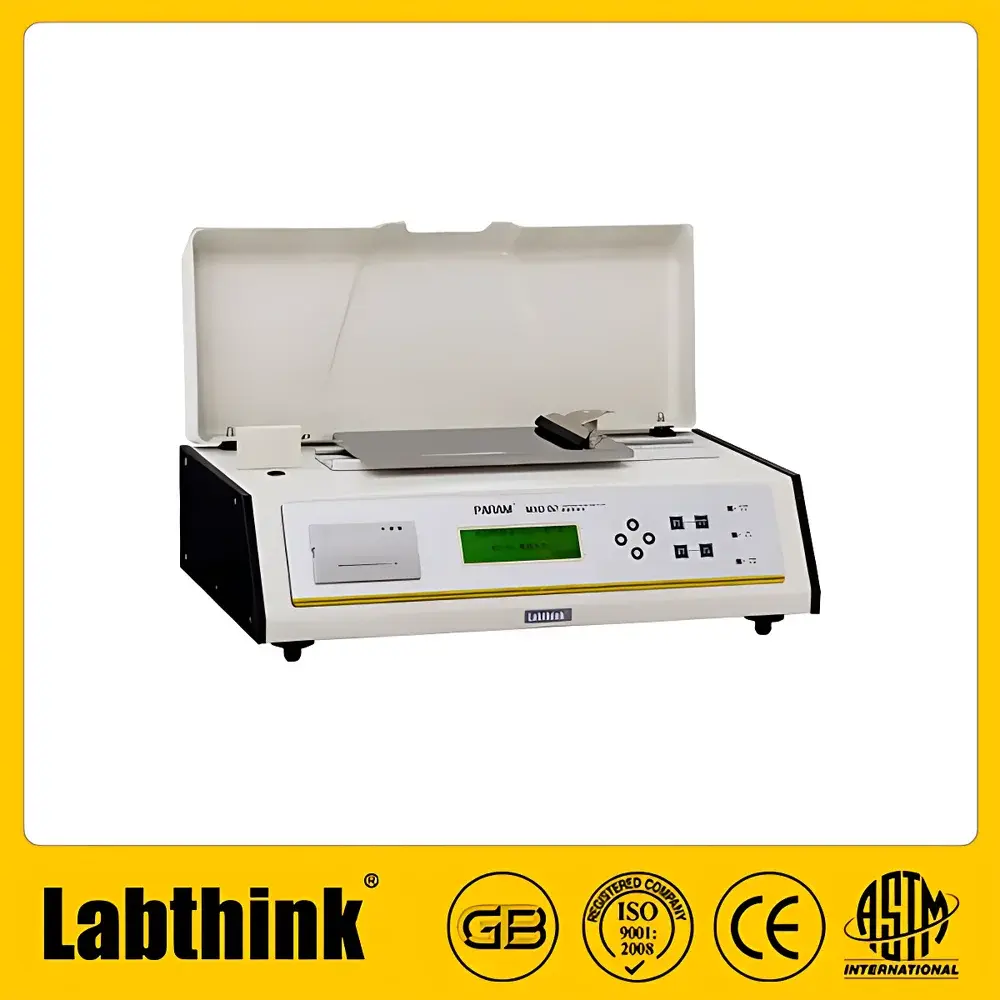
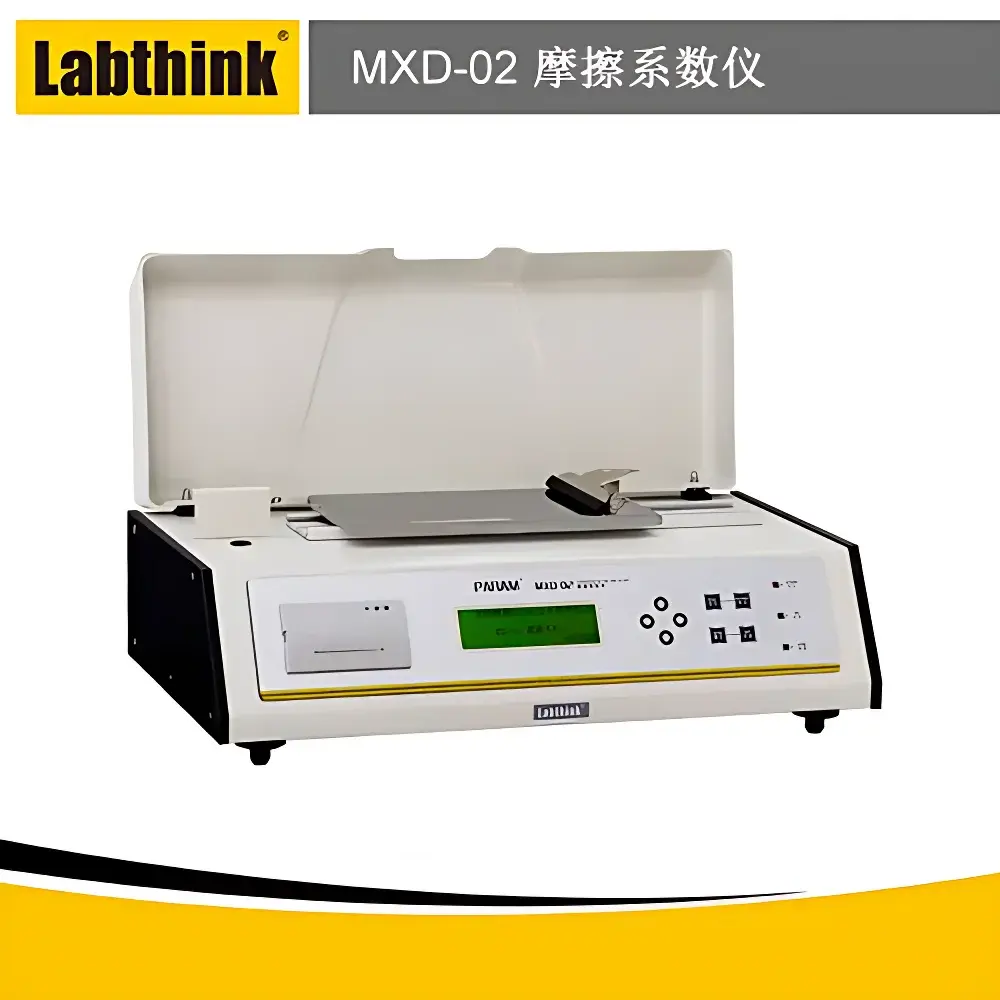
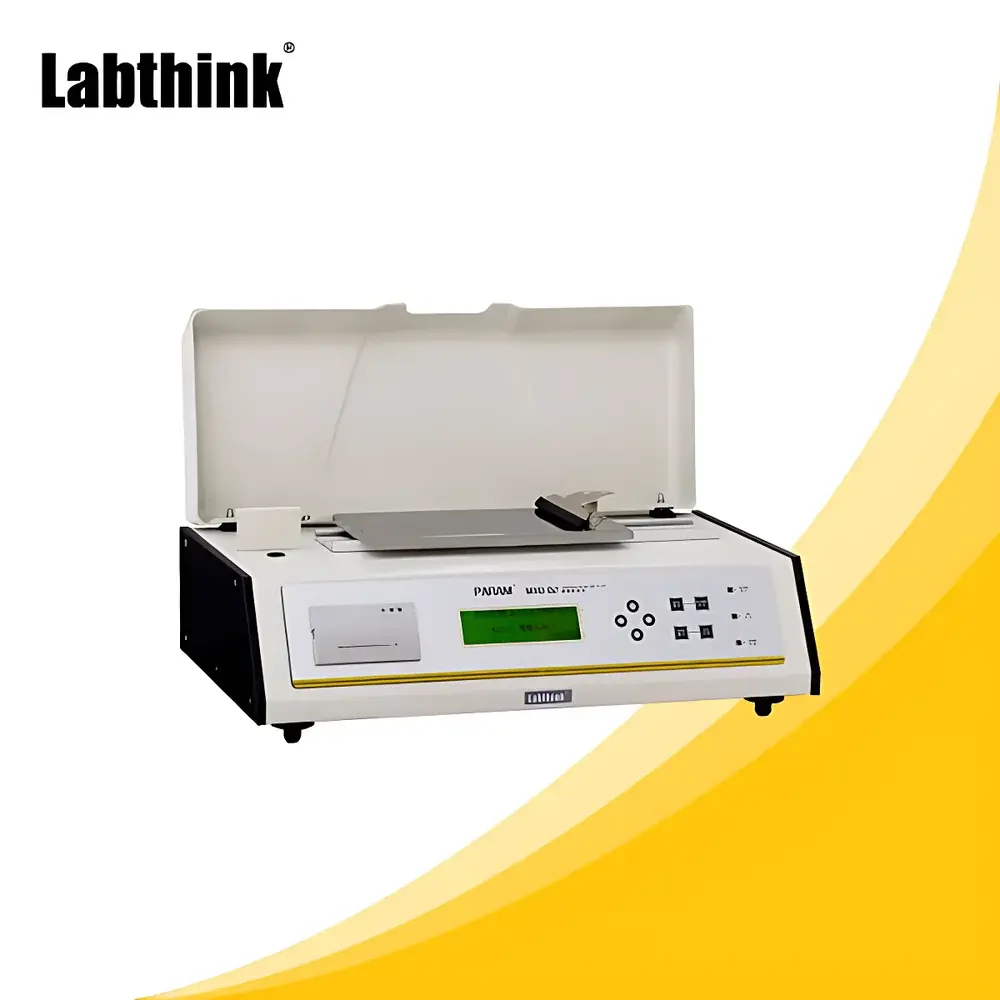
Labthink MXD-02 Coefficient of Friction Tester for Printed Coatings and Surface Slip Performance
| Brand | Labthink |
|---|---|
| Origin | Shandong, China |
| Manufacturer Type | Direct Manufacturer |
| Origin Category | Domestic (China) |
| Model | MXD-02 |
| Price Range | USD 1,400 – 8,500 |
| Load Range | 0–5 N |
| Accuracy Class | 0.5 |
| Travel Distance | 70 mm / 150 mm |
| Standard Sled Mass | 200 g (customizable sleds available) |
| Test Speeds | 100 mm/min, 150 mm/min (adjustable) |
| Environmental Requirements | 23 ± 2 °C, 20–70 %RH |
| Power Supply | 220 VAC 50 Hz / 120 VAC 60 Hz |
| Dimensions (L×W×H) | 630 × 360 × 230 mm |
| Net Weight | 33 kg |
| Compliance Standards | ISO 8295, GB 10006, ASTM D1894, TAPPI T816 |
Overview
The Labthink MXD-02 Coefficient of Friction Tester is a precision-engineered instrument designed for quantitative evaluation of static and kinetic coefficients of friction (COF) across a broad spectrum of flexible and semi-rigid materials used in packaging, printing, automotive, footwear, and personal care industries. It operates on the fundamental principle of horizontal sliding resistance measurement: a standardized sled is placed atop a conditioned test specimen and pulled at a controlled linear velocity across its surface while force transducers record the peak (static) and sustained (kinetic) frictional forces. The resulting COF values—calculated as the ratio of measured friction force to normal load—are critical indicators of surface slip behavior, directly influencing high-speed packaging line efficiency, label adhesion stability, printed ink rub resistance, and tactile user experience in consumer products such as cosmetics and hygiene wipes.
Key Features
- Simultaneous dual-mode measurement: single-test acquisition of both static (μs) and kinetic (μk) coefficients of friction under identical environmental and mechanical conditions.
- Programmable test velocity: factory-configured speeds of 100 mm/min and 150 mm/min; extended range available via firmware update or custom calibration for specialized applications (e.g., low-speed film unwinding or high-speed blister packaging).
- Modular sled system: standard 200 g sled compliant with ISO 8295 and ASTM D1894; optional calibrated masses (e.g., 500 g) support material-specific pressure normalization per ISO 15359 or internal QC protocols.
- Electromagnetically neutralized test platform: all metallic contact surfaces—including sled base and test bed—undergo certified demagnetization and residual flux verification to eliminate magnetic interference with strain-gauge-based load cells, ensuring long-term metrological integrity.
- Microprocessor-controlled architecture: embedded real-time OS with menu-driven interface on backlit LCD, PVC tactile keypad, and non-volatile memory for up to 100 test records without external storage.
- Traceable hardware design: load cell, stepper motor driver, and position encoder sourced from Tier-1 industrial suppliers (EU/US origin), validated per IEC 61000-6-3 EMC and ISO 9001 production controls.
Sample Compatibility & Compliance
The MXD-02 accommodates specimens up to 150 mm wide × 300 mm long, supporting films (BOPP, PET, PE), coated papers, laminated foils, rubber compounds, textile substrates, polymer-coated metals (e.g., Alu-PET composites for cable shielding), and elastomeric components (brake pad linings, wiper blades). Its mechanical design conforms to dimensional and procedural requirements of ISO 8295 (plastics), GB 10006 (Chinese national standard for plastic films), ASTM D1894 (standard test method for COF of plastic film and sheeting), and TAPPI T816 (paper and board). All electronic subsystems comply with CE marking directives (2014/30/EU EMC, 2014/35/EU LVD), and the instrument’s data output structure supports audit-ready documentation for GLP/GMP-regulated environments when paired with Lystem™ Laboratory Data Management System.
Software & Data Management
Optional Lystem™ v3.2 software enables automated statistical analysis (mean, SD, CV%, confidence intervals), batch-wise curve superposition, outlier detection via Grubbs’ test, and customizable report generation (PDF, CSV, XML). Raw force-vs.-displacement time-series data are preserved with 10 ms timestamp resolution. The system implements role-based user access control, electronic signature capability, and full 21 CFR Part 11 compliance—including audit trail logging of all parameter changes, result modifications, and user logins. RS232 serial interface ensures compatibility with legacy laboratory PCs; USB-to-serial adapters supported. Data export conforms to ASTM E1461-22 metadata schema for friction testing.
Applications
- Packaging R&D: optimizing anti-blocking agent concentration in PE films, validating matte vs. glossy varnish slip performance on cartons, assessing heat-seal layer migration effects on inner pouch COF.
- Printing Quality Control: quantifying ink-settling impact on post-print rub resistance, correlating UV-cure energy dose with surface tack and subsequent friction profile.
- Automotive Interiors: evaluating coefficient consistency of door panel trim fabrics across temperature/humidity cycles per ISO 17025-accredited test plans.
- Personal Care Product Development: measuring fingertip glide characteristics of silicone-treated tissue sheets or emollient-coated applicators under controlled RH conditions.
- Regulatory Submission Support: generating ISO/IEC 17025-compliant test reports for FDA premarket notifications (510(k)) involving medical device packaging slip properties.
FAQ
Does the MXD-02 meet ISO/IEC 17025 calibration traceability requirements?
Yes—load cell calibration certificates are issued by CNAS-accredited laboratories (certificate ID embedded in firmware), with uncertainty budgets ≤0.35% FS at 23 °C.
Can test data be exported directly to LIMS without manual re-entry?
Yes—via configurable ASCII-delimited output over RS232, mapping fields to ASTM E1461-defined friction test data elements.
Is thermal expansion compensation applied during high-temperature COF testing?
No—the MXD-02 is rated for ambient operation only (23 ± 2 °C); elevated temperature testing requires auxiliary climate chambers meeting ISO 291 conditioning specifications.
What maintenance intervals are recommended for long-term accuracy?
Load cell zero-point verification every 3 months; sled base surface inspection and cleaning with isopropanol prior to each test series; annual full-system metrological recalibration.
Are there application notes available for non-standard substrates like hydrogels or electrospun nanofibers?
Yes—Labthink’s Technical Library provides peer-reviewed methodology supplements for porous, viscoelastic, and ultra-low-mass specimens, including sled mass reduction protocols and dynamic preload compensation algorithms.






