
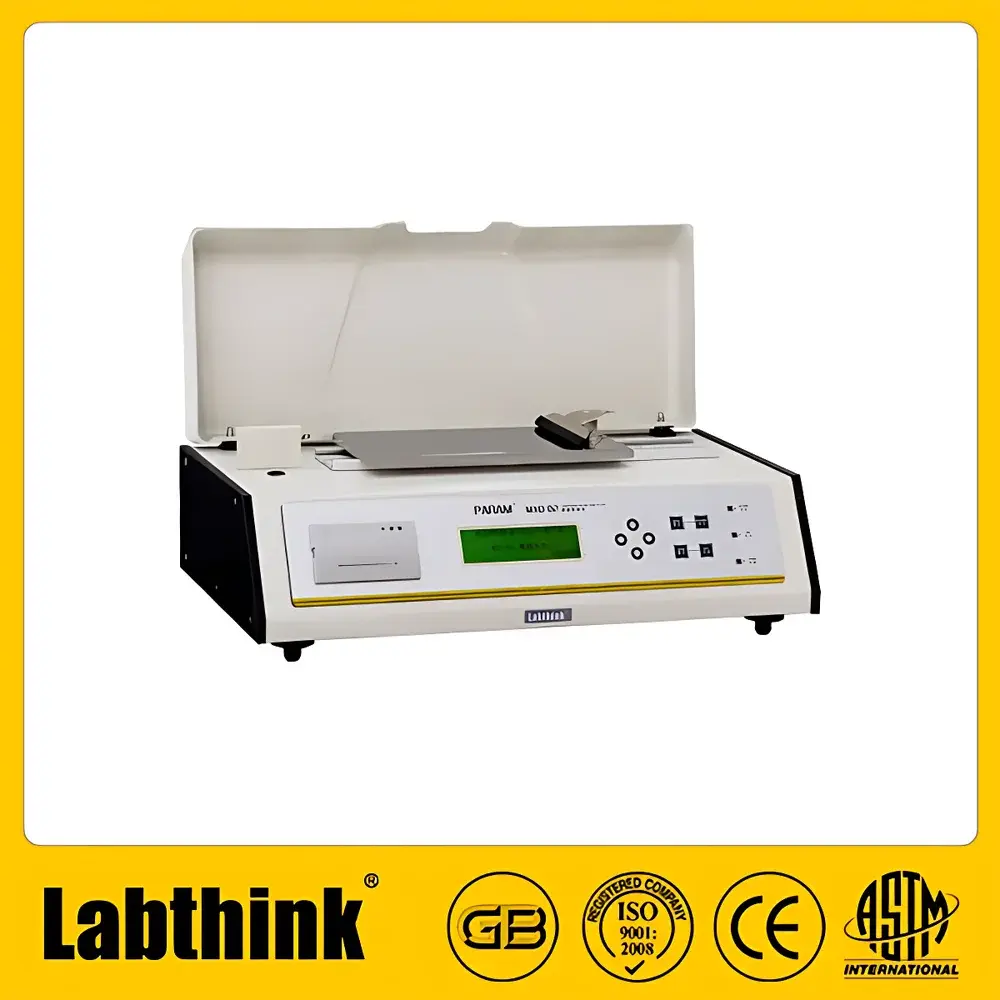
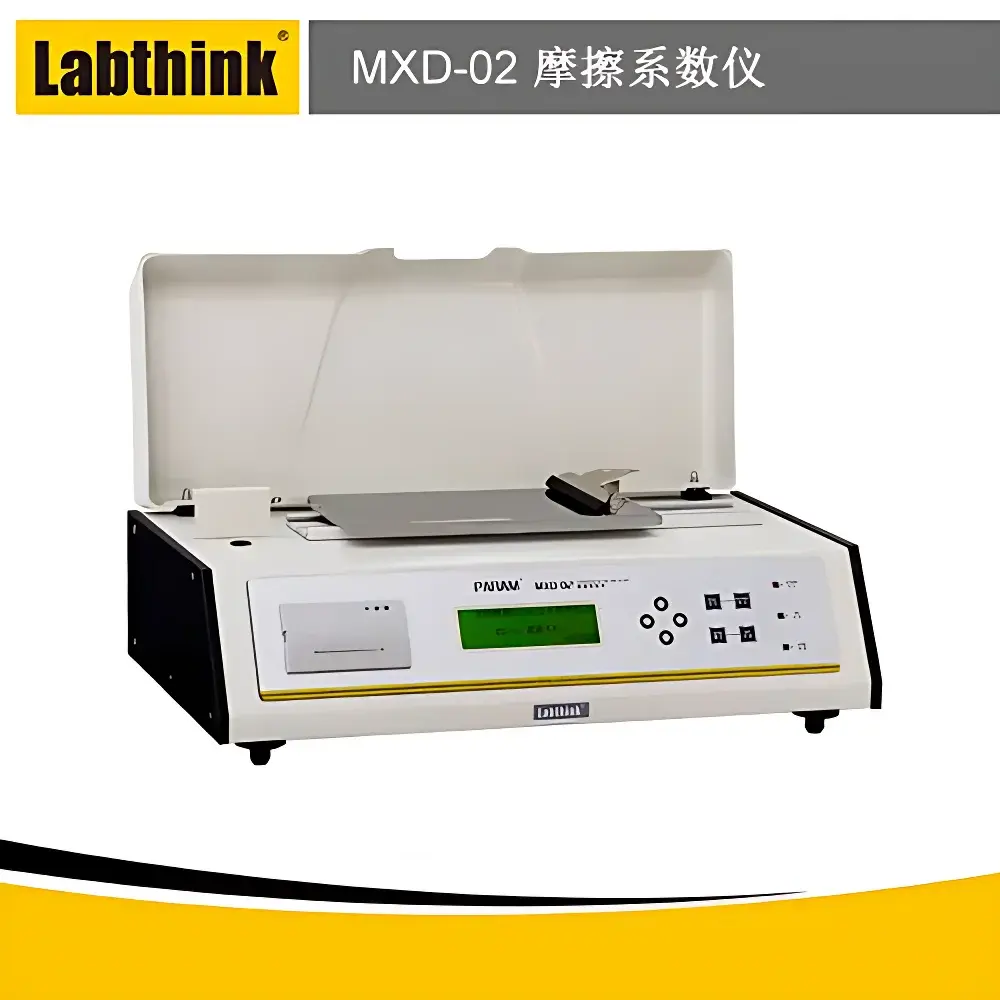
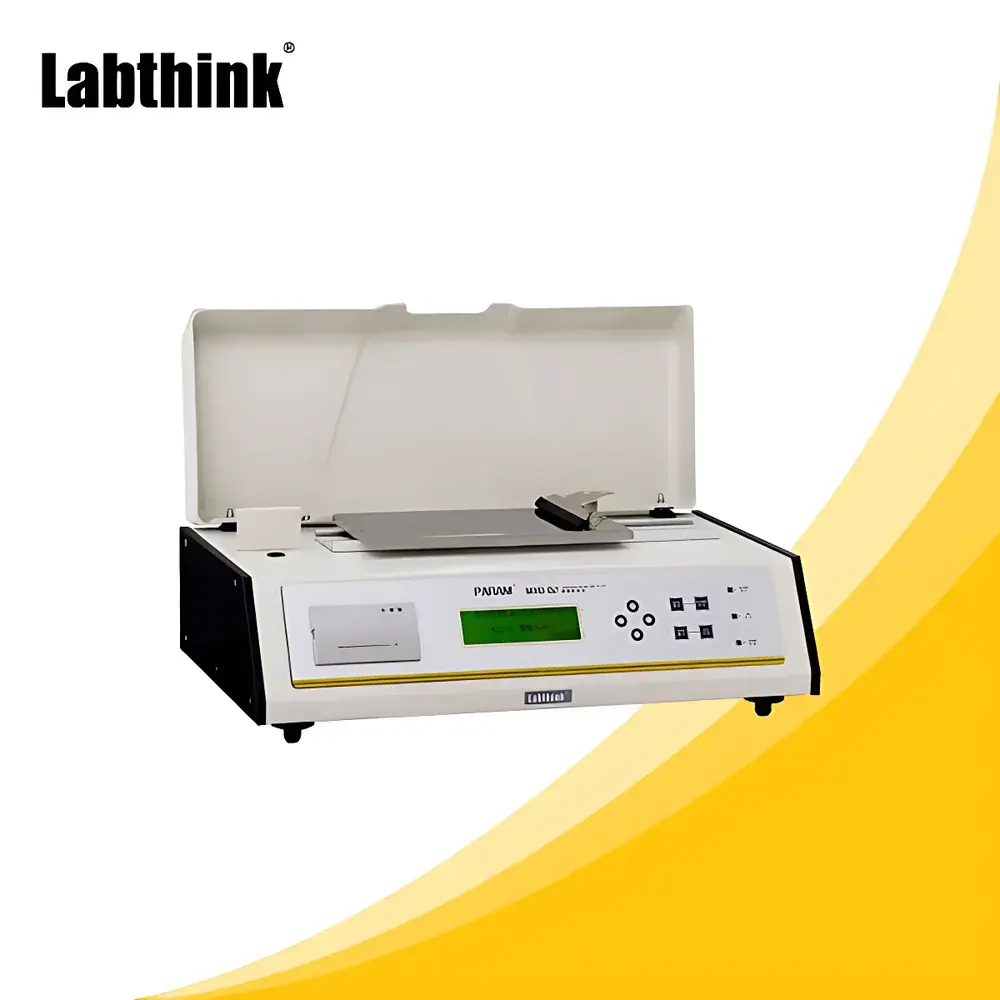
Labthink MXD-02 Coefficient of Friction Tester for Rubber Sheets and Packaging Materials
| Brand | Labthink |
|---|---|
| Origin | Shandong, China |
| Manufacturer | Labthink Co., Ltd. |
| Model | MXD-02 |
| Load Range | 0–5 N |
| Accuracy Class | 0.5 |
| Travel Distance | 70 mm / 150 mm |
| Standard Slider Mass | 200 g (customizable) |
| Test Speeds | 100 mm/min, 150 mm/min (adjustable) |
| Environmental Requirements | 23 ± 2 °C, 20–70 %RH |
| Power Supply | 220 VAC 50 Hz / 120 VAC 60 Hz |
| Dimensions (L×W×H) | 630 × 360 × 230 mm |
| Net Weight | 33 kg |
| Compliance | GB 10006, ISO 8295, ASTM D1894, TAPPI T816 |
Overview
The Labthink MXD-02 Coefficient of Friction Tester is an electromechanical instrument engineered for precision measurement of static and kinetic coefficients of friction (COF) between two planar material surfaces under controlled normal load and relative motion. It operates on the fundamental principle of tribological interface analysis: a standardized slider is placed atop a stationary test specimen; a motor-driven carriage imparts horizontal displacement at defined velocity while a high-stability load cell continuously records tangential resistance forces. The peak force prior to motion initiation defines the static friction force (Fs), whereas the average sustained force during steady-state sliding corresponds to the kinetic friction force (Fk). COF values are calculated as the ratio of these measured forces to the applied normal force (Fn), per the definitions μs = Fs/Fn and μk = Fk/Fn. Designed specifically for quality assurance in packaging, rubber, paper, and polymer manufacturing, the MXD-02 delivers repeatable, traceable results essential for process validation, material specification compliance, and regulatory documentation.
Key Features
- Simultaneous dual-mode measurement: single-test acquisition of both static and kinetic COF values, eliminating sequential setup and reducing operator-induced variability.
- Programmable test speed with factory-calibrated options at 100 mm/min and 150 mm/min; additional speeds configurable via firmware update to accommodate specialized material response profiles.
- Modular slider system supporting standard 200 g mass (ISO/ASTM compliant) and optional 500 g or custom-mass sliders—enabling evaluation across diverse pressure regimes without mechanical recalibration.
- Demagnetized test platform and slider assembly, verified via residual magnetism detection, minimizing electromagnetic interference with load cell signal integrity and ensuring long-term metrological stability.
- Microprocessor-based control architecture with intuitive PVC membrane keypad and backlit LCD display—providing real-time feedback on load, displacement, and elapsed time without external PC dependency.
- High-reliability component sourcing: load cells, stepper motors, and position encoders from globally recognized industrial suppliers, validated for >50,000 operational cycles under continuous laboratory use.
Sample Compatibility & Compliance
The MXD-02 accommodates rigid and flexible sheet materials up to 300 mm wide and 5 mm thick, including vulcanized rubber sheets, extruded polyolefin films, laminated pouches, corrugated fiberboard, coated papers, conveyor belt compounds, and elastomeric tire treads. Its mechanical design conforms to the dimensional and procedural constraints specified in GB 10006 (China), ISO 8295 (International), ASTM D1894 (USA), and TAPPI T816 (North America). All hardware and firmware implementations support audit-ready documentation workflows aligned with GLP and GMP requirements. The instrument’s mechanical repeatability (RSD ≤ 1.2% for μs, ≤ 0.9% for μk across ten replicate runs on PET film) meets the precision thresholds required for QC release testing in regulated packaging environments.
Software & Data Management
Optional Lystem™ Laboratory Data Sharing System enables centralized storage, version-controlled report generation, and cross-instrument result correlation. The embedded software module supports statistical analysis per ISO 5725 (accuracy, repeatability, reproducibility), automatic outlier identification using Grubbs’ test, and graphical overlay of COF-time curves for comparative kinetics assessment. Raw force-displacement datasets are exportable in CSV and XML formats compliant with FDA 21 CFR Part 11 requirements—including electronic signatures, audit trails, and user-access logging. Integrated RS232 serial interface ensures seamless connectivity with LIMS platforms and legacy QA databases. A built-in thermal printer provides immediate hard-copy output of test IDs, parameters, and final COF values—each bearing timestamp, operator ID, and calibration certificate reference.
Applications
- Optimizing slip agent concentration in blown PE and PP films to achieve target COF ranges (e.g., 0.20–0.40 μk) for high-speed vertical form-fill-seal operations.
- Validating surface treatment efficacy (e.g., corona, plasma) on rubber conveyor belts used in food processing lines, where excessive slip compromises product alignment.
- Assessing batch-to-batch consistency of silicone-coated release liners for medical adhesive tapes per ISO 2286-2.
- Supporting root-cause analysis of jamming incidents in pharmaceutical blister packaging machinery by correlating COF deviations with film crystallinity (DSC) and surface energy (contact angle) data.
- Generating technical dossiers for EU Regulation No. 10/2011 compliance, where COF performance influences migration barrier integrity under mechanical stress conditions.
FAQ
Does the MXD-02 comply with FDA 21 CFR Part 11 for electronic records?
Yes—the optional Lystem™ software package includes full Part 11 functionality: role-based access control, electronic signatures with biometric or token authentication, immutable audit trails, and data integrity verification hashes.
Can the instrument measure COF at elevated temperatures?
No—standard configuration operates within ambient environmental specifications (23 ± 2 °C). High-temperature testing requires auxiliary climate chambers and is outside the certified operating envelope of the base system.
Is calibration traceable to national standards?
Yes—factory calibration uses NIST-traceable deadweight standards and certified torque transducers; calibration certificates include uncertainty budgets per ISO/IEC 17025.
What maintenance intervals are recommended?
Load cell zero-point verification every 30 days; full mechanical inspection and slider rail lubrication every 6 months; annual third-party metrological recalibration advised for GLP/GMP environments.
How does the demagnetization process impact long-term measurement stability?
Residual magnetic fields induce parasitic signals in strain-gauge load cells; routine demagnetization reduces baseline drift to <0.02% FS/year, extending recalibration intervals and preserving inter-laboratory comparability.



