
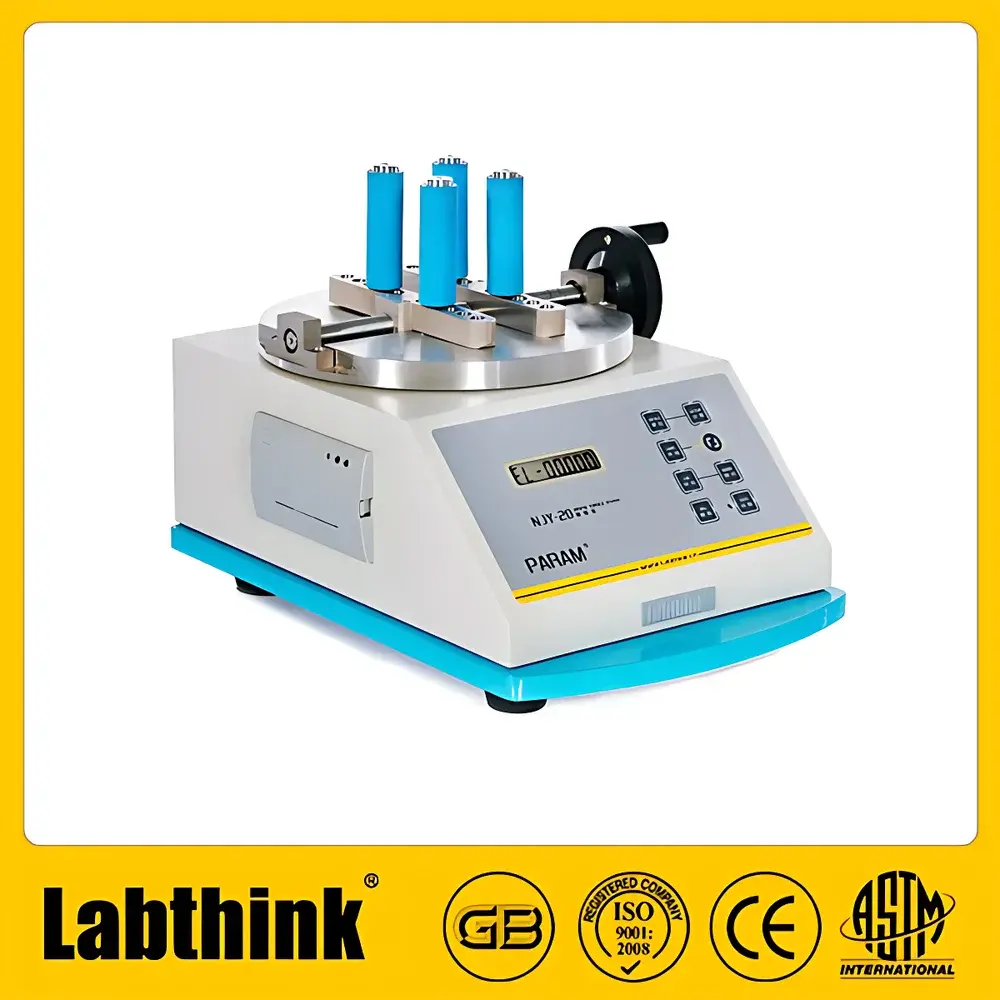
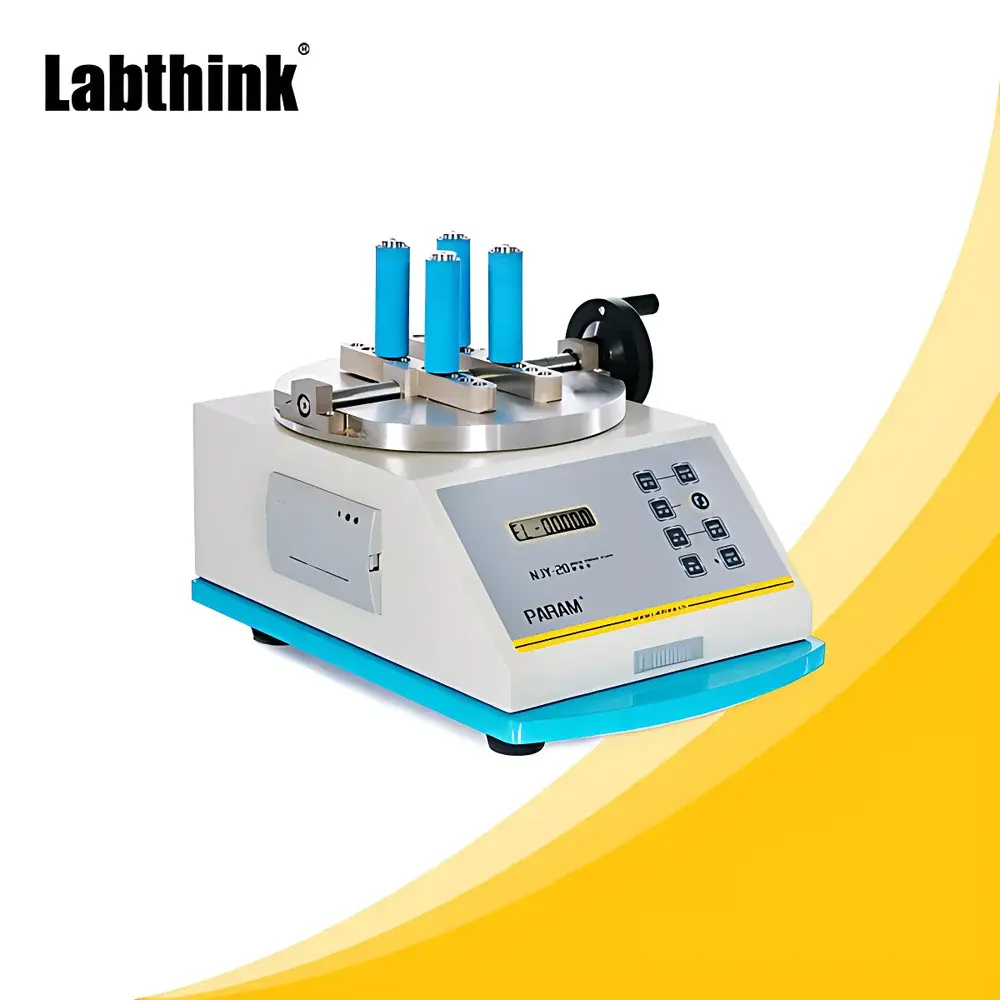
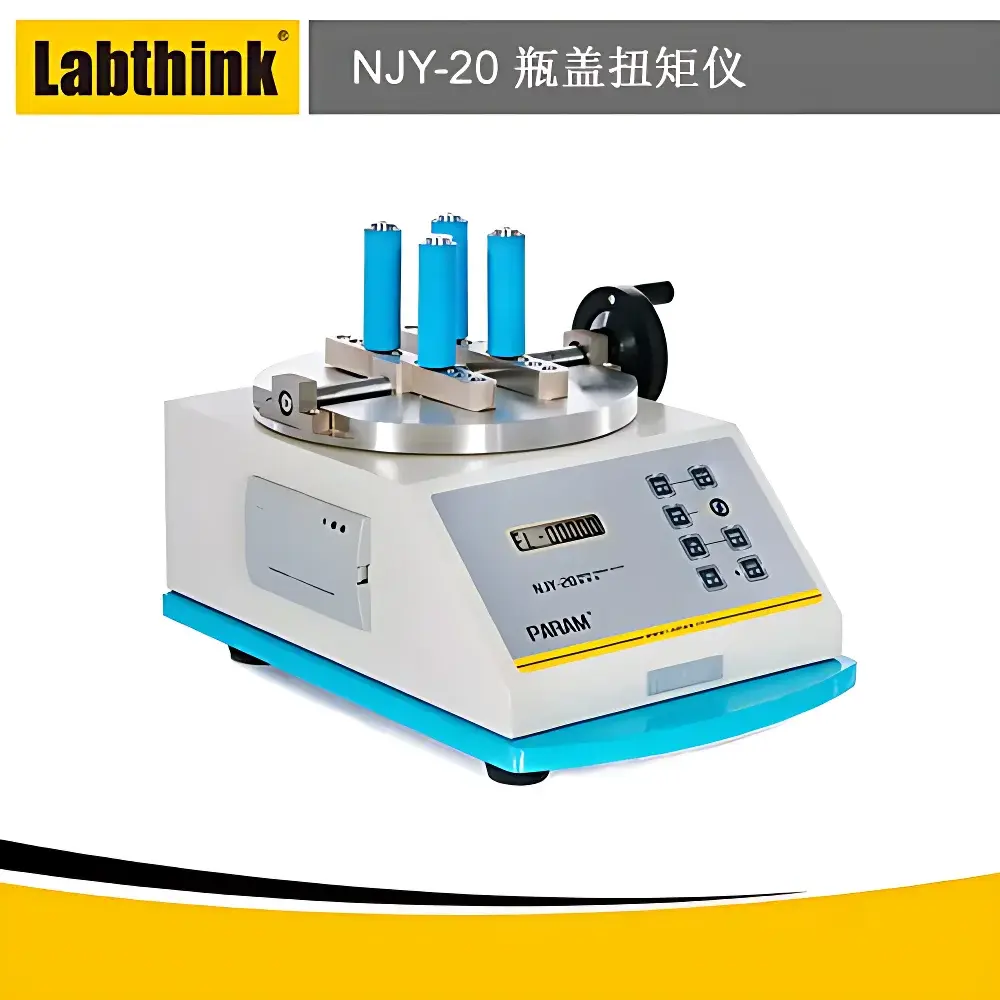
Labthink NJY-20 Digital Cap Torque Tester
| Brand | Labthink |
|---|---|
| Origin | Shandong, China |
| Manufacturer Type | Direct Manufacturer |
| Product Category | Domestic |
| Model | NJY-20 |
| Max Torque | 50 Nm |
| Torque Measurement Ranges | 20 Nm (standard), 40 Nm, 50 Nm (optional) |
| Torque Resolution | 0.001 Nm |
| Torsion Angle Range | Not applicable |
| Motor Power | Not applicable |
| Compliance Standards | GB/T 17876, ASTM D2063, ASTM D3198, ASTM D3474, BB/T 0025, BB/T 0034 |
| Clamping Diameter Range | Φ5–Φ170 mm |
| Data Output | RS232 interface, built-in thermal printer |
| Software Support | Lystem™ Laboratory Data Sharing System |
| Power Supply | AC 220 V, 50 Hz |
| Dimensions | 350 × 240 × 140 mm (L×W×H) |
| Net Weight | 19 kg |
| Accuracy Class | Class 1 |
Overview
The Labthink NJY-20 Digital Cap Torque Tester is a precision-engineered torsion testing instrument designed specifically for quantitative evaluation of closure torque in rigid and semi-rigid packaging systems. It operates on the principle of controlled rotational force application to measure both breakaway (opening) and applied (closing) torque values—critical parameters governing seal integrity, child-resistant functionality, dispensing consistency, and post-filling stability. Unlike general-purpose torque wrenches or analog gauges, the NJY-20 integrates microprocessor-based closed-loop control with high-resolution load cell feedback, enabling repeatable, traceable, and standards-compliant measurements across diverse cap geometries and material combinations—including polypropylene (PP), high-density polyethylene (HDPE), aluminum, and laminated closures used in agrochemical containers, pharmaceutical bottles, food-grade jars, and personal care tubes.
Key Features
- Microcomputer-controlled operation with real-time LCD display and tactile PVC membrane keypad for intuitive navigation and immediate result visualization
- Dual-mode testing capability: configurable for either “open” (breakaway) or “close” (application) torque measurement sequences
- Automatic peak-hold function ensures accurate capture and retention of maximum torque values during transient events
- Three selectable torque ranges (20 Nm standard; 40 Nm and 50 Nm optional) accommodate varying closure sizes—from small-diameter pesticide vials (Φ5 mm) to large industrial drums (up to Φ170 mm)
- Class 1 accuracy per ISO 7500-1 and verified against national metrological standards; resolution of 0.001 Nm supports statistical process control (SPC) and capability analysis (Cp/Cpk)
- Integrated overload protection, automatic zero-reset, and system fault diagnostics enhance operational safety and long-term calibration stability
- Built-in thermal printer and RS232 serial port enable direct hardcopy output and seamless integration into lab information management systems (LIMS)
Sample Compatibility & Compliance
The NJY-20 accommodates a broad spectrum of closure types without requiring tooling changes: screw caps, snap-fit lids, pump actuators, flip-top dispensers, and induction-sealed liners. Its adjustable clamping mechanism maintains consistent axial alignment and radial grip across heterogeneous materials—ensuring minimal slippage and measurement artifact suppression. The instrument conforms to internationally recognized test protocols including GB/T 17876 (Chinese standard for plastic caps), ASTM D2063 (standard test method for torque removal of closures), ASTM D3198 (for continuous-thread closures), ASTM D3474 (for torque-tension relationships), and BB/T 0025 and BB/T 0034 (Chinese packaging industry standards). These alignments support regulatory submissions under FDA 21 CFR Part 11 when paired with validated Lystem™ software and audit-trail-enabled workflows.
Software & Data Management
When equipped with the optional Lystem™ Laboratory Data Sharing System, the NJY-20 transitions from standalone tester to networked quality node. Lystem™ provides role-based user access, electronic signature support, automated report generation (PDF/Excel), trend charting over time, batch-level statistical summaries (mean, SD, min/max, histogram), and full audit trail compliance per ALCOA+ principles. All raw torque vs. time curves are stored with metadata—including operator ID, sample ID, environmental conditions (if linked to external sensors), and calibration status—facilitating GLP/GMP audits and CAPA investigations. Data export via RS232 enables synchronization with enterprise QMS platforms such as TrackWise or MasterControl.
Applications
- Agrochemical packaging validation: verifying torque specifications for pesticide bottles subjected to vibration, temperature cycling, and stack-load transport
- Pharmaceutical container-closure integrity (CCI) assessment: correlating torque with leak rate data from helium mass spectrometry or vacuum decay tests
- Consumer product R&D: optimizing cap design for ergonomic opening force while maintaining tamper evidence
- Contract manufacturing quality assurance: enforcing incoming inspection criteria for third-party supplied closures
- Regulatory documentation: generating test records compliant with ICH Q5C, ISO 11607-1, and USP guidance on package integrity
FAQ
What torque ranges are available on the NJY-20?
The standard configuration supports up to 20 Nm; optional upgrades extend the upper limit to 40 Nm or 50 Nm, selected at time of order based on typical closure size and material stiffness.
Is the instrument suitable for both manual and automated production line integration?
While primarily designed for offline QC labs, its RS232 interface and programmable trigger logic allow integration with PLC-controlled conveyor systems for 100% inline torque verification in high-volume environments.
How does the NJY-20 ensure measurement traceability?
Each unit ships with a factory calibration certificate traceable to NIM (National Institute of Metrology, China); annual recalibration using certified reference torque standards is recommended to maintain Class 1 performance.
Can the device measure torque-angle profiles?
No—the NJY-20 is optimized for static peak torque acquisition rather than dynamic torsional curve analysis; for angular displacement-dependent characterization, a dedicated torsion rheometer or universal testing machine with rotary actuator is required.
Does Lystem™ software comply with 21 CFR Part 11 requirements?
Yes—when deployed with electronic signatures, audit trails, and secure user authentication, Lystem™ meets predicate rule requirements for electronic records and signatures in regulated industries.
Related Products



