
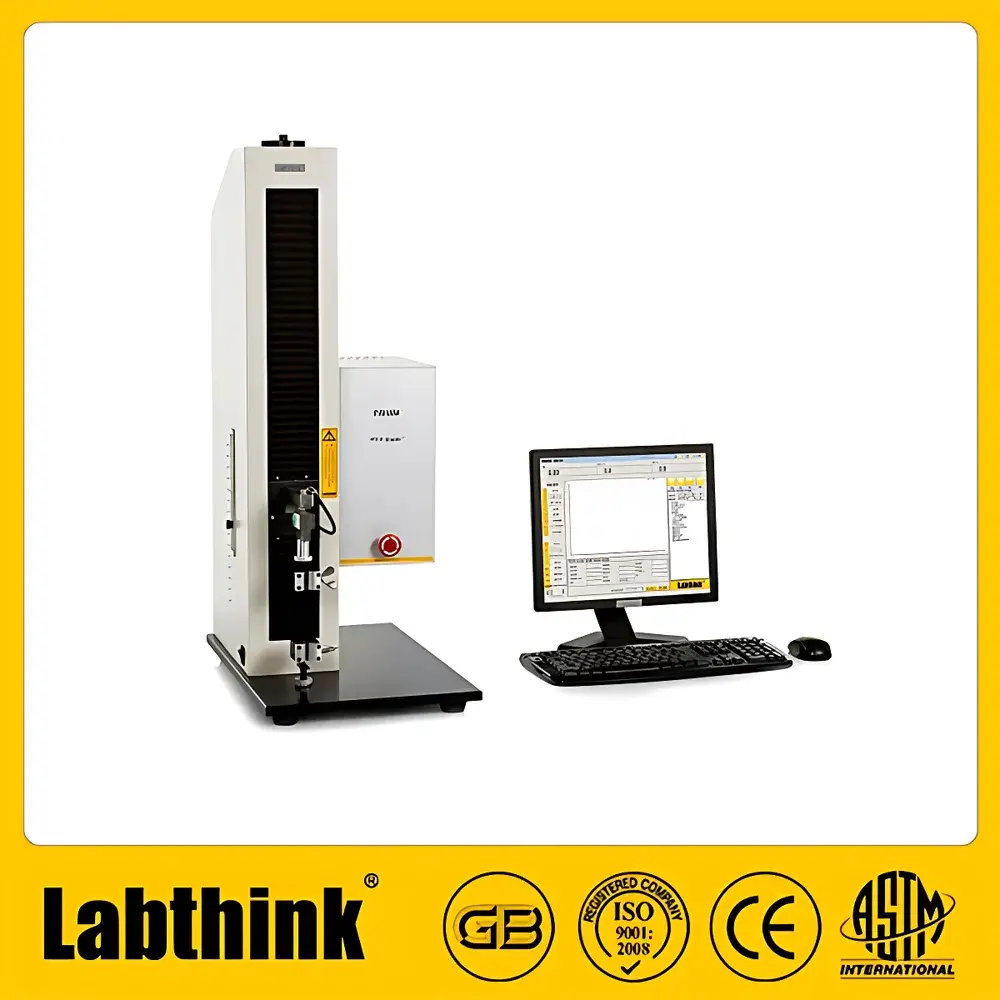
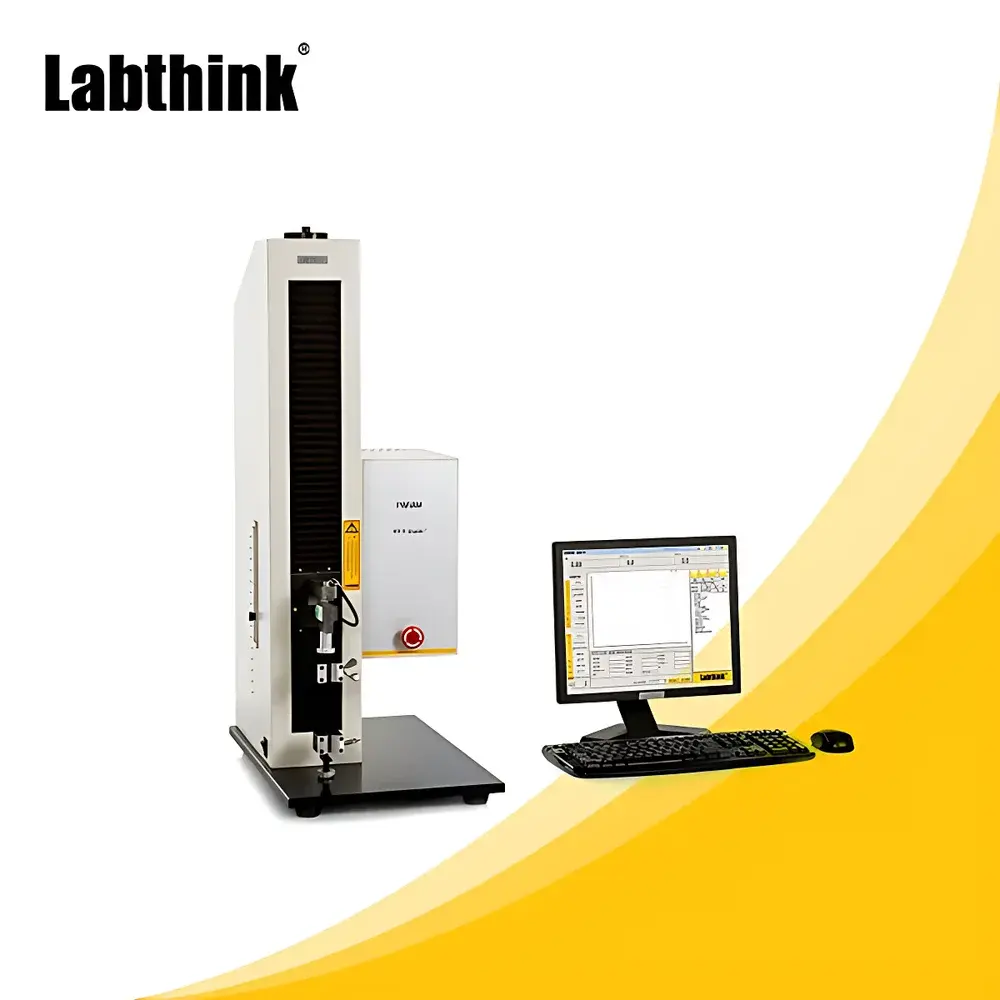
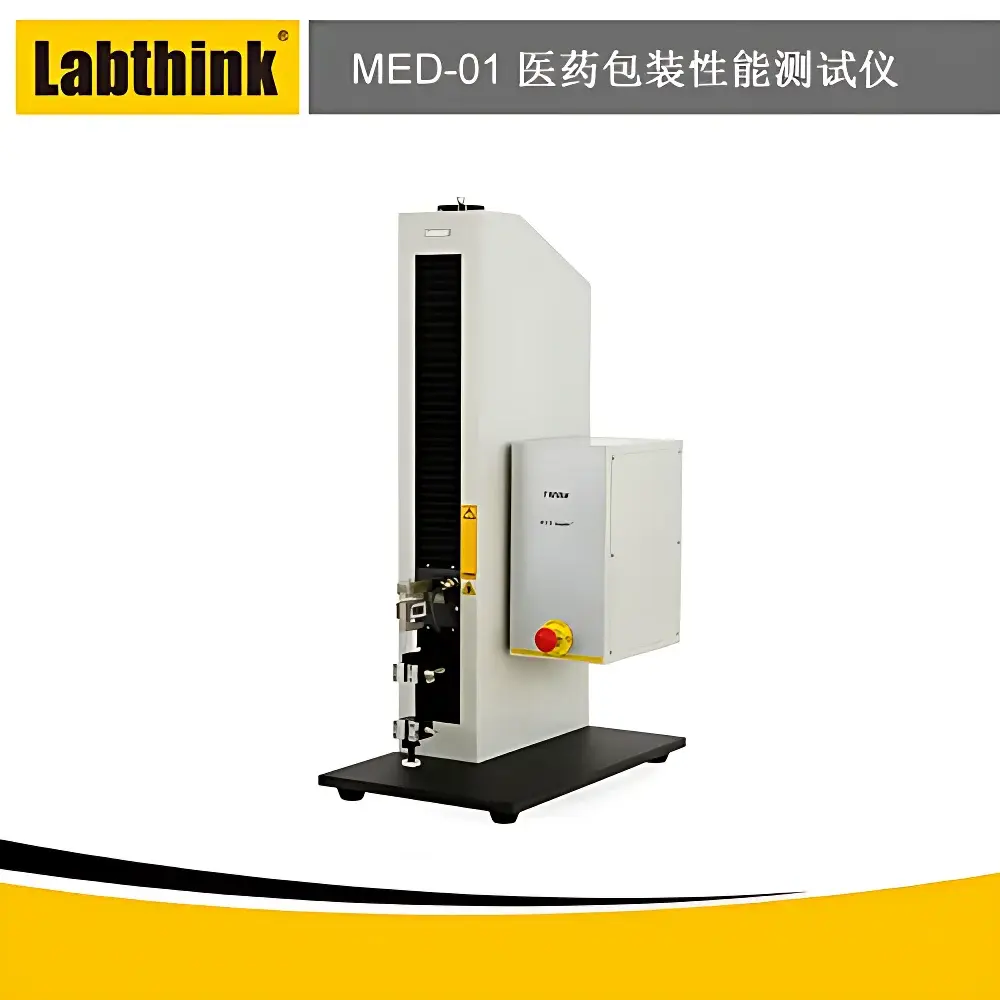
Labthink PARAM MED-01 Pharmaceutical Butyl Rubber Stopper Piercing Force Tester
| Brand | Labthink |
|---|---|
| Model | PARAM MED-01 |
| Origin | Shandong, China |
| Manufacturer Type | Direct Manufacturer |
| Origin Category | Domestic (China) |
| Load Capacity Options | 250 N (standard), 50/100/500 N (optional) |
| Force Accuracy | Better than Class 0.5 |
| Test Speed (Approach) | 10, 50, 100, 150, 200 mm/min (standard) |
| Test Speed (Return) | 10, 50, 100, 150, 200 mm/min (standard) |
| Specimen Width | 30 mm (standard fixture), 50 mm (optional fixture) |
| Specimen Count per Test | 1 |
| Stroke | 600 mm |
| Dimensions (L×W×H) | 851 × 500 × 940 mm |
| Power Supply | AC 220 V, 50 Hz |
| Max. Power Consumption | 60 W |
| Net Weight | 68 kg |
Overview
The Labthink PARAM MED-01 Pharmaceutical Butyl Rubber Stopper Piercing Force Tester is a precision-engineered mechanical testing system designed specifically for the quantitative evaluation of piercing resistance and particulate generation during needle penetration into pharmaceutical-grade butyl rubber stoppers. It operates on the principle of controlled uniaxial compression, where a standardized stainless-steel piercing device (typically conforming to ISO 8536-2 or USP <381>) is driven vertically at a defined rate through the center of a conditioned stopper specimen mounted on a rigid support platform. The instrument captures real-time force-displacement profiles using a high-stability load cell, enabling accurate determination of peak piercing force—the maximum load required to fully penetrate the stopper—and supporting analysis of post-penetration behavior, including residual deformation and potential flaking or shedding events. This methodology directly addresses pharmacopoeial requirements for primary packaging integrity, particularly in parenteral drug delivery systems where container closure integrity (CCI) and extractables/leachables risk are tightly regulated.
Key Features
- Compliant with key international standards: aligned with ISO 8536-2 (Infusion bottles and containers), USP <381> (Rubber Elastomeric Closures), and Chinese Pharmacopoeia (ChP) General Chapter 0952 (Testing Methods for Pharmaceutical Packaging Materials).
- Modular load cell configuration: standard 250 N capacity with optional ranges (50 N, 100 N, 500 N) to accommodate diverse stopper formulations—from low-durometer pediatric closures to high-hardness lyophilization-grade elastomers.
- Precisely regulated test speed: five discrete approach and return speeds (10–200 mm/min), with default setting at 200 ± 50 mm/min per ChP and ISO specifications—ensuring repeatability across laboratories.
- Manual clamping mechanism optimized for single-specimen testing, minimizing operator-induced variability while maintaining full accessibility for stopper positioning and post-test inspection.
- Robust mechanical architecture: rigid frame construction, linear motion guidance system, and thermal-stable transducer mounting ensure long-term measurement stability and minimal hysteresis.
- Compact footprint (851 × 500 × 940 mm) and low power demand (≤60 W) suitable for QC labs with space and energy constraints.
Sample Compatibility & Compliance
The MED-01 accommodates standard pharmaceutical butyl rubber stoppers used in vials (e.g., 13 mm, 20 mm, and 28 mm diameters) and pre-filled syringe plungers, provided specimens are conditioned per ICH Q5C (25 °C / 60% RH, 24 h minimum). Fixture options include 30 mm and 50 mm width supports to stabilize flat-bottomed or contoured stoppers during vertical puncture. All test protocols adhere to Good Manufacturing Practice (GMP) documentation requirements: raw force-time data is timestamped and stored with operator ID, test date, environmental conditions, and calibration status metadata. The system supports audit-ready reporting for FDA 21 CFR Part 11 compliance when integrated with Labthink’s certified data management software (sold separately).
Software & Data Management
When paired with Labthink’s proprietary testing software (e.g., eTestSuite v3.x), the MED-01 enables automated test sequence execution, real-time graphical display of force vs. displacement curves, and configurable pass/fail limits based on user-defined thresholds (e.g., ≤10 N for low-force pediatric applications or ≤80 N for high-barrier lyo stoppers). Data export is available in CSV, PDF, and XML formats—compatible with LIMS integration and statistical process control (SPC) platforms. Software-generated reports include full traceability: instrument serial number, load cell calibration certificate ID, environmental log, and electronic signature fields compliant with ALCOA+ principles (Attributable, Legible, Contemporaneous, Original, Accurate, Complete, Consistent, Enduring, Available).
Applications
- Quality control release testing of butyl rubber stoppers supplied to injectable drug manufacturers.
- Comparative evaluation of formulation changes (e.g., halogenated vs. bromobutyl, carbon black content variations) on piercing performance.
- Stability studies assessing aging effects (thermal, oxidative, gamma irradiation) on stopper mechanical integrity.
- Validation of stopper compatibility with specific needle geometries (e.g., bevel angle, tip radius) used in auto-injectors or infusion sets.
- Supporting regulatory submissions (e.g., ANDA, BLA) with documented evidence of container closure system robustness under simulated clinical use conditions.
FAQ
What standards does the MED-01 comply with for stopper piercing testing?
The instrument meets the mechanical test requirements of ISO 8536-2, USP <381>, and ChP 0952, including specified probe geometry, speed tolerance, and force resolution criteria.
Can the MED-01 measure both piercing force and post-penetration residue?
While the primary output is peak piercing force (in newtons), the continuous force-displacement curve allows qualitative assessment of post-penetration behavior—including rebound, adhesion, and visual inspection for silicone oil migration or particle shedding—when combined with standardized observation protocols.
Is calibration traceable to national metrology institutes?
Yes—Labthink provides factory calibration certificates traceable to CNAS-accredited standards (equivalent to ISO/IEC 17025), with optional annual recalibration services and on-site verification kits.
Does the system support multi-sample batch testing without manual intervention?
The MED-01 is configured for single-specimen operation per test cycle; however, automated sample changers are not integrated. High-throughput labs typically deploy multiple units or schedule sequential tests with programmable dwell times between runs.
How is environmental conditioning addressed during testing?
The MED-01 itself does not control temperature or humidity; users must condition specimens per ICH Q5C prior to testing and record ambient lab conditions (20–25 °C, 45–65% RH) in the test report as required by GLP and GMP guidelines.



