
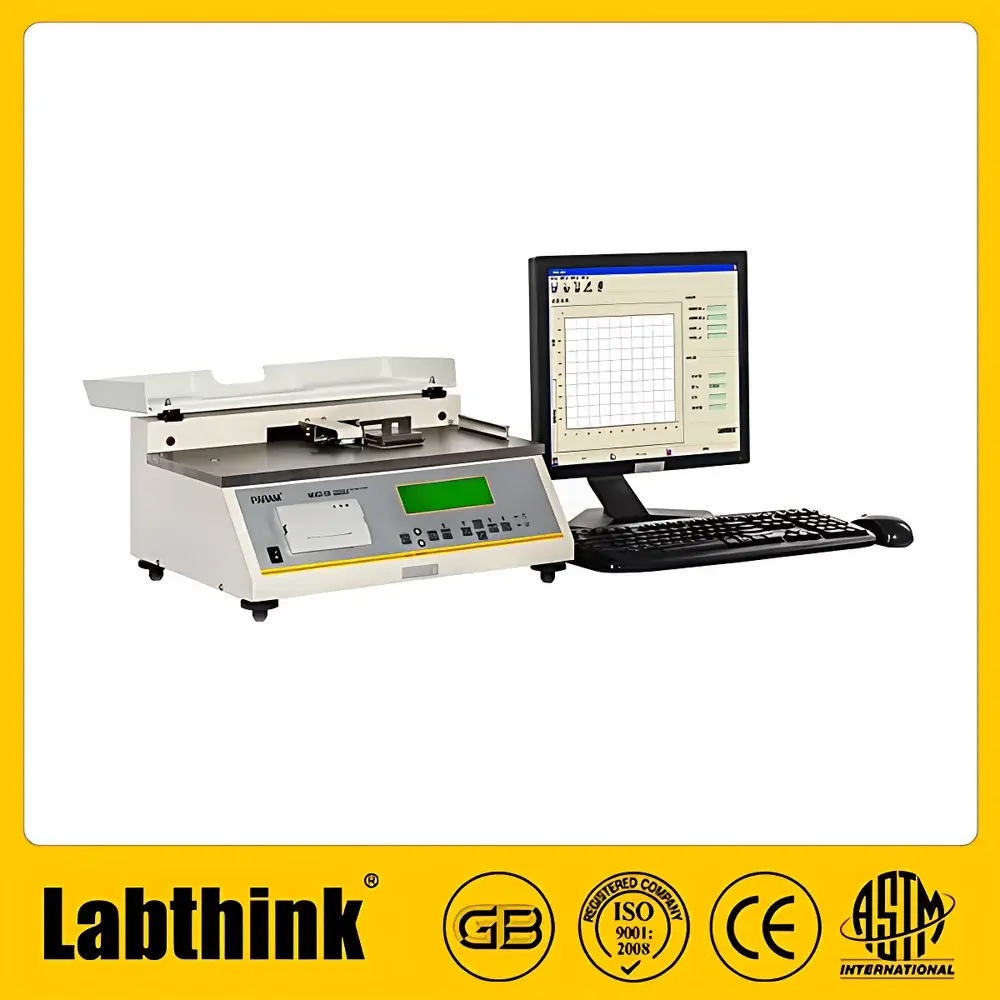
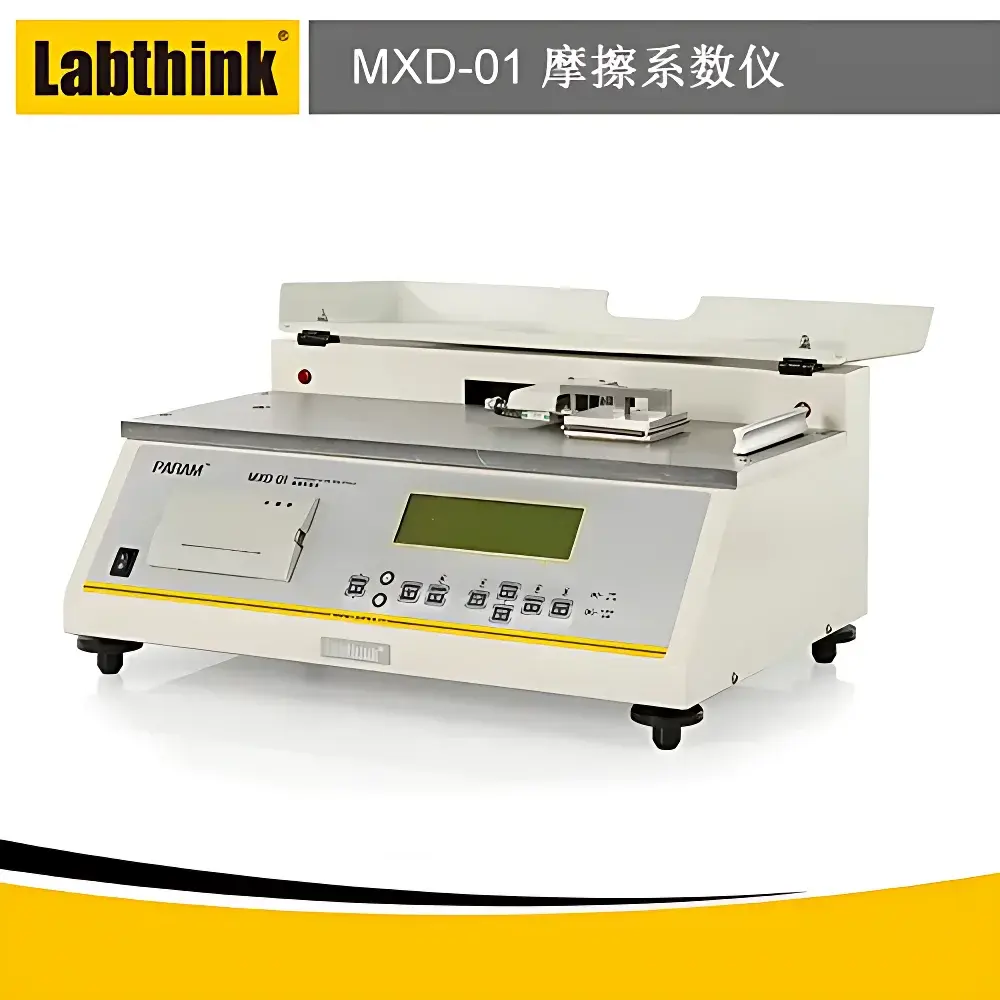
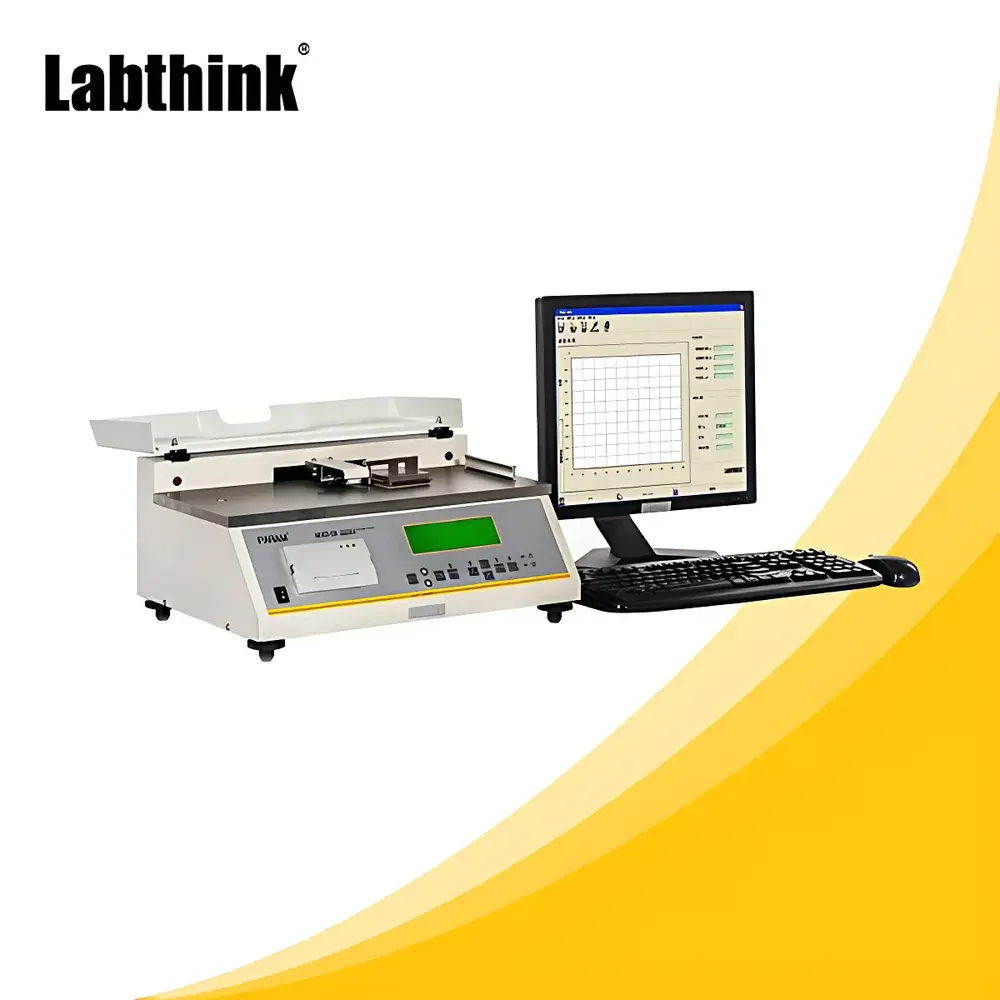
Labthink PARAM-MXD-01 Coefficient of Friction Tester for Paper, Paperboard & Flexible Packaging Materials
| Brand | Labthink |
|---|---|
| Origin | Shandong, China |
| Manufacturer Type | Direct Manufacturer |
| Country of Origin | China |
| Model | PARAM-MXD-01 |
| Price Range | USD 1,400 – 7,000 |
| Load Range | 0–5 N |
| Accuracy Class | Class 1 |
| Stroke | 10 mm + 60 mm |
| Slider Masses | 200 g, 500 g (1000 g optional) |
| Test Speed | 100 mm/min |
| Ambient Operating Conditions | 10–40 °C, 20–70 %RH |
| Power Supply | 220 VAC 50 Hz / 120 VAC 60 Hz |
| Dimensions (L×W×H) | 470 × 310 × 200 mm |
| Net Weight | 31 kg |
| Compliant Standards | GB 10006, ISO 8295 |
Overview
The Labthink PARAM-MXD-01 Coefficient of Friction Tester is an engineered precision instrument designed to quantify both static and kinetic coefficients of friction (COF) for planar materials used across packaging, paper, printing, and industrial manufacturing sectors. It operates on the fundamental principle of interfacial shear mechanics: two flat specimens — one fixed as the test bed and the other mounted on a calibrated slider — are brought into controlled contact under a defined normal force. The system then measures the peak tangential force required to initiate relative motion (static friction) and the sustained tangential force during steady-state sliding at 100 mm/min (kinetic friction). These forces are normalized against the applied normal load to compute dimensionless COF values (μs and μk). This methodology aligns with internationally recognized tribological test protocols, enabling objective assessment of surface slip resistance critical to high-speed converting, packaging line efficiency, stack stability, and end-user handling performance.
Key Features
- Simultaneous dual-mode measurement: automatic acquisition and differentiation of static (μs) and kinetic (μk) friction coefficients within a single test cycle.
- Integrated timing logic: programmable static dwell period with automatic initiation of motion upon expiration, ensuring consistent interfacial conditioning prior to slip onset.
- Zero-force calibration sequence: automated dynamic zeroing of load cell output immediately before motion commencement, eliminating baseline drift and enhancing repeatability.
- Demagnetized mechanical architecture: both test platform and slider undergo rigorous degaussing and residual magnetism verification (<0.2 mT), minimizing electromagnetic interference with strain gauge signal integrity.
- Dedicated microprocessor control: intuitive menu-driven interface via PVC membrane keypad and backlit LCD display; no external PC required for routine operation.
- High-stability componentry: load cell, stepper motor drive, and position encoder sourced from certified international suppliers to ensure long-term metrological consistency.
Sample Compatibility & Compliance
The PARAM-MXD-01 accommodates a broad spectrum of flexible and semi-rigid substrates including but not limited to: paper, corrugated board, coated and uncoated paperboard, BOPP/BOPET/PE films, rubber sheets, woven/nonwoven textiles, metallic foils, cable wrapping tapes, conveyor belt compounds, and elastomeric composites. Its standardized 200 g and 500 g sliders (with 1000 g and custom-mass options available) enable compliance with application-specific normal force requirements. The instrument fully conforms to GB/T 10006–2021 (Chinese national standard for plastic film and sheet friction testing) and ISO 8295:1995 (Plastics — Film and sheeting — Determination of the coefficient of friction), supporting regulatory documentation for quality assurance in ISO 9001-certified production environments and GLP-aligned R&D laboratories.
Software & Data Management
Optional Lystem™ Laboratory Data Sharing System software provides advanced analytical capabilities beyond basic COF calculation. It delivers automated stick-slip event detection, quantitative dispersion analysis (including 95% confidence interval estimation), statistical comparison across test groups (ANOVA-ready export), and full audit trail functionality compliant with FDA 21 CFR Part 11 requirements when deployed in regulated pharmaceutical or medical device packaging validation workflows. Raw force-time curves, COF time-series plots, and metadata-rich reports are exportable in CSV, PDF, and XML formats. RS232 serial communication enables seamless integration into centralized lab information management systems (LIMS) or MES platforms.
Applications
- Optimization of calendering, coating, and corona treatment parameters in paper and film manufacturing.
- Evaluation of anti-block additive efficacy in polyolefin films.
- Validation of release liner peel characteristics in pressure-sensitive adhesive systems.
- Assessment of print surface tack and ink transfer behavior on coated substrates.
- Quality control of frictional consistency in pharmaceutical blister lidding foils and child-resistant packaging.
- Characterization of tactile glide properties in cosmetic applicators and ophthalmic dropper tips.
- Baseline testing of brake pad composite formulations and automotive interior trim materials.
FAQ
What standards does the PARAM-MXD-01 comply with?
It meets GB/T 10006–2021 and ISO 8295:1995 for coefficient of friction testing of films and sheets.
Can the instrument differentiate between stick-slip and smooth sliding behavior?
Yes — the optional Lystem™ software includes algorithmic stick-slip classification based on force waveform morphology and velocity discontinuity detection.
Is calibration traceable to national metrology institutes?
Load cell calibration certificates are provided with NIST-traceable reference standards; annual recalibration services are available through Labthink’s accredited service centers.
What environmental conditions are required for valid test execution?
Ambient temperature must be maintained between 10 °C and 40 °C, with relative humidity between 20 %RH and 70 %RH, per ISO 291 conditioning guidelines.
How is data integrity ensured during extended testing campaigns?
The system logs operator ID, timestamp, environmental readings, calibration status, and raw sensor outputs — all embedded in each report file for full forensic traceability.




