
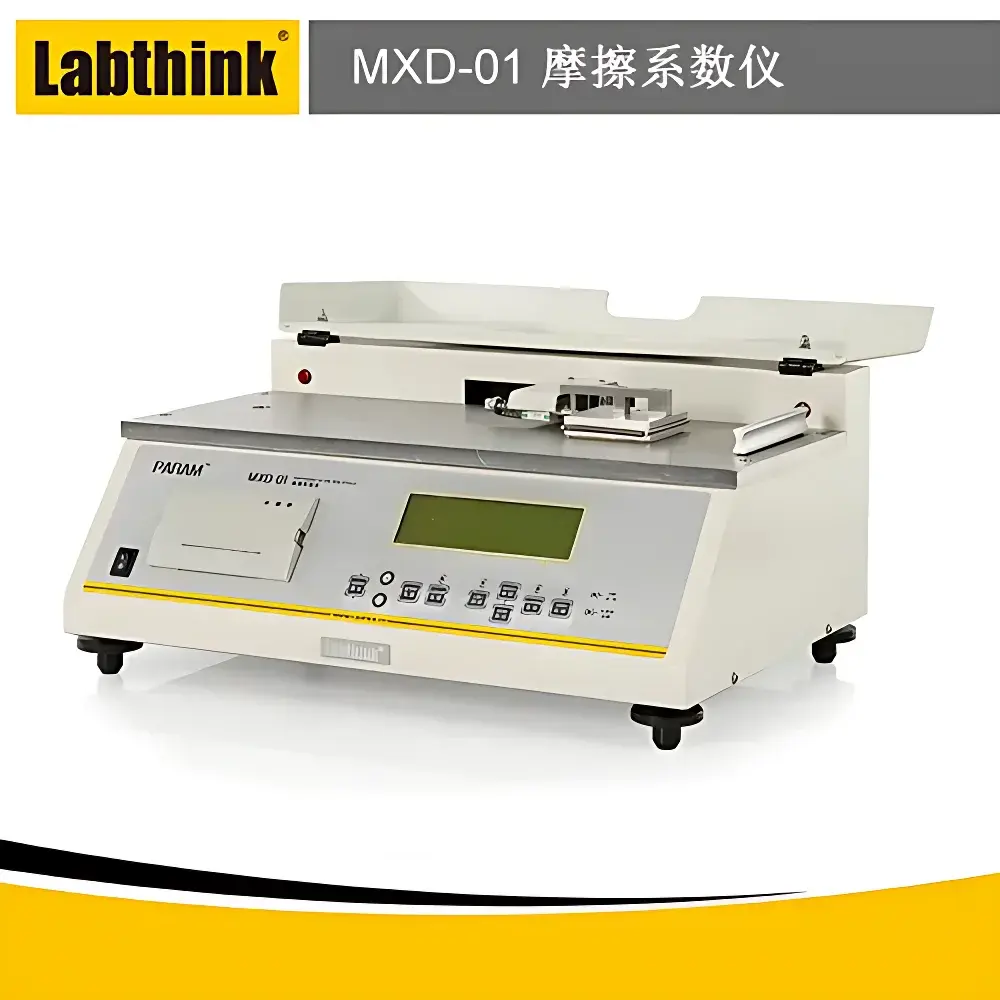
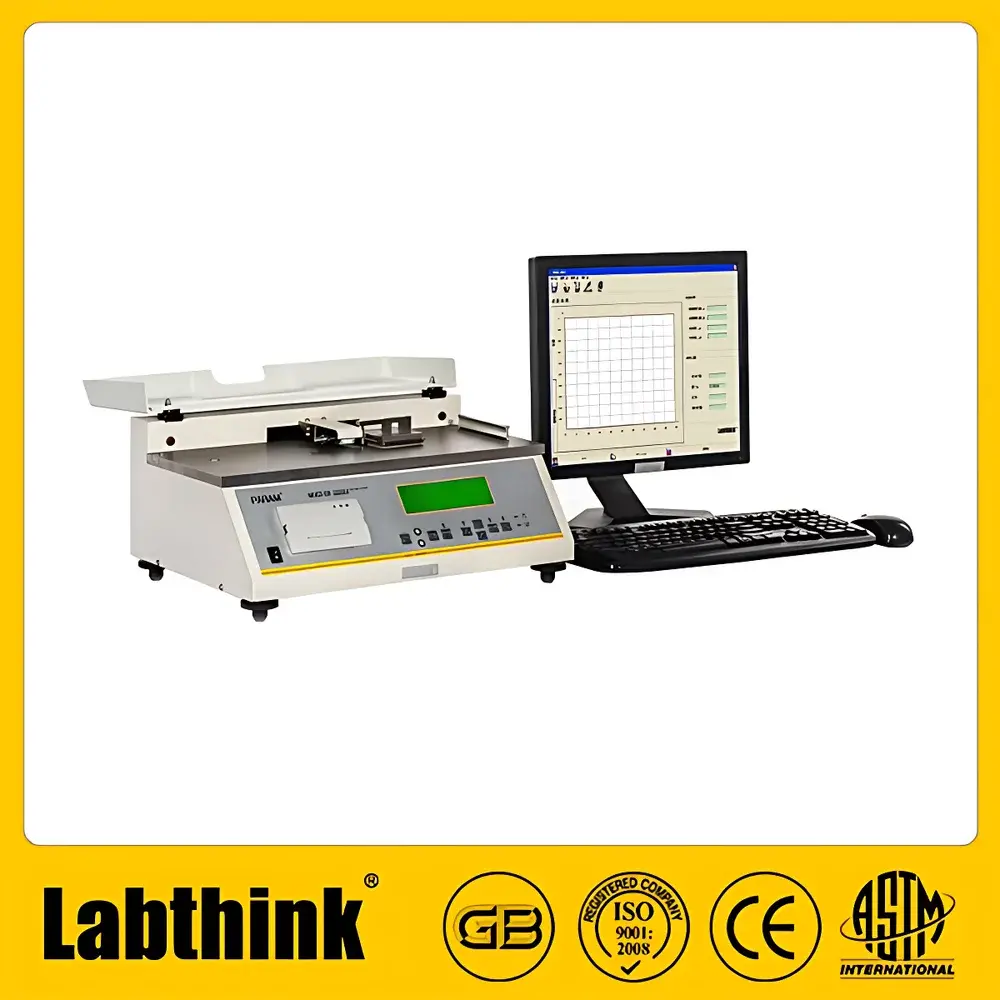
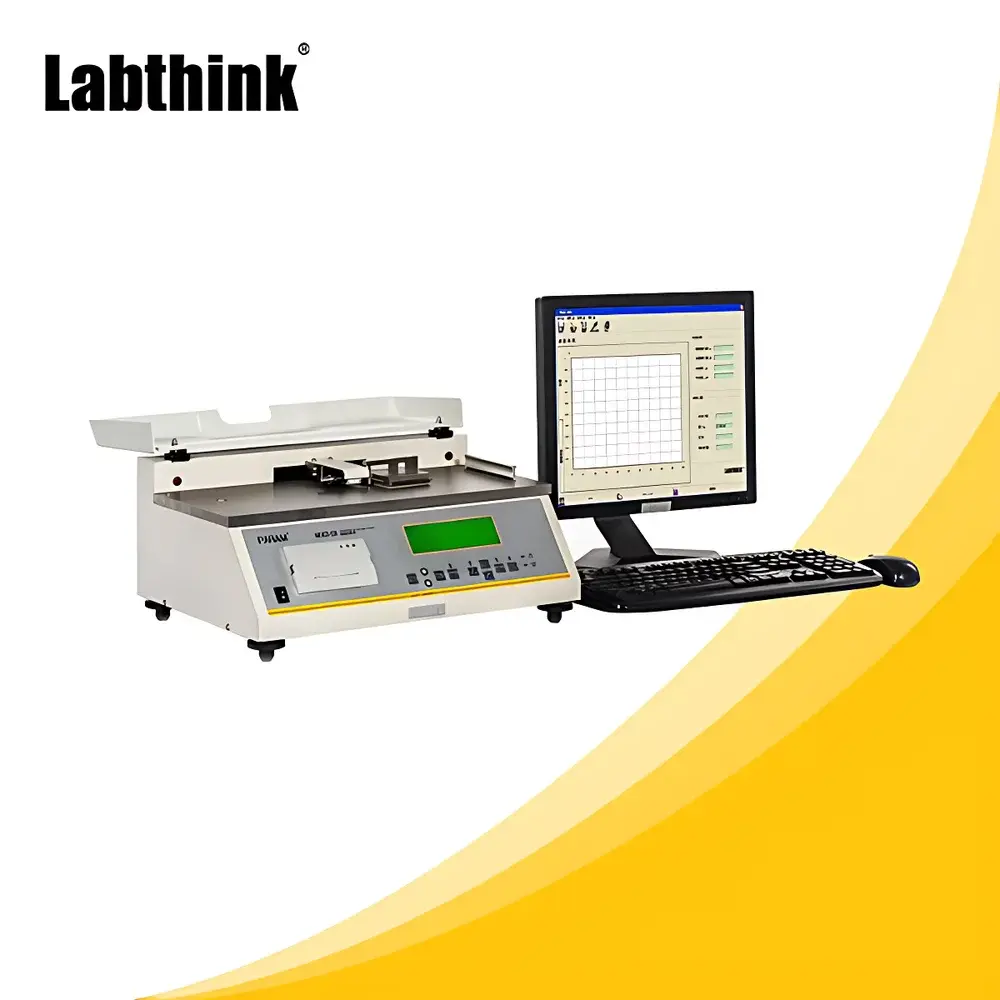
Labthink PARAM MXD-01 Coefficient of Friction Tester for Plastic Films and Packaging Materials
| Brand | Labthink |
|---|---|
| Origin | Shandong, China |
| Manufacturer Type | Direct Manufacturer |
| Country of Origin | China |
| Model | PARAM MXD-01 |
| Load Range | 0–5 N |
| Accuracy Class | Class 1 |
| Travel Distance | 10 mm + 60 mm |
| Slider Mass Options | 200 g, 500 g (1000 g optional) |
| Test Speed | 100 mm/min |
| Ambient Temperature | 10–40 °C |
| Relative Humidity | 20–70 %RH |
| Power Supply | 220 VAC 50 Hz / 120 VAC 60 Hz |
| Dimensions (L×W×H) | 470 × 310 × 200 mm |
| Net Weight | 31 kg |
Overview
The Labthink PARAM MXD-01 Coefficient of Friction Tester is an ASTM- and ISO-aligned instrument engineered for precise, repeatable measurement of static and kinetic coefficients of friction (COF) in flexible packaging materials and industrial sheet products. It operates on the fundamental principle of horizontal sliding resistance evaluation: two flat surfaces—typically a standardized slider and a fixed test specimen—are brought into controlled contact under a defined normal force; the system then measures the maximum tangential force required to initiate motion (static COF) and the sustained force during steady-state sliding (kinetic COF). This dual-phase quantification adheres strictly to GB/T 10006–2021 (Plastic Films and Sheets – Determination of Coefficient of Friction), ISO 8295:1995 (Plastics – Film and Sheet – Determination of Coefficient of Friction), and provides traceable data essential for process validation, material specification compliance, and regulatory documentation in packaging R&D, quality control, and production environments.
Key Features
- Simultaneous static and kinetic COF determination with automatic zeroing of both frictional force channels prior to each test cycle
- Digital microprocessor control with intuitive PVC membrane keypad and backlit LCD display enabling standalone operation without external PC
- Demagnetized test bed and stainless-steel sliders subjected to residual magnetism verification (<0.2 mT), minimizing electromagnetic interference with force transducer output
- Interchangeable slider masses (200 g and 500 g standard; 1000 g and custom-mass options available) to accommodate diverse surface pressure requirements per ISO/GB protocols
- High-stability load cell calibrated to Class 1 accuracy (per JJG 139–2014) with full-scale range of 0–5 N and resolution ≤0.01 N
- Fixed linear translation speed of 100 mm/min, compliant with GB/T 10006 and ISO 8295 test velocity specifications
- Integrated thermal and humidity monitoring sensors ensure environmental parameters remain within validated operating ranges (10–40 °C, 20–70 %RH)
Sample Compatibility & Compliance
The MXD-01 accommodates a broad spectrum of planar, non-porous, and semi-rigid substrates including polyethylene (PE), polypropylene (PP), polyester (PET), laminated films, coated papers, corrugated board liners, rubber sheets, textile composites, metal foils, and polymer-coated cables. Its mechanical architecture supports specimens up to 100 mm wide × 150 mm long, with thickness tolerance up to 3 mm. All testing procedures conform to Good Laboratory Practice (GLP) documentation requirements, and raw force/time data streams are timestamped and stored with audit-trail metadata. The instrument satisfies technical prerequisites for inclusion in FDA-regulated packaging validation packages (e.g., for pharmaceutical blister lidding or medical device pouches) when operated within documented environmental and calibration intervals.
Software & Data Management
Optional Lystem™ Laboratory Data Sharing System enables centralized management of COF datasets across multiple MXD-01 units and complementary Labthink instruments (e.g., permeation testers, seal strength analyzers). The software performs automated stick-slip event detection, calculates 95% confidence intervals for group-mean COF values, and generates statistical summaries (mean, SD, CV%, min/max) per test batch. Export formats include CSV, PDF, and XML for integration into LIMS or ERP platforms. RS232 serial interface supports bidirectional communication with external PCs, while built-in thermal printer outputs fully formatted reports—including specimen ID, test date/time, slider mass, normal load, static/kinetic COF values, and operator signature field—directly from the instrument.
Applications
- Optimization of slip additive concentration (e.g., erucamide, oleamide) in extruded polyolefin films
- Verification of anti-block performance in high-clarity PET metallized packaging
- Validation of coating uniformity on aluminum foil laminates used in food and pharma packaging
- Assessment of tactile glide properties in cosmetic tube liners and ophthalmic dropper components
- Comparative evaluation of brake pad friction stability under ambient conditions
- Quality release testing for automotive interior trim films per OEM material specifications (e.g., GMW14872, Ford WSS-M99P1111-A)
FAQ
Does the MXD-01 comply with FDA 21 CFR Part 11 requirements for electronic records?
The base instrument does not include Part 11–compliant user authentication or electronic signature modules; however, when integrated with Lystem™ v3.2+ and configured with role-based access control, audit trail logging, and digital certificate signing, it meets all technical criteria for regulated data integrity.
Can the instrument measure friction at elevated temperatures?
No—the MXD-01 is designed for ambient-condition testing only. For temperature-dependent COF analysis, Labthink offers the HTT-01 High-Temperature Tribology Tester as a dedicated solution.
Is calibration traceable to national standards?
Yes. Each unit ships with a factory calibration certificate traceable to CNAS-accredited reference standards (GB/T 50081, JJG 139), and annual recalibration services are available through Labthink’s ISO/IEC 17025–accredited service centers.
What maintenance is required for long-term accuracy?
Bi-weekly cleaning of the linear guide rail and slider contact surfaces with isopropyl alcohol, quarterly verification of slider mass tolerance (±0.5 g), and annual load cell recalibration constitute the recommended preventive maintenance schedule.




