
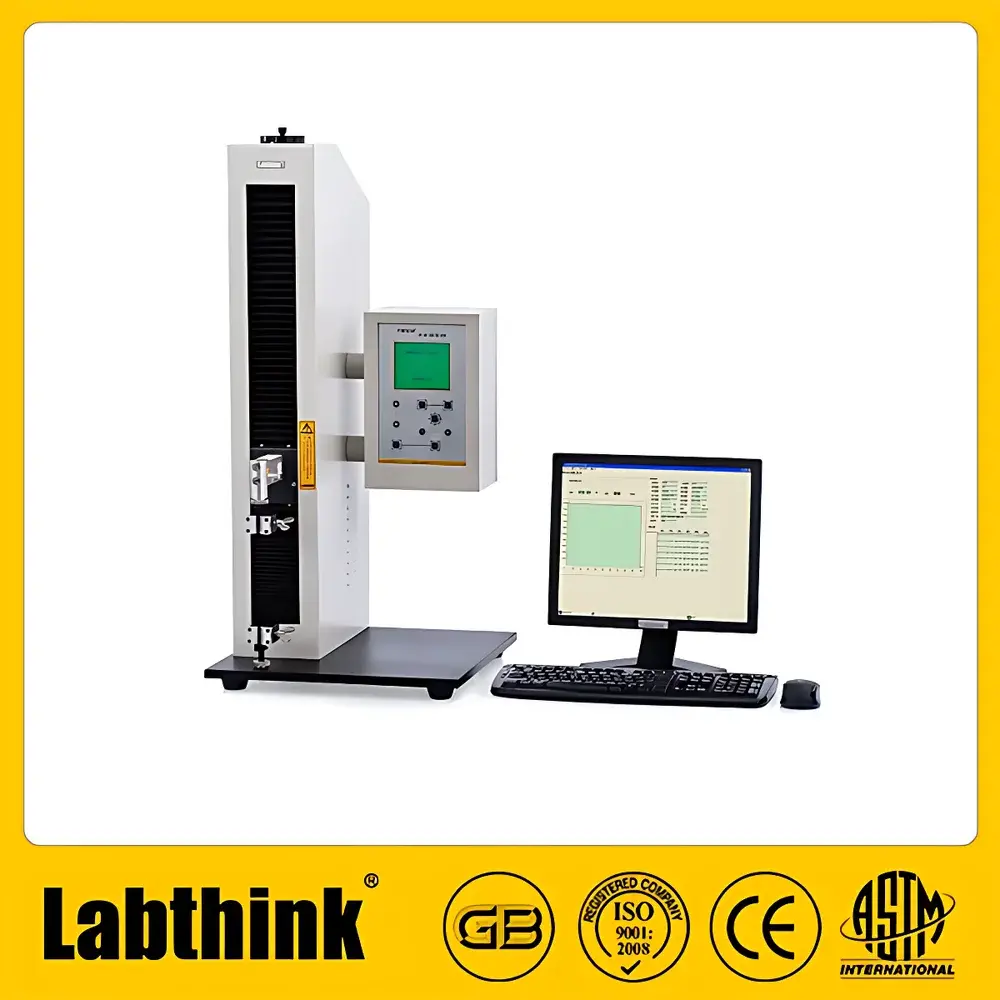
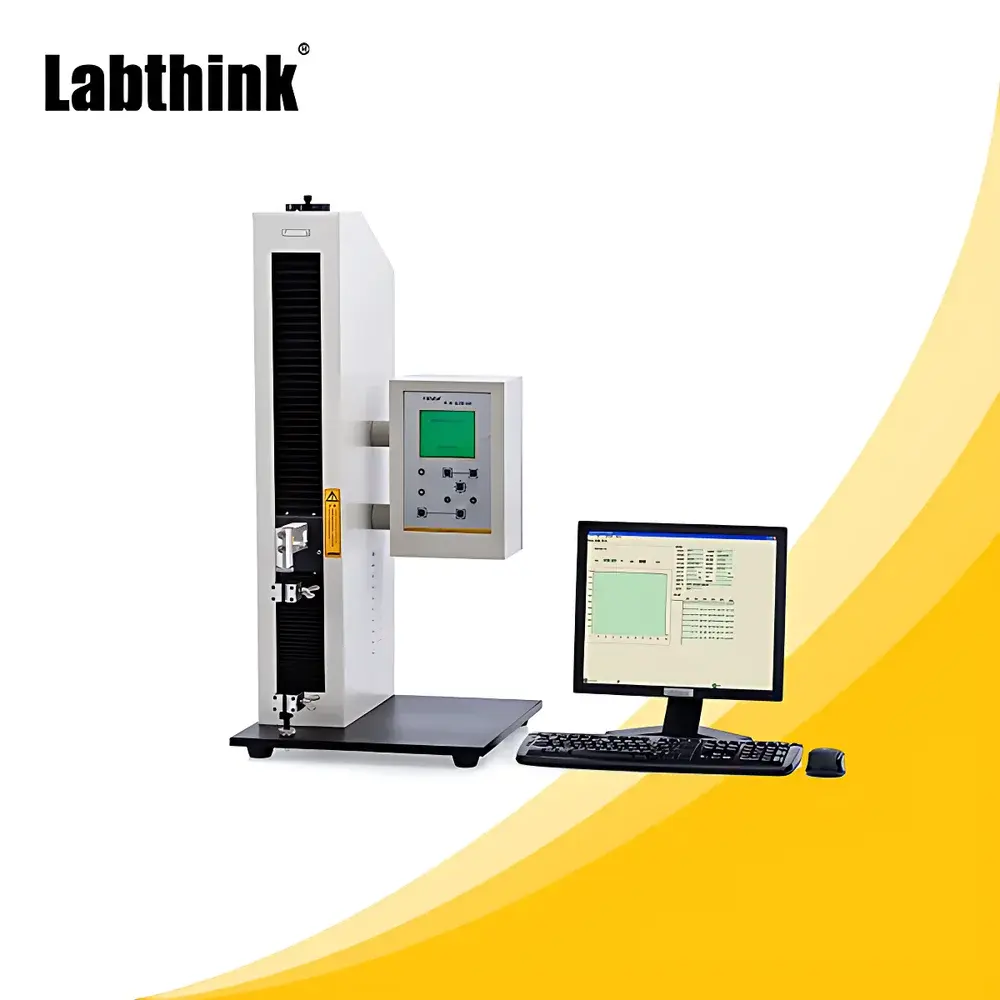
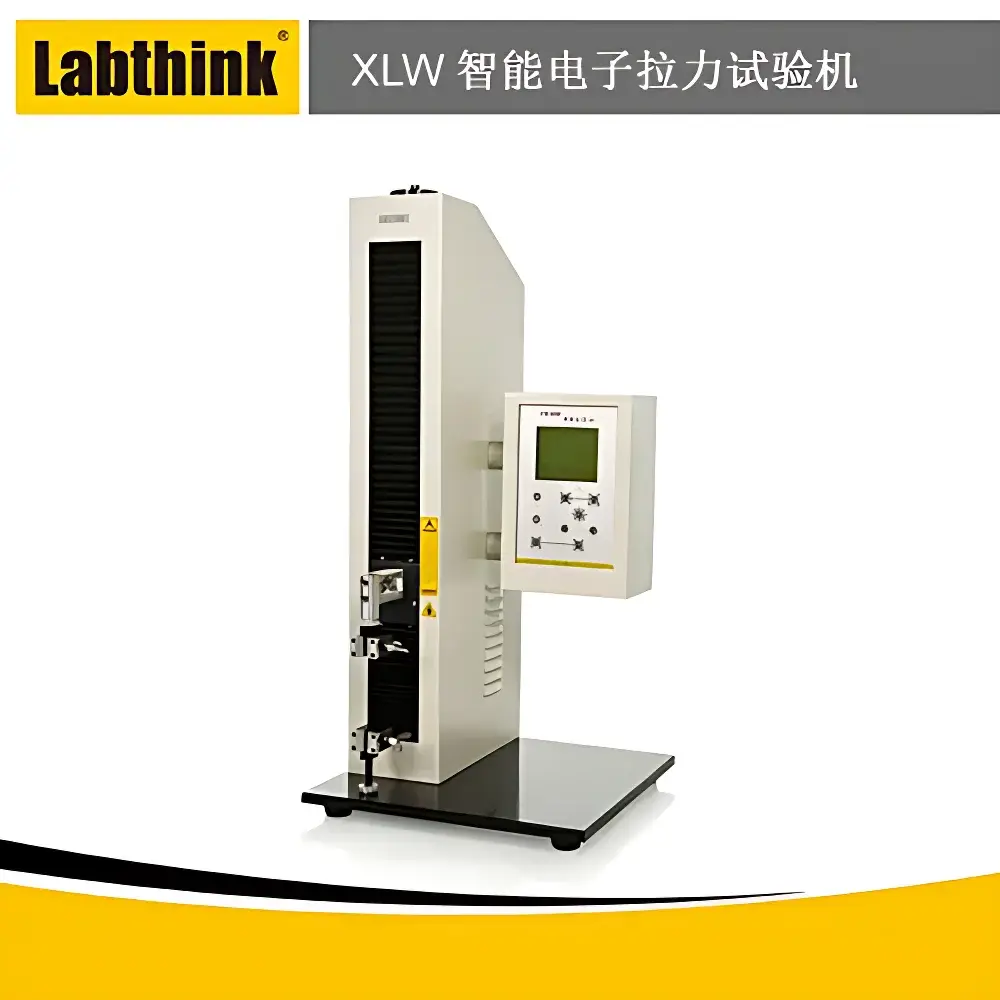
Labthink PARAM-XLW Electronic Tensile Testing Machine
| Brand | Labthink |
|---|---|
| Origin | Shandong, China |
| Manufacturer Type | Direct Manufacturer |
| Country of Origin | China |
| Model | PARAM-XLW |
| Instrument Type | Electronic Tensile Testing Machine |
| Maximum Test Load | 1 kN |
| Force Accuracy Class | Class 1 |
| Test Stroke | 600 mm |
| Standard Load Cell | 500 N |
| Optional Load Cells | 30 N, 50 N, 100 N, 200 N, 750 N, 1000 N |
| Test Speeds | 50, 100, 150, 200, 250, 300, 500 mm/min |
| Specimen Width (Standard Fixture) | 30 mm |
| Optional Fixture Width | 50 mm |
| Clamping Method | Manual |
| Dimensions (L×W×H) | 450 × 450 × 980 mm |
| Weight | 65 kg |
| Power Supply | 220 VAC 50 Hz / 120 VAC 60 Hz |
Overview
The Labthink PARAM-XLW Electronic Tensile Testing Machine is a precision-engineered universal testing system designed for mechanical property evaluation of thin, flexible materials used across packaging, pharmaceutical, medical device, and consumer goods industries. It operates on the principle of uniaxial tensile loading under controlled displacement rate, where specimens are gripped between two opposing jaws and subjected to programmed relative motion. Force is measured via high-stability load cells mounted on the moving crosshead, while axial displacement is captured by an integrated linear encoder. Real-time force–displacement data acquisition enables calculation of key mechanical parameters including tensile strength, elongation at break, Young’s modulus, peel strength, tear resistance, seal strength, puncture force, opening force, and low-speed unwind torque—fully compliant with standardized test methodologies defined in ISO, ASTM, GB/T, JIS, and QB/T standards.
Key Features
- Class 1 force accuracy per ISO 7500-1 and ASTM E4, ensuring traceable, reproducible results suitable for quality control and regulatory submissions.
- Seven pre-programmed test modes: tensile, peel, tear, heat seal, shear, puncture, and delamination—each configured with dedicated algorithmic logic and failure detection criteria.
- Modular load cell architecture supporting interchangeable sensors (30 N to 1000 N), enabling optimal resolution across diverse material stiffness ranges—from ultra-thin polymer films to reinforced laminates.
- Seven discrete test speeds (50–500 mm/min), calibrated per ISO 527-1 and ASTM D882, to accommodate standard compliance requirements and application-specific deformation kinetics.
- Microprocessor-based controller with PVC membrane keypad, backlit LCD display, and intuitive menu navigation—designed for operation in regulated laboratory or production floor environments.
- Comprehensive safety architecture: mechanical limit switches, overload cut-off, automatic return-to-start, power-loss position memory, and emergency stop circuitry aligned with IEC 61000-6-2 EMC and EN 61000-6-4 immunity standards.
Sample Compatibility & Compliance
The PARAM-XLW accommodates a broad spectrum of planar, flexible substrates up to 600 mm travel length and 30 mm (standard) or 50 mm (optional) specimen width. Validated applications include polymeric films (BOPP, PET, PE, CPP), aluminum foils, metallized barriers, nonwovens, medical adhesives, transdermal patches, blister lidding, pouch seals, protective coatings, and battery separator membranes. All test routines adhere to internationally recognized standards—including ISO 37 (rubber vulcanizates), ISO 1184 (plastic films), ASTM D882 (thin plastic sheeting), ASTM F88 (package seal strength), ASTM D1938 (tear propagation), GB/T 1040 series (tensile properties of plastics), GB/T 2792 (peel resistance), and USP for container closure integrity verification. The system supports GLP-compliant audit trails when integrated with Lystem™ Laboratory Data Management System.
Software & Data Management
The proprietary Lystem™ software provides full test lifecycle management: method configuration, real-time curve visualization, multi-curve overlay analysis, statistical reporting (mean, SD, CV%, min/max), elastic modulus derivation via tangent or secant methods, and customizable report generation (PDF, CSV, XML). All data entries—including operator ID, timestamp, calibration logs, and instrument configuration—are time-stamped and cryptographically hashed to satisfy FDA 21 CFR Part 11 requirements for electronic records and signatures. RS232 serial interface enables bidirectional communication with external PCs; optional USB-to-serial adapters support modern Windows 10/11 platforms. Data export conforms to ASTM E1447 and ISO/IEC 17025 documentation frameworks for accredited testing laboratories.
Applications
- Quality assurance of primary and secondary pharmaceutical packaging: blister seal integrity, pouch burst strength, vial cap torque consistency.
- Evaluation of barrier film performance under mechanical stress during filling, transport, and sterilization cycles.
- Validation of adhesive bond durability in wound dressings, electrocardiogram electrodes, and wearable sensor substrates.
- Development of sustainable mono-material laminates requiring precise interlayer cohesion quantification.
- Regulatory submission support for ISO 13485-certified medical device manufacturers performing design verification per ISO 14971.
- Routine QC screening in food packaging lines to verify compliance with shelf-life mechanical stability requirements.
FAQ
What standards does the PARAM-XLW comply with for pharmaceutical packaging testing?
It fully supports ASTM F88 (seal strength), ASTM F904 (comparative seal strength), ISO 11607-2 (packaging validation), and GB/T 10004 (flexible composite packaging)—all critical for FDA and NMPA registration dossiers.
Can the system be validated for GMP environments?
Yes. With IQ/OQ documentation packages, calibration certificates traceable to NIST standards, and Lystem™ software configured for 21 CFR Part 11 compliance, it meets EU Annex 11 and PIC/S requirements.
Is custom fixture design available for non-standard specimens?
Labthink offers engineering consultation and bespoke fixture development—including pneumatic clamps, floating roller grips, and environmental chamber integration—for specialized material geometries and test protocols.
How is force calibration maintained over time?
The system includes internal auto-zero and span calibration routines. External verification uses certified deadweight sets per ISO 376, with annual recalibration recommended per ISO/IEC 17025 guidelines.
Does the machine support multi-specimen batch testing?
While single-specimen loading is standard, automated sample loaders and barcode-scanned test sequencing can be implemented via Lystem™ API integration for high-throughput labs.



