
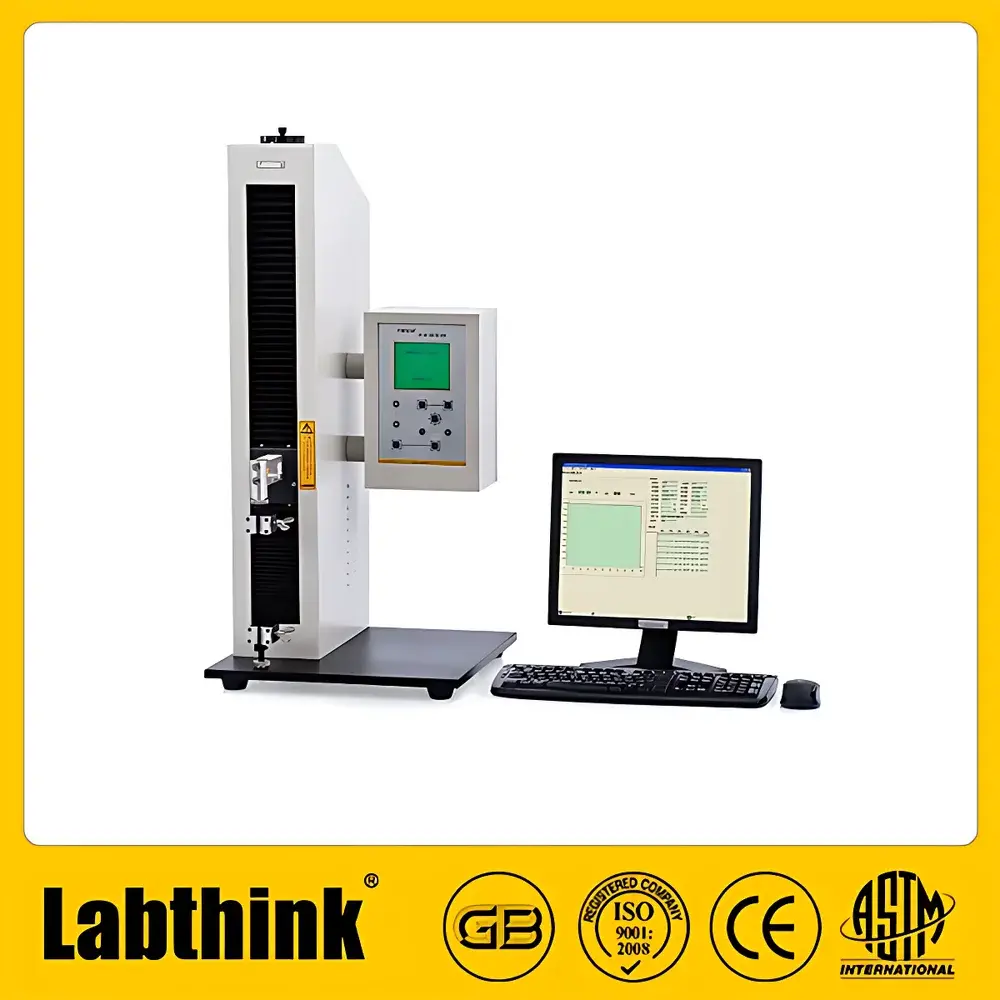
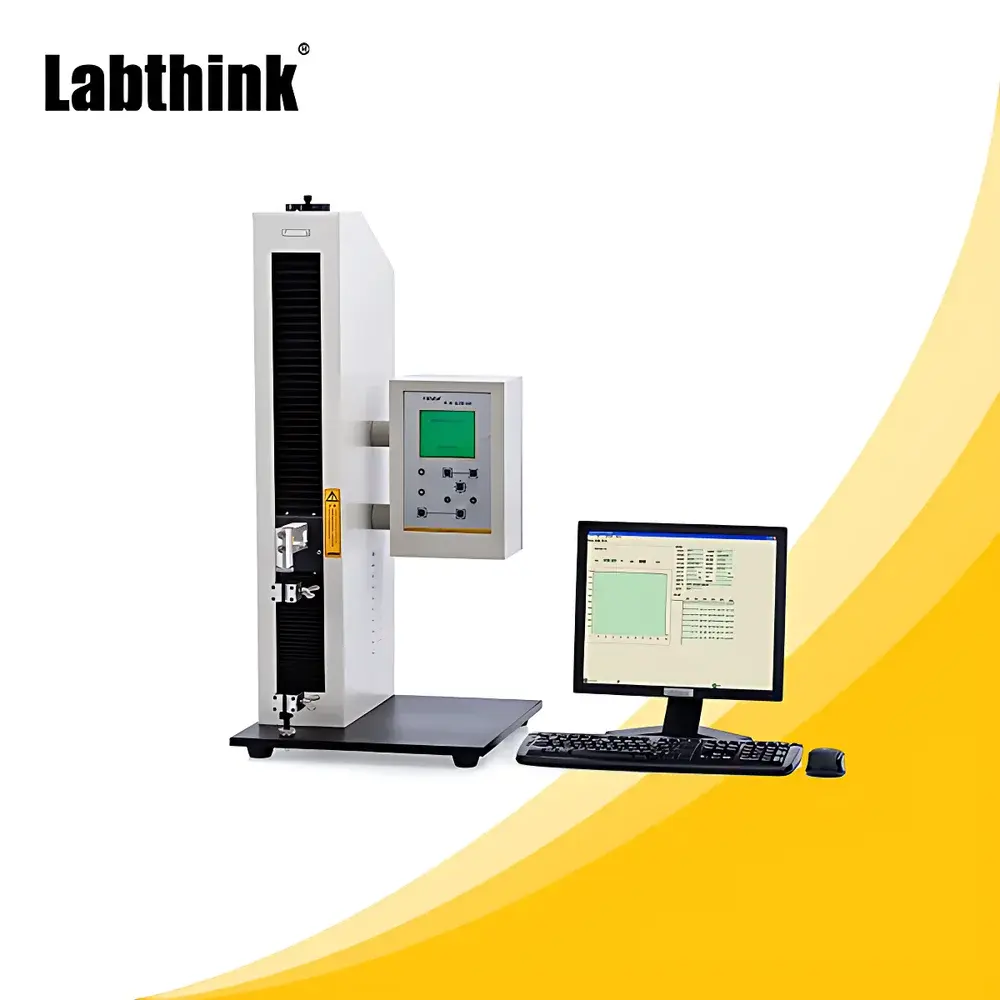
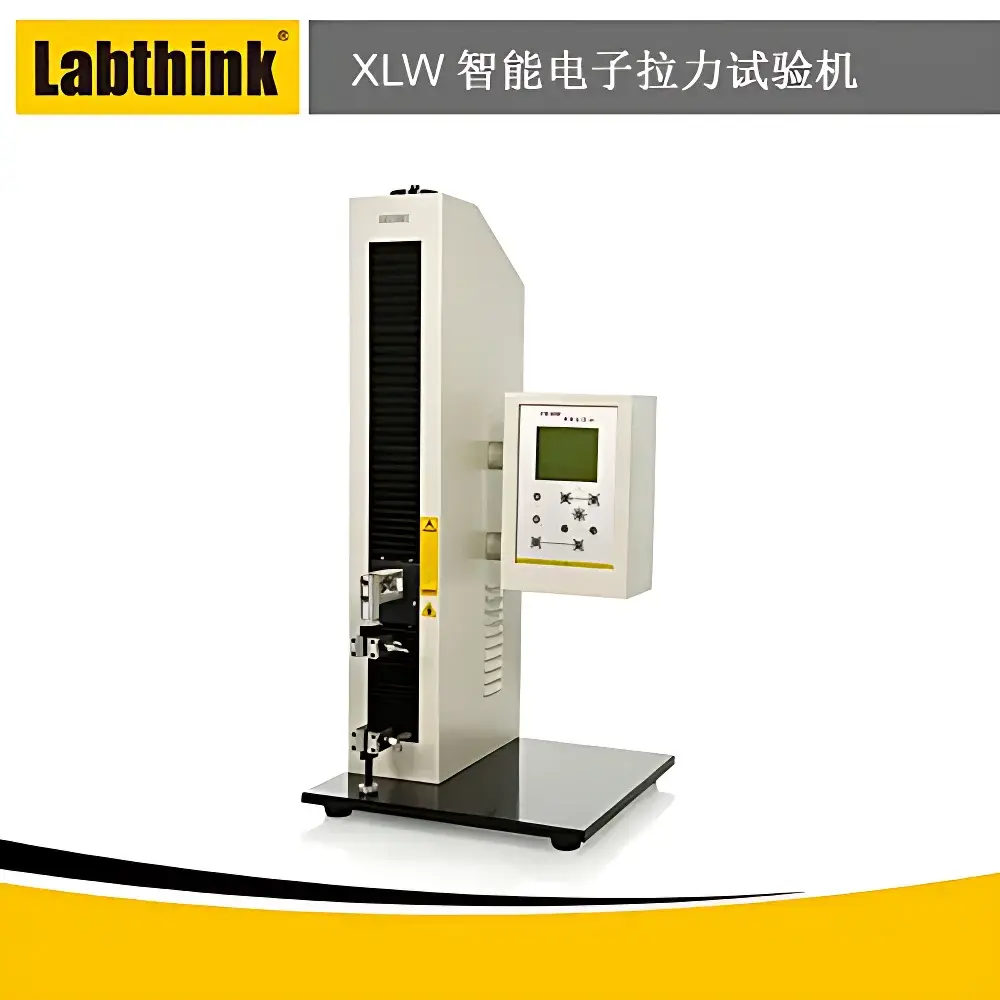
Labthink PARAM XLW Intelligent Electronic Tensile Testing Machine
| Brand | Labthink |
|---|---|
| Model | PARAM XLW |
| Type | Electronic Tensile Testing Machine |
| Origin | Shandong, China |
| Manufacturer | Labthink (OEM/ODM Producer) |
| Test Stroke | 600 mm |
| Force Capacity Options | 30 N, 50 N, 100 N, 200 N (standard 500 N), 750 N, 1000 N (customizable) |
| Accuracy Class | Class 1 per ISO 7500-1 & ASTM E4 |
| Test Speeds | 50, 100, 150, 200, 250, 300, 500 mm/min |
| Sample Width | 30 mm (standard fixture), 50 mm (optional) |
| Power Supply | 220 VAC 50 Hz / 120 VAC 60 Hz |
| Dimensions (L×W×H) | 450 × 450 × 980 mm |
| Net Weight | 65 kg |
| Compliance | ISO 37, ASTM D882, ASTM D1938, ASTM F88, GB/T 1040.1–1040.5, GB/T 8808, GB/T 12914, GB/T 16578.1, JIS P8113, QB/T 2358 |
Overview
The Labthink PARAM XLW Intelligent Electronic Tensile Testing Machine is a precision-engineered universal testing system designed for static mechanical property evaluation of thin, flexible materials under uniaxial loading conditions. Based on the fundamental principle of controlled displacement-driven tensile testing—where two grips move relative to one another at defined velocities while measuring real-time force and displacement—the instrument quantifies critical mechanical parameters including tensile strength, elongation at break, Young’s modulus, yield point, tear resistance, peel adhesion, heat seal strength, puncture force, and low-speed unwind torque. Its architecture conforms to standardized test methodologies defined in ISO 37 (rubber vulcanized or thermoplastic), ASTM D882 (thin plastic sheeting), ASTM F88 (heat seal strength of flexible barrier materials), and GB/T 1040 series (plastics—determination of tensile properties). The system operates within a rigid frame equipped with high-resolution load cells and linear displacement transducers, delivering Class 1 accuracy per ISO 7500-1 and ASTM E4, ensuring traceable, repeatable, and inter-laboratory comparable results.
Key Features
- Multi-functional test platform supporting seven independent test modes: tensile, peel, tear, heat seal, shear, puncture, and low-speed unwind—each with dedicated algorithmic processing and pass/fail logic.
- Modular force sensor configuration: standard 500 N capacity with optional ranges from 30 N to 1000 N, enabling precise measurement across ultra-thin films (e.g., PET, BOPP, CPP) and reinforced laminates.
- Seven programmable crosshead speeds (50–500 mm/min), compliant with ASTM D882 (50–500 mm/min) and ISO 37 (100–500 mm/min), facilitating method-specific velocity selection without hardware modification.
- Microprocessor-controlled operation with intuitive PVC membrane keypad, large backlit LCD display, and menu-driven navigation—designed for minimal operator training and robust daily use in QC labs.
- Integrated safety mechanisms: mechanical limit switches, overload cut-off, automatic return-to-start post-test, and power-loss memory retention to preserve test state integrity.
- Comprehensive data acquisition engine capturing ≥100 data points/sec, synchronized force-displacement sampling for high-fidelity stress-strain curve reconstruction.
Sample Compatibility & Compliance
The PARAM XLW accommodates a broad spectrum of planar, flexible substrates used in packaging, medical device, electronics, and automotive applications. Validated sample types include biaxially oriented polyethylene terephthalate (BOPET), cast polypropylene (CPP), aluminum foil laminates, pressure-sensitive adhesive tapes, medical transdermal patches, lithium-ion battery separators, nonwovens, kraft paper, and metallized films. All test fixtures—including manual pneumatic clamps, floating roller grips for low-tension film handling, and specialized seal strength platens—are designed to minimize slippage and edge failure, ensuring specimen failure occurs exclusively within the gauge length. The instrument meets regulatory expectations for routine quality control in GMP-compliant environments: audit trails, user access levels, electronic signature support, and data immutability features align with FDA 21 CFR Part 11 requirements when paired with Lystem™ Laboratory Data Sharing System.
Software & Data Management
Bundled Lystem™ TestSuite software provides full lifecycle test management—from method setup and calibration verification to statistical reporting and archival. Key capabilities include group-wise statistical analysis (mean, SD, CV%, min/max), overlay of up to eight stress-strain curves for comparative assessment, elastic modulus calculation via tangent or secant methods, and customizable report templates compliant with ISO/IEC 17025 documentation standards. Raw data exports are supported in CSV, XML, and PDF formats; RS232 serial interface enables direct integration with LIMS or ERP systems. Optional micro-printer connectivity allows on-device hardcopy generation of test certificates with timestamp, operator ID, and calibration status metadata.
Applications
- Quantitative validation of PET film tensile performance during extrusion and orientation process optimization.
- Heat seal integrity verification of pouches and blister lidding per ASTM F88 and ISO 11607-2.
- Peel strength assessment of medical adhesive tapes against ISO 29462 and ASTM D3330.
- Evaluation of battery separator mechanical robustness under dry and wet conditions per IEC 62660-1.
- Quality conformance testing of protective films for display panels per JIS P8113 and IPC-CC-830B.
- Regulatory submission support for FDA 510(k) dossiers requiring mechanical characterization of Class II packaging components.
FAQ
What standards does the PARAM XLW comply with for PET film testing?
It fully supports ASTM D882 (Standard Test Method for Tensile Properties of Thin Plastic Sheeting), ISO 1183 (for density-correlated modulus estimation), and GB/T 1040.3 (Plastics—Determination of tensile properties—Part 3: Thin sheet and thin film).
Can the system perform simultaneous multi-specimen testing?
No—it is a single-station tester optimized for high repeatability per specimen; however, automated batch sequencing minimizes turnaround time for routine QC workflows.
Is calibration traceable to national metrology institutes?
Yes—force sensors are calibrated using NIST-traceable deadweight standards; displacement calibration follows ISO 9513 procedures with certified linear encoders.
Does the software support GLP-compliant audit trails?
Yes—Lystem™ TestSuite logs all user actions, parameter changes, calibration events, and result modifications with timestamps and operator IDs, satisfying GLP Annex 11 and 21 CFR Part 11 requirements.
What maintenance is required for long-term accuracy?
Annual verification of load cell linearity and crosshead alignment is recommended; routine cleaning of guide rails and periodic lubrication per Labthink Maintenance Manual ensures mechanical stability over 10,000+ test cycles.



