
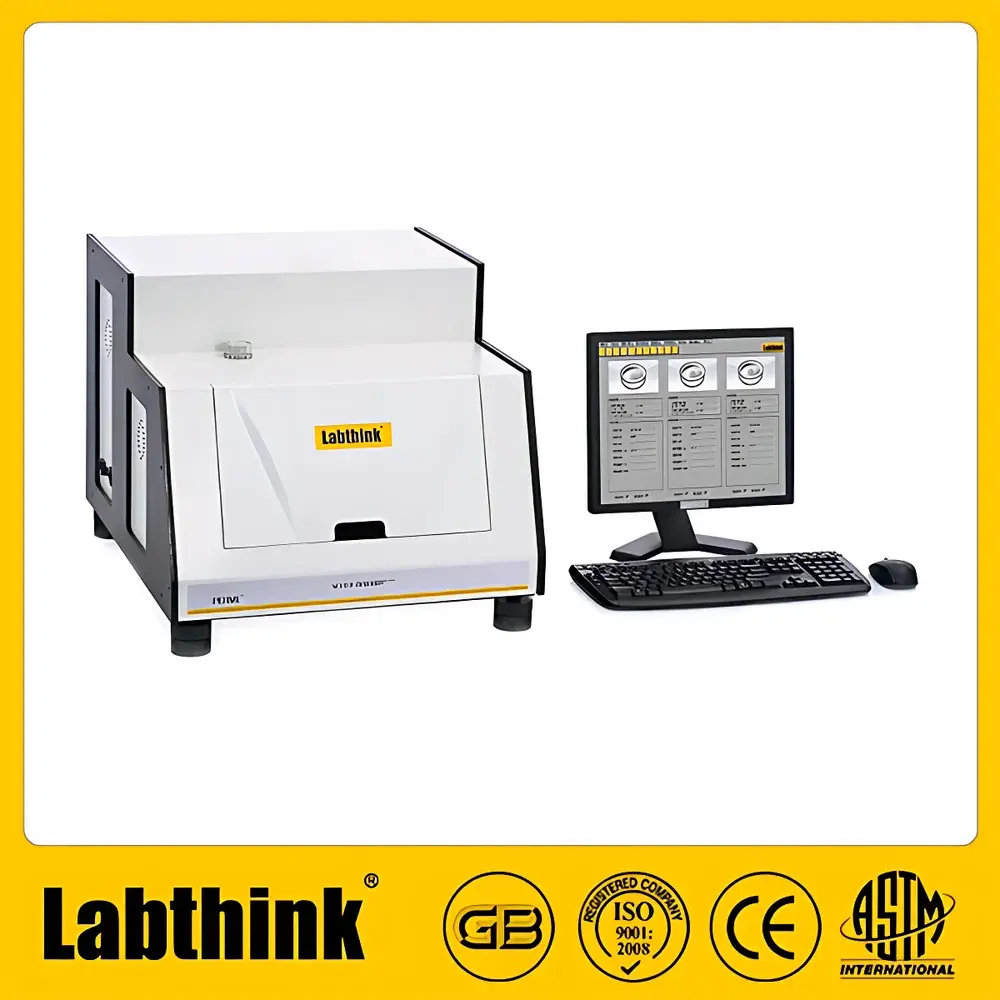
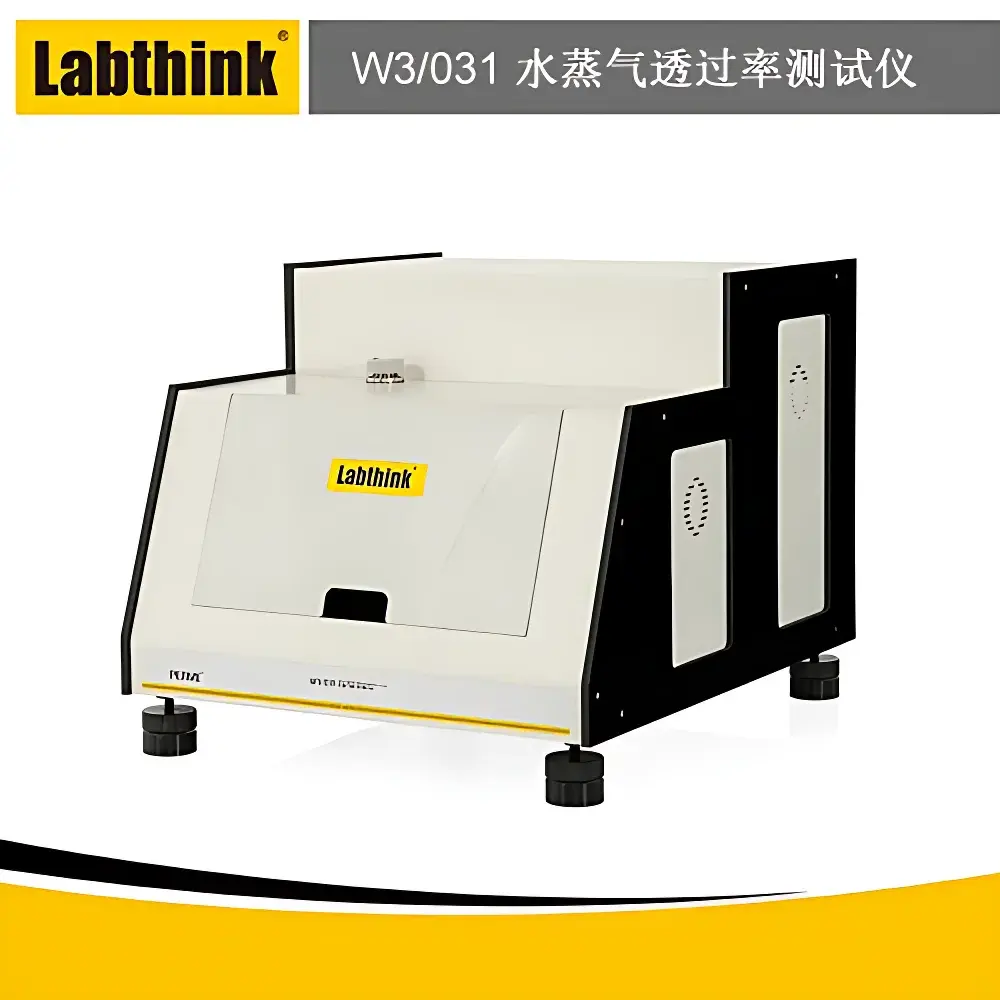
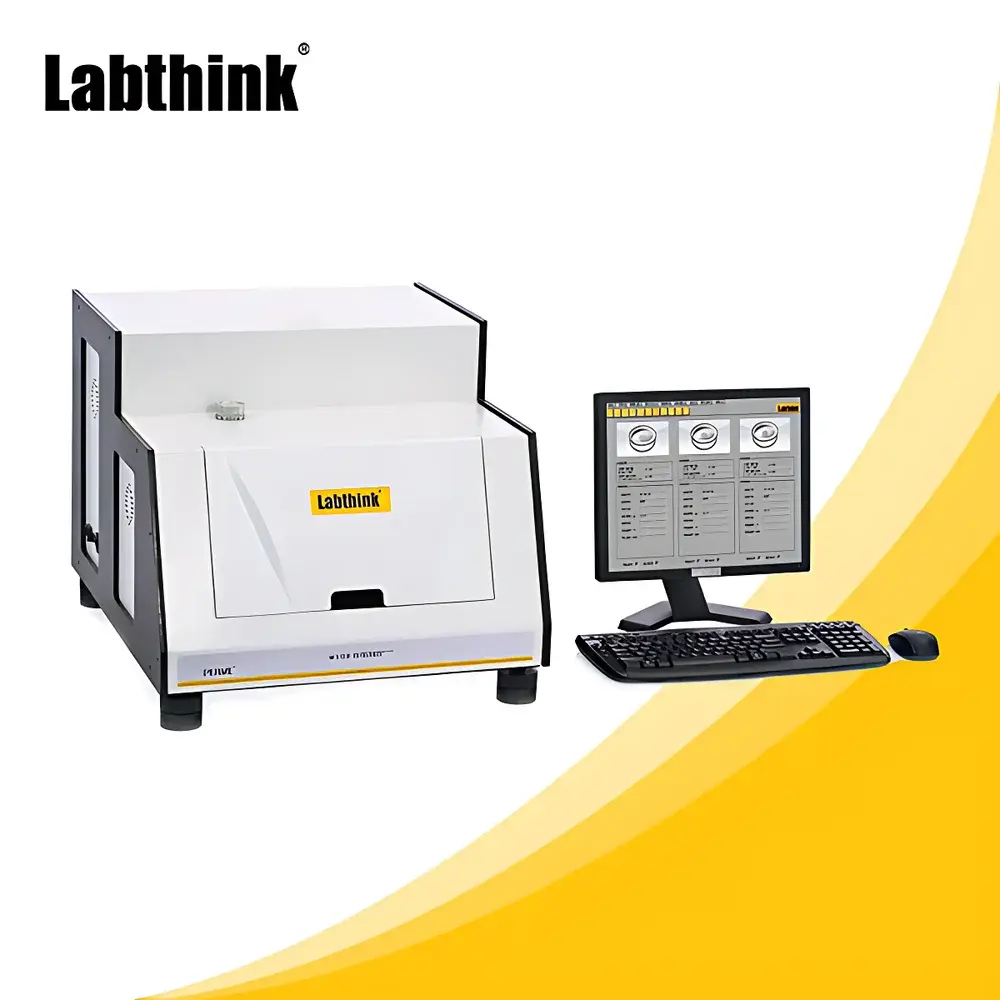
Labthink PERME-W3/031 Gravimetric Water Vapor Transmission Rate Tester
| Brand | Labthink |
|---|---|
| Model | PERME-W3/031 |
| Principle | Gravimetric Cup Method |
| Test Range | 0.1–10,000 g/m²·24h |
| Resolution | 0.0001 g |
| Accuracy | ±0.01 g/m²·24h |
| Temperature Control | 15–55 °C (±0.1 °C) |
| Humidity Control | 10–98% RH (±1% RH) |
| Sample Area | 33 cm² |
| Sample Thickness | ≤3 mm |
| Sample Diameter | Φ74 mm |
| Cup Capacity | 3 independent test cups |
| Air Supply | 0.6 MPa, Φ4 mm polyurethane tubing |
| Power | 220 VAC 50 Hz / 120 VAC 60 Hz |
| Net Weight | 83 kg |
| Dimensions | 580 × 680 × 470 mm (L×W×H) |
Overview
The Labthink PERME-W3/031 is a gravimetric water vapor transmission rate (WVTR) tester engineered for precision measurement of moisture barrier performance in flexible packaging materials—including aluminum foil laminates, polymer films, coated papers, and pharmaceutical blister substrates. It operates on the standardized cup method (also known as the gravimetric or desiccant method), wherein a conditioned test specimen seals a permeation cup containing a desiccant or saturated salt solution. Under controlled temperature and relative humidity (RH) conditions across the specimen, water vapor migrates from the high-humidity side to the dry side. The mass gain of the cup is recorded at defined intervals using a high-resolution analytical balance integrated into a thermally and mechanically stabilized weighing station. WVTR is calculated per ISO 2528, ASTM E96, GB/T 1037, and other international standards based on steady-state mass change, exposure area, and time. The instrument’s triple-cup architecture enables concurrent, statistically independent measurements—critical for method validation, QC batch release, and comparative material screening in regulated environments.
Key Features
- Triple independent permeation cup stations with fully automated sequential weighing—eliminates manual handling errors and ensures inter-cup reproducibility.
- Patented mechanical isolation system minimizes vibration and thermal drift during microgram-level mass acquisition, supporting long-duration tests up to 168 hours with <0.0001 g resolution.
- Embedded industrial computer platform replaces legacy microcontroller-based control, delivering deterministic real-time environmental regulation (±0.1 °C, ±1% RH) and synchronized data logging at user-defined intervals.
- Modular humidity generation: dual-path design supports both desiccant-based dry-side operation and active RH control (10–98% RH) via N₂-dry air mixing and saturated salt reference calibration.
- Integrated gas drying and filtration unit maintains consistent dew point stability; optional compressed air supply interface (0.6 MPa, Φ4 mm PU tubing) enables continuous purge flow (0.5–2.5 m/s) for enhanced boundary layer control.
- Compliant sample handling: standard 33 cm² test area (Φ74 mm), accommodates specimens up to 3 mm thick; custom fixtures available for non-standard geometries or rigid substrates.
Sample Compatibility & Compliance
The PERME-W3/031 is validated for use with homogeneous and multilayered planar packaging materials including metallized PET, AlOx-coated OPP, cold-form foil, PVDC-coated paperboard, and barrier-laminated pouch films. Its operational envelope meets the physical constraints specified in ISO 2528, ASTM E96 (Procedure A & B), ASTM D1653, TAPPI T464, JIS Z0208, DIN 53122-1, and Chinese pharmacopoeial standard YBB00092003. All hardware and firmware components are designed to support GLP-compliant workflows: audit trails record operator ID, timestamp, parameter settings, calibration events, and raw mass vs. time datasets. When configured with Lystem™ Laboratory Data Sharing System (optional), the instrument satisfies FDA 21 CFR Part 11 requirements for electronic records and signatures—including role-based access control, electronic signature capture, and immutable data archiving.
Software & Data Management
The instrument runs Labthink’s proprietary PERME™ software v3.x, featuring a Qt-based GUI optimized for laboratory workflow efficiency. Users define test protocols—including temperature setpoint, RH gradient, sampling frequency, pass/fail criteria, and statistical confidence thresholds—via intuitive wizards. Real-time plots display cumulative mass gain, slope-derived WVTR, and coefficient of variation (CV%) across all three cups. Automated report generation exports PDF and Excel formats compliant with ISO/IEC 17025 documentation requirements. With Lystem™ integration (optional), test results synchronize to a central SQL database, enabling cross-instrument trend analysis, CAPA linkage, and automated certificate-of-analysis (CoA) generation. All data files include embedded metadata: instrument ID, calibration certificate numbers, environmental log history, and digital signatures traceable to ISO/IEC 17025-accredited calibration labs.
Applications
- Quality assurance of high-barrier pharmaceutical blister packaging to verify shelf-life compliance against moisture-induced degradation of hygroscopic APIs.
- R&D evaluation of novel nanocomposite films and atomic-layer-deposited oxide coatings for food packaging applications.
- Regulatory submission support: generating GLP-auditable WVTR datasets for FDA IND/NDA dossiers and EMA CTD Module 3 submissions.
- Supplier qualification testing for aluminum foil laminates used in medical device sterile barrier systems (ISO 11607-1).
- Accelerated aging correlation studies linking WVTR values at elevated RH/temperature to real-time stability data under ICH Q1A conditions.
- Root cause analysis of delamination or pinhole formation in multi-layer coextrusions through localized WVTR mapping (using optional fixture kits).
FAQ
What standards does the PERME-W3/031 directly support?
It natively implements test protocols aligned with ASTM E96 (desiccant and water methods), ISO 2528, GB/T 1037, JIS Z0208, and YBB00092003, with preloaded calculation engines for each.
Can the instrument perform tests at non-standard RH levels?
Yes—humidity is actively controlled from 10% to 98% RH with ±1% RH accuracy; users may define custom gradients beyond the default 90% RH/0% RH condition.
Is calibration traceable to national metrology institutes?
All mass calibration uses NIST-traceable stainless-steel weights (class E2); temperature and RH sensors are certified per ISO/IEC 17025 by an accredited third-party lab, with certificates supplied upon delivery.
How is data integrity ensured during extended 7-day tests?
The embedded OS employs journaling file system (ext4), redundant RAM buffering, and automatic power-fail recovery—ensuring no data loss during grid fluctuations or unscheduled shutdowns.
Does the system support remote monitoring and control?
Via Ethernet interface and Lystem™ integration, authorized users can view live status, download raw data, and initiate/restart tests from any workstation within the local network—without compromising audit trail integrity.





