
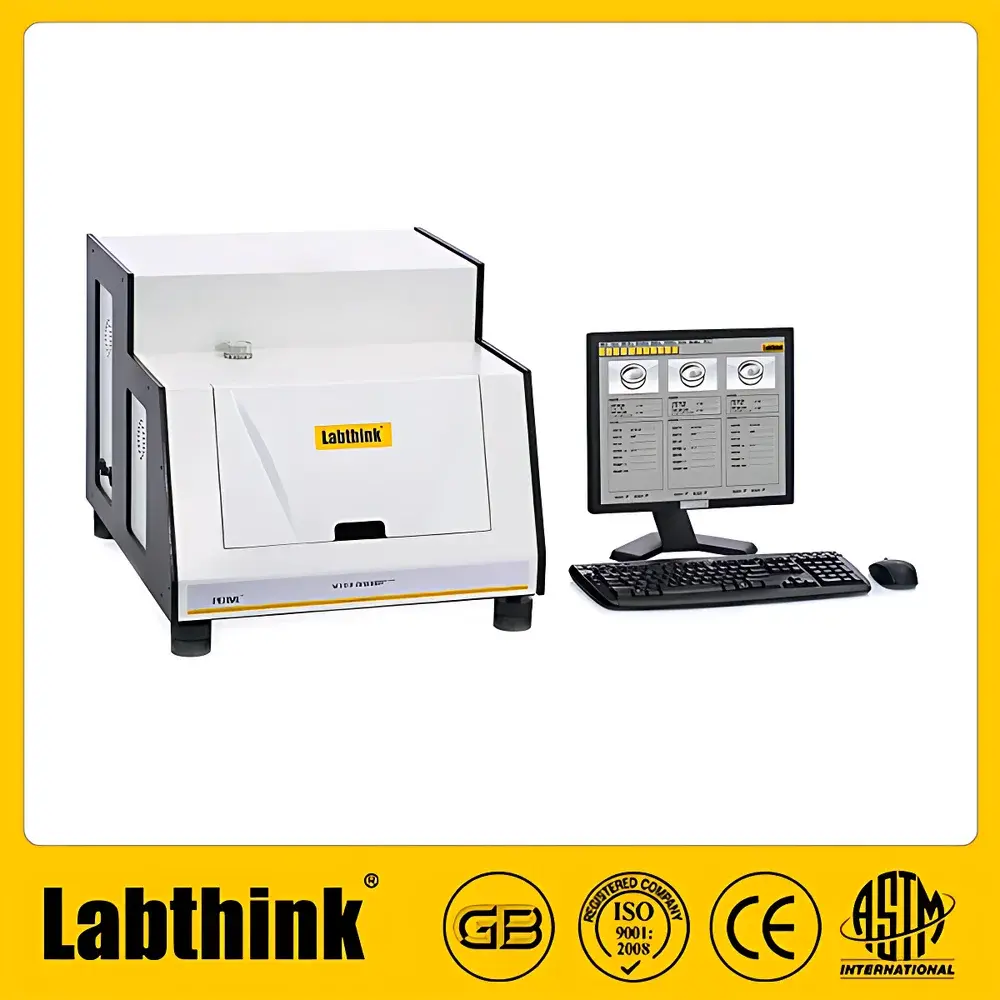
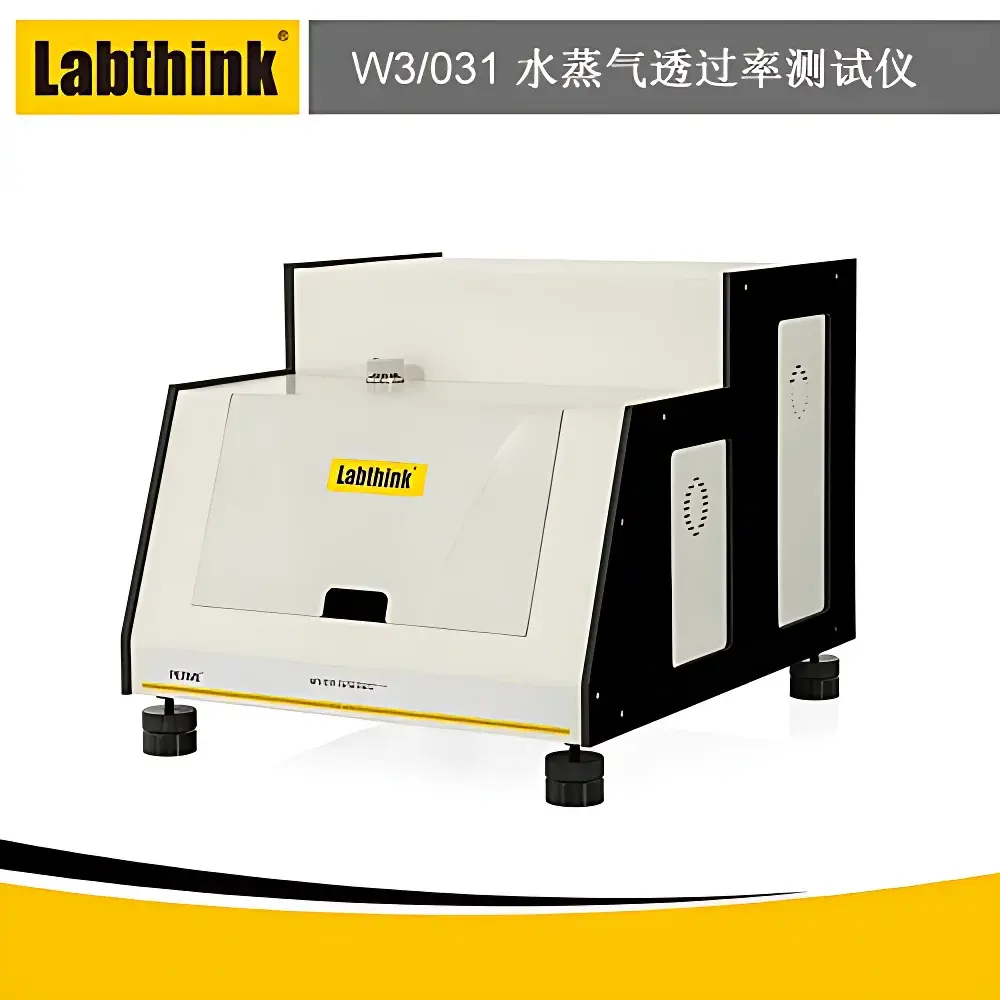
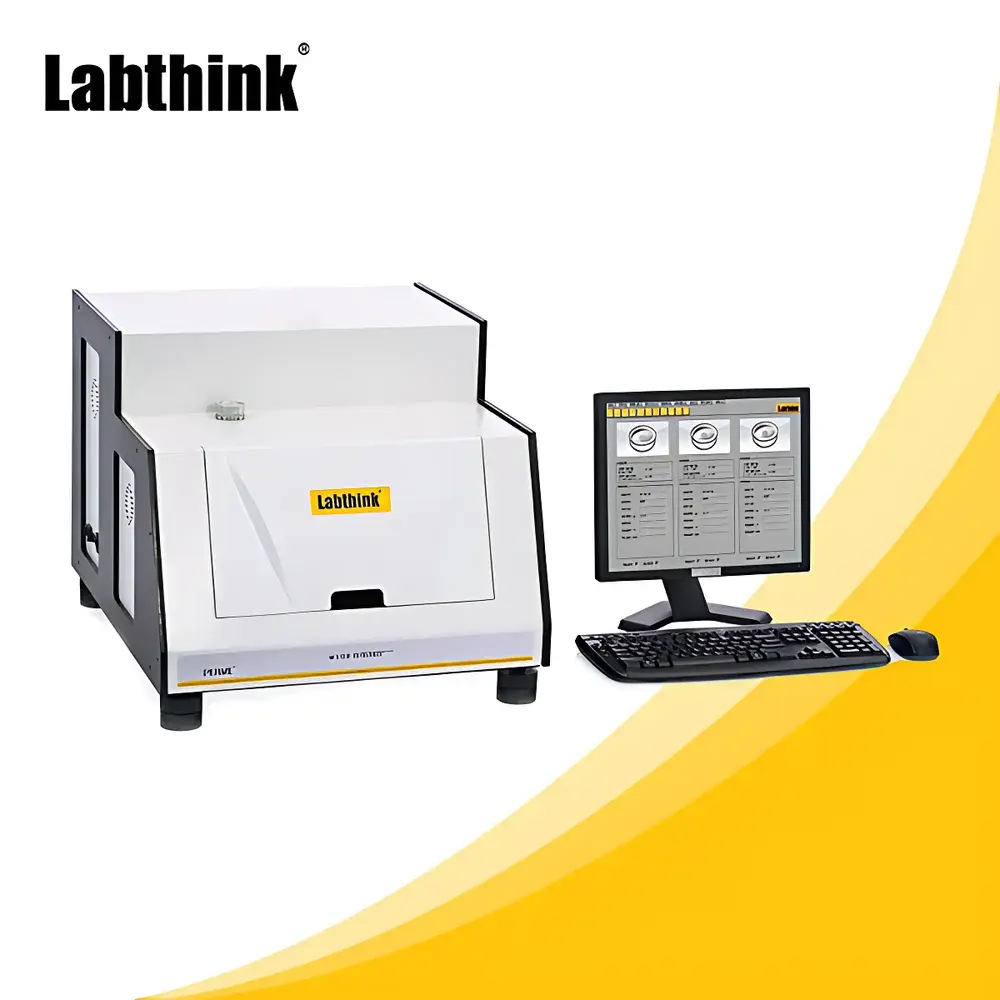
Labthink PERME W3/031 Water Vapor Transmission Rate (WVTR) Tester for Pharmaceutical Packaging
| Brand | Labthink |
|---|---|
| Model | PERME W3/031 |
| Origin | Shandong, China |
| Manufacturer Type | Direct Manufacturer |
| Origin Category | Domestic (China) |
| Price Range | USD 14,000–57,000 |
| Test Principle | Gravimetric Cup Method (ASTM E96, GB/T 1037) |
| Test Range | 0.1–10,000 g/m²·24h |
| Sample Capacity | 1–3 independent cups |
| Measurement Resolution | 0.0001 g |
| Weight Accuracy | ±0.01 g/m²·24h |
| Temperature Control | 15–55 °C (±0.1 °C) |
| Humidity Control | 10–98 %RH (±1 %RH) |
| Test Area | 33 cm² |
| Sample Thickness | ≤3 mm |
| Sample Diameter | Φ74 mm |
| Chamber Volume | 27 L |
| Air Supply | 0.6 MPa, Φ4 mm PU tubing |
| Dimensions | 580 × 680 × 470 mm (L×W×H) |
| Net Weight | 83 kg |
| Power | 220 VAC 50 Hz / 120 VAC 60 Hz |
Overview
The Labthink PERME W3/031 Water Vapor Transmission Rate (WVTR) Tester is a gravimetric cup-based instrument engineered for precise, standardized measurement of water vapor permeation through flexible packaging materials used in pharmaceutical, medical device, and food applications. It operates in strict accordance with ASTM E96 (Standard Test Methods for Water Vapor Transmission of Materials), ISO 2528 (Plastics — Film and sheeting — Determination of water-vapour transmission rate — Gravimetric method), and GB/T 1037–1988 (Plastic films and sheets — Determination of water vapour transmission — Cup method). The system utilizes the classic desiccant-filled cup configuration: a conditioned test specimen seals the cup opening, separating a high-humidity environment (typically 90 %RH) from a dry interior containing desiccant. Under controlled temperature and humidity gradients, water vapor diffuses across the film and is absorbed by the desiccant; mass gain of the cup is measured at predefined intervals using an integrated high-resolution analytical balance (0.0001 g resolution). WVTR is calculated per unit area and time (g/m²·24h), enabling direct comparison against regulatory thresholds for blister foil, cold-forming aluminum, laminated pouches, and polymer-coated paperboard.
Key Features
- Triple independent test stations: Three sealed permeation cups operate simultaneously under identical or individually programmed environmental conditions, enabling parallel testing of heterogeneous samples without cross-contamination or thermal/hygrometric interference.
- Precision mechanical architecture: Patented cup-loading mechanism minimizes vibration and positional drift during weighing cycles, ensuring long-term repeatability and compliance with GLP traceability requirements.
- Embedded computing platform: Real-time Linux-based controller replaces legacy microcontroller systems, delivering deterministic timing control, error-resilient data logging, and secure firmware update capability via Ethernet.
- Automated environmental conditioning: Dual-zone Peltier-driven temperature control and saturated salt solution-based humidity generation deliver stable, programmable RH setpoints from 10 %RH to 98 %RH with ±1 %RH accuracy over 24 h.
- Configurable airflow management: Adjustable laminar air curtain (0.5–2.5 m/s) sweeps across cup surfaces to eliminate boundary-layer moisture accumulation and ensure kinetic consistency per ASTM E96 Annex A4.
Sample Compatibility & Compliance
The W3/031 accommodates rigid and flexible barrier materials up to 3 mm thickness, including pharmaceutical-grade aluminum foils, PVDC-coated films, SiOx– and AlOx-metallized polyester, cold-forming aluminum alloys, and multilayer laminates (e.g., PET/AL/PE, PP/AL/PP). Sample diameter is standardized at Φ74 mm (33 cm² test area), with custom fixtures available for non-circular geometries. All hardware and software modules comply with ISO/IEC 17025 documentation requirements for calibration traceability. Instrument validation protocols support IQ/OQ/PQ execution per FDA 21 CFR Part 11 guidelines, including electronic signature enforcement, audit trail generation, and user-access role assignment. Data integrity is preserved through encrypted local storage and optional integration with networked Lystem™ Laboratory Data Management System (LDMS).
Software & Data Management
The W3/031 runs Labthink’s proprietary PermeationTest™ v3.x software, featuring a validated GUI with configurable test templates, real-time mass vs. time curve visualization, automatic linear regression of steady-state slope, and built-in uncertainty propagation per GUM (JCGM 100:2008). All raw weight measurements, environmental logs, and calculation parameters are timestamped and stored in a relational SQLite database with SHA-256 hashing. Export options include CSV, PDF test reports (with digital signature fields), and XML for LIMS ingestion. Remote monitoring and multi-user collaboration are enabled via secure HTTPS interface; audit trails record every parameter change, report generation, and user login event with immutable timestamps.
Applications
- Pharmaceutical primary packaging qualification: WVTR verification of blister lidding foils (e.g., 80 µm hard temper aluminum), strip-pack films, and sachet laminates prior to stability studies (ICH Q1A–Q5C).
- Regulatory submission support: Generation of GLP-compliant data packages for USP , EP 3.2.1, and China NMPA CDE technical documents.
- Process development: Correlation of coating thickness, metallization density, and curing parameters with barrier performance across pilot-scale production batches.
- Accelerated aging correlation: Paired with thermo-hygrometric chambers to model shelf-life under defined climatic zones (e.g., Zone IVb, 30 °C/75 %RH).
- Supplier quality assurance: Incoming inspection of rollstock and pre-formed components against contractual WVTR limits (e.g., ≤0.5 g/m²·24h @ 38 °C/90 %RH).
FAQ
What standards does the W3/031 directly support?
ASTM E96 (Procedure A, B, and E), ISO 2528, GB/T 1037–1988, JIS Z 0208, and TAPPI T464.
Can the instrument test non-planar or molded samples?
Standard operation requires flat, circular specimens; custom fixtures for shallow-dome blister cavities or formed trays are available upon engineering review.
Is calibration traceable to national metrology institutes?
Yes—mass calibration uses NIST-traceable weights; temperature and RH sensors are certified per ISO/IEC 17025-accredited third-party calibration certificates.
How is data integrity ensured for regulated environments?
PermeationTest™ software includes 21 CFR Part 11-compliant features: electronic signatures, role-based access control, full audit trail, and tamper-evident data archives.
What maintenance intervals are recommended for routine operation?
Desiccant replacement every 72 h per cup; annual sensor recalibration; biannual verification of cup seal integrity and balance linearity using certified reference masses.






