
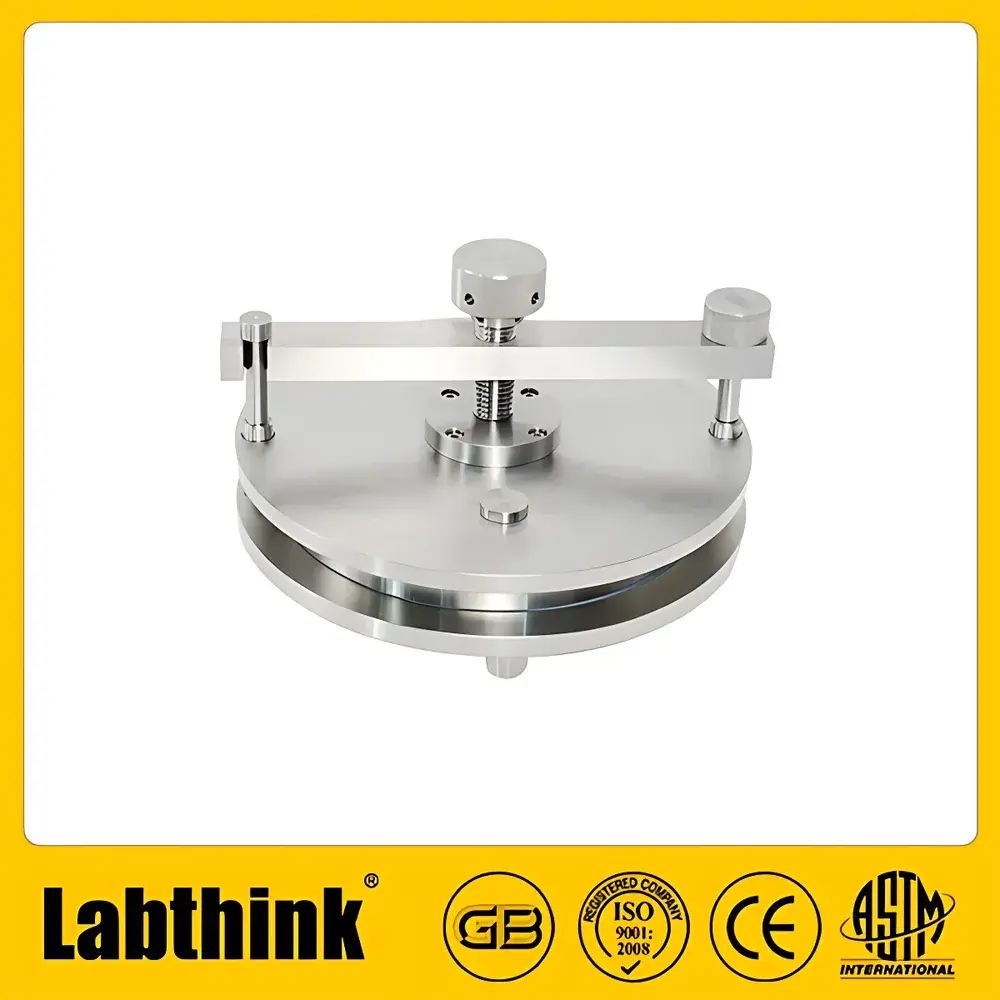
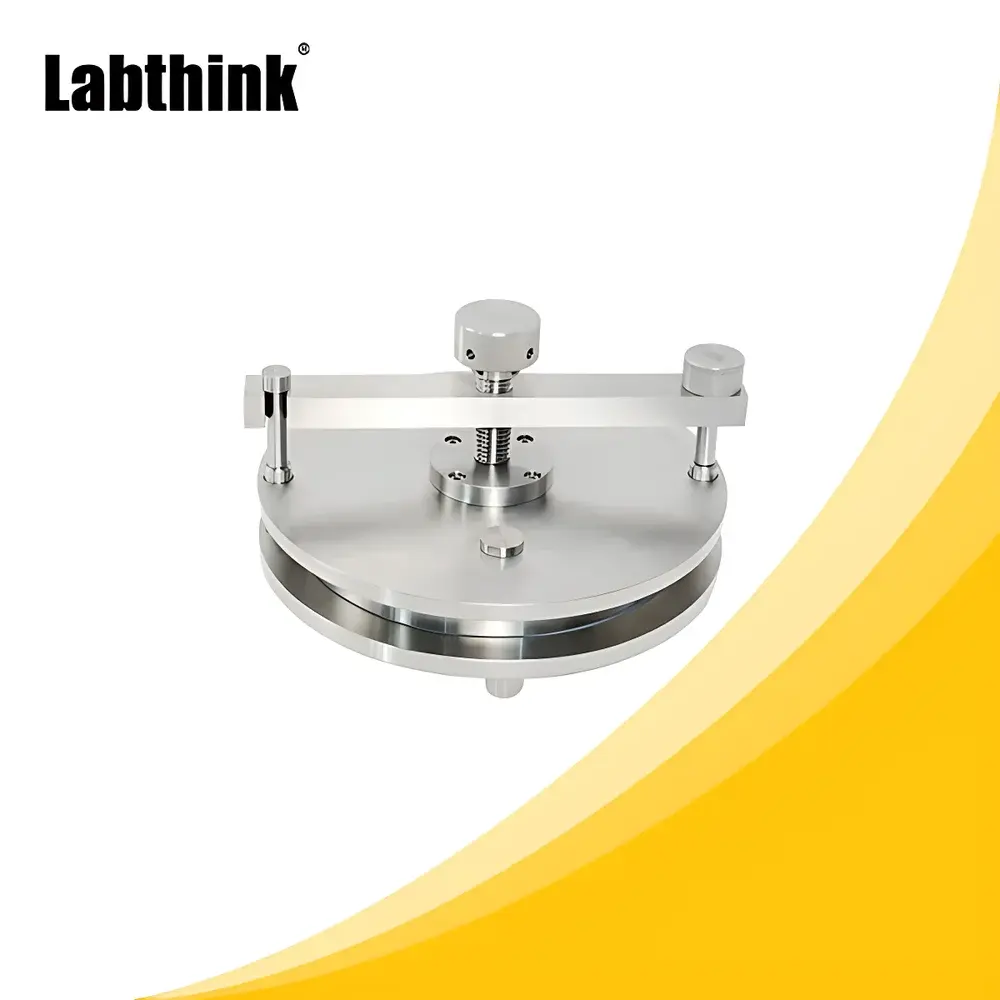
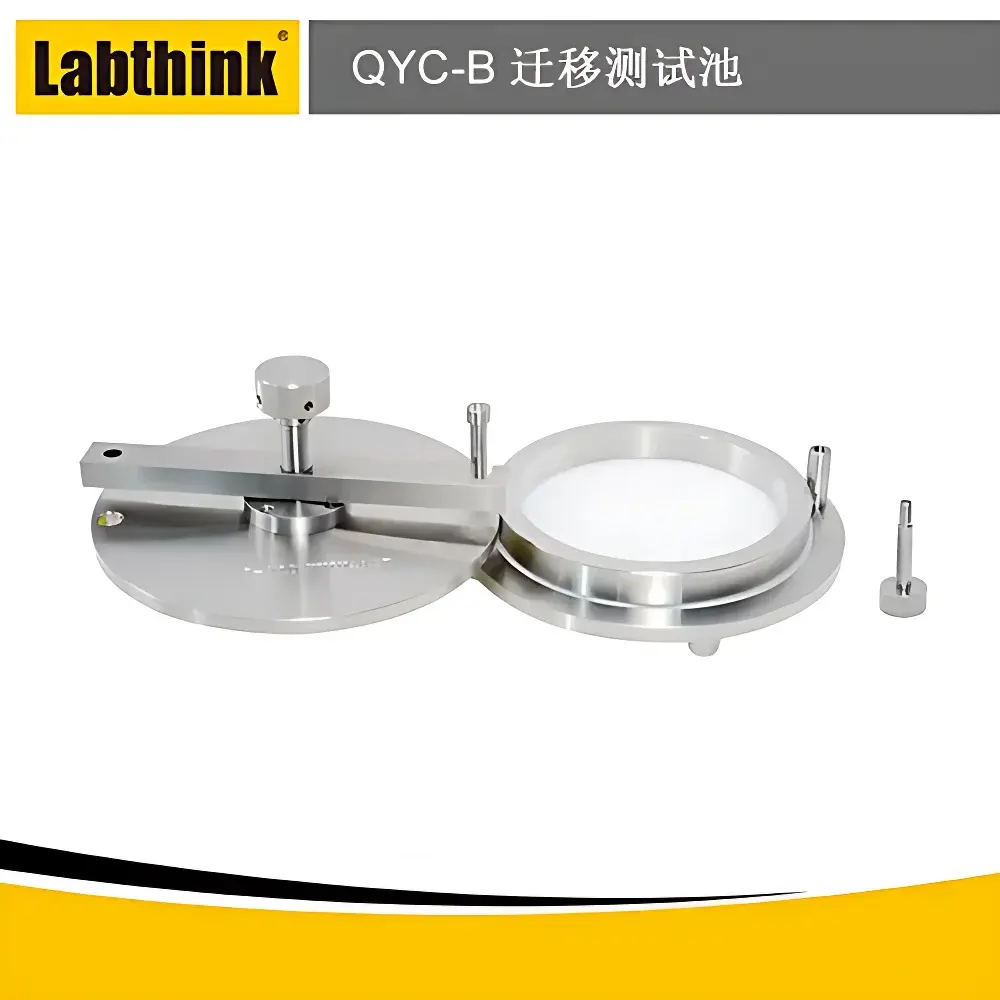
Labthink QYC-B Food Contact Material Migration Test Cell
| Brand | Labthink |
|---|---|
| Model | QYC-B |
| Material | High-grade stainless steel (US grade compliant) |
| Contact Mode | Single-sided |
| Effective Contact Area | 196 cm² (Φ158 mm) |
| Cell Volume | 390 mL |
| Operating Temperature Range | 5 °C to 180 °C |
| Dimensions (L×W×H) | 235 × 225 × 135 mm |
| Net Weight | 8.2 kg |
| Compliance | GB 5009.156–2016, GB 31604.1–2015 |
Overview
The Labthink QYC-B Food Contact Material Migration Test Cell is an engineered pre-treatment device designed specifically for standardized migration testing of food contact materials (FCMs) and articles under controlled thermal and immersion conditions. It operates on the principle of static, single-sided exposure—where a defined surface area of the test specimen is brought into direct, sealed contact with a food simulant (e.g., water, olive oil, 3% acetic acid, or ethanol solutions), while the reverse side remains isolated from any chemical interaction. This configuration replicates real-world packaging use scenarios in which only one surface interfaces with food, ensuring regulatory-relevant exposure geometry. The QYC-B cell is fully aligned with the structural specifications outlined in Appendix B, Figure B.4 (“Migration Test Cell B”) of China’s national standard GB 5009.156–2016, and supports all non-volatile food simulants mandated by GB 31604.1–2015, the General Principles for Migration Testing of Food Contact Materials and Articles.
Key Features
- Precision-engineered single-sided contact geometry with a certified effective test area of 196 cm² (Φ158 mm), enabling reproducible surface exposure across multiple test cycles.
- Robust stainless-steel construction using US-specified alloy grades (e.g., AISI 316 or equivalent), selected for minimal extractable metal content and long-term chemical inertness against acidic, fatty, and aqueous simulants.
- Center-mounted heavy-duty threaded rod mechanism ensures uniform axial compression and leak-tight sealing without gasket deformation or torque variability—critical for maintaining integrity during high-temperature tests up to 180 °C.
- Optimized internal volume of 390 mL provides sufficient simulant headspace and thermal mass stability, reducing evaporation losses and improving temperature homogeneity during incubation.
- Full perimeter sealing isolates the non-tested side of flexible or elastic specimens (e.g., laminated films, coated papers, elastomeric closures), preventing edge wicking or lateral diffusion that could compromise result validity.
Sample Compatibility & Compliance
The QYC-B cell accommodates rigid and semi-rigid flat specimens as well as elastic or deformable food contact materials—including multilayer plastic films, aluminum foil composites, paperboard with barrier coatings, and thermoplastic elastomer seals—provided they can be clamped within the 158 mm diameter aperture without buckling or folding. Its design satisfies the dimensional and functional requirements of GB 5009.156–2016 and GB 31604.1–2015, and is routinely employed in laboratories undergoing CNAS accreditation or preparing for regulatory submissions to the National Center for Food Safety Risk Assessment (CFSA) or provincial CDCs. While not certified to ISO 10993 or FDA 21 CFR §170–189 by default, its geometry and material traceability support method validation per ICH Q5C and GLP-aligned study protocols.
Software & Data Management
The QYC-B is a manually operated, hardware-only test cell and does not integrate embedded electronics or digital controls. As such, it functions as a passive, standards-compliant sample holder within externally managed migration workflows. Users are expected to document test parameters—including simulant type, temperature, duration, and post-extraction analytical methods (e.g., HPLC-UV, GC-MS, ICP-MS)—using laboratory information management systems (LIMS) compliant with ISO/IEC 17025:2017 and audit-ready formats. Its mechanical simplicity ensures full compatibility with GLP and GMP environments where instrument qualification (IQ/OQ/PQ) focuses on dimensional verification, material certification, and seal integrity validation—not firmware or software validation.
Applications
- Pre-treatment of plastic, rubber, and coated packaging materials prior to quantification of overall migration (OML) or specific migration limits (SMLs) of monomers, additives, or degradation products.
- Validation studies supporting compliance claims for novel packaging structures intended for hot-fill, retort, or microwave applications (e.g., pouches exposed at 121 °C for 30 min).
- Interlaboratory comparison trials organized under GB/T 27404–2008 (Guidelines for Proficiency Testing Programs) or APAC MLAR schemes.
- Developmental screening of barrier coatings, adhesives, and ink systems under accelerated aging conditions (e.g., 40 °C/75% RH + simulant immersion).
- Supporting technical dossiers for EFSA or FDA food contact notifications where Chinese-standard-compliant test cells are referenced for bridging data.
FAQ
Does the QYC-B cell require calibration or periodic verification?
Yes—per GB 31604.1–2015 Clause 5.2, users must verify dimensional conformity (diameter, depth, seal surface flatness) annually or after any maintenance affecting compression geometry. A traceable caliper and surface plate are recommended.
Can the QYC-B be used with volatile simulants such as 10% ethanol or 20% ethanol?
No—it is explicitly designed for non-volatile simulants per GB 31604.1–2015. Volatile simulants require vapor-tight dynamic systems (e.g., reflux condensers) not supported by this static cell architecture.
Is third-party certification available for the QYC-B’s stainless-steel composition?
Yes—Labthink provides mill test reports (MTRs) upon request, confirming elemental composition and compliance with ASTM A240/A240M for austenitic stainless steels.
What cleaning protocol is recommended between tests?
Rinse thoroughly with deionized water, followed by sequential solvent rinses (e.g., acetone → isopropanol), then air-dry in a particle-free environment. Avoid chlorine-based cleaners to prevent pitting corrosion.
How is seal integrity validated before each test run?
A pre-test blank trial using distilled water at target temperature for 1 hour is advised; absence of leakage or visible distortion confirms mechanical seal performance.






