
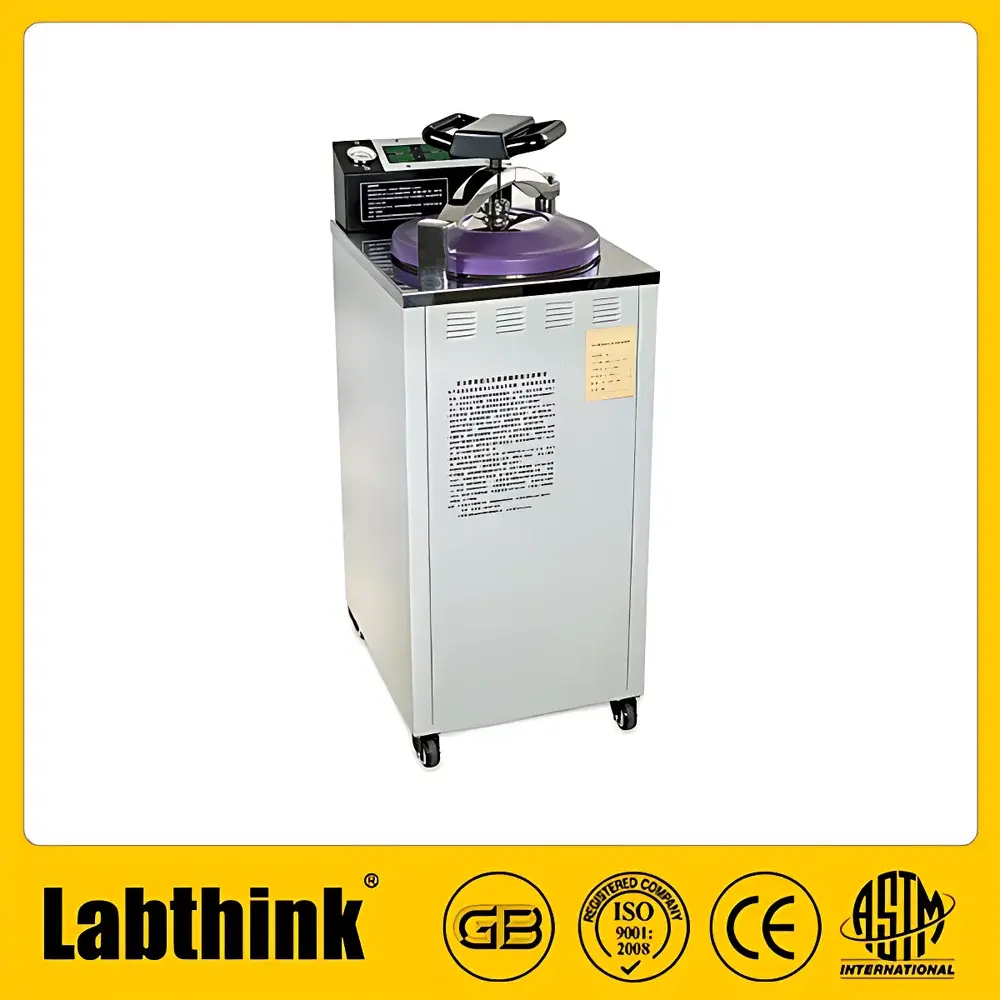
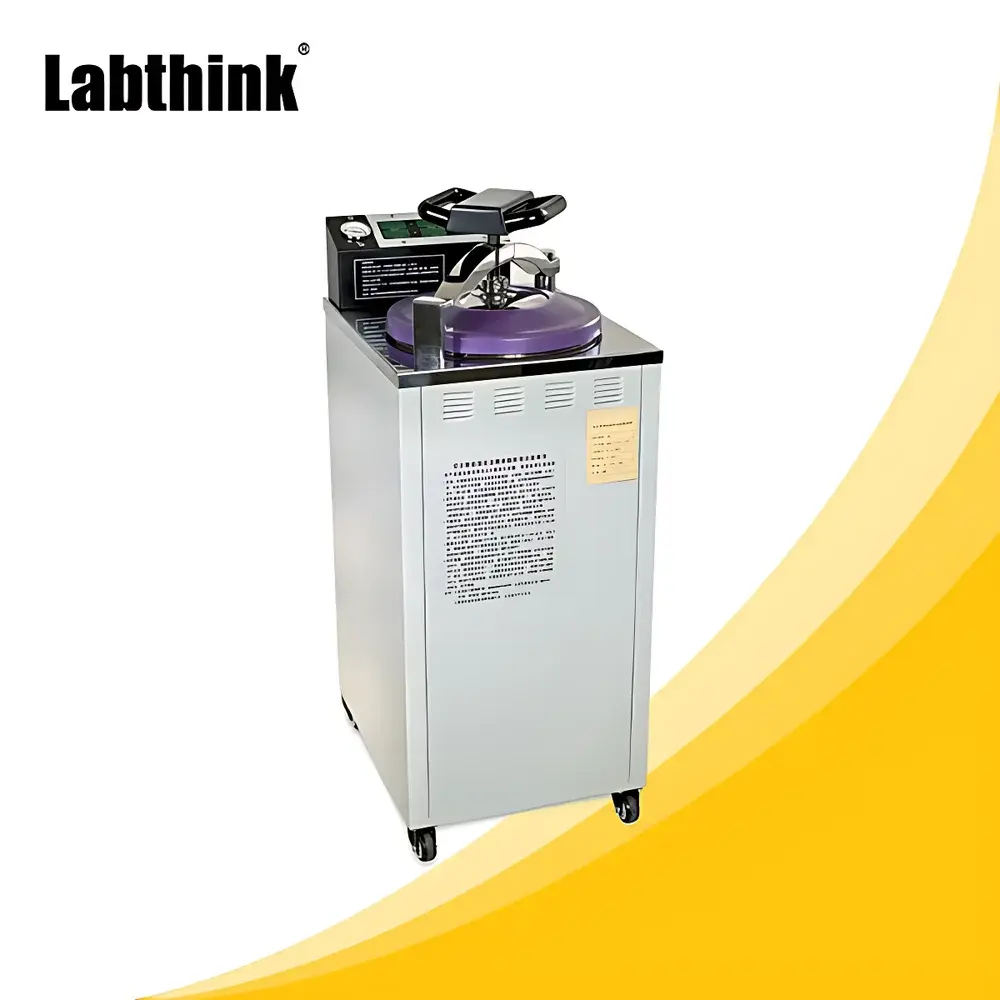
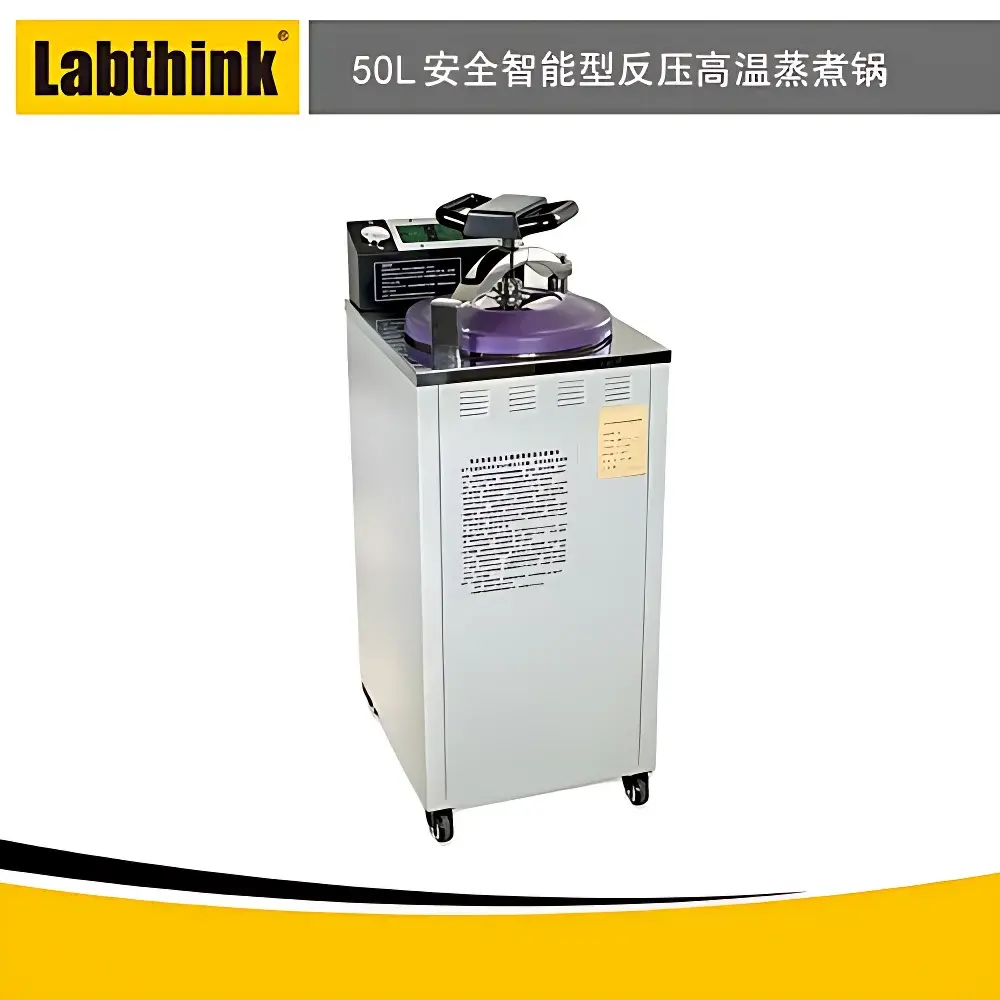
Labthink RCP-50 Reverse Pressure High-Temperature Retort Cooker
| Brand | Labthink |
|---|---|
| Origin | Shandong, China |
| Manufacturer Type | Direct Manufacturer |
| Product Category | Domestic |
| Capacity | 50 L |
| Max Operating Temperature | 10°C above ambient to 135°C |
| Max Working Pressure | 0–0.22 MPa |
| Chamber Volume | 50 L |
| Power Supply | AC 220 V, 50 Hz |
| Rated Power | 2 kW |
| Timer Range | 0–999 min |
| Cooling Method | Forced-air cooling with reverse-pressure compensation |
| Safety Features | Over-temperature, over-pressure, low-water-level, and leakage protection |
| Compliance Documentation | Full calibration records, verification reports, and metrological compliance documentation per Chinese National Verification Regulation JJG 748 |
Overview
The Labthink RCP-50 Reverse Pressure High-Temperature Retort Cooker is a precision-engineered laboratory-scale retort system designed for controlled thermal stability evaluation of flexible packaging materials, adhesives, inks, and laminates under simulated industrial sterilization and retorting conditions. Unlike conventional autoclaves intended primarily for microbiological sterilization, the RCP-50 operates on the principle of saturated steam heating combined with active reverse-pressure control—enabling precise emulation of commercial retort processes where internal package pressure must be dynamically balanced against external chamber pressure to prevent pouch deformation, delamination, or seal failure. Its operating envelope (10°C above ambient to 135°C at up to 0.22 MPa gauge pressure) aligns with ISO 11607-2, ASTM F2054, and GB/T 10004 requirements for retort-resistant packaging validation. The unit employs a microprocessor-based PID temperature and pressure regulation system with real-time feedback loops, ensuring ±0.5°C temperature uniformity across the 50 L stainless-steel chamber and repeatable ramp/hold/cool profiles critical for comparative accelerated aging studies.
Key Features
- Reverse-pressure compensation system: Actively injects compressed air during cooling to maintain internal-to-external pressure equilibrium—eliminating pouch bloating, burst, or seal creep during depressurization.
- Automated safety interlocks: Integrated sensors monitor chamber temperature, pressure, water level, and electrical leakage; automatic shutdown occurs if any parameter exceeds pre-defined thresholds per IEC 61000-6-2 and GB 4793.1.
- Forced-air rapid cooling: Energy-efficient axial fan assembly reduces post-cycle cooldown time by >40% versus passive water-cooled systems—minimizing total cycle duration while preserving thermal gradient integrity.
- Full-cycle programmability: Independent control of heating rate, dwell time at target temperature, cooling onset delay, and reverse-pressure setpoint enables replication of diverse retort profiles (e.g., 121°C/20 min, 135°C/5 min).
- Stainless-steel 316L chamber with polished interior (Ra ≤ 0.8 µm): Ensures corrosion resistance against acidic or saline food simulants and facilitates GLP-compliant cleaning validation.
- Comprehensive metrological traceability: Each unit ships with NIST-traceable calibration certificates for temperature (PT100 sensor), pressure (digital transducer), and timer—fully compliant with JJG 748-2004 verification protocol for retort cookers.
Sample Compatibility & Compliance
The RCP-50 accommodates standard flat and gusseted pouches (up to 300 × 400 mm), roll stock samples mounted on stainless carriers, and multi-layer laminates containing PET/AL/PE, CPP, or metallized films. Its 50 L chamber volume permits batch testing of ≥20 pouches per run under statistically representative conditions. All operational parameters meet the procedural rigor required for regulatory submissions under FDA 21 CFR Part 11 (when paired with Labthink’s optional audit-trail-enabled software), ISO/IEC 17025-accredited laboratories, and EU Regulation (EC) No 1935/2004 compliance dossiers. The system supports validation protocols aligned with USP , ASTM F1980 (accelerated aging), and ISO 11607-2 Annex D (thermal resistance mapping).
Software & Data Management
When integrated with Labthink’s optional WinRCP data acquisition software (v3.2+), the RCP-50 delivers 21 CFR Part 11-compliant electronic records—including user authentication, immutable audit trails, electronic signatures, and encrypted raw data export (CSV, PDF, XML). Real-time graphing displays temperature/pressure/time curves with configurable alarm thresholds; automated report generation includes pass/fail status per test point, deviation analysis, and metadata stamping (operator ID, environmental conditions, calibration status). Data archives are stored locally with optional network backup to NAS or LIMS-compatible servers via TCP/IP.
Applications
- Thermal resistance validation of retortable pouches, stand-up pouches, and vacuum-sealed trays used in ready-to-eat meals, pet food, and infant formula.
- Accelerated shelf-life prediction through Arrhenius-based thermal degradation modeling of barrier layers and adhesive bonds.
- Process qualification of new packaging formats prior to commercial scale-up—reducing risk of field failures due to seal integrity loss or delamination.
- Quality control testing of incoming packaging materials per supplier specifications (e.g., “Must withstand 135°C/15 min without seal rupture”).
- Root-cause analysis of field complaints involving bloating, leaking, or discoloration post-sterilization.
FAQ
What standards does the RCP-50 support for packaging validation?
It meets core requirements of ISO 11607-2, ASTM F2054, GB/T 10004, and JJG 748 for thermal stability and seal integrity assessment.
Is reverse pressure applied only during cooling?
Yes—reverse pressure is dynamically introduced during the cooling phase to match internal vapor pressure decay, preventing mechanical stress on seals.
Can the chamber accommodate irregularly shaped samples?
Standard configuration includes a stainless-steel wire basket; custom fixtures (e.g., tray holders, vertical racks) are available upon request.
Does the system require external compressed air?
No—the integrated oil-free diaphragm compressor supplies reverse-pressure air up to 0.3 MPa, eliminating dependency on facility air lines.
How is temperature uniformity verified within the chamber?
Each unit undergoes thermal mapping per ASTM F1782 using 9-point PT100 probe arrays; validation reports document spatial deviation (±0.5°C max) at 121°C and 135°C setpoints.



