
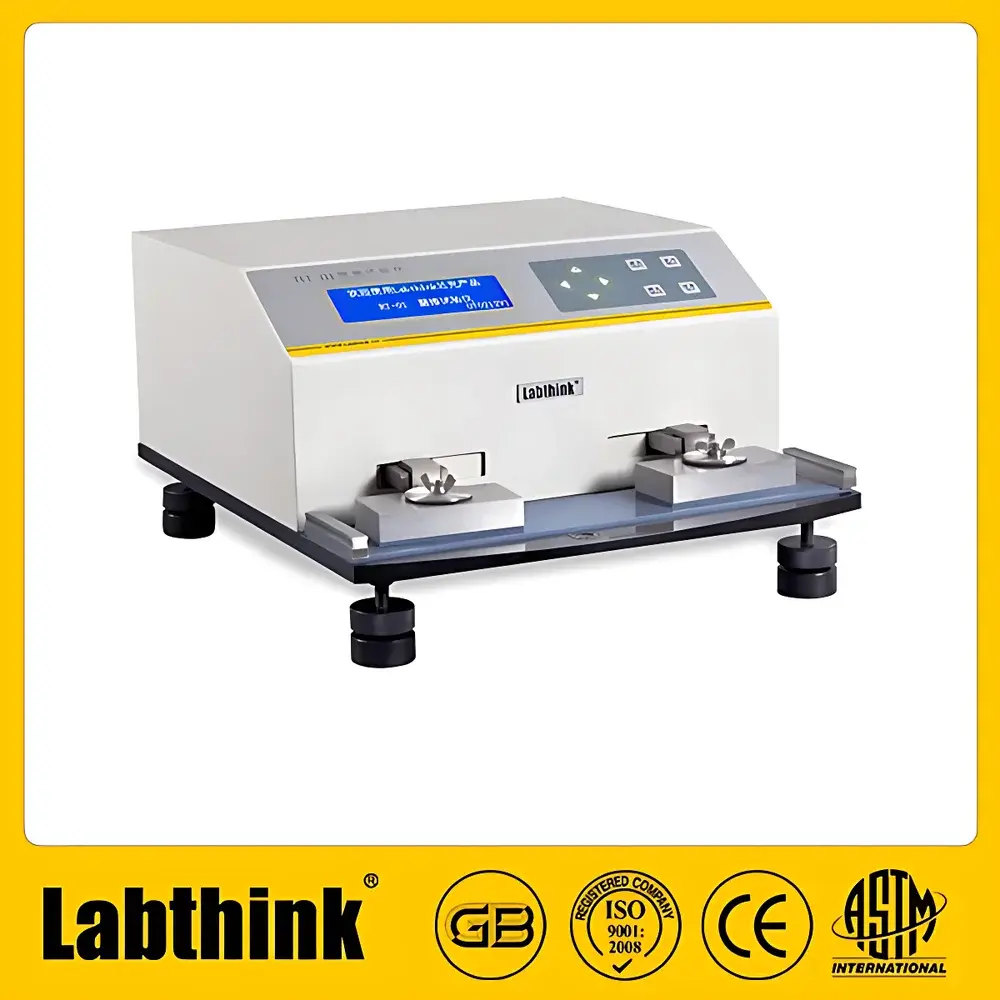
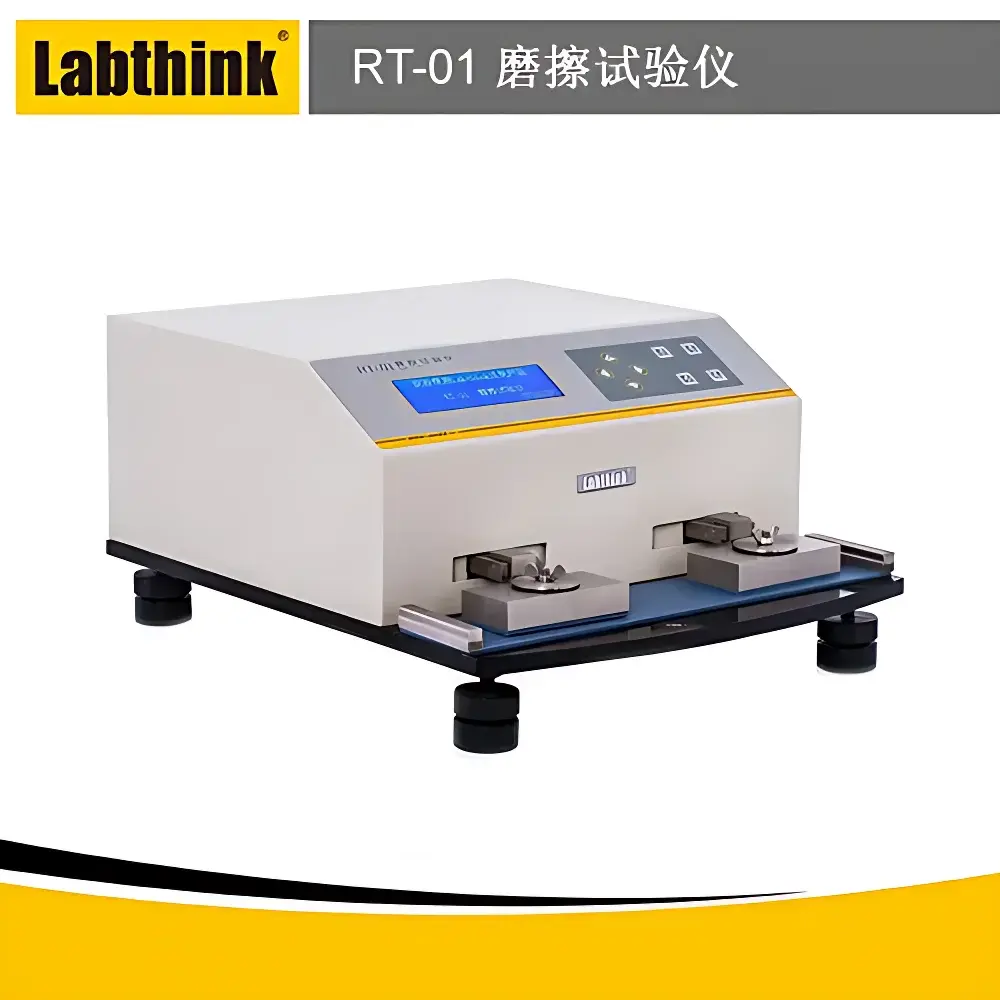
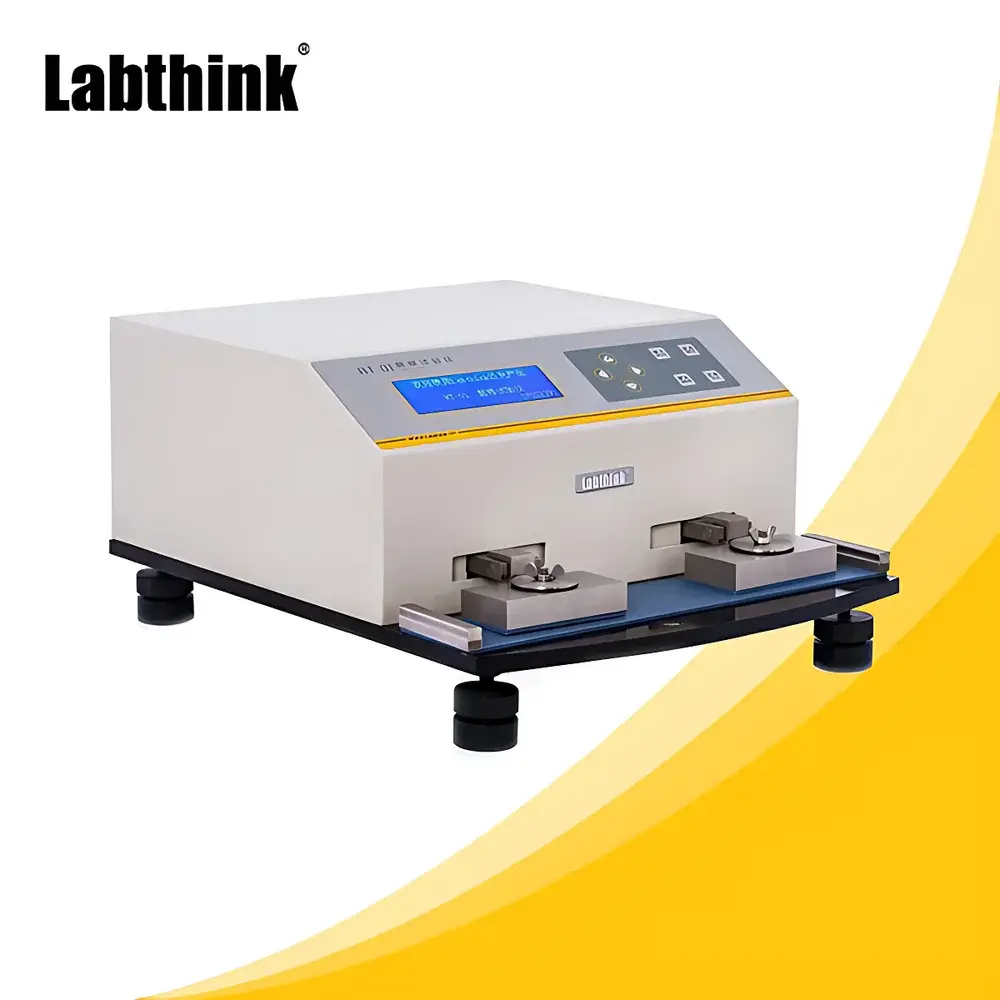
Labthink RT-01 Abrasion Resistance Tester for Printed Ink Layers (ASTM D5264 Compliant)
| Brand | Labthink |
|---|---|
| Model | RT-01 |
| Standard Compliance | ASTM D5264, TAPPI T830 |
| Applied Load | 8.9 N (2 lb) and 17.8 N (4 lb) |
| Oscillation Frequency | 21, 42, 85, 106 cycles per minute (cpm) |
| Motion Profile | Arcuate reciprocating motion |
| Cycle Count Range | 0–999,999 |
| Sample Capacity | 1–2 specimens |
| Power Supply | 220 VAC 50 Hz / 120 VAC 60 Hz |
| Dimensions (L×W×H) | 485 × 390 × 230 mm |
| Net Weight | 40 kg |
| Control System | Microprocessor-based with PVC membrane keypad and LCD display |
| Test Modes | Dry abrasion, wet abrasion, migration, and wet trace |
Overview
The Labthink RT-01 Abrasion Resistance Tester is an engineered solution for quantitative evaluation of surface coating durability—specifically designed for printed ink layers, photopolymer plate emulsions (e.g., PS plates), and functional thin-film coatings on packaging, labels, and graphic media. It operates on the principle of controlled arcuate reciprocating motion under defined normal load and frequency, simulating real-world mechanical wear conditions such as handling, stacking, conveyance, and manual contact. Unlike linear abrasion testers, the RT-01’s arcuate path replicates non-uniform stress distribution observed in practical use, delivering higher correlation with end-use performance. Its design adheres strictly to the test methodology outlined in ASTM D5264 (“Standard Practice for Determining the Abrasion Resistance of Printed Materials by the Sutherland Rub Tester”) and TAPPI T830 (“Rub Resistance of Printing Inks”), ensuring methodological validity for QC labs, R&D departments, and third-party certification bodies engaged in print quality assurance.
Key Features
- Four standardized test modes: dry abrasion, wet abrasion, migration, and wet trace—enabling differentiation between mechanical adhesion loss and solvent-induced pigment displacement.
- Dual independent test stations support concurrent evaluation of identical or dissimilar specimens under identical or divergent parameters (e.g., load, speed, medium), enhancing throughput and comparative analysis efficiency.
- Precisely calibrated normal loads of 8.9 N (2 lb) and 17.8 N (4 lb) are applied via interchangeable stainless-steel weights; optional non-standard loads can be integrated upon request for specialized validation protocols.
- Four selectable oscillation frequencies—21, 42, 85, and 106 cpm—allow simulation of low-intensity handling (e.g., shelf stocking) or high-frequency friction (e.g., automated packaging line contact).
- Microprocessor-based control system with intuitive PVC membrane keypad and backlit LCD interface enables rapid parameter entry, real-time cycle monitoring, and immediate result recall without software dependency.
- Embedded power-loss memory retains set values and accumulated cycle count during unexpected shutdowns; audible buzzer alerts signal test completion or fault conditions, supporting unattended operation within regulated lab environments.
Sample Compatibility & Compliance
The RT-01 accommodates rigid and semi-rigid flat specimens up to 100 mm × 100 mm, including offset-printed paperboard, flexographic films, gravure-laminated pouches, and pre-sensitized aluminum PS plates. Its arcuate stroke length (±12.5 mm) and fixed radius geometry ensure consistent contact geometry across specimen batches—critical for inter-laboratory reproducibility. The instrument meets the mechanical and procedural requirements of ASTM D5264 and TAPPI T830, and its operational documentation supports alignment with ISO/IEC 17025:2017 clause 7.2.2 (method validation) and GLP-compliant recordkeeping when paired with Labthink’s optional audit-trail-capable data logger (sold separately). All load blocks and abradant pads are traceable to NIST-certified mass standards; calibration certificates are provided with initial delivery.
Software & Data Management
While the RT-01 operates autonomously via embedded firmware, it supports optional RS-232 or USB-to-serial connectivity for integration into centralized laboratory information management systems (LIMS). When used with Labthink’s proprietary WinTest Suite (v3.2+), users gain access to automated report generation compliant with FDA 21 CFR Part 11 requirements—including electronic signatures, user-level access control, and immutable audit trails for all test records, parameter changes, and calibration events. Raw cycle counts, elapsed time, and pass/fail status are exportable in CSV or PDF format for inclusion in regulatory submissions (e.g., packaging validation dossiers under ICH Q5C or USP ).
Applications
- Quantifying rub resistance of UV-curable, water-based, and solvent-based inks on folding cartons and flexible packaging substrates.
- Evaluating photoresist integrity on lithographic printing plates after development and baking cycles.
- Assessing scratch resistance of anti-fog or barrier coatings on medical device packaging films.
- Validating ink adhesion stability during accelerated aging studies involving temperature-humidity cycling and mechanical stress coupling.
- Supporting root-cause analysis in print failure investigations—distinguishing between poor ink-substrate bonding, insufficient curing, or inadequate overprint varnish formulation.
FAQ
What abradant materials are recommended for ASTM D5264 testing?
Standardized wool felt pads (ASTM D4382-compliant, 1/4-inch thickness, 20–25 g/m² density) are specified; Labthink supplies certified replacement pads with lot-specific performance verification reports.
Can the RT-01 be used for non-printing applications such as automotive interior trim testing?
Yes—provided specimens meet dimensional and rigidity criteria and test parameters are re-validated per ISO 5470-1 or SAE J2527; application-specific protocol development services are available from Labthink’s Technical Support Group.
Is routine calibration required, and what intervals are recommended?
Load verification using calibrated force gauge should be performed quarterly; motion frequency accuracy should be confirmed annually with optical tachometer; full metrological calibration is advised every 24 months or after major component replacement.
Does the instrument comply with electrical safety standards for international deployment?
Yes—the RT-01 carries CE marking per EN 61010-1:2010 and UL/cUL recognition per UL 61010-1:2012, supporting dual-voltage operation (120 VAC/60 Hz and 220 VAC/50 Hz) with automatic input sensing.






