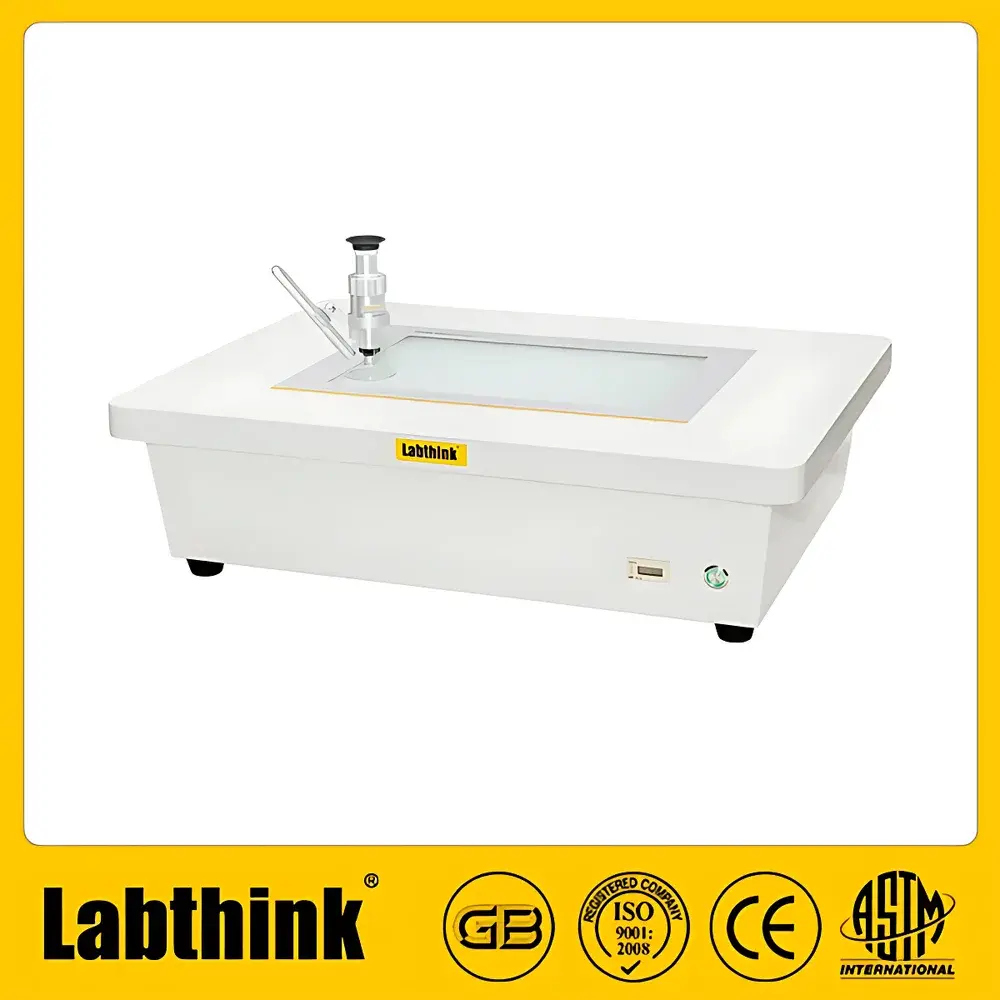
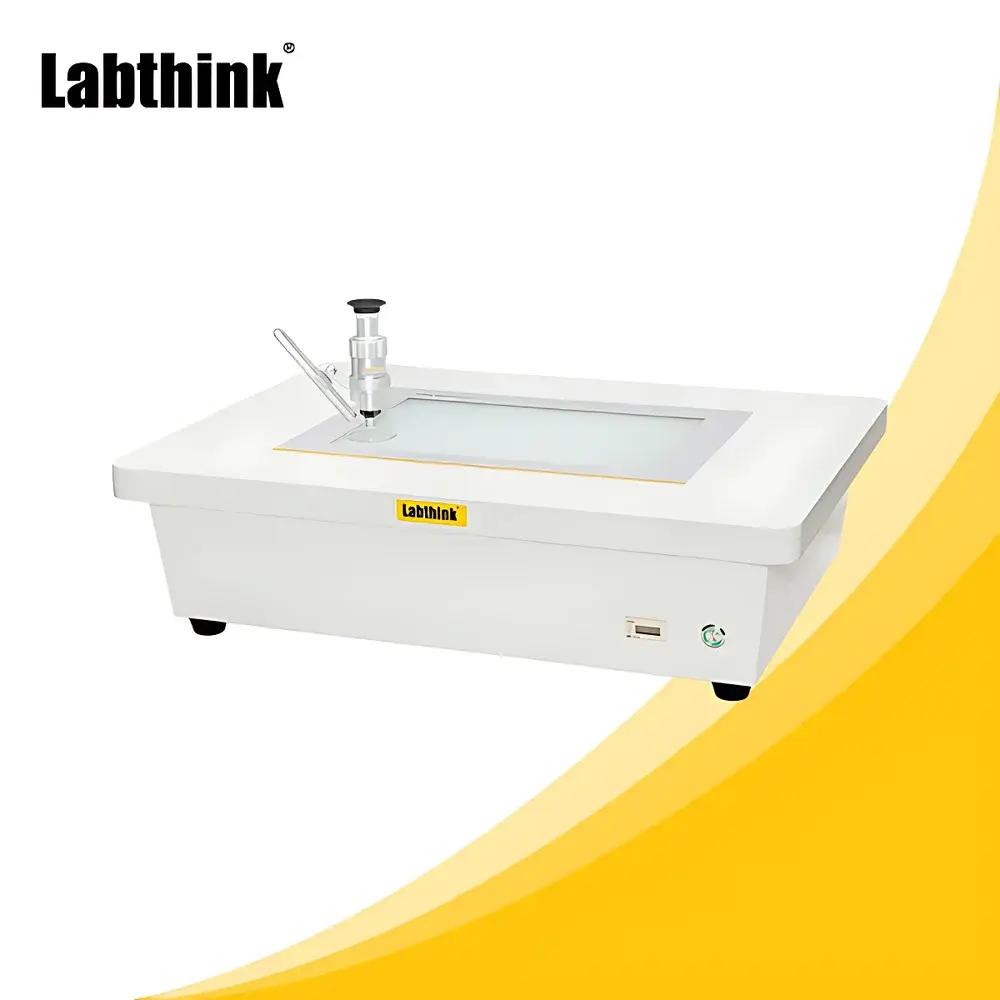
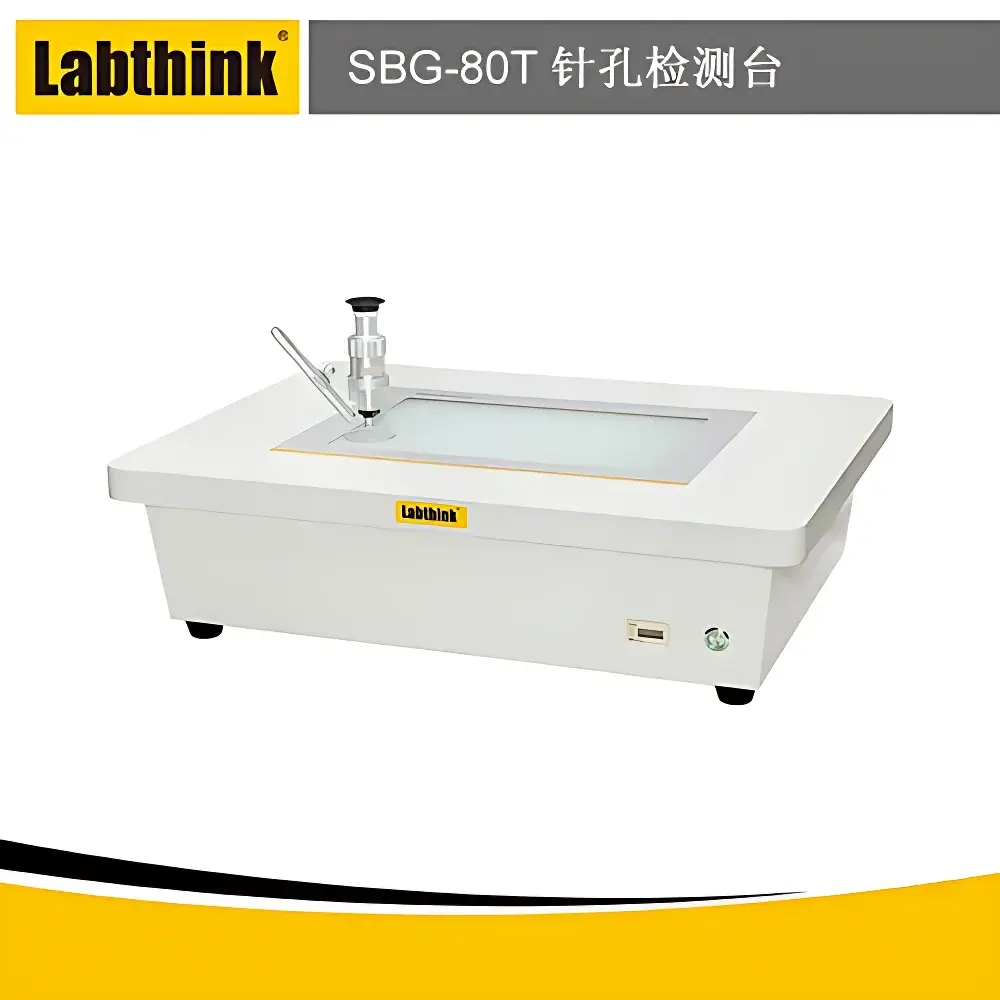
Labthink SBG-80T Pharmaceutical Aluminum Foil Pinhole Inspection Station
| Brand | Labthink |
|---|---|
| Model | SBG-80T |
| Light Source | CIE D65-compliant 6500 K fluorescent lamp (D6500 high-CRI super daylight tube) |
| Viewing Area | 400 × 250 mm |
| Illuminance on Glass Surface | ~1000 lux |
| Ambient Illuminance Requirement | 20–50 lux |
| Magnification | 100× |
| Minimum Scale Division | 0.01 mm |
| Color Rendering Index (CRI) | ≥95 |
| Light Uniformity | ±5% across viewing area |
| Power Supply | 220 VAC, 50 Hz / 120 VAC, 60 Hz |
| Dimensions (L×W×H) | 800 × 600 × 230 mm |
| Net Weight | 10 kg |
| Compliance | GB/T 3198, GB/T 22638.2, YBB 00152002–2015, CY3–91, CIE S 002:2022 (Standard General Lighting Conditions for Visual Assessment) |
Overview
The Labthink SBG-80T Pharmaceutical Aluminum Foil Pinhole Inspection Station is a precision optical assessment system engineered for quantitative evaluation of pinhole defects in pharmaceutical and industrial aluminum foil laminates. It operates on the principle of controlled transmittance visualization: under standardized D65 illuminance conditions, microscopic discontinuities—such as pinholes, micro-cracks, or localized thinning—in aluminum foil substrates become optically resolvable due to differential light transmission. Unlike automated image-analysis systems, the SBG-80T provides a manually operated, human-vision-based inspection platform calibrated to international visual assessment protocols. Its optical architecture integrates a CIE D65-spectrum fluorescent lamp (D6500 type), spectrally stabilized and mounted within a rigid, vibration-damped projection housing. The illumination field achieves ≤±5% spatial uniformity across the full 400 × 250 mm viewing area, ensuring consistent contrast perception and minimizing observer bias during manual enumeration and dimensional estimation.
Key Features
- CIE D65-compliant illumination source with ≥95 CRI and stable 6500 K chromaticity—certified per CIE S 002:2022 and CY3–91 for color-critical visual evaluation
- Optically optimized tempered glass diffuser delivering uniform 1000 lux illumination at the sample plane, traceable to NIST-traceable photometric standards
- Integrated light-hour counter enabling predictive maintenance scheduling and GLP-compliant usage logging
- 100× magnification stereomicroscope with 0.01 mm graduated reticle for direct measurement of pinhole diameter and spatial distribution mapping
- Dual-voltage power supply (220 VAC/50 Hz or 120 VAC/60 Hz) supporting global laboratory deployment without external transformers
- Compact benchtop footprint (800 × 600 × 230 mm) with ergonomic height-adjustable viewing geometry and low-heat emission design for extended operator use
Sample Compatibility & Compliance
The SBG-80T accommodates standard roll-fed or sheet-form aluminum foils up to 0.2 mm thickness, including pharmaceutical-grade cold-forming foils (e.g., OPA/AL/PVC laminates), blister packaging foils, and industrial barrier foils. It supports both single-layer and multi-layer composite structures, provided the aluminum layer is contiguous and non-perforated prior to testing. The instrument conforms to multiple regulatory and industry test standards: GB/T 3198 (Aluminum and aluminum alloy foils for general purpose), GB/T 22638.2 (Test methods for aluminum foil used in pharmaceutical packaging – Part 2: Pinhole test), and YBB 00152002–2015 (National Medical Packaging Standard for aluminum foil used in pharmaceutical blister packs). Its lighting configuration satisfies ASTM E308 and ISO/CIE 11664-2 requirements for standardized visual inspection environments, making it suitable for audit-ready quality control workflows under GMP and ISO 9001 frameworks.
Software & Data Management
The SBG-80T is a hardware-only inspection station with no embedded firmware or digital data capture capability. All measurements are performed manually using the integrated microscope and calibrated reticle; results are recorded externally in laboratory notebooks or LIMS-compatible spreadsheets. This analog design eliminates software validation burdens and ensures compliance with FDA 21 CFR Part 11 where electronic records are not generated. For laboratories requiring traceability, the built-in lamp-hour meter provides auditable runtime data, while the stable D65 spectral output enables cross-laboratory reproducibility without recalibration between sites. Optional documentation packages—including calibration certificates for illuminance uniformity and photometric verification reports—are available upon request to support internal QA audits.
Applications
- Pharmaceutical packaging QC: Routine pinhole screening of blister foil prior to cold-forming or thermoforming operations
- Supplier qualification: Objective verification of incoming aluminum foil batches against YBB 00152002–2015 acceptance criteria (e.g., ≤5 pinholes per 100 cm² for Grade A foil)
- Process troubleshooting: Correlation of pinhole density with rolling mill parameters, annealing profiles, or slitting tension settings
- Stability studies: Monitoring foil integrity after accelerated aging (e.g., 40°C/75% RH for 6 months) per ICH Q1 guidelines
- Regulatory submission support: Generating visual evidence compliant with Annex 1 (EU GMP) and USP container closure integrity expectations
FAQ
What standards does the SBG-80T comply with for pharmaceutical foil testing?
It meets YBB 00152002–2015, GB/T 22638.2, and GB/T 3198, and its lighting fulfills CIE S 002:2022 and CY3–91 requirements for standardized visual assessment.
Is the instrument suitable for ISO 17025-accredited laboratories?
Yes—its photometric performance is verifiable via third-party calibration; optional NIST-traceable illuminance reports support scope accreditation.
Can the SBG-80T be used for non-aluminum flexible packaging materials?
It is validated only for aluminum-containing foils; transparent or semi-transparent films (e.g., PET, CPP) lack sufficient opacity contrast for reliable pinhole detection under this optical method.
Does the system require annual recalibration?
While the lamp output degrades over time, photometric recalibration is recommended every 12 months or after 2000 operating hours—whichever occurs first—to maintain compliance with GB/T 22638.2 Annex A.
Is operator training required for GLP-compliant use?
Yes—users must complete documented competency assessment per SOPs covering viewing distance, ambient light control (20–50 lux), and reticle-based measurement technique to ensure inter-operator reproducibility.