
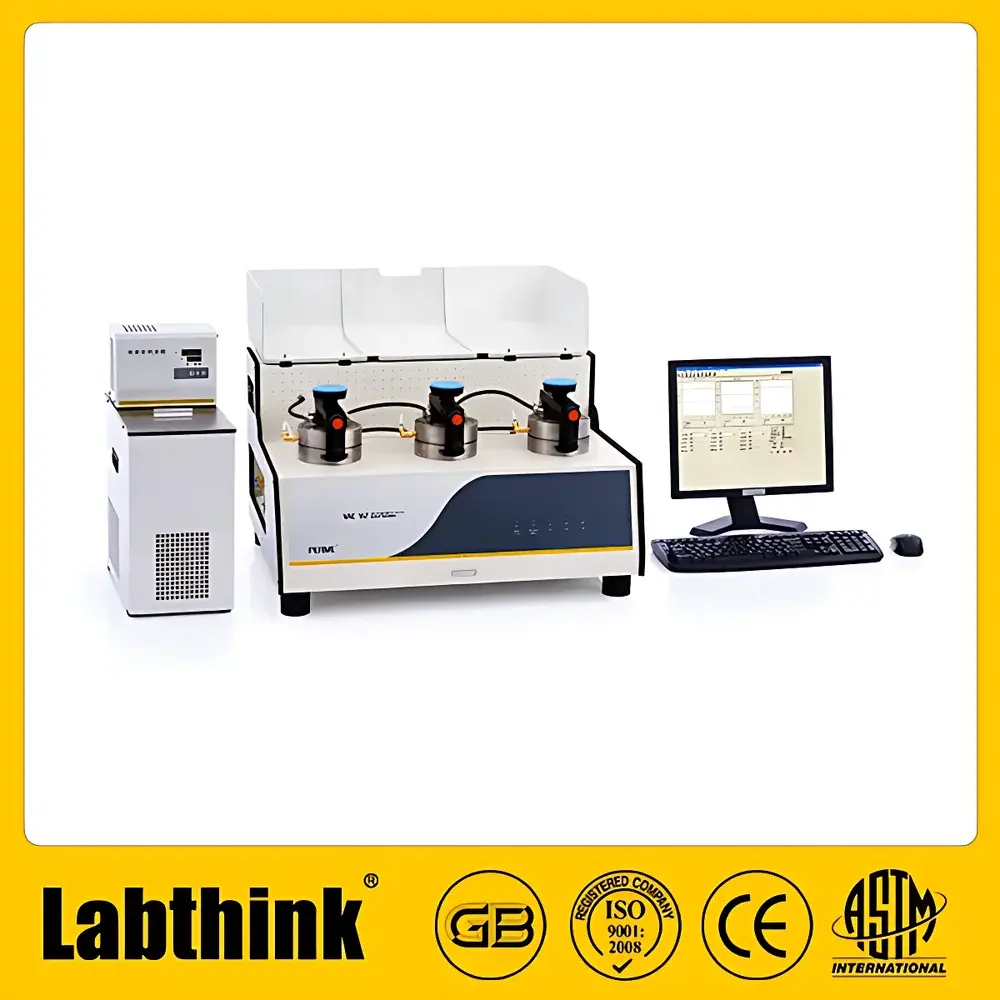
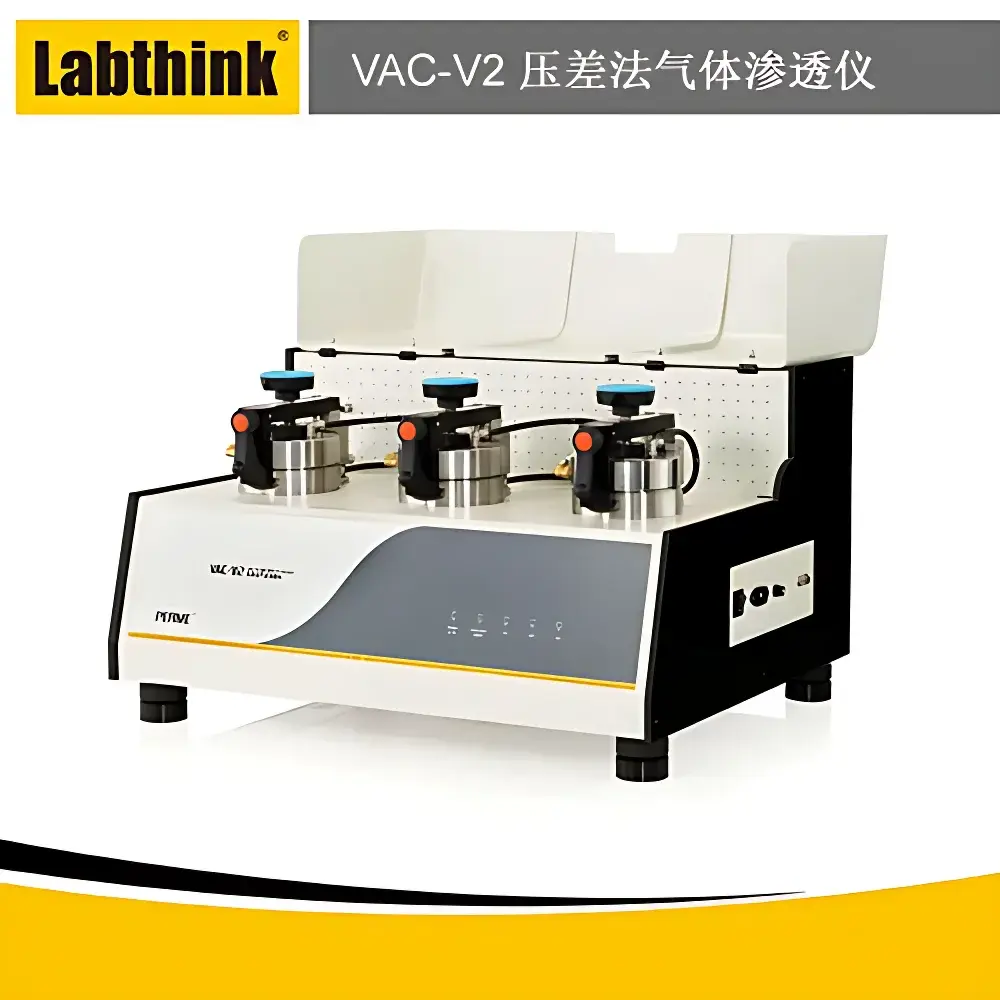
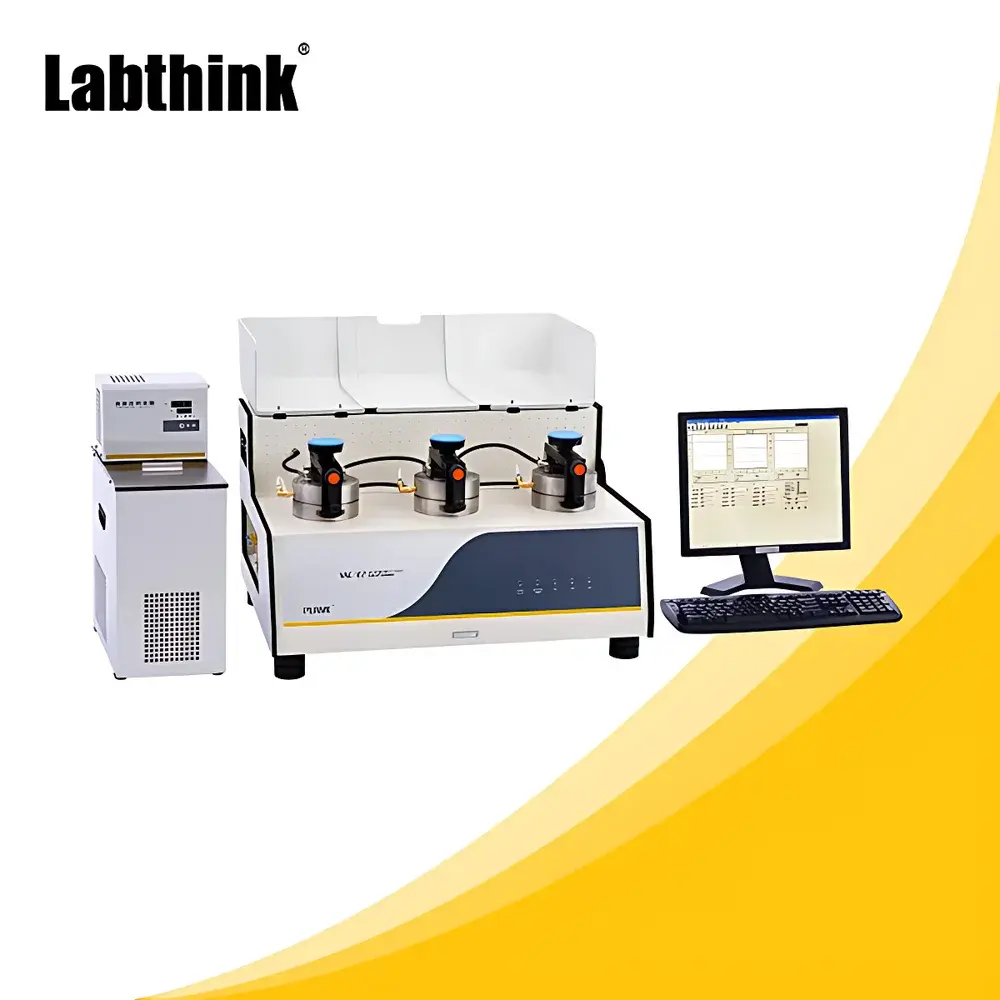
Labthink VAC-V2 Differential Pressure Gas Permeability Tester
| Brand | Labthink |
|---|---|
| Model | VAC-V2 |
| Principle | Differential Pressure Method |
| Test Gases | O₂, N₂, CO₂, H₂ |
| Standard Compliance | GB/T 1038-2000, ASTM D1434, ISO 2556, ISO 15105-1, JIS K7126, YBB00082003 |
| Measurement Range | 0.05–50,000 cm³/m²·24h·0.1MPa (extendable to ≥500,000 cm³/m²·24h·0.1MPa) |
| Test Chambers | 3 independent |
| Vacuum Resolution | 0.1 Pa |
| Vacuum Level in Test Chamber | <20 Pa |
| Temperature Control | 5–95 °C (±0.1 °C) |
| Humidity Control | 0%RH, 2–98.5%RH, 100%RH (optional humidifier) (±1%RH) |
| Specimen Size | Φ97 mm |
| Effective Permeation Area | 38.48 cm² |
| Test Pressure Range | −0.1 to +0.1 MPa |
| Gas Supply Pressure | 0.4–0.6 MPa |
| Data Interface | RS232 |
| Software Integration | Lystem™ Laboratory Data Management System |
Overview
The Labthink VAC-V2 Differential Pressure Gas Permeability Tester is an engineered precision instrument designed for quantitative determination of gas transmission rates—including oxygen, nitrogen, carbon dioxide, and hydrogen—through polymeric packaging materials under controlled temperature and humidity conditions. It operates on the established differential pressure (manometric) principle defined in international standards such as ASTM D1434 and ISO 15105-1:2003. In this method, a specimen is sealed between two chambers: one maintained at atmospheric or elevated gas pressure, the other evacuated to high vacuum. The transient pressure rise in the downstream chamber is measured with high-resolution capacitance manometers, enabling calculation of gas permeability (P), diffusion coefficient (D), and solubility coefficient (S) via Fickian modeling and time-lag analysis. This approach delivers traceable, reproducible results essential for regulatory submissions, shelf-life prediction, and barrier performance validation in cosmetic, pharmaceutical, food, and medical device packaging development.
Key Features
- Three fully independent test chambers enable concurrent evaluation of up to three distinct specimens—either identical replicates for statistical robustness or dissimilar materials for comparative barrier assessment.
- High-stability thermal control system maintains temperature within ±0.1 °C across a broad operational range (5–95 °C), supporting accelerated aging studies and low-temperature barrier characterization.
- Optional integrated humidity control module provides precise RH regulation (2–98.5%RH, ±1%RH), critical for evaluating moisture-sensitive polymers and hygroscopic barrier layers used in cosmetic tubes and laminated sachets.
- Dual-mode test logic—proportional and fuzzy inference algorithms—ensures reliable endpoint detection across diverse permeation kinetics, from ultra-low-barrier metallized films to highly permeable elastomeric gels.
- Expandable measurement range accommodates both ultra-high-permeability materials (e.g., breathable cosmetic film substrates) and ultra-low-permeability structures (e.g., AlOx-coated PET), with extended capability up to ≥500,000 cm³/m²·24h·0.1MPa.
- Compliant vacuum architecture achieves <20 Pa base pressure with 0.1 Pa resolution, minimizing measurement uncertainty in low-flux regimes and ensuring compliance with ISO 2556 sensitivity requirements.
- Modular gas handling design supports safe operation with toxic or flammable gases (e.g., H₂) following factory-approved modifications and installation of certified gas-tight fittings and leak-tested manifolds.
Sample Compatibility & Compliance
The VAC-V2 accepts rigid and flexible planar specimens up to Φ97 mm, covering standard formats for cosmetic packaging components including extruded plastic tubes (HDPE, PP), laminated pouches (PET/AL/PE), aluminum foil composites, and coated paperboard. Its validated methodology meets all major global regulatory and industry standards: GB/T 1038-2000 (China), ASTM D1434 (USA), ISO 2556 and ISO 15105-1 (International), JIS K7126 (Japan), and YBB00082003 (Chinese Pharmacopoeia). Data integrity is reinforced through automated calibration using certified reference films traceable to NIST standards, and full audit trail functionality compliant with FDA 21 CFR Part 11 when deployed with Lystem™ software under GLP/GMP environments.
Software & Data Management
Controlled via Windows-based Lystem™ Laboratory Data Management System, the VAC-V2 executes fully automated test sequences—including vacuum evacuation, gas dosing, real-time pressure logging, and multi-parameter regression fitting. Lystem™ supports raw data export in CSV and PDF formats, customizable report templates aligned with ISO/IEC 17025 documentation requirements, and centralized database synchronization across distributed lab networks. Role-based user access, electronic signatures, and immutable audit trails ensure compliance during internal quality audits or external regulatory inspections. Integration with enterprise QMS platforms is enabled via standardized RS232 communication and optional OPC UA gateway modules.
Applications
- Quantification of O₂ transmission rate (OTR) for air-sensitive cosmetic formulations (e.g., vitamin C serums, retinol creams) packaged in aluminum-plastic laminates or multilayer coextrusions.
- Diffusion coefficient profiling of CO₂ through squeeze-tube seals to assess fragrance retention stability over 24-month shelf life.
- Comparative barrier screening of biodegradable polymer alternatives (PLA, PHA) against conventional PE-based cosmetic sachets under tropical (40 °C/75%RH) storage conditions.
- Validation of plasma-enhanced surface treatments on HDPE tubes to quantify improvement in H₂O vapor and O₂阻隔性能 prior to scale-up production.
- Regulatory dossier preparation for US FDA or EU CPNP submissions requiring documented barrier performance per ISO 11607-1 for primary packaging of sterile cosmetic actives.
FAQ
What gases can be tested on the VAC-V2 besides oxygen?
Nitrogen (N₂), carbon dioxide (CO₂), hydrogen (H₂), and other non-corrosive process gases may be evaluated; testing with reactive or hazardous gases requires hardware modification and safety certification.
Is humidity control built-in or optional?
Humidity generation is an optional add-on module; standard configurations support dry (0%RH) and ambient-pressure testing only.
Can the instrument calculate diffusion and solubility coefficients directly?
Yes—time-lag analysis and dual-chamber pressure modeling allow simultaneous derivation of permeability (P), diffusion (D), and solubility (S) coefficients without external computation.
How many samples can be run simultaneously without operator intervention?
Three independent tests proceed in parallel with full automation, including vacuum cycling, gas introduction, and data acquisition.
Does the system meet FDA 21 CFR Part 11 requirements for electronic records?
When operated with Lystem™ v4.0 or later under configured user roles and audit-trail settings, the system satisfies electronic signature and record retention criteria for regulated laboratories.





