
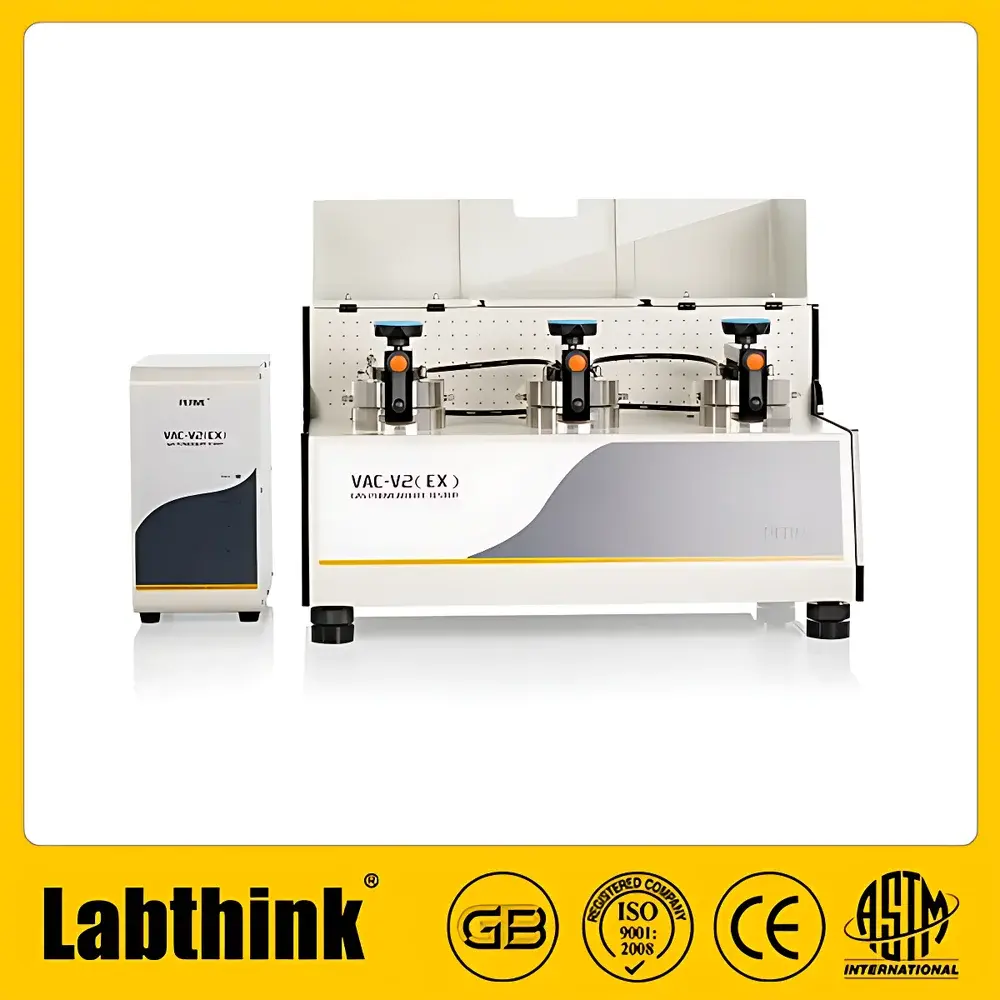
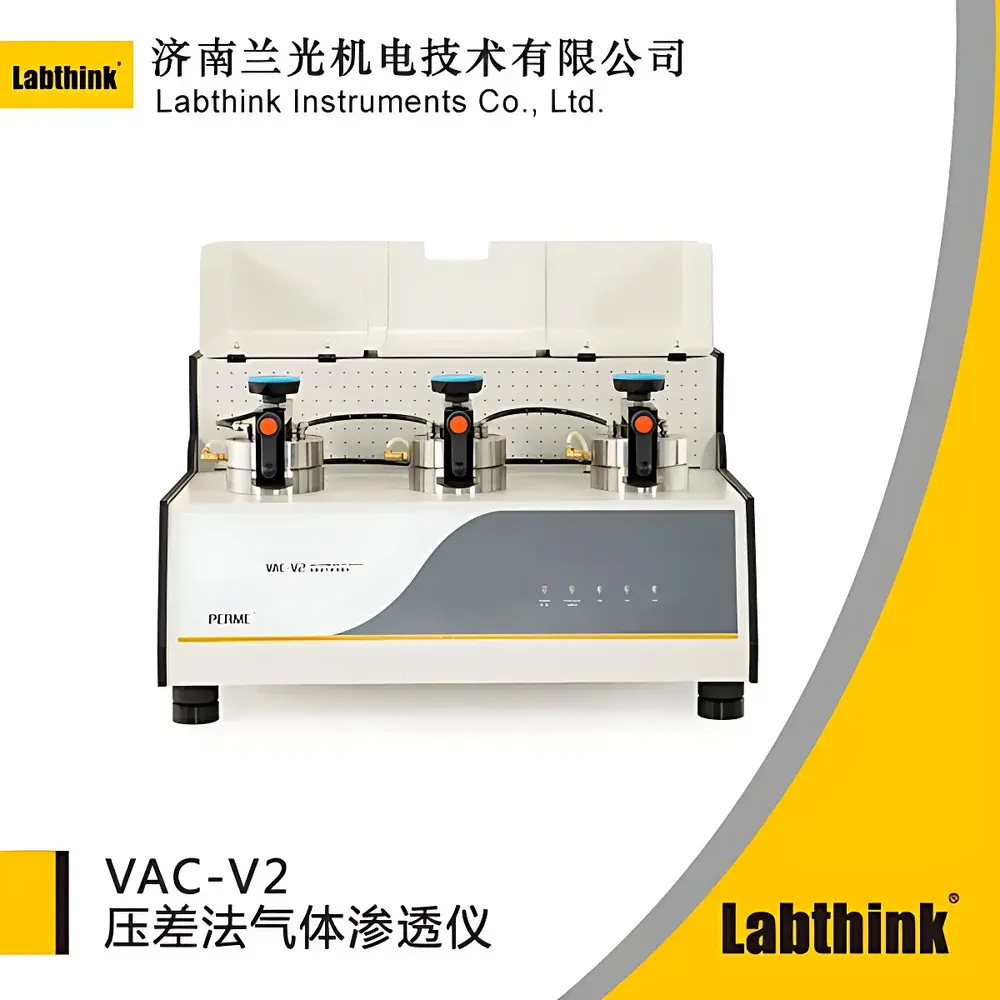
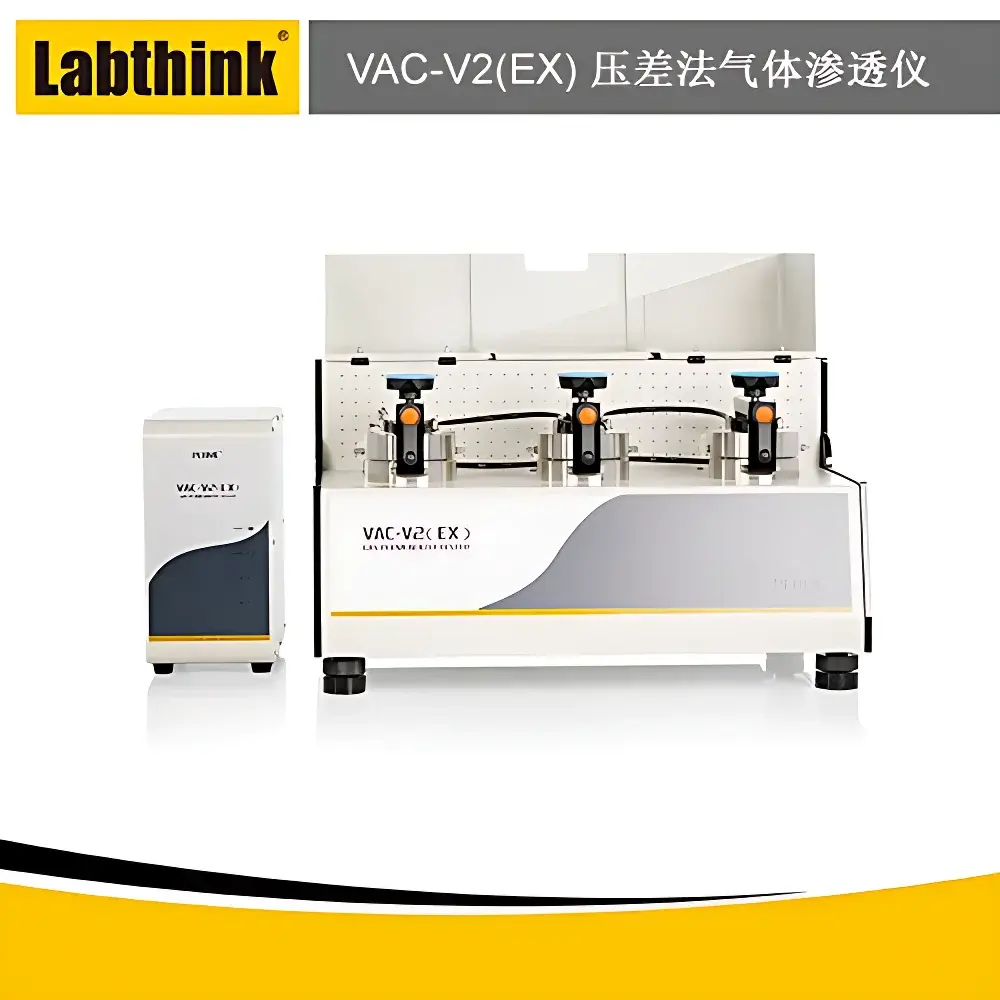
Labthink VAC-V2(EX) ASTM D1434 Differential-Pressure Gas Permeability Analyzer
| Brand | Labthink |
|---|---|
| Model | VAC-V2(EX) |
| Principle | Differential-Pressure (Manometric) Method |
| Standards Compliance | ASTM D1434, ISO 15105-1, ISO 2556, GB/T 1038-2000, JIS K7126-1, YBB 00082003 |
| Test Gases | O₂, N₂, CO₂, H₂, Air, He |
| Temperature Range | 5 °C to 95 °C (±0.1 °C stability) |
| Vacuum Resolution | 0.1 Pa |
| Test Chamber Vacuum Level | ≤10 Pa |
| Permeation Area | 38.48 cm² |
| Sample Diameter | Φ97 mm |
| Gas Pressure Range | 10–200 kPa |
| Extended Permeability Range | up to 500,000 cm³/m²·24h·0.1MPa |
Overview
The Labthink VAC-V2(EX) is a differential-pressure (manometric) gas permeability analyzer engineered for precise, traceable, and safe measurement of gas transmission rates (GTR), permeability coefficients (P), diffusion coefficients (D), and solubility coefficients (S) in flexible barrier materials. It operates on the fundamental principle of Fick’s first law of diffusion under a controlled transmembrane pressure gradient: a pre-conditioned specimen is sealed between two isolated chambers; the low-pressure side is evacuated to ≤10 Pa (with 0.1 Pa resolution), while the high-pressure side is pressurized with test gas (10–200 kPa). The resulting gas flux—quantified via real-time pressure rise in the low-pressure chamber—is mathematically resolved into P, D, and S using standardized thermodynamic and kinetic models defined in ASTM D1434 and ISO 15105-1. Its TÜV-certified explosion-proof architecture enables compliant testing of flammable (e.g., H₂, CH₄) and toxic gases (e.g., NH₃, Cl₂), distinguishing it from conventional permeability analyzers restricted to inert gases only.
Key Features
- Triple independent test cavities—enabling concurrent, statistically independent measurements of three identical or dissimilar specimens under identical environmental conditions, improving throughput and inter-sample comparability.
- Modular control architecture—fully separated test host and control unit eliminate electrical hazards in the gas-handling zone, fulfilling IEC 60079-0 and ATEX Zone 1 safety requirements for explosive atmospheres.
- High-stability liquid-circulated temperature control (5 °C–95 °C, ±0.1 °C uniformity)—supports Arrhenius-based activation energy analysis and accelerated aging simulations per ISO 2556 Annex B.
- Dual-mode process logic—proportional control for rapid equilibration and fuzzy logic for adaptive endpoint detection—ensures robust convergence across ultra-low and ultra-high permeability regimes (0.05–500,000 cm³/m²·24h·0.1MPa).
- Integrated data traceability—automated audit trail records operator ID, timestamp, calibration event, environmental logs, and raw pressure vs. time curves in accordance with FDA 21 CFR Part 11 and GLP/GMP documentation standards.
- Expandable hardware architecture—modular vacuum manifold and pressure sensor bays allow future integration of additional gas lines or high-range transducers without firmware modification.
Sample Compatibility & Compliance
The VAC-V2(EX) accommodates flat, non-porous, and semi-crystalline polymeric specimens with diameters up to Φ97 mm and thicknesses ≤3 mm—including monolayer films (LDPE, PET, PA), coextrusions (EVOH, PVDC), metallized substrates (AlOx, SiOx, Al foil composites), biodegradable matrices (PLA, PHA, starch blends), elastomeric sheets (EPDM, silicone rubber), and reinforced laminates (glass fiber/polyimide, fluoropolymer-coated fabrics). All test protocols align with regulatory frameworks governing packaging integrity: USP for pharmaceutical primary packaging, ASTM F1927 for food contact materials, and MIL-STD-810G Method 511.5 for aerospace inflatable structures. Certificate of Conformance includes full metrological validation against NIST-traceable reference membranes (O₂, CO₂) per ISO 17025-accredited procedures.
Software & Data Management
Lystem™ v4.0 software provides ISO/IEC 17025-compliant instrument control, real-time curve fitting (nonlinear regression of pressure-time data), and automated parameter derivation (P, D, S) with uncertainty propagation per GUM (JCGM 100:2008). Raw datasets are stored in encrypted SQLite databases with SHA-256 hash verification; export formats include CSV, PDF reports (with digital signature), and XML for LIMS integration. Role-based access control (RBAC) enforces SOP-driven workflows: calibration lockout, electronic signatures for report approval, and immutable audit trails meeting FDA 21 CFR Part 11 Subpart B requirements. Optional cloud synchronization enables cross-site method harmonization and centralized QA review.
Applications
- Pharmaceutical packaging—quantifying O₂ ingress into blister packs (PVC/PVDC) and moisture vapor transmission in cold-chain pouches (Alu-Alu laminates).
- Food packaging R&D—evaluating CO₂ retention in modified atmosphere packaging (MAP) films and ethylene barrier performance in produce liners.
- Aerospace material qualification—measuring He leakage rates in zero-pressure balloon envelopes and hypergolic propellant containment films.
- Automotive component validation—assessing fuel vapor permeation through multilayer fuel tank liners (PA6/SEBS/EVOH).
- Sustainable packaging development—comparing degradation-correlated permeability shifts in compostable films under controlled humidity/temperature ramps.
- Medical device barrier validation—testing helium leak rates in sterilization pouches per ISO 11607-1 and ASTM F1929.
FAQ
What safety certifications does the VAC-V2(EX) hold for hazardous gas testing?
The system carries TÜV Rheinland certification to IEC 60079-0 (Explosive Atmospheres – General Requirements) and IEC 60079-15 (Type “n” Protection), enabling safe operation with H₂, CH₄, and other Group IIA/IIB gases in laboratory environments.
Can the instrument comply with FDA 21 CFR Part 11 for electronic records?
Yes—Lystem™ software implements full Part 11 compliance: electronic signatures with identity verification, audit trail archiving, and record retention controls validated per IQ/OQ protocols.
Is temperature-controlled testing possible at sub-ambient conditions?
No—the integrated liquid-circulated thermostat supports 5 °C minimum; for sub-zero studies, external cryostat integration requires custom engineering consultation.
How is calibration traceability maintained?
Each system ships with NIST-traceable O₂ and CO₂ reference membranes; calibration certificates document uncertainty budgets, measurement repeatability (≤1.2% RSD), and drift monitoring over 12-month intervals.
Does the triple-cavity design support different gases in parallel tests?
No—gas supply is manifold-shared; simultaneous multi-gas testing requires sequential cavity purging and reconditioning, though cross-contamination risk is mitigated by automated vacuum bake-out cycles.





