
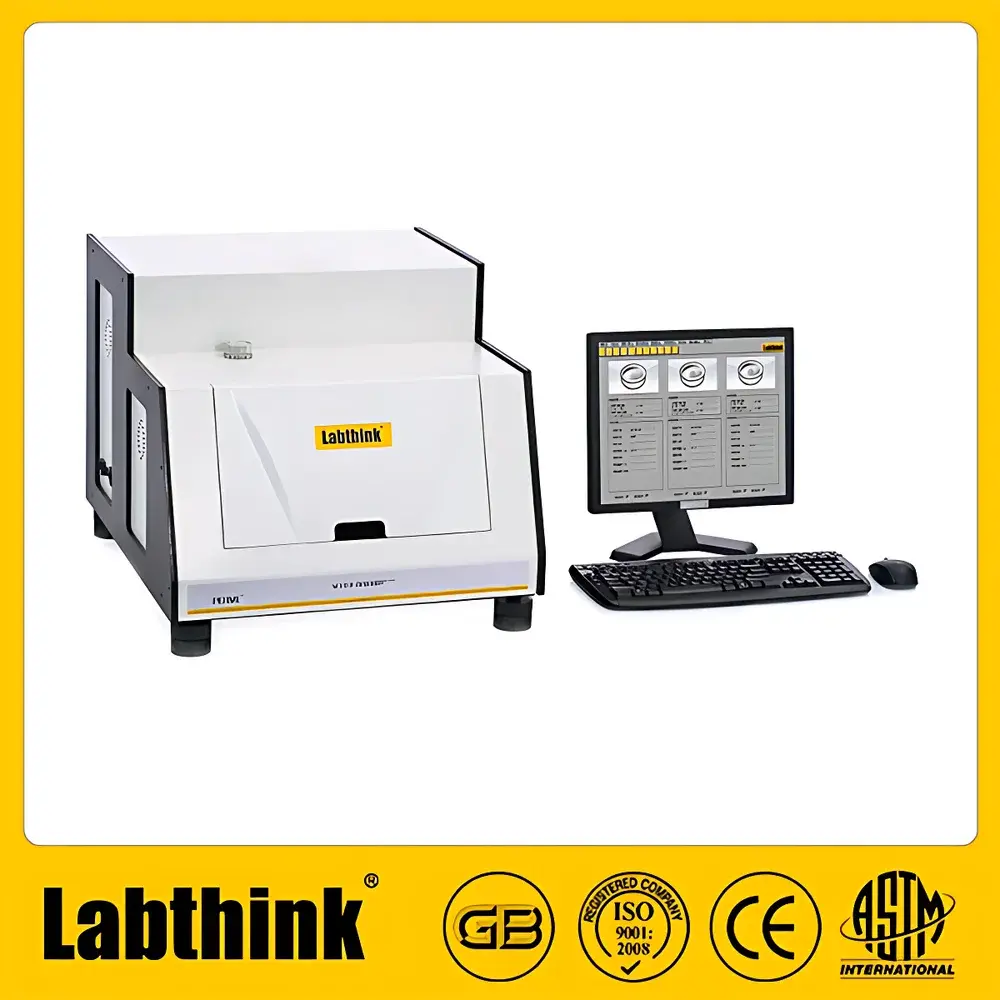
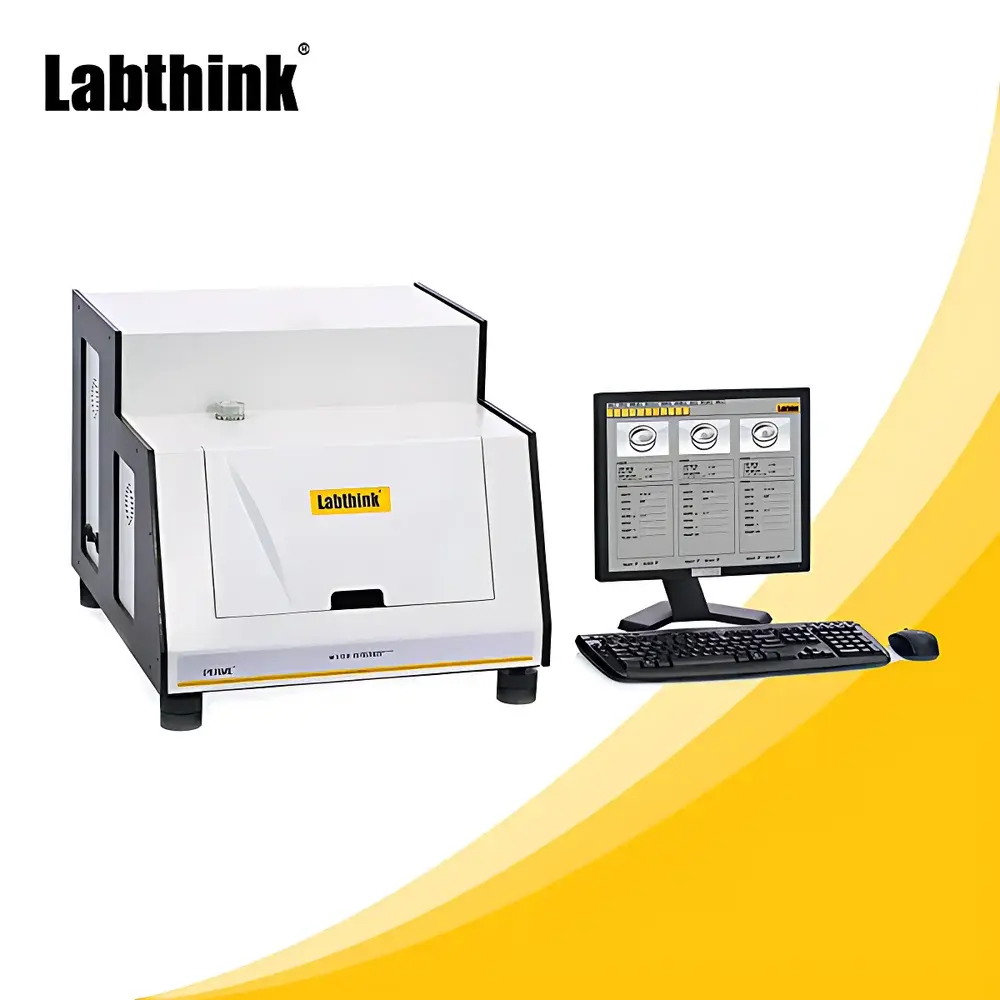
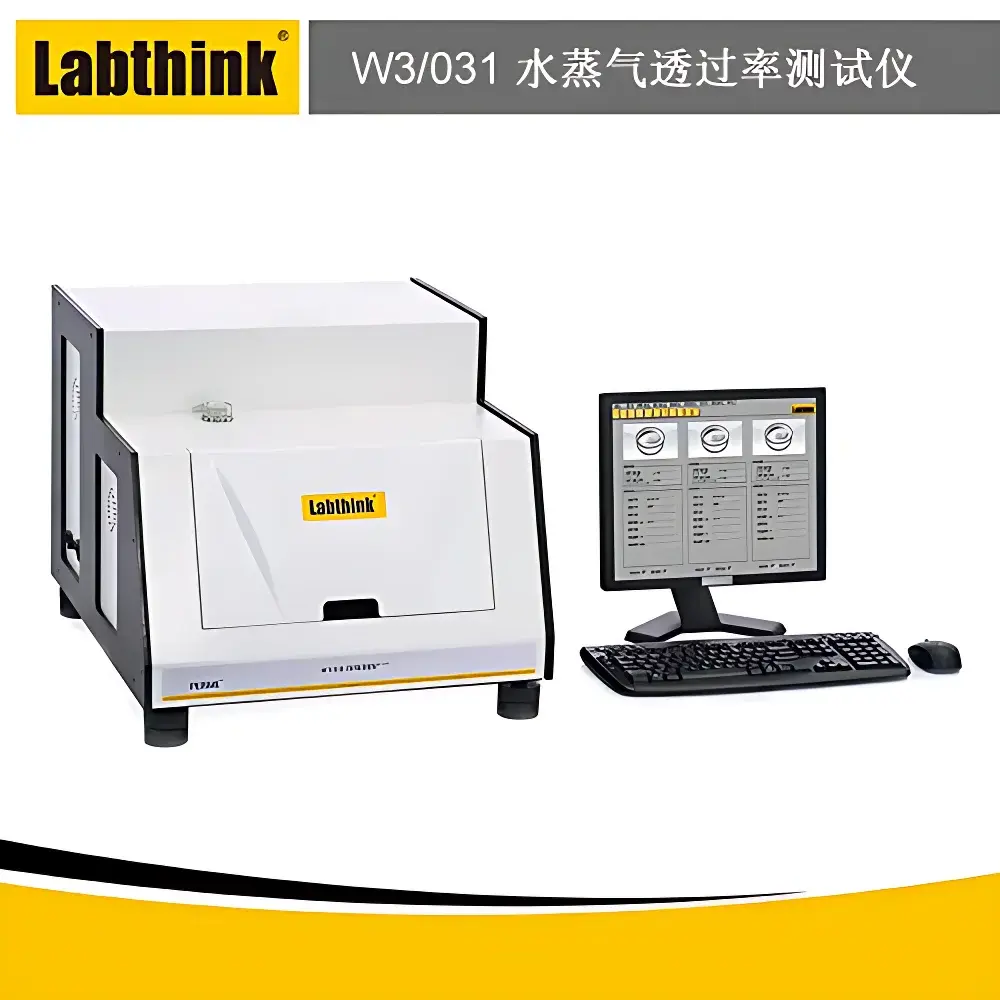
Labthink W3/031-PERME Gravimetric Water Vapor Transmission Rate (WVTR) Tester
| Brand | Labthink |
|---|---|
| Model | W3/031-PERME |
| Origin | Shandong, China |
| Manufacturer | Labthink Instruments Co., Ltd. |
| Type | Gravimetric Cup Method WVTR Tester |
| Test Range | 0.1–10,000 g/m²·24h |
| Sample Capacity | 1–3 independent cups |
| Resolution | 0.0001 g |
| Temperature Control | 15–55 °C (±0.1 °C) |
| Humidity Control | 10–98 %RH (±1 %RH) |
| Test Area | 33 cm² |
| Sample Thickness | ≤3 mm |
| Sample Diameter | Φ74 mm |
| Chamber Volume | 27 L |
| Air Supply | 0.6 MPa, Φ4 mm polyurethane tubing |
| Power | 220 VAC 50 Hz / 120 VAC 60 Hz |
| Net Weight | 83 kg |
Overview
The Labthink W3/031-PERME Gravimetric Water Vapor Transmission Rate (WVTR) Tester is a precision-engineered instrument designed for quantitative determination of water vapor permeation through flexible packaging materials—including plastic films, laminates, coated papers, and aluminum foil composites—under controlled temperature and humidity conditions. It operates on the gravimetric cup method (also known as the desiccant or moisture cup method), in accordance with internationally recognized standards such as ASTM E96, ISO 2528, GB/T 1037, and JIS Z0208. In this method, a conditioned test specimen is sealed over a cup containing desiccant (e.g., anhydrous calcium chloride) or water, establishing a defined vapor pressure gradient across the sample. The change in mass of the cup assembly is measured at regular intervals using a high-resolution analytical balance integrated into the system. From these time-dependent mass measurements—and under strict environmental control—the instrument calculates the steady-state water vapor transmission rate (WVTR) in units of g/m²·24h, along with related parameters including permeability coefficient and diffusion coefficient when material thickness and driving force are specified.
Key Features
- Triple independent test stations: Three sealed permeation cups operate simultaneously yet autonomously, enabling parallel testing of up to three specimens under identical or individually configured environmental conditions—significantly improving throughput without compromising data integrity.
- Precision mechanical architecture: Incorporates Labthink’s proprietary cup-loading mechanism and vibration-dampened weighing platform, minimizing mechanical drift and ensuring long-term stability of mass measurements (0.0001 g resolution).
- Embedded computing platform: Replaces legacy microcontroller-based controllers with a real-time Linux-based embedded computer system, delivering deterministic response times, robust multitasking capability, and seamless firmware upgradability.
- Automated environmental control: Dual-zone climate chamber maintains precise, uniform temperature (±0.1 °C) and relative humidity (±1 %RH) across all cup positions via PID-regulated heating/cooling and saturated salt/water vapor generation systems.
- Integrated gas management: Onboard air drying and filtration module ensures consistent, particle- and moisture-free purge gas supply; optional compressed air source integration supports continuous low-velocity sweep (0.5–2.5 m/s) across cup surfaces to minimize boundary layer resistance.
Sample Compatibility & Compliance
The W3/031-PERME accommodates standard circular specimens (Φ74 mm) up to 3 mm thick, suitable for monolayer polymers (e.g., LDPE, PET, PP), coextruded structures, metallized films, and pharmaceutical blister lidding materials. Custom fixtures support non-standard geometries upon request. All operational modes comply with Good Laboratory Practice (GLP) requirements, including full audit trail logging of calibration events, environmental setpoints, user actions, and raw mass/time datasets. Instrument validation documentation aligns with ASTM E96 Annex A1 (gravimetric procedure verification), ISO/IEC 17025 clause 5.5.2 (equipment suitability), and FDA 21 CFR Part 11 readiness when paired with LystemTM laboratory data management software.
Software & Data Management
Control and analysis are executed via Labthink’s proprietary WinWVTR software—a Windows-native application featuring intuitive workflow navigation, real-time mass trend visualization, automatic endpoint detection, and customizable report templates compliant with ISO 15142 and USP . Raw data export is supported in CSV, XML, and PDF formats, preserving metadata such as operator ID, calibration certificate numbers, and environmental logs. When deployed within a local area network, the instrument natively integrates with LystemTM—a centralized, role-based laboratory information management system (LIMS) that enforces electronic signatures, version-controlled SOPs, automated QC flagging, and cross-instrument data correlation for multi-parameter packaging qualification (e.g., OTR + WVTR + seal strength).
Applications
- Quality assurance of food packaging films for shelf-life modeling and barrier performance certification.
- Regulatory submission support for pharmaceutical primary packaging (e.g., PTP blisters, sachets, cold-form foil) per YBB00092003 and ICH Q5C.
- R&D evaluation of novel biodegradable polymers, nanocomposite coatings, and vapor-deposited barrier layers.
- Supplier qualification and incoming inspection of industrial protective wraps and agricultural mulch films.
- Stability studies under accelerated aging conditions (e.g., 40 °C / 75 %RH per ICH Q1A).
FAQ
What standards does the W3/031-PERME support for WVTR testing?
ASTM E96 (Procedure A & B), ASTM D1653, ISO 2528, GB/T 1037, GB/T 16928, TAPPI T464, DIN 53122-1, JIS Z0208, and YBB00092003.
Can the instrument test samples thicker than 3 mm?
Standard configuration supports ≤3 mm; custom cup depth extensions and clamping fixtures are available for thicker rigid substrates upon technical review.
Is external compressed air required for operation?
Yes—an external clean, dry air supply at 0.6 MPa is mandatory for purge gas delivery; optional integrated oil-free air compressor kits are available as accessories.
How is calibration traceability maintained?
The system includes NIST-traceable stainless-steel reference weights (±0.0001 g uncertainty); annual third-party calibration services include balance linearity, temperature/humidity sensor verification, and cup seal integrity testing.
Does the software support 21 CFR Part 11 compliance?
Yes—when used with LystemTM v3.2+, the system provides electronic signature enforcement, audit trail archiving, and role-based access control meeting FDA requirements for regulated environments.






