
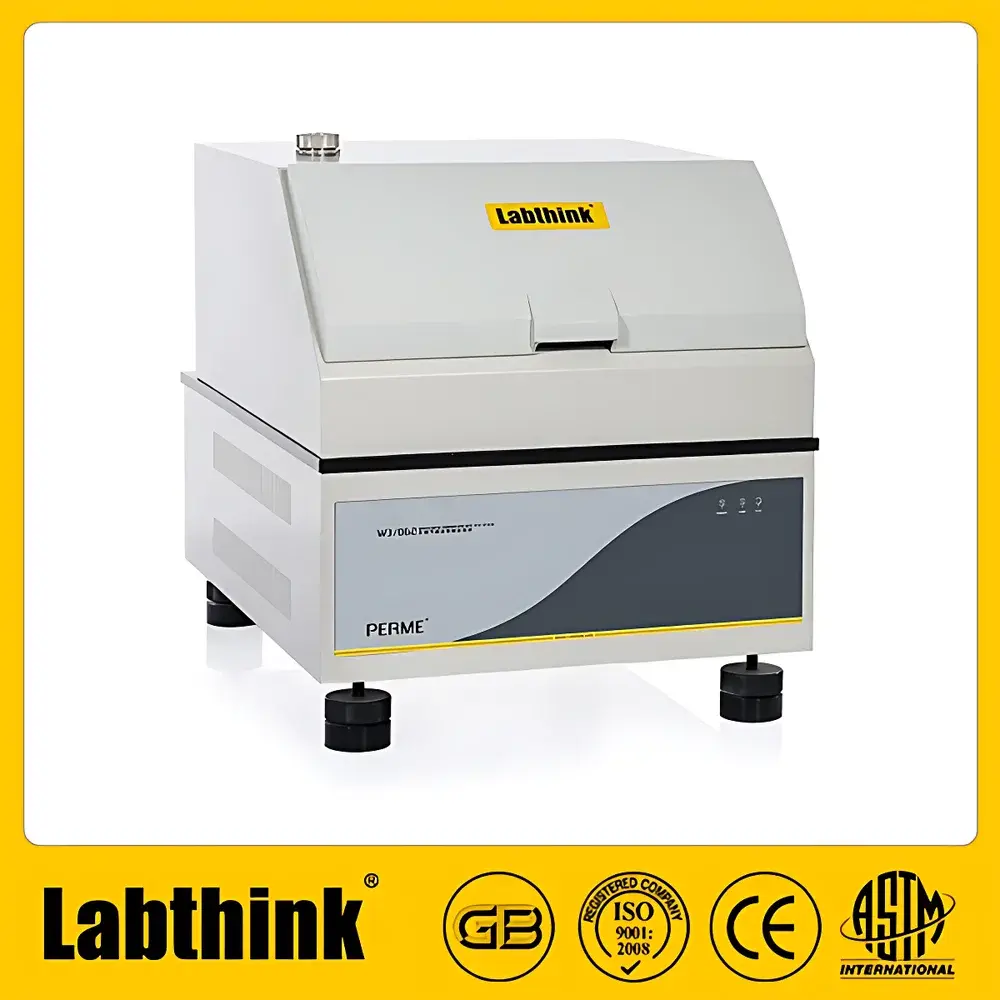
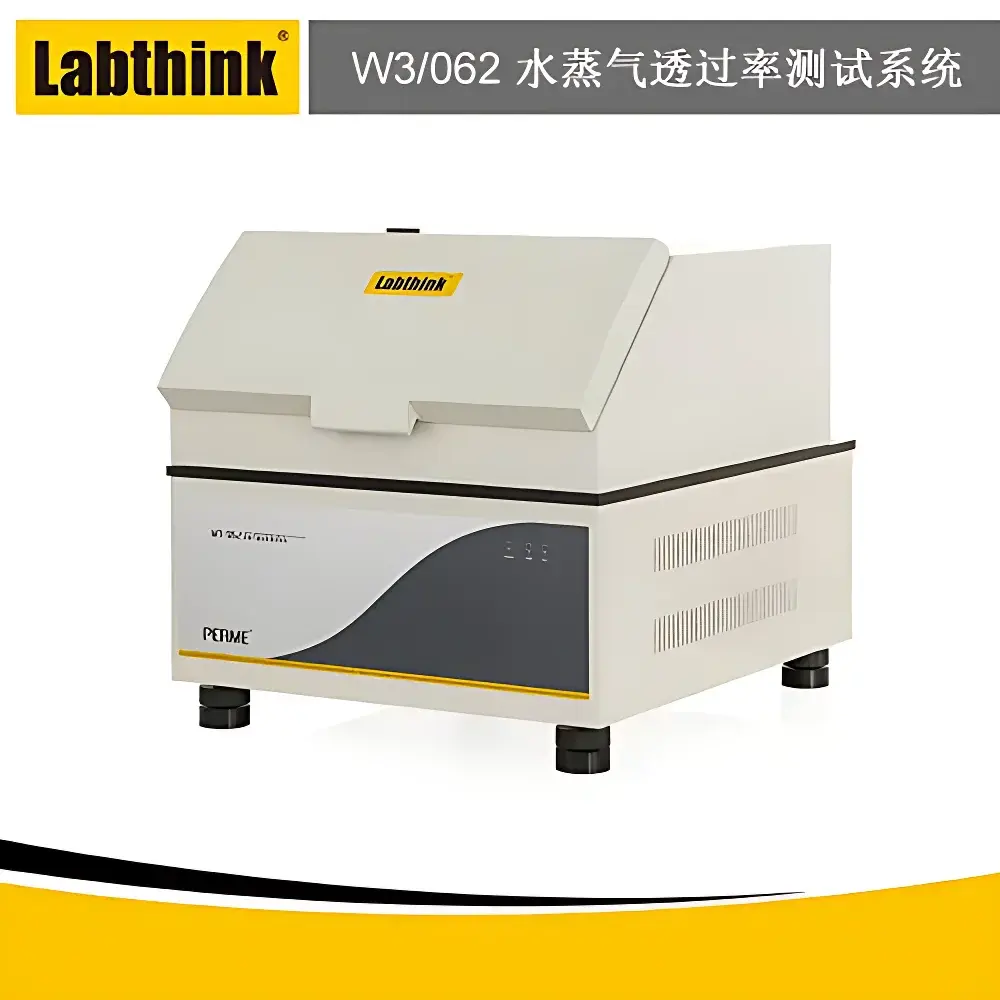
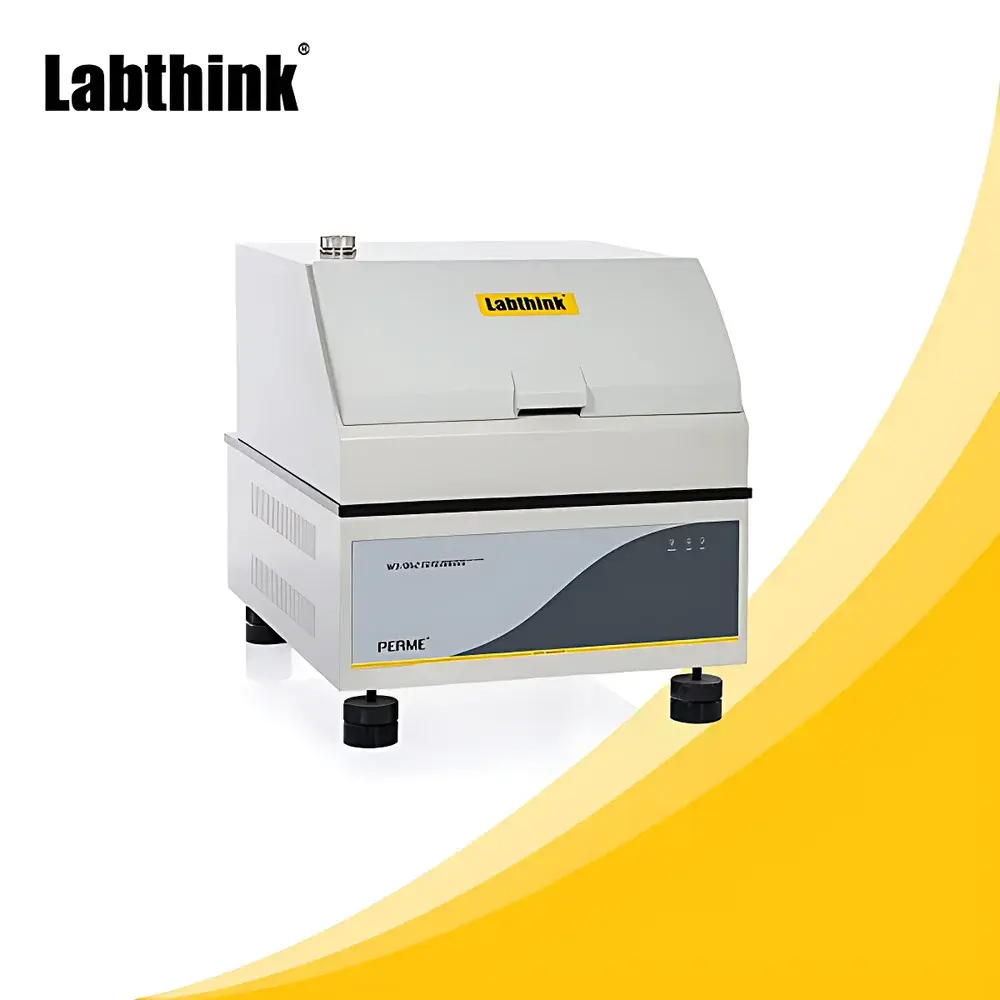
Labthink W3/062-PERME Gravimetric Cup Method Water Vapor Transmission Rate (WVTR) Tester
| Brand | Labthink |
|---|---|
| Model | W3/062-PERME |
| Origin | Shandong, China |
| Manufacturer | Labthink Instruments Co., Ltd. |
| Application Category | Packaging & Medical Film Barrier Testing |
| Test Principle | Gravimetric Cup Method (ASTM E96, GB 1037, ISO 2528) |
| Measurement Range | 0.1–10,000 g/m²·24h (loss mode) |
| Sample Capacity | 1–6 specimens per test cycle (independent channels) |
| Temperature Control | 15–55 °C ±0.1 °C |
| Humidity Control | 10–98% RH ±1% RH |
| Test Area | 33 cm² |
| Specimen Diameter | Φ74 mm |
| Max Thickness | ≤3 mm |
| Weight Resolution | 0.001 g |
| WVTR Resolution | 0.01 g/m²·24h |
| Air Supply | 0.6 MPa, Φ6 mm polyurethane tubing |
| Power | 220 VAC 50 Hz / 120 VAC 60 Hz |
| Net Weight | 80 kg |
| Dimensions | 660 × 580 × 580 mm (L×W×H) |
Overview
The Labthink W3/062-PERME is a precision-engineered gravimetric cup method water vapor transmission rate (WVTR) tester designed for rigorous barrier performance evaluation of flexible packaging films, laminates, pharmaceutical blister foils, medical device pouches, and construction membranes. It operates on the fundamental principle of dynamic mass change measurement: under controlled temperature and relative humidity (RH) gradients across a specimen, water vapor migrates through the material and induces measurable weight variation in a sealed permeation cup. This gravimetric approach—standardized in ASTM E96, GB 1037, ISO 2528, and JIS Z0208—delivers traceable, absolute WVTR values without reliance on calibration curves or sensor drift compensation. The system supports both desiccant-based loss-mode (dry side) and humidified gain-mode (wet side) configurations, enabling accurate quantification across an exceptionally broad range—from ultra-high-barrier materials (e.g., AlOx-coated PET at ~0.1 g/m²·24h) to highly permeable nonwovens (>10,000 g/m²·24h). Its dual-mode capability ensures compliance with regulatory testing protocols across global packaging and medical device quality systems.
Key Features
- High-resolution microbalance subsystem with 0.001 g resolution and 0.01 g/m²·24h WVTR repeatability—engineered for long-term stability under continuous thermal-hygrometric stress.
- Modular six-position circular test tray enabling concurrent, statistically independent measurements on up to six specimens per cycle; eliminates inter-sample cross-contamination and operator-induced variability.
- Scalable architecture supporting up to nine satellite units per host controller—enabling 60-channel parallel testing for high-throughput QC labs operating under ISO/IEC 17025 or FDA 21 CFR Part 11 environments.
- Precise dual-zone environmental control: temperature regulated to ±0.1 °C from 15–55 °C; RH maintained within ±1% RH across 10–98% RH via integrated humidity generation and desiccant drying modules.
- Standardized 33 cm² test area (Φ74 mm specimen) compliant with ASTM D1653 and TAPPI T464; optional custom fixtures available for non-standard geometries or thicknesses up to 3 mm.
- Integrated air purge system with adjustable laminar flow (0.5–2.5 m/s) to minimize boundary layer effects and ensure uniform vapor flux distribution across the test surface.
Sample Compatibility & Compliance
The W3/062-PERME accommodates a wide spectrum of planar barrier materials, including monolayer polymers (LDPE, PP, PET), coextruded structures, metallized films, SiOx/AlOx barrier coatings, aluminum foil laminates, Tyvek®-type medical packaging substrates, and hydrophilic/hydrophobic breathable membranes used in wound dressings and protective apparel. All test methodologies adhere strictly to internationally recognized standards: GB 1037 and GB/T 16928 for domestic Chinese regulatory submissions; ASTM E96 (Procedure A/B for gain/loss modes) and ASTM D1653 for North American packaging validation; ISO 2528 and DIN 53122-1 for EU CE-marking dossiers; and YBB00092003 for Chinese pharmaceutical packaging registration. The instrument’s design facilitates full auditability—each test record includes timestamped environmental logs, raw mass vs. time datasets, and pass/fail flags against predefined acceptance criteria per standard clause.
Software & Data Management
The system runs Labthink’s LSYST™ v3.0 software—a validated, 21 CFR Part 11-compliant platform featuring electronic signatures, role-based access control, and immutable audit trails. Real-time mass trending, automatic slope calculation for steady-state determination, and nonlinear regression for transient-phase analysis are embedded. Data export conforms to ASTM WK54727 metadata schema (CSV, XML, PDF report templates). When deployed within a local area network, the W3/062 integrates natively with Labthink’s Lystem™ Laboratory Data Management System (LDMS), enabling centralized storage, cross-instrument correlation (e.g., correlating WVTR with OTR from an OX2/230), automated report generation per GLP/GMP Annex 11 requirements, and configurable alerting for out-of-specification results. All software modules undergo annual IQ/OQ/PQ verification per ISO/IEC 17025:2017 Clause 6.4.10.
Applications
- Quality assurance of food packaging films—verifying shelf-life predictions for moisture-sensitive products (e.g., snacks, powders, dried fruits).
- Pharmaceutical primary packaging validation—demonstrating compliance with USP and EP 3.2.1 for blister lidding foils and sachet laminates.
- Medical device packaging qualification per ISO 11607-1:2019 Annex C, ensuring sterility maintenance during accelerated aging and real-time storage.
- R&D of novel barrier coatings—quantifying WVTR reduction efficacy of nanocomposite layers, plasma polymerization treatments, or bio-based barrier resins.
- Construction membrane certification—assessing vapor retarder performance in roofing underlayment and wall assembly systems per ASTM E96 Class I/II/III definitions.
- Regulatory submission support—generating GLP-compliant datasets for NMPA, PMDA, Health Canada, and EMA dossier packages.
FAQ
What standards does the W3/062-PERME fully support for regulatory testing?
It implements ASTM E96 (Procedures A and B), GB 1037, ISO 2528, JIS Z0208, DIN 53122-1, TAPPI T464, and YBB00092003 with hardware-level parameter enforcement and software-driven reporting templates.
Can the system operate unattended for extended duration tests (e.g., 7+ days)?
Yes—the environmental chamber and balance subsystem are thermally stabilized and humidity-compensated for continuous operation; scheduled auto-zero and drift correction routines maintain metrological integrity over multi-week trials.
Is calibration traceable to national metrology institutes?
All mass sensors are factory-calibrated using NIST-traceable weights (Class E2); optional on-site calibration with certified reference standards (e.g., NIST SRM 2812) is available upon request.
How is data integrity ensured for FDA-regulated environments?
LSYST™ enforces 21 CFR Part 11 requirements: electronic signatures, audit trail encryption, user permission hierarchies, and immutable record archiving—validated per Annex 11 of EU GMP guidelines.
What maintenance intervals are recommended for routine operation?
Desiccant replacement every 3 months; humidity generator cleaning quarterly; balance recalibration annually or after relocation; full IQ/OQ requalification every 2 years per ISO/IEC 17025.





