
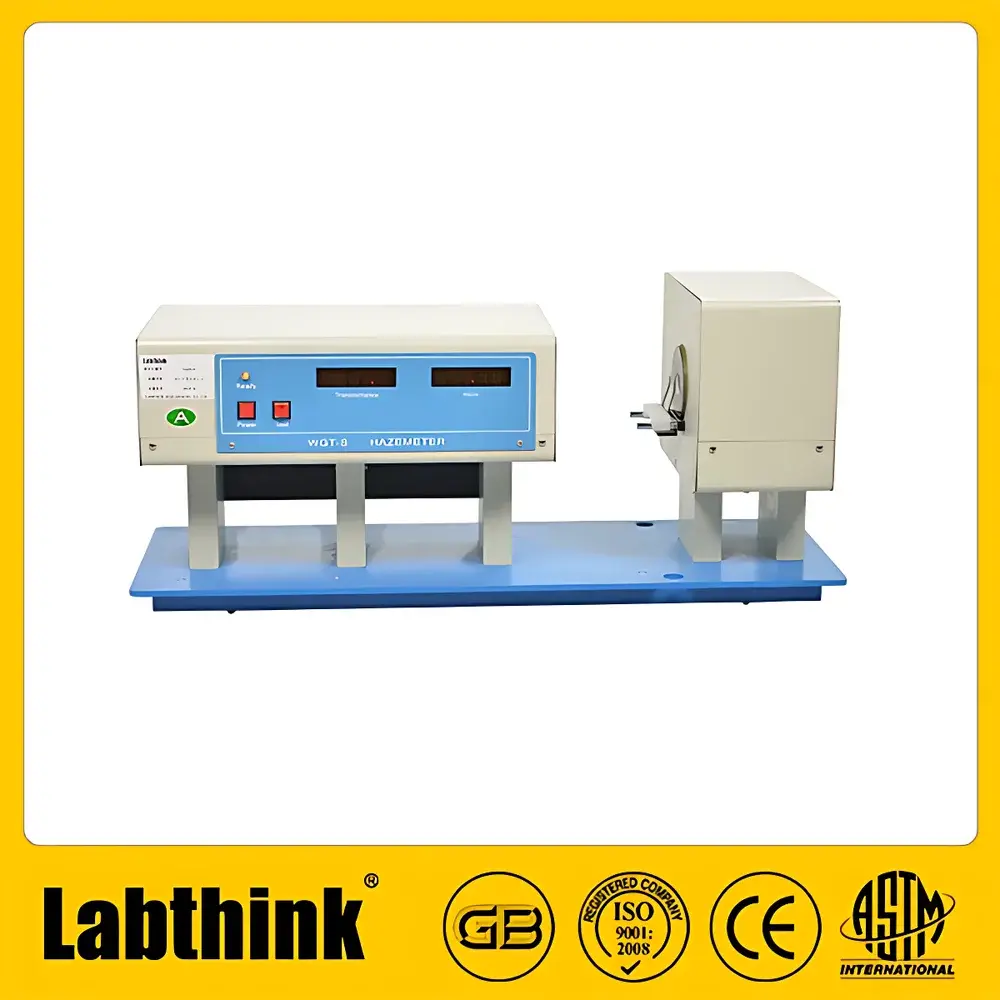
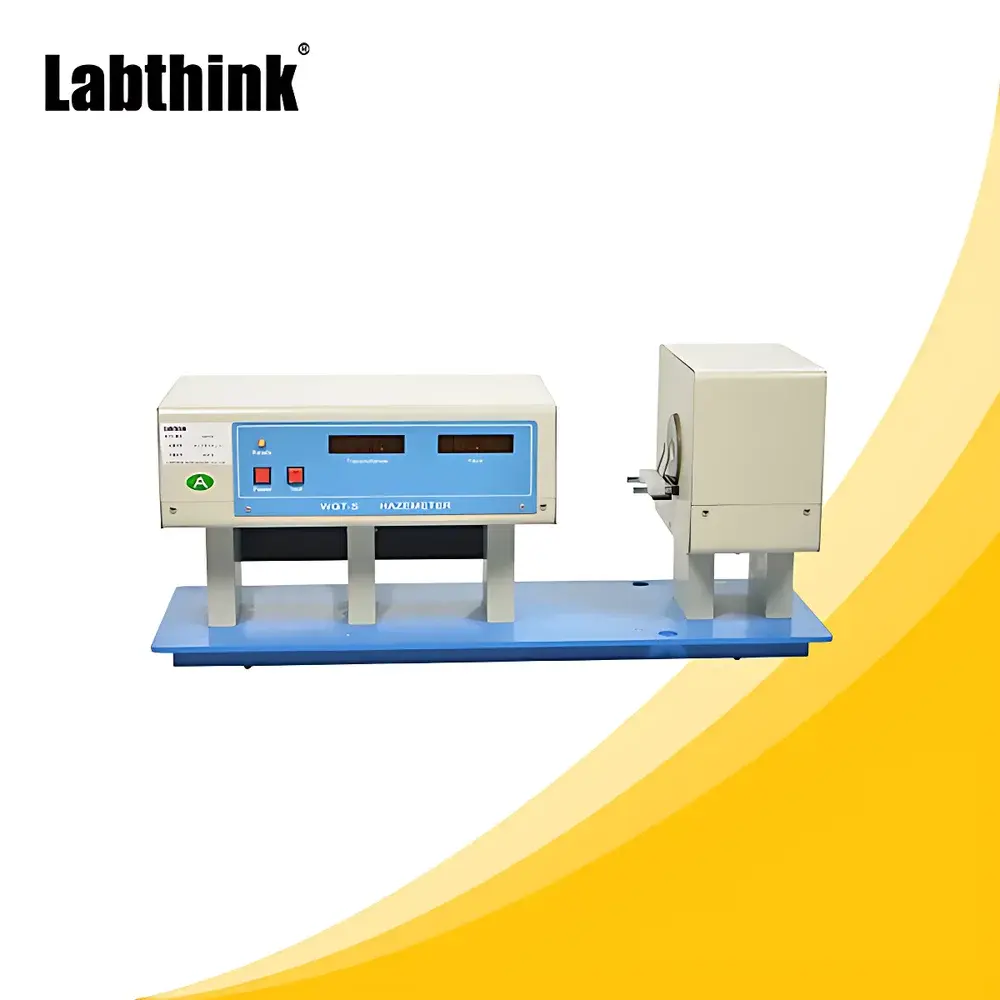
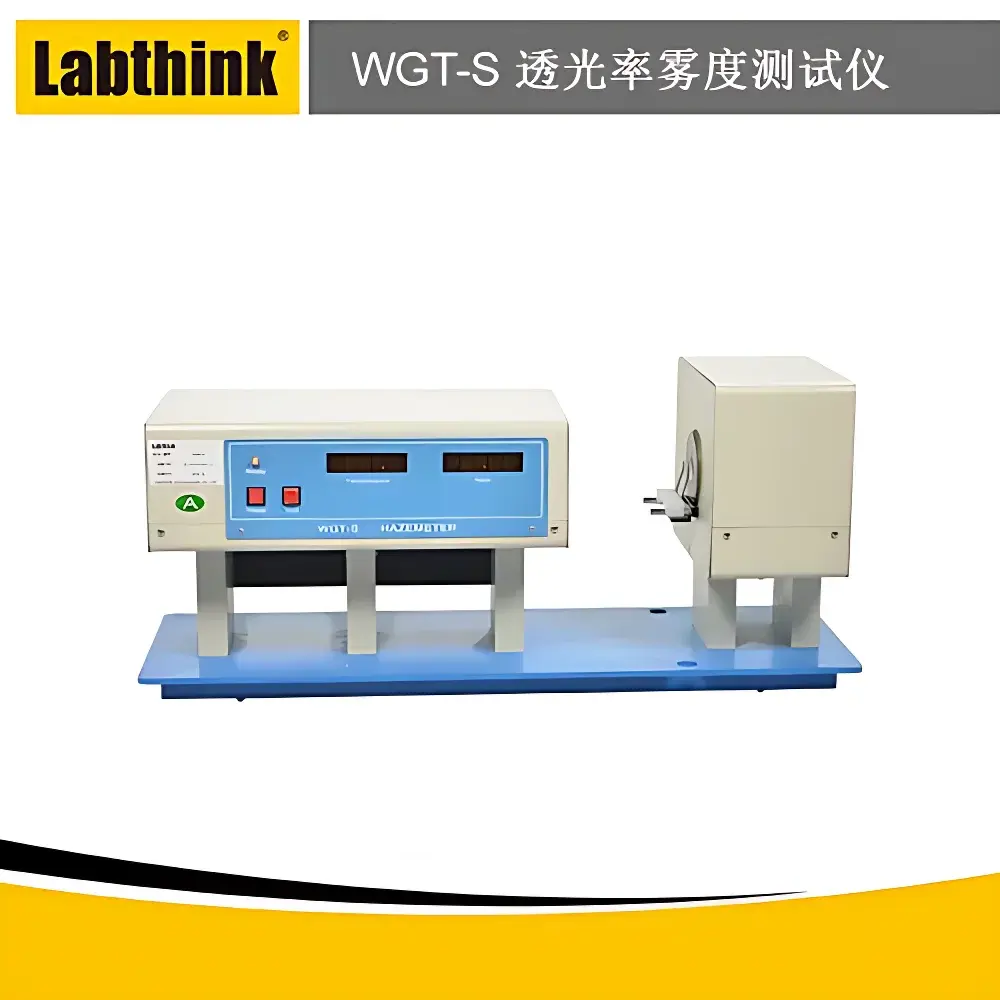
Labthink WGT-S Automatic Transmittance and Haze Tester
| Brand | Labthink |
|---|---|
| Model | WGT-S |
| Origin | Shandong, China |
| Manufacturer Type | Direct Manufacturer |
| Product Type | Automatic |
| Haze Range | 0–30.00% |
| Transmittance Range | 0–100.0% |
| Haze Repeatability | ±0.05% (when H ≤ 0.5%) |
| Transmittance Repeatability | ±0.5% |
| Light Source | C-illuminant (12 V DC, 50 W tungsten-halogen lamp + color temperature correction filter) |
| Sample Size | 50 mm × 50 mm (for films) |
| Aperture Dimensions | Input port Ø25 mm, Output port Ø21 mm |
| Detection Method | Collimated illumination, diffuse viewing, integrating sphere detection |
| Detector | Silicon photodiode with photopic luminosity function (V(λ)) correction |
| Compliance Standards | GB/T 2410, ASTM D1003–07 (Standard Test Method for Haze and Luminous Transmittance of Transparent Plastics), JIS K7105–1981 |
| Dimensions | 740 mm (L) × 270 mm (W) × 300 mm (H) |
| Net Weight | 21 kg |
| Power Supply | 220 V, 50 Hz |
Overview
The Labthink WGT-S Automatic Transmittance and Haze Tester is a precision optical instrument engineered for the quantitative evaluation of luminous transmittance and haze in planar transparent and translucent materials. It operates on the fundamental principles defined in ASTM D1003–07 and GB/T 2410: transmittance is calculated as the ratio of total transmitted luminous flux to incident luminous flux, expressed as a percentage; haze is defined as the ratio of diffusely transmitted luminous flux (scattered at angles greater than 2.5° from the incident beam axis) to total transmitted luminous flux. The system employs C-illuminant spectral distribution—realized via a stabilized 12 V DC, 50 W tungsten-halogen lamp coupled with a color temperature correction filter—to ensure metrological alignment with human photopic vision (CIE Standard Illuminant C and V(λ) spectral luminous efficiency function). An integrating sphere detector with silicon photodiode and V(λ)-matched correction enables high-fidelity spectral weighting and minimizes angular sensitivity errors. Designed for laboratory and quality control environments, the WGT-S delivers traceable, reproducible measurements compliant with international optical material standards.
Key Features
- Automated dual-parameter measurement: Simultaneous acquisition and display of transmittance (%) and haze (%) with real-time BCD serial output and standard parallel printer interface.
- Microprocessor-controlled operation: Fully automated calibration, sample measurement, data averaging across consecutive cycles, and auto-switching between transmittance/haze modes.
- Optically optimized detection architecture: Collimated incident beam (Ø25 mm input port) combined with diffuse-viewing geometry (2.5° acceptance threshold) and an integrating sphere (Ø21 mm output port) ensures compliance with ASTM D1003’s geometric requirements.
- High-stability C-illuminant source: Thermally regulated tungsten-halogen lamp with spectral correction filter maintains consistent chromaticity coordinates (x ≈ 0.310, y ≈ 0.316) over extended operational periods.
- Digital LED readout with 0.1% transmittance and 0.01% haze resolution, supporting GLP-aligned documentation workflows.
- Robust mechanical design: Precision-machined sample stage, fixed-aperture film夹具 (50 mm × 50 mm), and vibration-damped chassis ensure mechanical repeatability across daily use.
Sample Compatibility & Compliance
The WGT-S accommodates rigid and flexible planar specimens including plastic films, polymer sheets, glass substrates, coated optics, and liquid cuvettes (e.g., pharmaceutical solutions, beverage clarity assessment). Its standardized 50 mm × 50 mm test area and fixed-port geometry enforce uniform beam interaction, minimizing edge effects and enabling inter-laboratory comparability. All measurements adhere strictly to the geometric and photometric definitions in ASTM D1003–07 (Section 6.1–6.3), ISO 14782:1999, and GB/T 2410–2008. Instrument validation includes factory-certified reference standards (certified haze disc, Ø40 mm × 2 mm, traceable to NIM), and routine verification follows documented SOPs aligned with ISO/IEC 17025 clause 6.5. The device supports audit-ready operation under GMP and GLP frameworks, with optional timestamped data logging compatible with FDA 21 CFR Part 11–compliant software extensions.
Software & Data Management
While the WGT-S operates as a standalone benchtop unit with embedded microcontroller firmware, its BCD serial output (RS-232C compliant) enables seamless integration with external LIMS or QC databases. Raw transmittance and haze values are transmitted in ASCII-encoded numeric format with configurable baud rate (default 9600 bps), allowing direct ingestion into Excel, MATLAB, or custom Python-based analysis pipelines. Optional Labthink VisionLink™ software (sold separately) provides full data traceability—including operator ID, sample ID, environmental conditions (ambient temperature/humidity metadata), calibration history, and digital signature fields—supporting ALCOA+ data integrity principles. Audit trails record all parameter changes, calibration events, and result exports, satisfying regulatory expectations for electronic records in pharmaceutical and medical device manufacturing.
Applications
- Quality assurance of optical films: PET, PC, PMMA, and TPU substrates used in displays, touch panels, and AR/VR optics.
- Regulatory testing of pharmaceutical packaging: Verification of blister foil transparency and moisture-barrier film haze per USP and EP 2.2.1.
- Automotive glazing R&D: Quantification of haze growth in polycarbonate laminates after UV aging and thermal cycling.
- Food & beverage industry: Turbidity assessment of bottled water, juices, and dairy alternatives using standardized liquid cell holders.
- Academic research: Correlation studies between polymer morphology (via SEM/DSC) and macroscopic optical performance metrics.
- Standards laboratories: Reference instrument for interlaboratory comparison exercises under ILAC MRA protocols.
FAQ
What standards does the WGT-S comply with?
ASTM D1003–07, GB/T 2410–2008, JIS K7105–1981, and ISO 14782:1999.
Can the instrument measure liquids?
Yes—when equipped with optional liquid sample cells (quartz or borosilicate glass, 10 mm path length), it quantifies turbidity in accordance with ASTM D1003 Annex A3.
Is calibration traceable to national standards?
Factory calibration uses NIM-traceable reference standards; users receive a calibration certificate with uncertainty budget per ISO/IEC 17025.
What maintenance is required?
Annual lamp replacement, quarterly sphere interior inspection for coating integrity, and biannual verification with certified haze/transmittance standards.
Does the WGT-S support network connectivity?
Native Ethernet or Wi-Fi is not integrated; however, RS-232 output allows connection to industrial gateways for SCADA or MES integration.




