
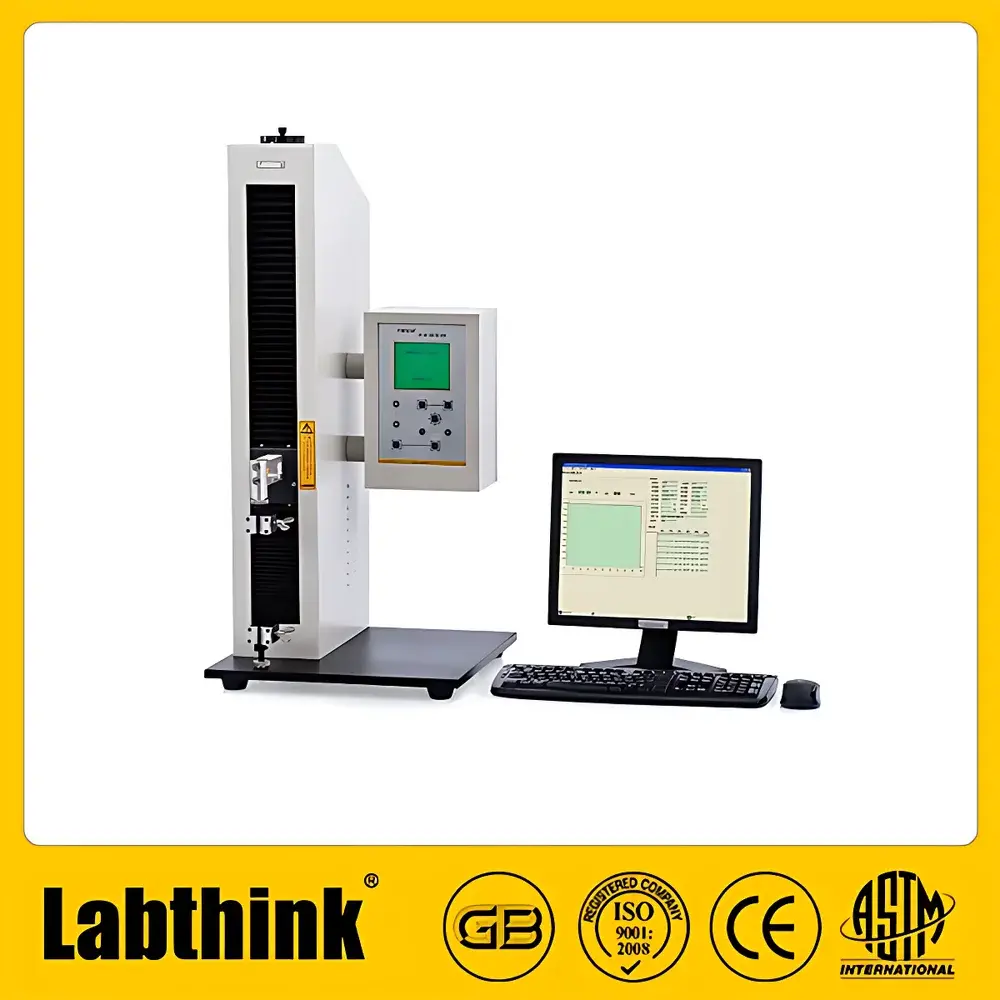
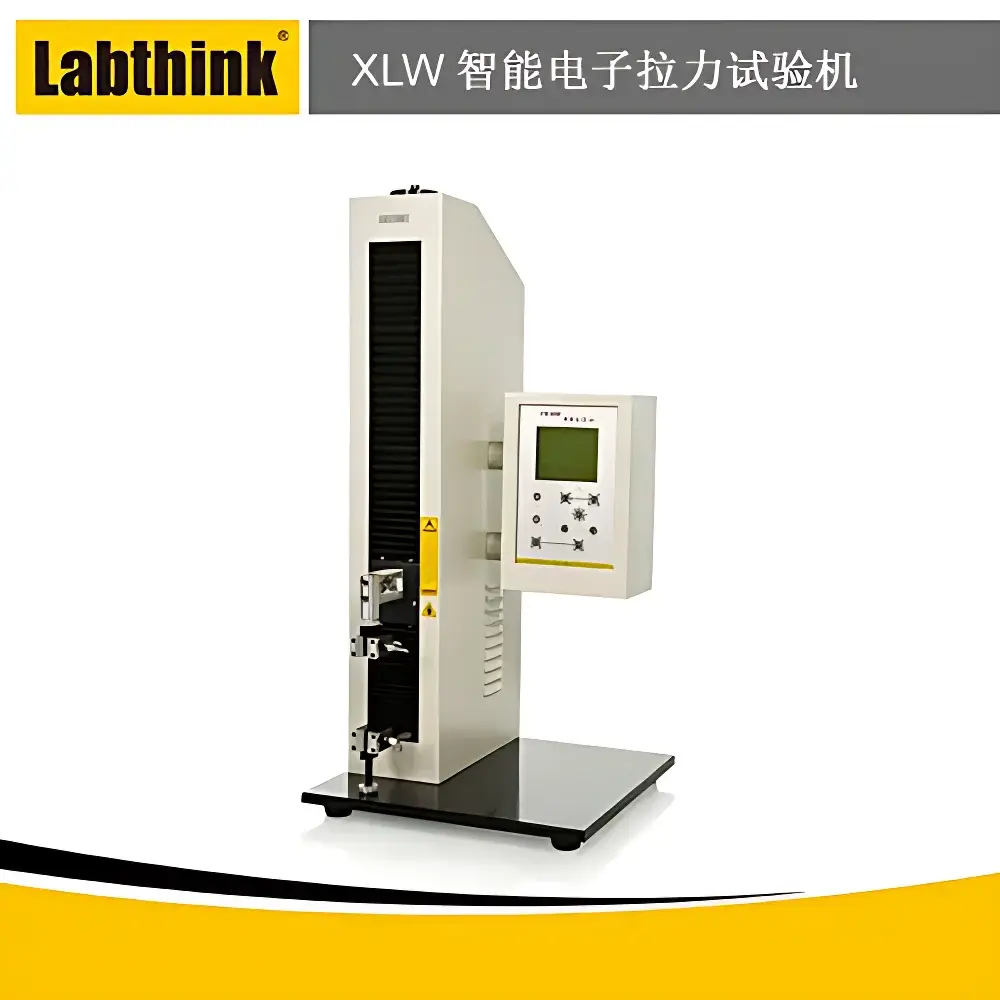
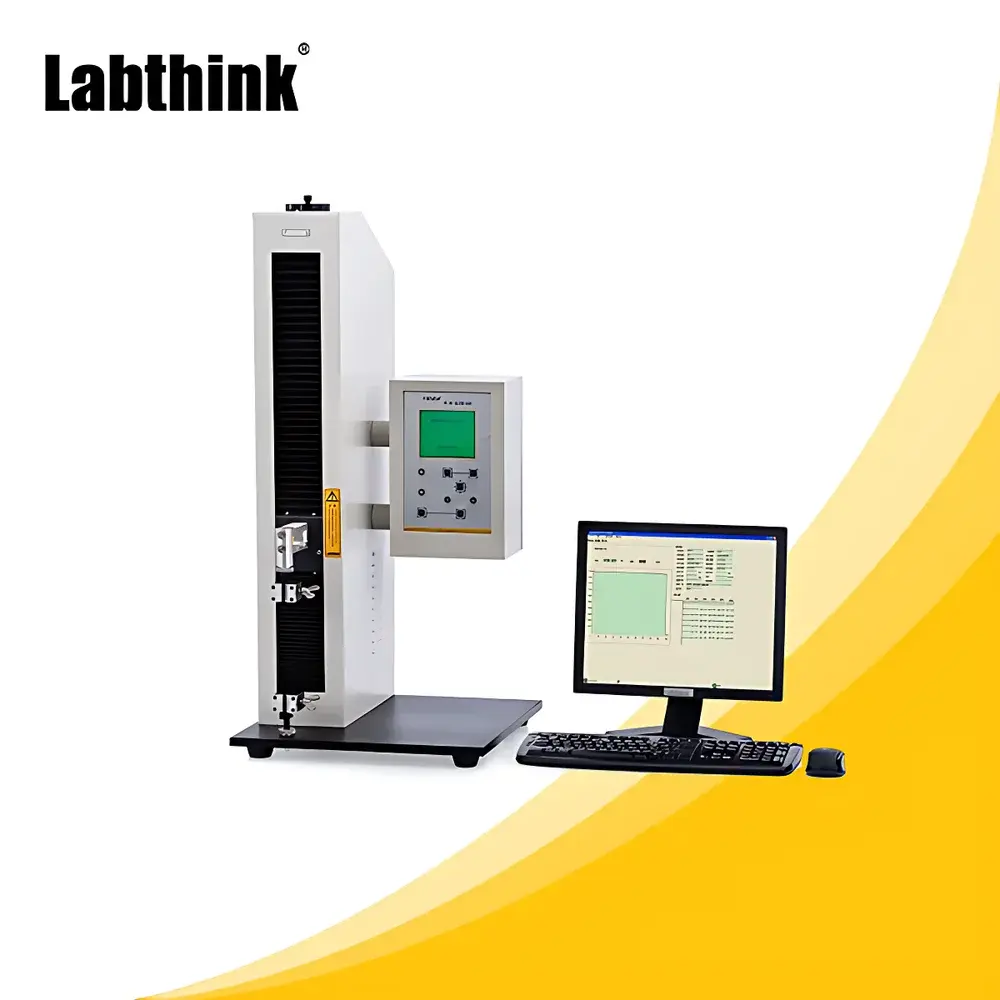
Labthink XLW Intelligent Electronic Tensile Tester for Composite Film Interlayer Peel Strength Testing
| Brand | Labthink |
|---|---|
| Origin | Shandong, China |
| Manufacturer Type | Direct Manufacturer |
| Product Category | Domestic |
| Model | XLW |
| Instrument Type | Electronic Tensile Testing Machine |
| Maximum Test Load | 1 kN |
| Force Accuracy Class | Class 1 |
| Test Stroke | 600 mm |
| Standard Test Width | 30 mm |
| Optional Test Width | 50 mm |
| Test Speed Range | 50–500 mm/min (7 steps) |
| Dimensions (L×W×H) | 450 × 450 × 980 mm |
| Weight | 65 kg |
| Power Supply | AC 220 V, 50 Hz |
Overview
The Labthink XLW Intelligent Electronic Tensile Tester is a precision-engineered mechanical testing system designed specifically for quantitative evaluation of interlayer adhesion strength in laminated flexible packaging materials. Operating on the principle of controlled uniaxial tensile force application, it measures peel resistance—defined as the force required to separate two bonded layers at a defined angle and rate—according to standardized angular peel configurations (e.g., 90° or 180°). The instrument complies with fundamental mechanics-of-materials test paradigms and integrates load-cell-based force transduction with high-resolution position sensing to deliver traceable, repeatable measurements essential for quality assurance in packaging R&D, production line validation, and regulatory compliance workflows.
Key Features
- Microprocessor-controlled operation with large LCD display showing real-time force, displacement, and stress-strain curves
- Modular software interface supporting seven independent test modes: tensile, 90° peel, 180° peel, tear, heat seal strength, puncture, and opening force
- Three selectable load ranges (100 N, 200 N, 500 N) calibrated to ISO 7500-1 and ASTM E4 Class 1 accuracy requirements
- Seven programmable crosshead speeds (50–500 mm/min), enabling precise replication of industry-standard test conditions per ASTM D882, ASTM F88, and GB/T 2792
- Standard 30 mm jaw width with optional 50 mm configuration for broader specimen compatibility
- 600 mm vertical stroke ensures full extension capability for elongation-to-failure analysis of highly extensible films and laminates
- Comprehensive safety architecture including overload protection, mechanical limit switches, automatic return-to-initial-position, and emergency stop circuitry
- Integrated data management via RS232 serial port, parallel printer interface (for micro-printer), and Ethernet-enabled network connectivity for centralized lab data aggregation
Sample Compatibility & Compliance
The XLW accommodates a broad spectrum of flexible substrate combinations encountered in modern packaging engineering—including PET/AL/PE laminates, BOPP/CPP coextrusions, metallized polyester structures, medical-grade pouches, protective release liners, and functional barrier composites. Its mechanical design conforms to dimensional and operational constraints specified in GB/T 2792 (peel strength of pressure-sensitive tapes), GB/T 2790 (adhesive bond strength of flexible materials), and ASTM D3330 (peel adhesion of pressure-sensitive tapes). All force measurement subsystems are traceably calibrated against national metrological standards (CNAS-accredited reference masses), and the system supports audit-ready documentation aligned with GLP and GMP environments where 21 CFR Part 11 electronic record integrity is required.
Software & Data Management
The proprietary Labthink testing software provides full control over test parameter definition, real-time graphical visualization of load-displacement profiles, and post-test statistical analysis—including mean, standard deviation, coefficient of variation, and curve overlay comparison across up to 20 grouped specimens. Raw data export is supported in CSV and XML formats for integration into LIMS or statistical process control platforms. The software implements non-volatile memory for parameter retention during power loss, automatic zero-point compensation, and digital calibration routines accessible only via password-protected administrator mode. Audit trails log all user actions, method modifications, and calibration events in chronological order—meeting requirements for regulated pharmaceutical and food contact material testing.
Applications
- Quantification of interlaminar peel strength in multi-layer food packaging to ensure shelf-life integrity under thermal, mechanical, and humidity stress
- Validation of adhesive selection and lamination process parameters during pilot-scale development
- Comparative assessment of aging effects on bond durability after accelerated shelf-life testing (e.g., 40°C/75% RH for 30 days)
- Quality conformance testing of incoming raw materials such as aluminum foil laminates, metallized films, and barrier-coated papers
- Regulatory submission support for FDA 21 CFR 177.1390 (adhesives in food-contact laminates) and EU Commission Regulation (EC) No 1935/2004
- Determination of seal integrity in medical device pouches per ISO 11607-2 and ASTM F1886/F1886M
- Evaluation of delamination risk in photovoltaic backsheet assemblies under thermal cycling per IEC 61215
FAQ
What standards does the XLW tester support for peel testing?
It fully supports GB/T 2792, GB/T 2790, ASTM D903, ASTM F904, ASTM F88, ISO 8510-2, and JIS Z0237—with configurable peel angle, speed, and grip separation settings.
Can the XLW perform both 90° and 180° peel tests?
Yes—the instrument includes dedicated fixtures for both angular configurations, with interchangeable peel jigs and alignment guides ensuring reproducible specimen positioning.
Is the system compliant with FDA 21 CFR Part 11 requirements?
While the base hardware meets electromagnetic compatibility and electrical safety standards (IEC 61000-4, GB/T 17626), full Part 11 compliance requires deployment of validated software version 3.2+ with enabled electronic signature, audit trail, and role-based access controls.
What is the recommended maintenance interval for force calibration?
Labthink recommends annual recalibration by an accredited third-party metrology laboratory; internal verification using certified reference loads should be performed before each daily test session.
Does the XLW support custom夹具 design for non-standard substrates?
Yes—custom jaw geometries, pneumatic clamping modules, and floating roller fixtures can be engineered upon request to accommodate specialty materials such as foams, hydrogels, or ultra-thin nanolaminates.



