
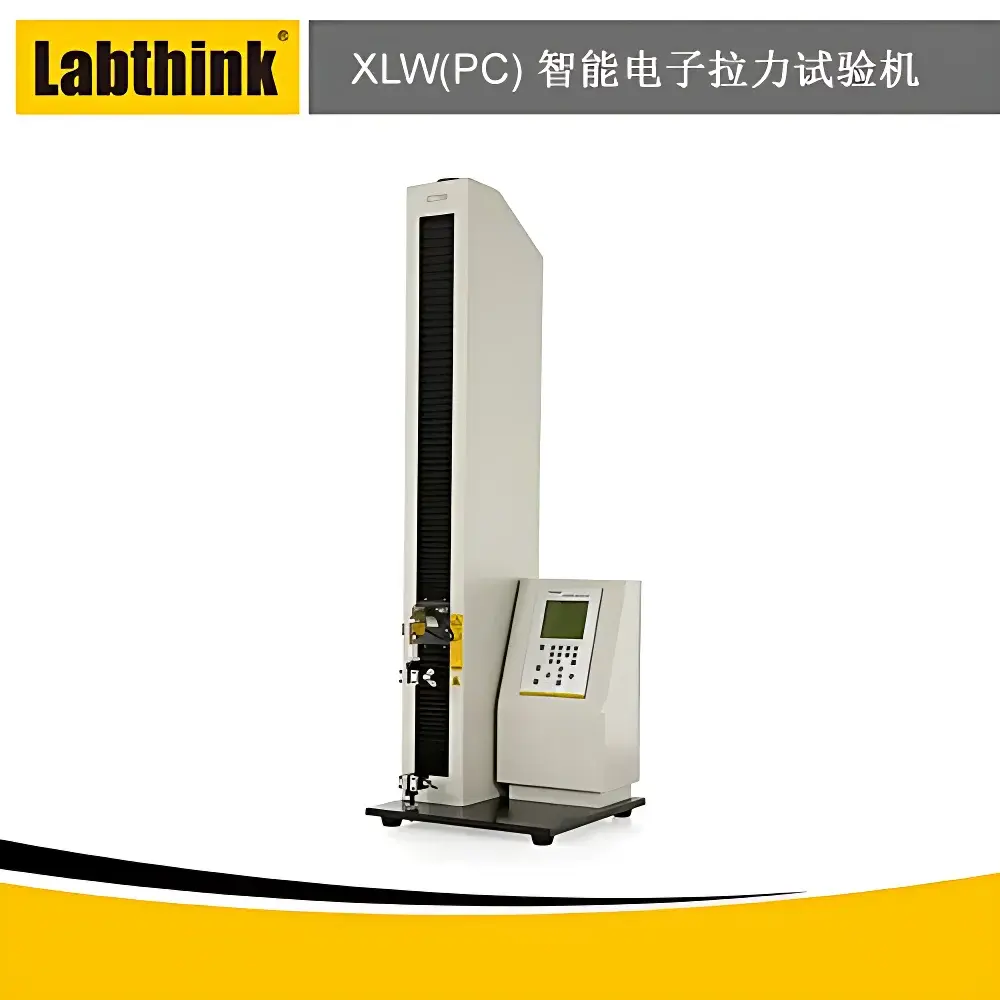
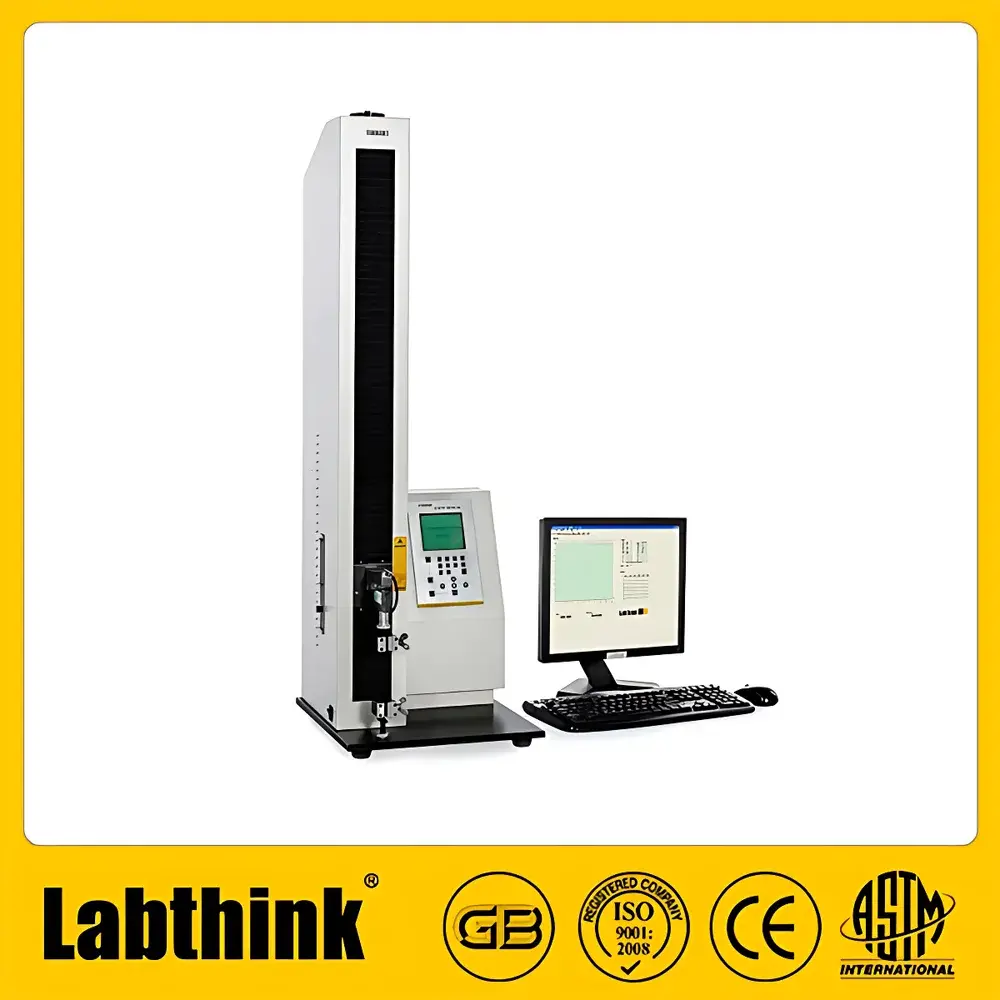
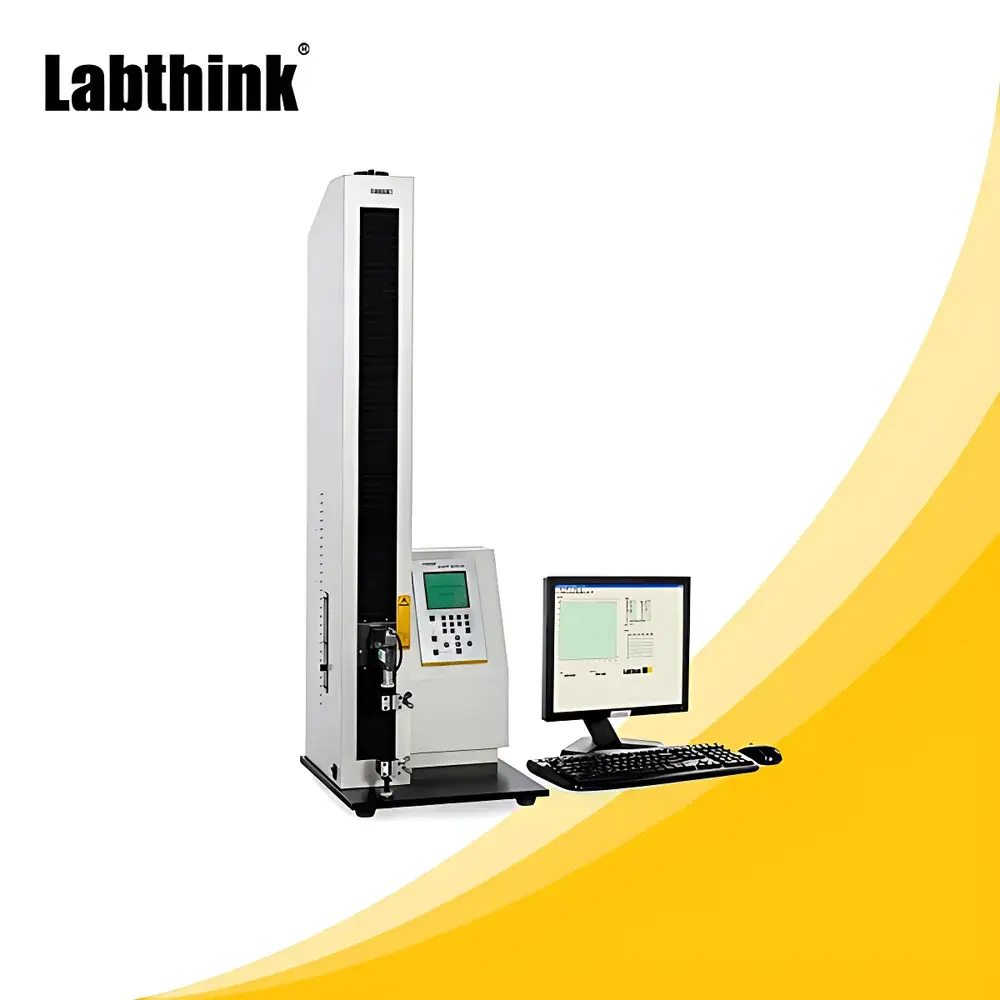
Labthink XLW-PC Intelligent Electronic Tensile Tester for Adhesive Tape Peel Strength Testing
| Brand | Labthink |
|---|---|
| Model | XLW-PC |
| Type | Electronic Tensile & Peel Testing Machine |
| Origin | Shandong, China |
| Manufacturer | Labthink Instruments Co., Ltd. |
| Max Load Capacity | 1 kN |
| Force Accuracy Class | 0.5 |
| Test Stroke | 1000 mm |
| Displacement Resolution | 1 mm |
| Standard Load Cell | 500 N |
| Optional Load Cells | 50 N, 100 N, 250 N, 750 N, 1000 N |
| Test Speeds | 50, 100, 150, 200, 250, 300, 500 mm/min |
| Specimen Width | 30 mm (standard), 50 mm (optional) |
| Dimensions (L×W×H) | 450 × 450 × 1410 mm |
| Weight | 68 kg |
| Power Supply | 220 VAC 50 Hz / 120 VAC 60 Hz |
Overview
The Labthink XLW-PC Intelligent Electronic Tensile Tester is a precision-engineered instrument designed specifically for quantitative mechanical evaluation of pressure-sensitive adhesives (PSAs), including adhesive tapes, labels, medical transdermal patches, protective films, and laminated packaging materials. It operates on the fundamental principle of uniaxial tensile displacement under controlled speed and load measurement, conforming to standardized peel geometry configurations—most commonly 90° and 180° peel tests per ASTM D3330, ASTM D1000, ISO 8510-2, and GB/T 2792. The system employs dual high-stability load cells (with selectable ranges from 50 N to 1000 N), a calibrated linear motion actuator, and synchronized force/displacement acquisition at 100 Hz sampling rate to ensure traceable, repeatable data generation. Its rigid frame architecture, integrated overload protection, and programmable end-of-travel limits support GLP-compliant operation in regulated QC laboratories.
Key Features
- Force accuracy certified to ISO 7500-1 Class 0.5 — enabling reliable quantification of peel strength down to ±0.5% of full-scale reading
- Extended 1000 mm test stroke accommodates high-elongation substrates and multi-layer composites requiring large deformation envelopes
- Seven preconfigured test modes: tensile, 90° peel, 180° peel, tear, seal strength (ASTM F88), puncture, and shear — all compliant with ISO, ASTM, GB, and JIS standards
- Seven discrete test speeds (50–500 mm/min) with closed-loop servo control, ensuring velocity stability within ±1% across the full range
- Microprocessor-based controller with PVC membrane keypad, 128×64 LCD display, and intuitive menu navigation — no external PC required for basic operation
- Comprehensive safety architecture: mechanical limit switches, electronic over-force cutoff, automatic return-to-start, and power-loss position memory
- Modular fixture system supporting standard 30 mm specimen width (ISO/GB-compliant), optional 50 mm jaws, floating roller fixtures for low-tension peel alignment, and custom-designed clamps for irregular geometries
Sample Compatibility & Compliance
The XLW-PC is validated for testing a broad spectrum of flexible, anisotropic, and viscoelastic materials used in labeling, medical device assembly, electronics encapsulation, and food/pharma packaging. Compatible specimens include acrylic- and rubber-based PSAs, silicone release liners, PET/PE laminates, aluminum foil composites, nonwovens, hydrocolloid dressings, and thermoplastic elastomer films. All test methods align with internationally recognized regulatory frameworks: ASTM D882 (tensile properties of thin plastic sheeting), ASTM D1938 (trouser tear), ASTM F904 (bond strength of flexible barrier materials), ISO 37 (vulcanized rubber tensile testing), and GB/T 2790–2792 series (peel adhesion of PSAs). The instrument meets mechanical design requirements of ISO 17025-accredited labs and supports audit-ready documentation when paired with Lystem™ Laboratory Data Management System (LDMS).
Software & Data Management
The included Labthink proprietary software provides full test automation, real-time curve visualization (force vs. displacement), and post-test analytical tools compliant with FDA 21 CFR Part 11 requirements — including user-level access control, electronic signatures, and immutable audit trails. Functions include group statistical analysis (mean, SD, CV%), overlay comparison of up to eight curves, slope calculation for initial modulus, plateau identification for steady-state peel force, and automatic pass/fail flagging against user-defined specification limits. Raw data exports to CSV, Excel, or PDF report formats; integration with Lystem™ LDMS enables centralized storage, cross-instrument trending, and automated report generation for QA/QC workflows. Software updates are delivered via secure HTTPS channel with version-controlled release notes.
Applications
- Quantifying peel adhesion of pressure-sensitive tapes used in automotive trim bonding and electronic component masking
- Evaluating label removability and residue performance on HDPE, PETG, and glass substrates per ISTA 3A and ASTM D3330
- Validating hot-melt adhesive bond integrity in medical pouch seals (ASTM F88) and blister lidding (ASTM F1160)
- Assessing cohesive failure vs. interfacial failure modes in transdermal patch backing layers
- Measuring delamination resistance of multilayer barrier films under thermal cycling conditions
- Supporting formulation development for low-tack repositionable adhesives by correlating peel force with dwell time and temperature
- Performing routine QC checks on incoming raw materials (e.g., liner release force, face stock tensile strength) per ISO 15270
FAQ
What peel angles does the XLW-PC support?
The instrument is configured for both 90° and 180° peel geometries using dedicated fixtures; angular alignment is verified via machined reference surfaces and certified calibration gauges.
Can it perform creep or stress-relaxation tests?
No — the XLW-PC is optimized for quasi-static, constant-speed mechanical tests per ISO 6892-1 Annex C; dynamic or time-dependent rheological characterization requires a dedicated electromechanical rheometer.
Is third-party calibration certification available?
Yes — Labthink offers ISO/IEC 17025-accredited calibration services traceable to NIST and CNAS standards, including as-found/as-left reports and uncertainty budgets.
How is compliance with 21 CFR Part 11 ensured?
Through role-based authentication, biometric or token-assisted electronic signatures, immutable audit logs recording all parameter changes and result modifications, and encrypted local database storage.
What maintenance intervals are recommended?
Load cell verification every 6 months; linear guide lubrication and belt tension check quarterly; full mechanical inspection and firmware validation annually — documented in the included Maintenance Logbook.



