
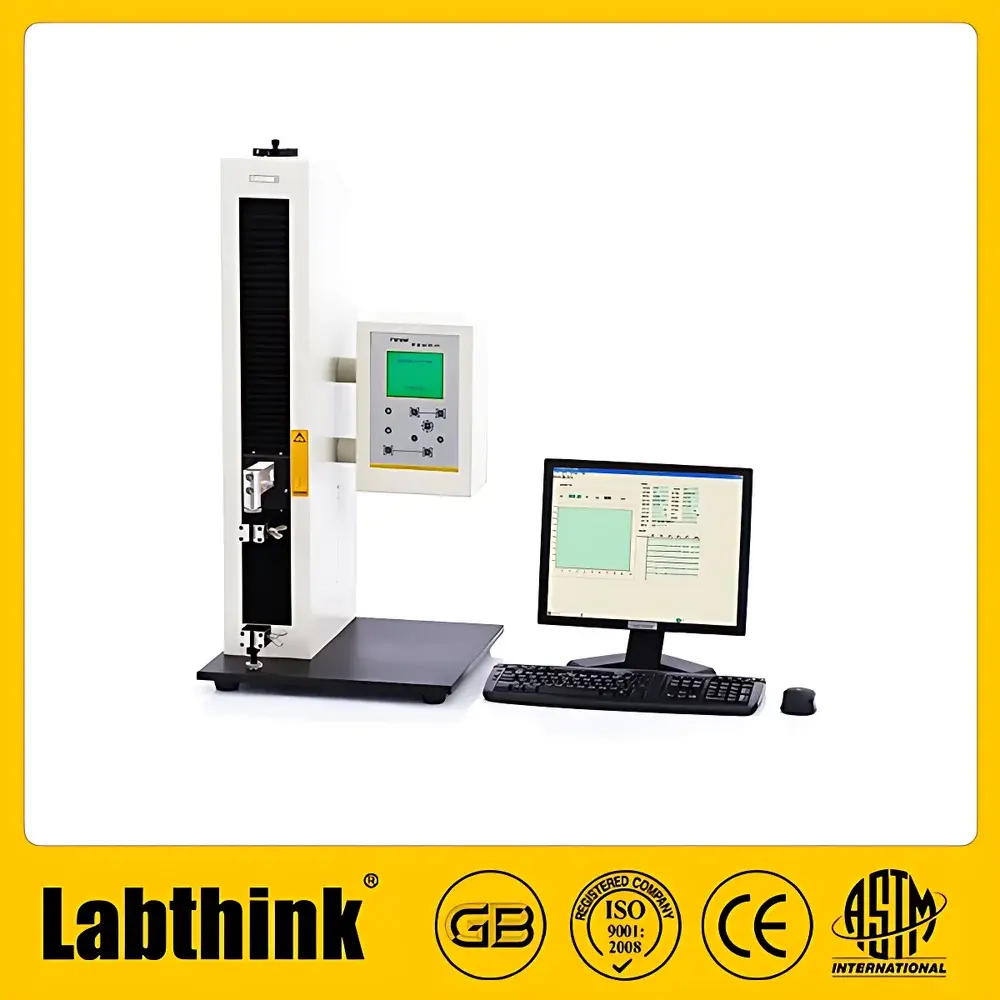
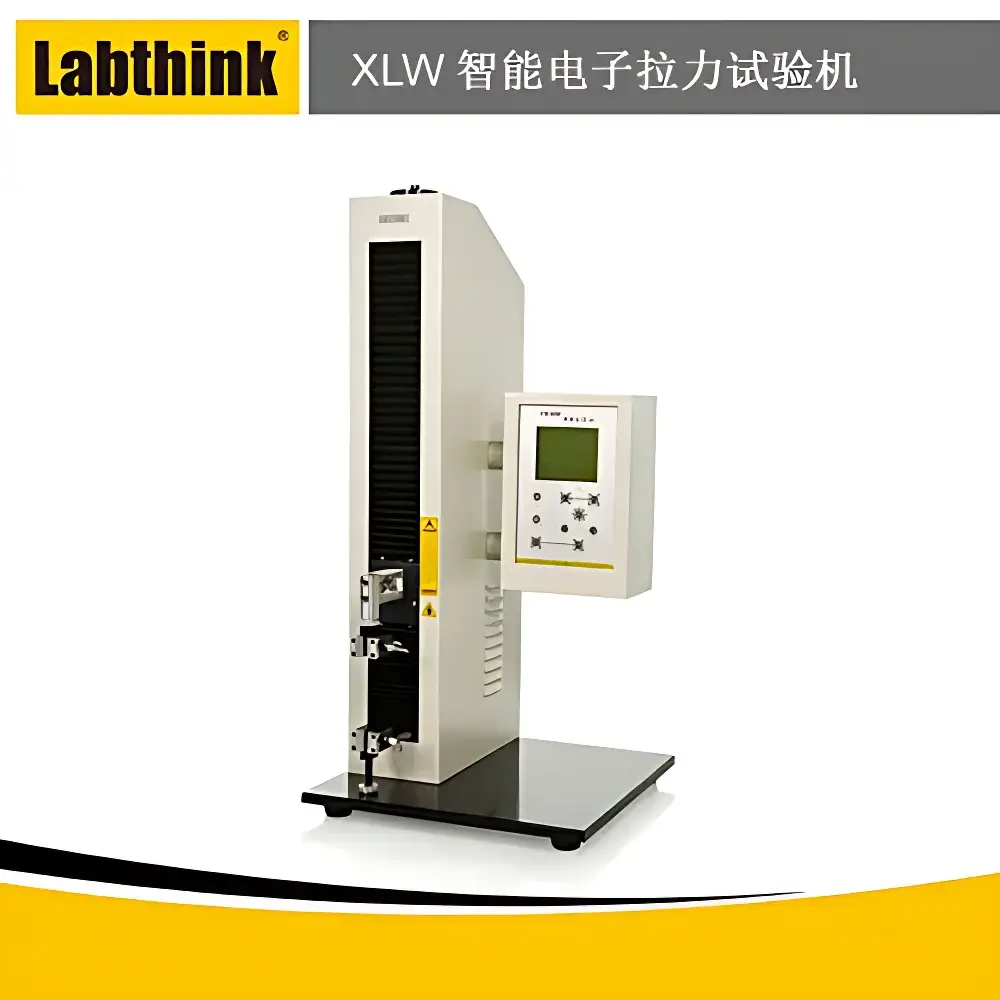
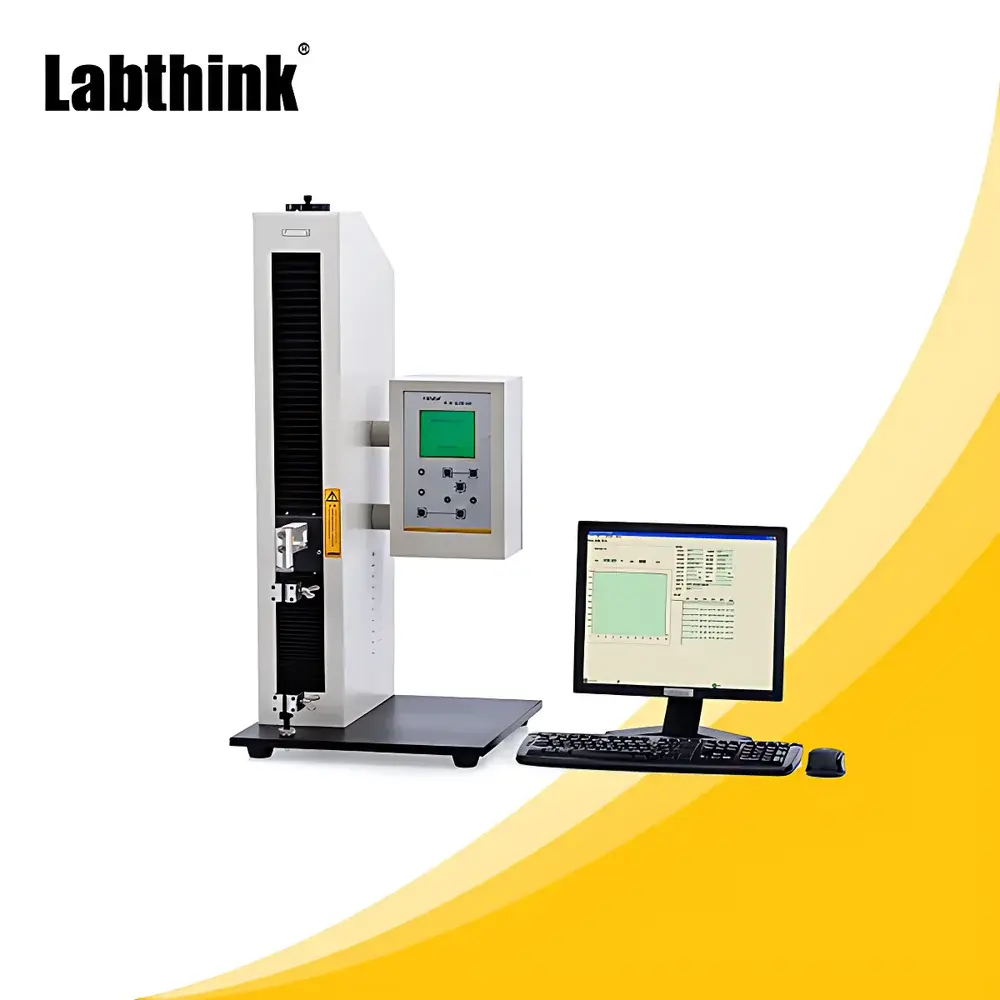
Labthink XLW Series Universal Tensile Tester for Pharmaceutical Foil Heat Seal Strength Testing (YBB00152002 Compliant)
| Brand | Labthink |
|---|---|
| Origin | Shandong, China |
| Manufacturer Type | Direct Manufacturer |
| Regional Classification | Domestic (China) |
| Model | XLW Tensile Tester |
| Price Range | USD 4,200 – 8,400 |
| Load Capacity Options | 100 N / 200 N / 500 N |
| Accuracy Class | Class 1 |
| Test Speeds | 50–500 mm/min (7 discrete settings) |
| Standard Jaw Width | 30 mm |
| Optional Jaw Width | 50 mm |
| Maximum Travel | 600 mm |
| Dimensions (L×W×H) | 450 × 450 × 980 mm |
| Compliance Standards | YBB00152002, GB 13022, GB 8808, GB 1040, ASTM F88, ASTM F904, ISO 37, JIS P8113, QB/T 2358 |
Overview
The Labthink XLW Series Universal Tensile Tester is a microprocessor-controlled mechanical testing instrument engineered for precision evaluation of heat seal strength in pharmaceutical aluminum foil packaging—specifically designed to meet the stringent requirements of Chinese Pharmacopoeia standard YBB00152002. It operates on the fundamental principle of uniaxial tensile force application: test specimens are clamped between two parallel jaws, one stationary and one motor-driven; during controlled separation, high-fidelity load cells (mounted on the moving jaw) and integrated displacement transducers continuously record force vs. extension data. This raw signal stream enables quantitative derivation of critical mechanical parameters—including peel strength, tear resistance, tensile strength at break, elongation at yield, seal integrity under shear, and puncture initiation force—across a broad spectrum of flexible barrier materials used in sterile drug delivery systems.
Key Features
- Microcomputer-based control architecture with large LCD display for real-time visualization of force curves, numerical results, and test progress
- Intuitive menu-driven interface with PVC membrane keypad for rapid method selection and parameter input
- Triple-range load cell configuration (100 N / 200 N / 500 N), each calibrated to ISO 7500-1 Class 1 accuracy (±1% of full scale)
- Seven programmable test speeds (50, 100, 150, 200, 250, 300, 500 mm/min), compliant with ASTM F88 and YBB00152002 specified conditions for heat seal evaluation
- Seven preloaded test modes: tensile, peel, tear, heat seal strength, adhesion, puncture, and opening force—each with independent calibration and validation protocols
- Comprehensive safety architecture including overload protection, mechanical limit switches, automatic return-to-start positioning, and power-loss memory retention
- RS232 serial port, thermal printer interface (for optional micro-printer), and Ethernet connectivity for LAN-based data aggregation and remote diagnostics
Sample Compatibility & Compliance
The XLW tester accommodates diverse specimen geometries and material classes essential to pharmaceutical packaging QA/QC workflows. Validated substrates include laminated aluminum foils (e.g., PET/Al/PE), cold-forming blister foils, peelable lidstock, Tyvek®-based pouches, silicone-coated release liners, medical-grade adhesive tapes, elastomeric septa, and composite backsheet materials. All test fixtures—including standard 30 mm parallel-jaw clamps and optional 50 mm wide or floating-roller configurations—are manufactured to dimensional tolerances traceable to NIST standards. The system fully supports regulatory audit requirements: test methods align with YBB00152002 (Chinese Pharmacopoeia), ASTM F88 (Standard Test Method for Seal Strength of Flexible Barrier Materials), ASTM F904 (Comparative Seal Strength of Flexible Packaging), ISO 37 (Rubber—Determination of Tensile Stress–Strain Properties), and GB/T 2790–2792 series for adhesive bond performance. Data integrity meets GLP/GMP expectations via timestamped digital records and configurable audit trails.
Software & Data Management
The included PC-based analysis software provides full lifecycle test management—from method creation and instrument calibration to statistical reporting and compliance documentation. Users define test parameters (speed, dwell time, trigger thresholds), assign sample IDs, and configure pass/fail criteria per pharmacopeial limits. Raw force-displacement datasets are stored in CSV and proprietary binary formats with metadata tagging (operator ID, environmental conditions, calibration date). Advanced analytics include group-wise statistical summaries (mean, SD, CV%), curve superposition for comparative seal quality assessment, and fixed-strain stress calculation (e.g., 10% elongation modulus). Export modules support PDF report generation with embedded graphs, Excel-compatible tabular outputs, and direct integration into LIMS environments via ODBC drivers. Software validation documentation (IQ/OQ/PQ templates) is provided for FDA 21 CFR Part 11 readiness.
Applications
This instrument serves as a core verification tool across pharmaceutical packaging development, manufacturing, and quality control laboratories. Primary use cases include: validation of heat seal process windows for aluminum foil lidding on plastic bottles and vials; comparative assessment of seal strength across different sealing temperatures, dwell times, and pressure settings (when paired with Labthink HST-H3 Heat Sealer); stability testing of seal integrity after accelerated aging (40°C/75% RH); evaluation of delamination resistance in multilayer foil composites; quantification of peel initiation force for child-resistant closures; and routine QC release testing of incoming foil rolls against YBB00152002 acceptance criteria (≥1.5 N/15 mm for primary packaging). It is also deployed in R&D for formulation optimization of heat-sealable coatings and polymer blends.
FAQ
Does the XLW tester require external calibration services after installation?
No—it includes factory calibration certificates traceable to national metrology institutes. However, users must perform periodic in-house verification using certified reference weights and dimensional standards per ISO/IEC 17025 guidelines.
Can the instrument validate seals formed on non-planar surfaces such as ampoules or syringes?
The XLW measures flat specimen strips cut from finished packages. For complex geometries, users extract representative seal samples using standardized die-cutting tools (e.g., GB/T 2790-compliant sample cutter) prior to testing.
Is ASTM F88-compliant seal strength measurement possible without pairing with a heat sealer?
Yes—the XLW independently performs the peel test per ASTM F88 Section 7. However, generating reproducible seals requires a controlled thermal sealing step, typically executed using the complementary HST-H3 Heat Sealer.
How is data security ensured for regulated environments?
User access levels (admin/operator/auditor) are enforced via password authentication. All test events—including parameter changes, calibration actions, and result modifications—are logged with timestamps and operator IDs, satisfying FDA 21 CFR Part 11 electronic record requirements.
What maintenance intervals are recommended for long-term reliability?
Lubrication of lead screws and inspection of jaw alignment are advised every 6 months or after 5,000 test cycles. Load cell linearity verification should be performed quarterly using traceable dead-weight standards.
Related Products






