
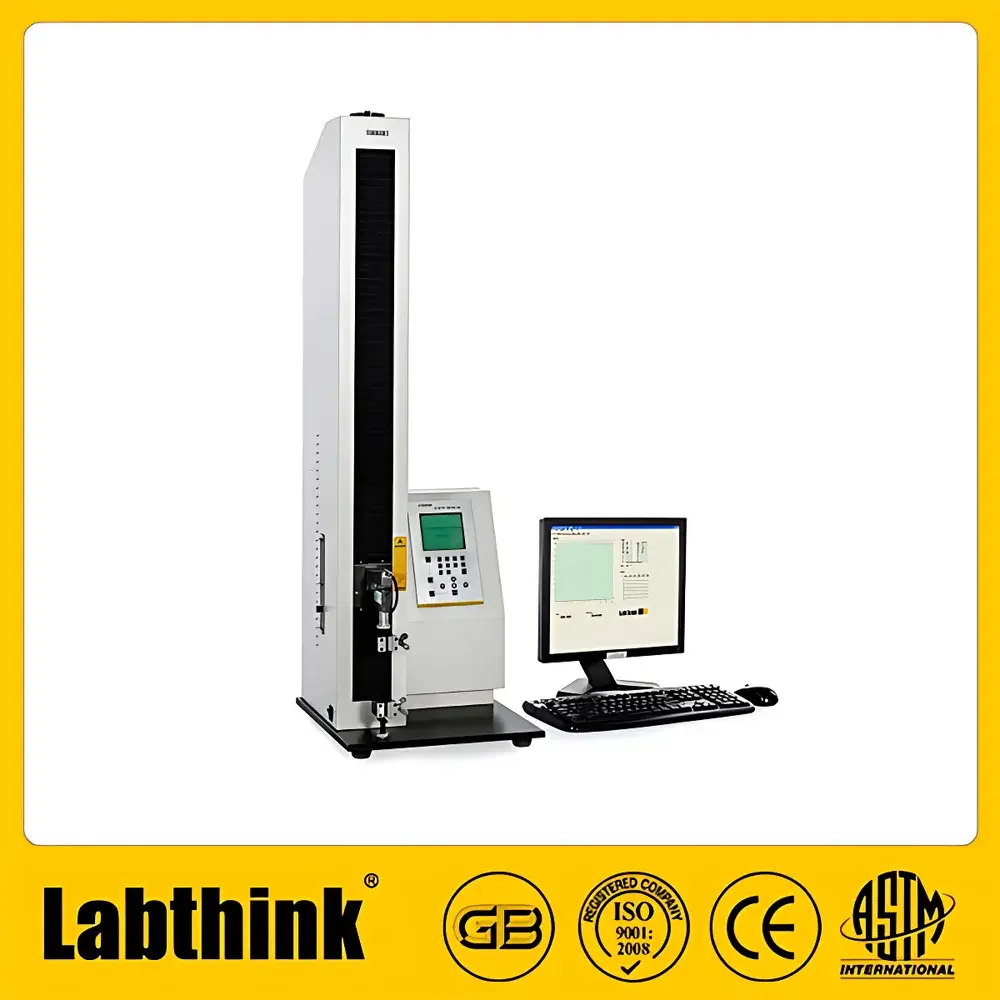
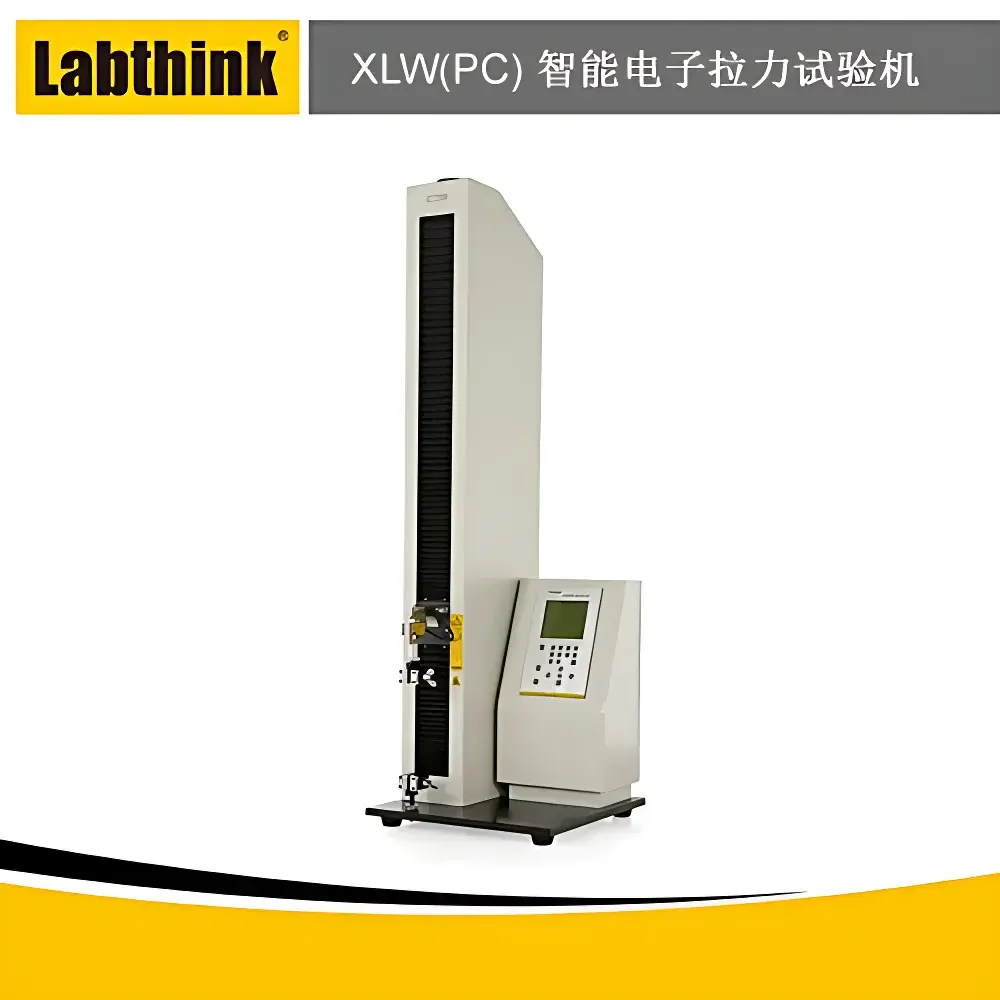
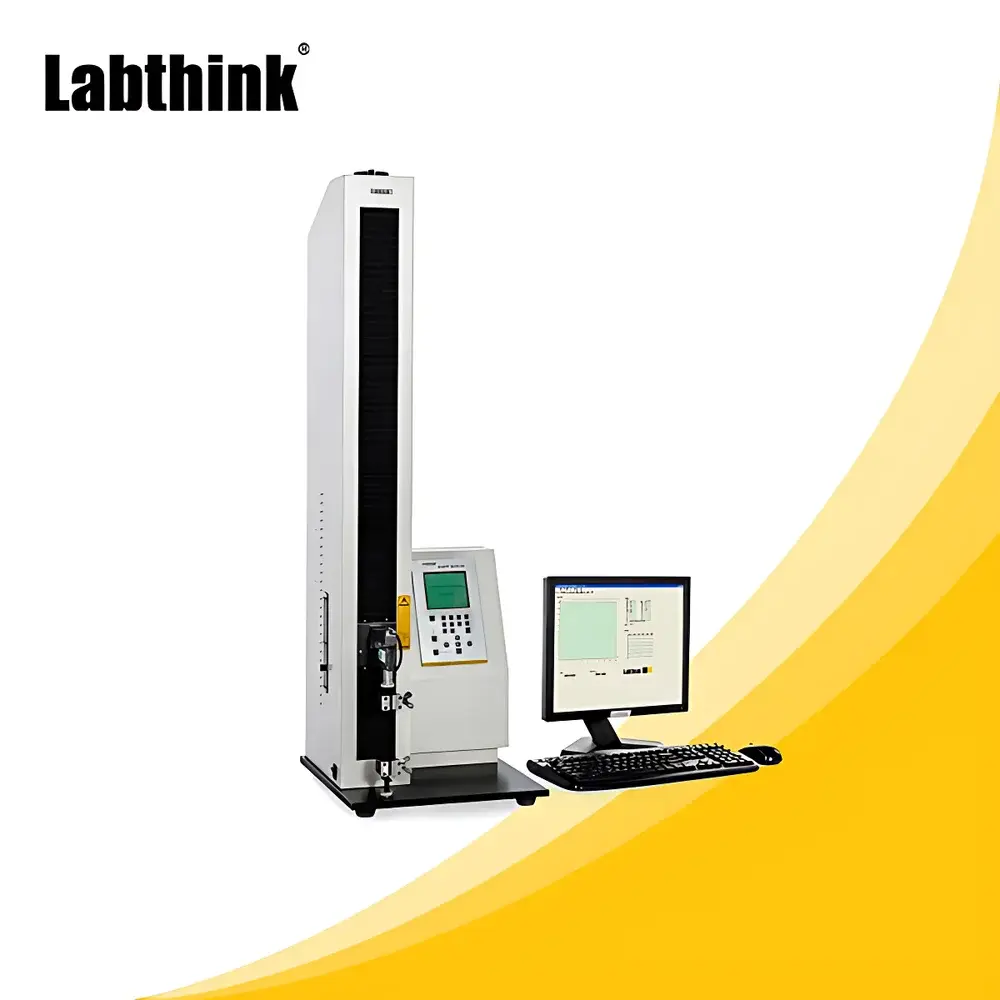
Labthink XLW(PC) 90° Peel Strength Tester for Hydrophilic Plasters and Transdermal Patches
| Brand | Labthink |
|---|---|
| Model | XLW(PC) |
| Type | Electromechanical Tensile Testing Machine |
| Force Accuracy | Class 0.5 |
| Maximum Travel | 1000 mm |
| Standard Load Capacity | 500 N |
| Test Speed Range | 50–500 mm/min (adjustable in discrete steps) |
| Sample Width | 30 mm (standard), 50 mm (optional) |
| Dimensions (L×W×H) | 450 × 450 × 1410 mm |
| Weight | 68 kg |
| Power Supply | 220 VAC 50 Hz / 120 VAC 60 Hz |
Overview
The Labthink XLW(PC) 90° Peel Strength Tester is a precision electromechanical tensile testing system engineered for quantitative mechanical evaluation of adhesive performance in hydrophilic plasters, transdermal patches (including traditional Chinese medicine-based bu-bu gao formulations), medical tapes, protective films, and flexible packaging materials. It operates on the principle of controlled uniaxial tension under standardized angular peel configurations—primarily 90° and 180°—in accordance with internationally recognized test methodologies. The instrument applies calibrated force via a servo-controlled crosshead to separate a bonded specimen from a rigid substrate at a defined angle and constant speed, enabling direct measurement of interfacial adhesion energy per unit width (N/25 mm or N/mm). Its modular architecture supports both routine quality control and advanced R&D workflows across pharmaceutical, biomedical device, and functional packaging sectors.
Key Features
- Class 0.5 force accuracy compliant with ISO 7500-1 and ASTM E4, ensuring traceable metrological reliability for regulatory submissions.
- Programmable test speeds (50, 100, 150, 200, 250, 300, and 500 mm/min) aligned with pharmacopoeial requirements (e.g., USP , Ph. Eur. 2.9.27) and material-specific standards.
- 1000 mm vertical travel range accommodates extended peel paths required for low-tack hydrogels and viscoelastic patch matrices without repositioning.
- Modular夹具 system: standard 30 mm parallel jaw clamps (ISO 29862-compliant), optional 50 mm jaws, floating roller fixtures (ASTM D3330), and custom-designed fixtures for non-planar substrates (e.g., curved vials, catheter hubs).
- Rigid four-column load frame with reinforced aluminum alloy construction minimizes deflection during high-force peel events (up to 1000 N with customization), maintaining linearity across full stroke.
- Integrated thermal stabilization circuitry ensures consistent motor torque output across ambient temperature fluctuations (15–30 °C operational range).
Sample Compatibility & Compliance
The XLW(PC) accommodates a broad spectrum of anisotropic and heterogeneous specimens: hydrophilic polymer matrices (carbomer-, PVP-, or sodium alginate-based plasters), silicone- or acrylic-coated medical tapes, laminated pouch films (PET/AL/PE), nonwovens, rubberized backing layers, and elastomeric sealants. It fully supports compliance with ISO 37 (rubber tensile properties), ISO 29862 (peel adhesion of pressure-sensitive tapes), ASTM D1000 (electrical tape adhesion), ASTM F88 (package seal strength), ASTM F904 (comparative peel adhesion), GB/T 2792 (180° peel), GB/T 4850 (90° peel), and YY/T 0148 (medical adhesive tapes). All test protocols are executable under GLP-aligned conditions, with audit-trail-enabled software logging operator ID, calibration status, environmental parameters, and raw force-displacement data.
Software & Data Management
Labthink’s proprietary PC-based control and analysis software provides real-time force–displacement curve visualization, automatic peak detection, plateau averaging (per ASTM D903), and statistical reporting (mean, SD, CV%, min/max). Raw data exports in CSV and XML formats comply with FDA 21 CFR Part 11 requirements when deployed with electronic signatures and role-based access controls. Software modules support multi-method sequencing (e.g., sequential 90° peel → tensile rupture → tear initiation), batch processing of up to 99 samples, and customizable report templates aligned with internal SOPs or external regulatory dossiers (e.g., CMC sections of NDAs).
Applications
- Quantification of 90° peel adhesion strength for hydrophilic plasters under hydrated conditions (simulating in vivo skin contact).
- Evaluation of aging effects on transdermal patch adhesive integrity after accelerated stability testing (40 °C/75% RH, ICH Q1A).
- Comparative assessment of release liner adhesion loss during manufacturing and storage.
- Determination of debonding force thresholds for peel-and-reseal packaging systems (e.g., diagnostic test strips, wound care kits).
- Characterization of cohesive failure vs. interfacial failure modes via post-test specimen inspection and force curve morphology analysis.
- Validation of adhesive uniformity across large-area patches using multi-point peel mapping (with optional automated stage).
FAQ
What standards does the XLW(PC) directly support for pharmaceutical adhesive testing?
It natively executes test methods specified in USP , Ph. Eur. 2.9.27, ISO 29862, ASTM F88/F904, and YY/T 0148, with preloaded method templates and pass/fail criteria configuration.
Can the system perform both 90° and 180° peel tests without hardware modification?
Yes—the angular orientation is determined solely by fixture geometry; standard 90° and 180° peel fixtures are included, and additional angles (e.g., 45°, 135°) are supported via optional tooling.
Is the force sensor calibrated traceable to national metrology institutes?
All factory calibrations are performed using NIST-traceable deadweight standards, and calibration certificates include uncertainty budgets per ISO/IEC 17025.
Does the software meet 21 CFR Part 11 requirements for electronic records?
When configured with user authentication, audit trail logging, and electronic signature modules, the system satisfies Part 11 technical controls for regulated environments.
What maintenance intervals are recommended for long-term force accuracy retention?
Annual verification against certified reference loads is recommended; daily zero-point checks and quarterly sensitivity validation using check weights are advised for GMP operations.



