
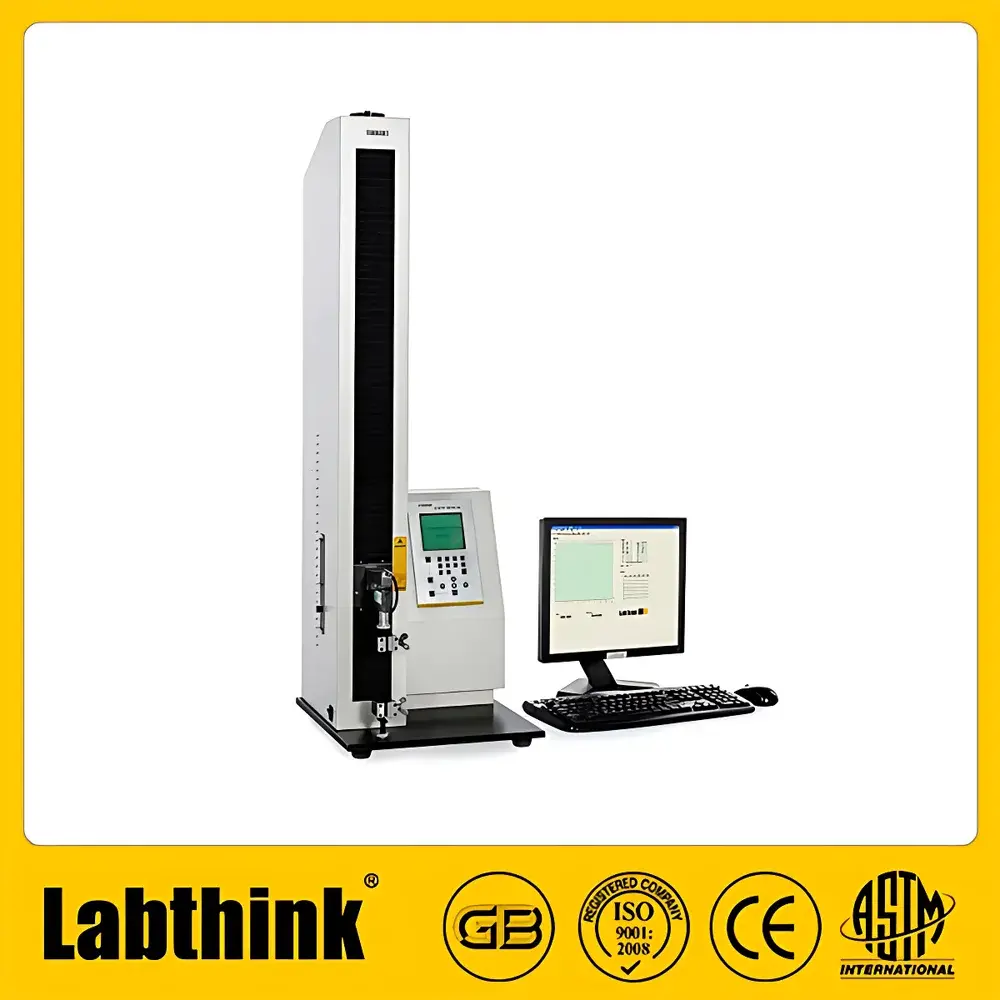
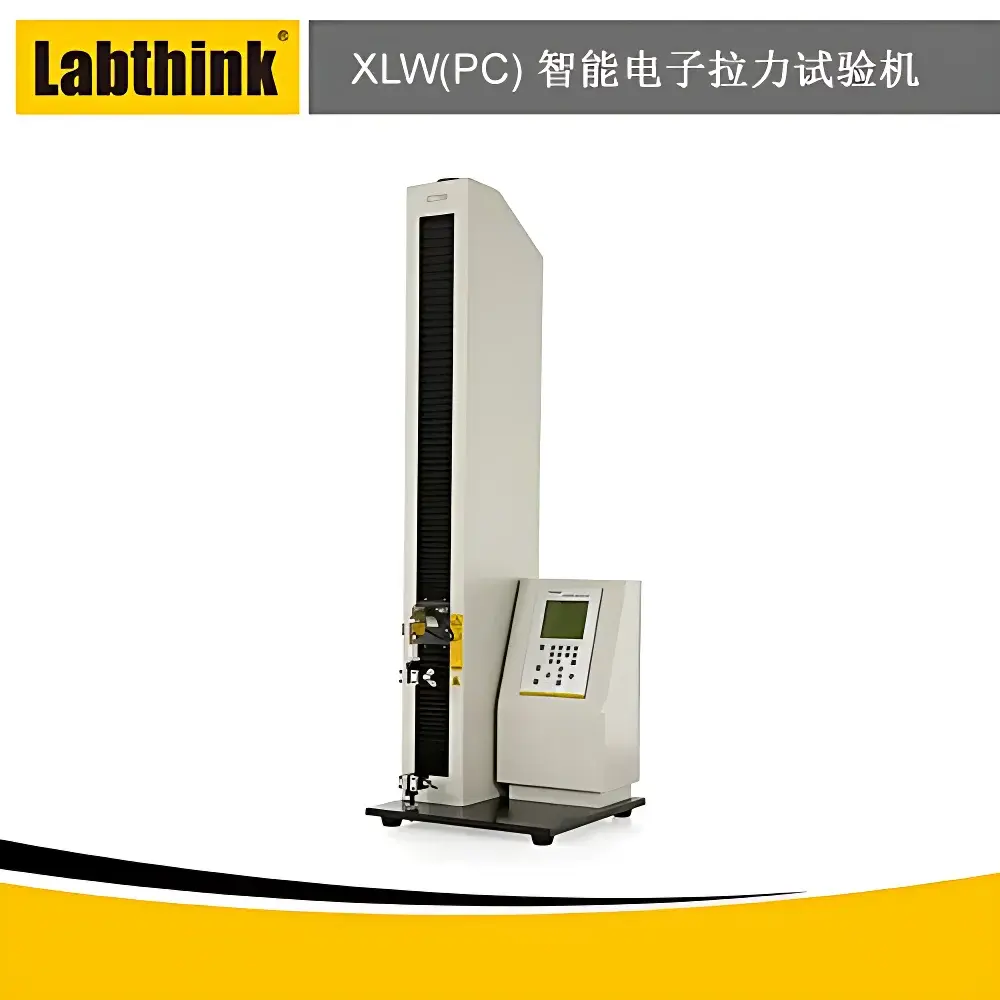
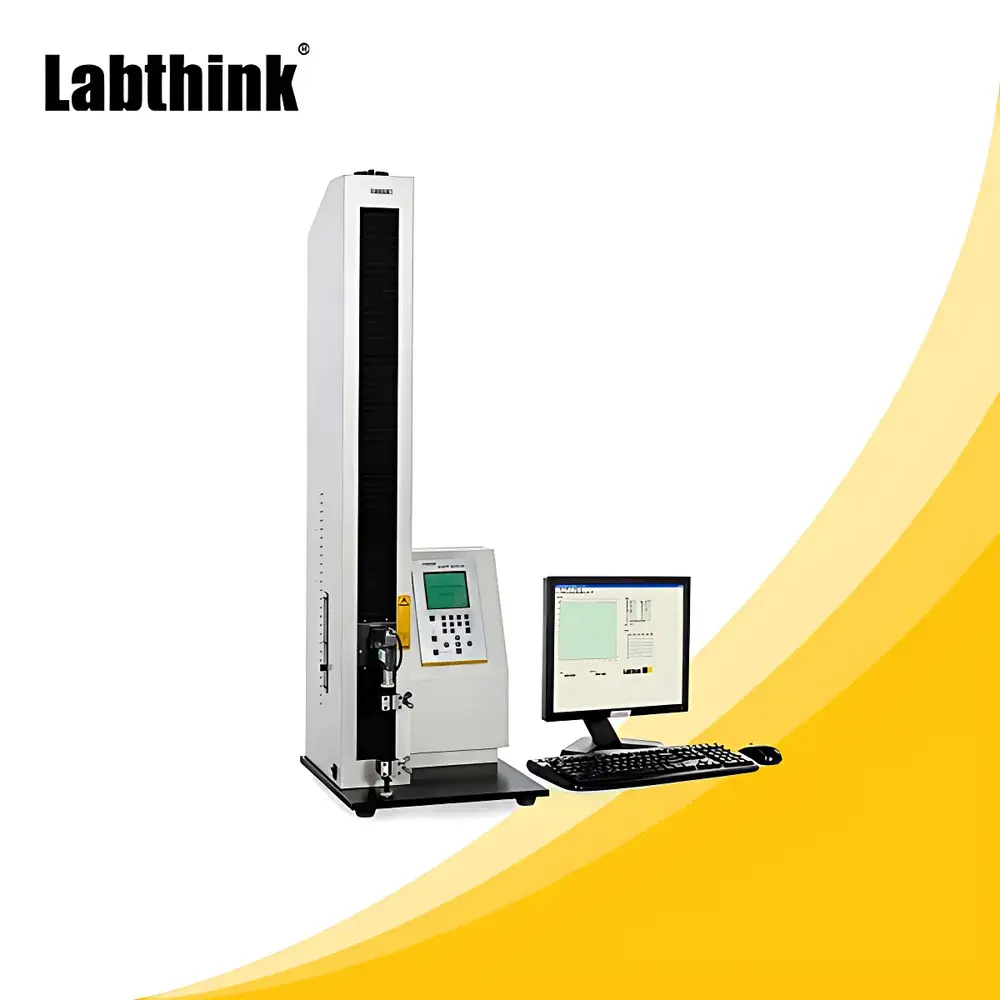
Labthink XLW(PC) Advanced Electronic Tensile Tester for Flexible Packaging Materials
| Brand | Labthink |
|---|---|
| Model | XLW(PC) |
| Origin | Shandong, China |
| Manufacturer Type | Direct Manufacturer |
| Instrument Type | Electronic Tensile Testing Machine |
| Maximum Load Capacity | 1 kN |
| Force Accuracy Class | 0.5 |
| Test Stroke | 1000 mm |
| Standard Load Cell | 500 N |
| Optional Load Cells | 50 N, 100 N, 250 N, 750 N, 1000 N |
| Test Speeds | 50, 100, 150, 200, 250, 300, 500 mm/min |
| Specimen Width (Standard Clamp) | 30 mm |
| Optional Clamp Width | 50 mm |
| Dimensions (L×W×H) | 450 × 450 × 1410 mm |
| Weight | 68 kg |
| Power Supply | 220 VAC 50 Hz / 120 VAC 60 Hz |
| Compliance | ISO 37, ASTM D882, ASTM D1938, ASTM F88, GB/T 1040.1–1040.5, GB/T 4850, GB/T 12914, GB/T 17200, GB/T 16578.1, QB/T 2358 |
Overview
The Labthink XLW(PC) Advanced Electronic Tensile Tester is a precision-engineered universal testing system designed specifically for mechanical property evaluation of thin, flexible materials used in packaging, medical device assembly, and functional laminates. It operates on the fundamental principle of uniaxial tensile loading under controlled displacement rate, where specimens are clamped between two parallel grips and subjected to programmed relative motion. Force is measured via high-stability load cells mounted on the moving crosshead, while axial displacement is tracked using an integrated linear encoder with sub-millimeter resolution. The system computes key mechanical parameters—including tensile strength, elongation at break, Young’s modulus, peel adhesion, tear resistance, heat seal strength, puncture force, and low-speed unwind torque—based on real-time force–displacement data acquisition synchronized at ≥1 kHz sampling frequency. Its architecture adheres to the mechanical design conventions defined in ASTM E4 for verification of force-measuring instruments and ISO 7500-1 for static calibration of universal testing machines.
Key Features
- Force measurement accuracy certified to Class 0.5 per ISO 376 and GB/T 16825.1, ensuring traceable repeatability within ±0.5% of full-scale reading across the entire operating range.
- Seven preconfigured test modes: tensile, 180° peel, 90° peel, tear (Elmendorf-type geometry), heat seal strength, puncture, and low-speed unwind—each compliant with dedicated international standards (e.g., ASTM D882 for tensile, ASTM F88 for seal strength, ASTM D1938 for tear).
- Extended 1000 mm stroke accommodates high-elongation polymers such as LDPE, TPU, and hydrogel films without premature grip slippage or frame interference.
- Modular load cell options (50 N to 1000 N) enable optimal signal-to-noise ratio for both ultra-thin substrates (<12 µm PET) and reinforced composites (e.g., aluminum-laminated barrier films).
- Seven discrete test speeds (50–500 mm/min) satisfy regulatory requirements for method-specific strain rates—e.g., 300 mm/min for ASTM D882, 200 mm/min for GB/T 1040.3, and 50 mm/min for slow-peel adhesive validation.
- Dual-safety architecture includes mechanical limit switches, electronic overload cutoff (>110% FS), automatic return-to-start post-test, and non-volatile memory retention during power interruption.
- Human-machine interface features a 7-inch LCD touchscreen with tactile PVC membrane keypad, supporting multilingual menu navigation (English, Spanish, Chinese) and real-time graphical display of force–displacement curves.
Sample Compatibility & Compliance
The XLW(PC) is validated for routine testing of single-layer and multilayer flexible substrates including polyolefins, polyesters, nylons, metallized films, paperboard laminates, medical-grade nonwovens, silicone-coated release liners, and pressure-sensitive adhesive tapes. Its clamp geometry conforms to ISO 37 Annex B for dumbbell-shaped specimens and ASTM D882 Section 7 for gauge-length definition. All test protocols align with Good Laboratory Practice (GLP) documentation requirements: audit trails record operator ID, timestamp, environmental conditions (optional humidity/temperature input), calibration history, and raw data checksums. The instrument supports 21 CFR Part 11-compliant electronic signatures when paired with Lystem™ Laboratory Data Management System (LDMS), enabling secure user access control, versioned report generation, and FDA-submission-ready PDF archives.
Software & Data Management
The embedded Lystem™ TestSuite software provides ISO/IEC 17025-aligned data handling capabilities. It enables batch-wise statistical analysis (mean, SD, CV%, min/max, confidence intervals), overlay comparison of up to eight test curves, and automated pass/fail evaluation against user-defined specification limits. Raw ASCII data exports include time-stamped force (N), displacement (mm), stress (MPa), and strain (%) columns—compatible with MATLAB, OriginLab, and JMP for advanced regression modeling. Integration with Lystem™ LDMS permits centralized storage, role-based permissions, cross-instrument trending, and scheduled calibration alerts. All software modules undergo annual verification per ISO/IEC 17025 Clause 5.9.2 for computational integrity.
Applications
- Quality assurance of thermoformed blister lidding films per USP extractable profiling prerequisites.
- Evaluation of pouch seal integrity for sterile barrier systems under ISO 11607-2 accelerated aging protocols.
- Comparative tear propagation resistance of battery separator membranes (e.g., PE/PP trilayer) per IEC 62660-1.
- Adhesion quantification of functional coatings on pharmaceutical foil laminates per EP 2.9.40.
- Mechanical stability assessment of wound dressing backing layers under dynamic hydration conditions.
- Validation of label adhesion durability on HDPE containers exposed to thermal cycling (−20°C to 60°C).
FAQ
What international standards does the XLW(PC) support out-of-the-box?
It natively implements test sequences aligned with ASTM D882, ASTM F88, ISO 37, GB/T 1040.1–1040.5, GB/T 4850, and QB/T 2358—with parameter presets matching required specimen dimensions, speed, and fixture configurations.
Can the system be integrated into an existing LIMS environment?
Yes—via TCP/IP or RS232 serial protocol using ASTM WK51232-compliant ASCII data streaming; optional OPC UA gateway available for Siemens, Rockwell, or LabVantage interoperability.
Is calibration traceable to national metrology institutes?
All factory calibrations are performed using NIST-traceable deadweight standards (Fluke 6200 series) and documented in ISO/IEC 17025-accredited certificates valid for 12 months.
Does the instrument meet electromagnetic compatibility (EMC) requirements for laboratory deployment?
Complies with EN 61326-1:2013 for laboratory equipment immunity and emissions, tested per IEC 61000-4-2 (ESD), -4-3 (RF), and -4-4 (EFT) at third-party accredited facilities.
What maintenance intervals are recommended for long-term accuracy retention?
Load cell zero-point verification every 30 days; full recalibration annually or after 5,000 test cycles; lubrication of lead screws and guide rails every 6 months per maintenance logbook entry.



