
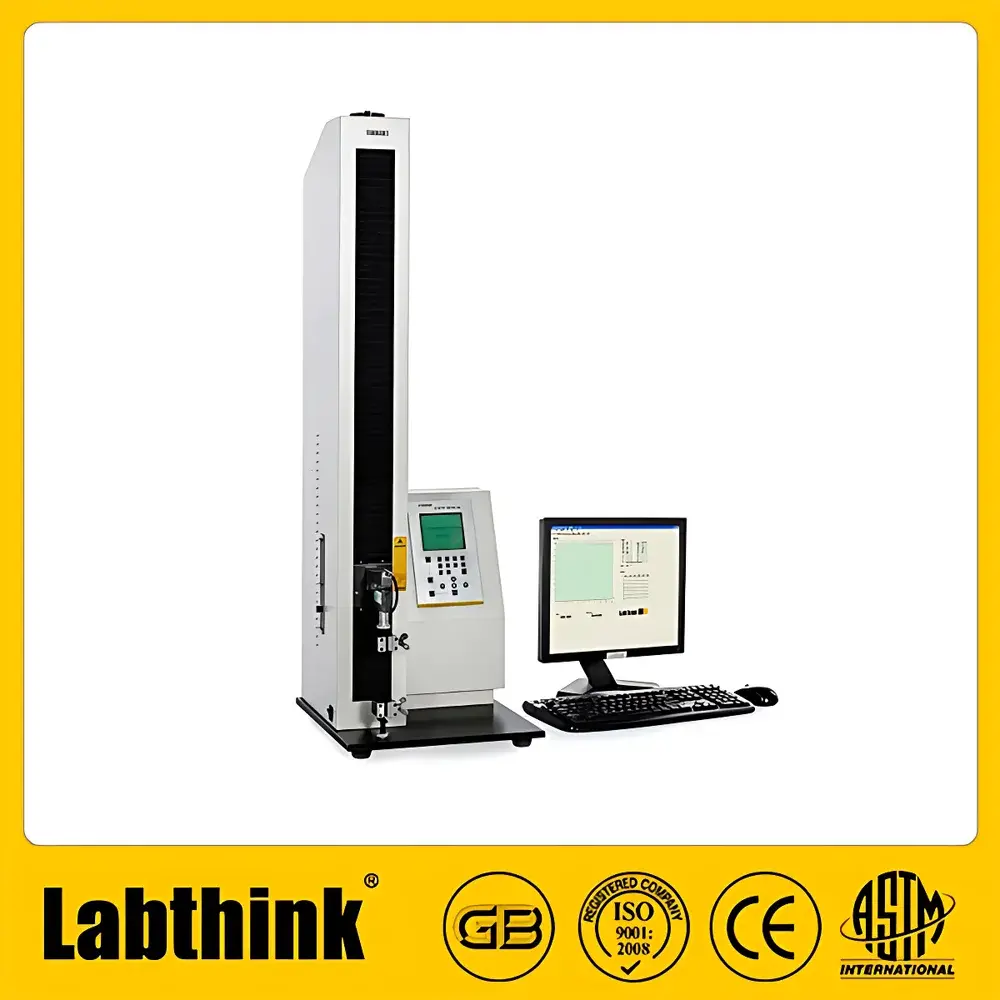
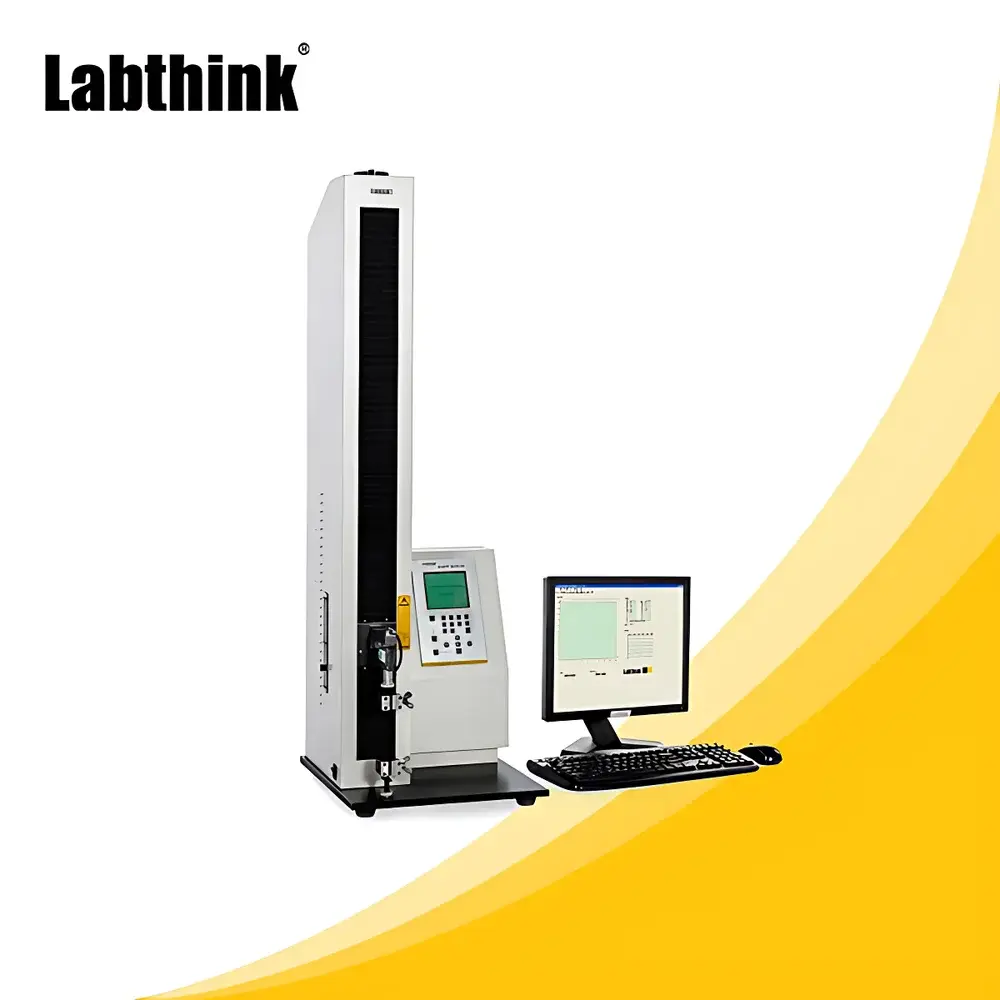
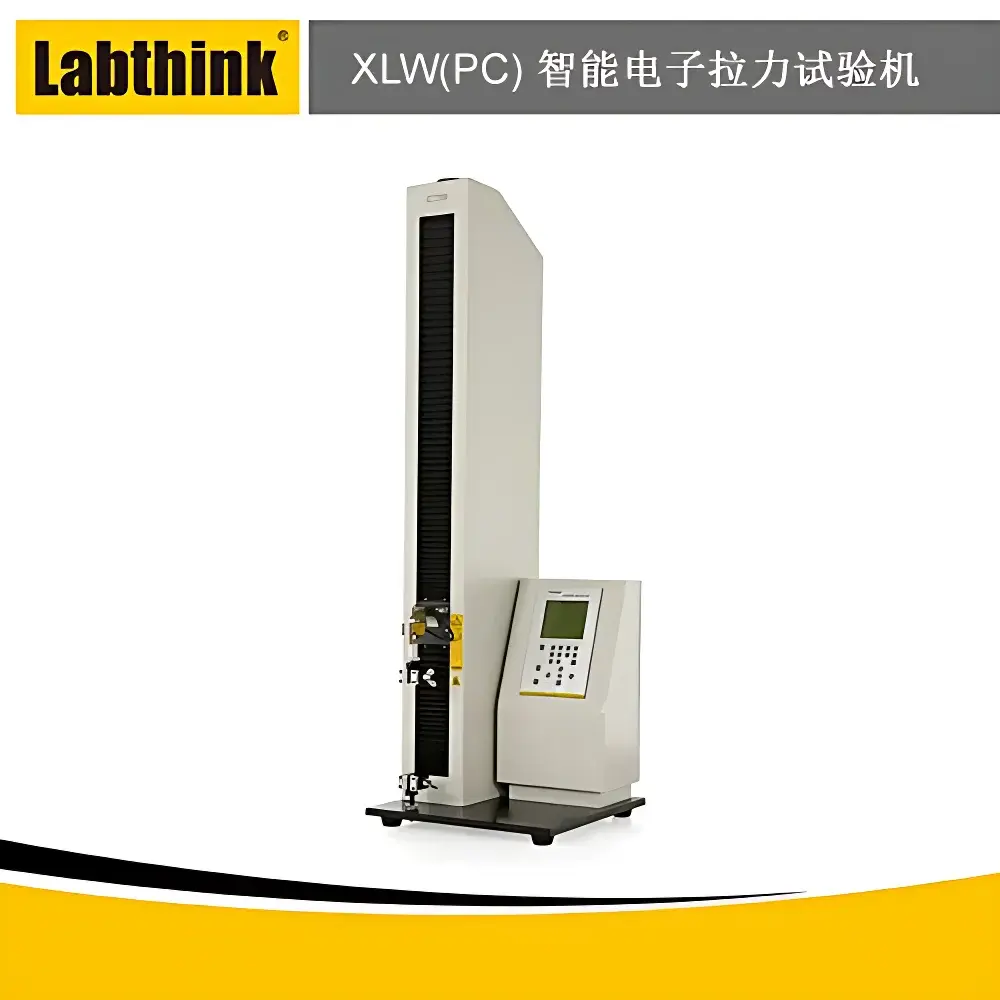
Labthink XLW(PC) Intelligent Tensile Tester for Pant-type and Right-angle Tear Strength Testing of Packaging Films
| Brand | Labthink |
|---|---|
| Model | XLW(PC) |
| Type | Universal Electronic Tensile & Tear Tester |
| Standards Compliance | ISO 37, ASTM D1938 (Pant Tear), ASTM D882 (Tensile), ASTM F88 (Seal Strength), GB/T 1040, GB/T 16578.1, GB/T 12914, QB/T 2358 |
| Load Capacity | 50–1000 N (standard 500 N) |
| Accuracy Class | 0.5 |
| Test Speeds | 50, 100, 150, 200, 250, 300, 500 mm/min |
| Stroke | 1000 mm |
| Specimen Width | 30 mm (standard), 50 mm (optional) |
| Power Supply | 220 VAC 50 Hz / 120 VAC 60 Hz |
| Dimensions (L×W×H) | 450 × 450 × 1410 mm |
| Net Weight | 68 kg |
| Control System | Microprocessor-based with PVC membrane keypad and large LCD display |
| Data Interface | Lystem™ Laboratory Data Sharing System compatible |
| Safety Features | Limit switch protection, overload cutoff, automatic return, power-loss memory |
Overview
The Labthink XLW(PC) Intelligent Tensile Tester is a precision-engineered universal testing system designed specifically for mechanical property evaluation of flexible packaging materials in regulated industrial and R&D environments. It operates on the fundamental principle of uniaxial force application under controlled displacement: test specimens are clamped between two parallel grips, one stationary and one motor-driven, while high-fidelity load cells and linear displacement transducers continuously record force (N) and extension (mm) throughout the test cycle. This raw data enables quantitative derivation of critical mechanical parameters—including tensile strength, elongation at break, tear initiation resistance (pant-type), right-angle tear strength, peel adhesion, heat seal strength, puncture force, and deformation modulus—per standardized test geometries defined in ISO, ASTM, and GB methodologies. The instrument’s modular architecture supports both routine QC verification and method development workflows, making it suitable for laboratories requiring traceable, repeatable, and auditable mechanical testing per GLP/GMP frameworks.
Key Features
- Class 0.5 accuracy certified load measurement across seven selectable force ranges (50 N to 1000 N), ensuring metrological integrity for regulatory submissions and inter-laboratory comparisons.
- Seven pre-programmed, independent test modes—including pant-type tear (ASTM D1938), right-angle tear (ISO 37), tensile (ASTM D882), peel (ASTM D3330), heat seal strength (ASTM F88), puncture (ASTM F1306), and shear adhesion (GB/T 7122)—all accessible via intuitive menu navigation.
- Extended 1000 mm crosshead stroke accommodates high-elongation films, elastomeric laminates, and nonwovens without specimen slippage or premature failure.
- Seven discrete test speeds (50–500 mm/min) allow precise alignment with standard-specified strain rates, minimizing viscoelastic artifacts during dynamic loading.
- Microprocessor-controlled operation with tactile PVC keypad, real-time LCD display, and built-in safety logic—including mechanical limit switches, electronic overload cutoff, auto-return post-test, and EEPROM-based power-loss memory.
- Modular fixture system supporting standardized 30 mm wide specimens (ISO/ASTM compliant), optional 50 mm jaws, floating roller clamps for low-modulus films, and custom-designed fixtures for specialized geometries (e.g., pouch seals, medical device backing layers).
Sample Compatibility & Compliance
The XLW(PC) accommodates a broad spectrum of soft packaging substrates: biaxially oriented polypropylene (BOPP), polyethylene terephthalate (PET), cast polypropylene (CPP), aluminum foil laminates, metallized films, pressure-sensitive adhesives, medical-grade hydrocolloid dressings, breathable backsheets, spunbond/meltblown nonwovens, and paper-based composites. All test configurations adhere strictly to internationally recognized reference standards—including ISO 37 (rubber and plastics—determination of tear strength), ASTM D1938 (standard test method for tear propagation resistance of plastic film and thin sheeting by pendulum method—pant tear), ASTM D882 (tensile properties of thin plastic sheeting), ASTM F88 (seal strength of flexible barrier materials), and GB/T 16578.1 (plastics—film and sheeting—determination of tear resistance—trouser tear method). Instrument validation documentation supports compliance with FDA 21 CFR Part 11 requirements when used with Lystem™ software-enabled audit trails and electronic signatures.
Software & Data Management
The embedded control firmware and optional Lystem™ Laboratory Data Sharing System provide full lifecycle data governance. Real-time curve plotting displays force vs. displacement, stress vs. strain, and derivative metrics (e.g., modulus, yield point). Post-test analysis includes group statistics (mean, SD, CV%), overlaid comparative curves for material lot evaluation, pass/fail threshold flagging against specification limits, and export-ready reports in PDF, CSV, and XML formats. Lystem™ integration enables centralized storage, role-based access control, versioned report archiving, and automated synchronization across distributed QA labs—facilitating internal audits and regulatory inspections under ISO/IEC 17025 and ICH Q5E guidelines.
Applications
- Quantitative assessment of tear resistance in food and pharmaceutical blister lidding foils under accelerated aging conditions.
- Validation of seal integrity for sterile barrier systems per ISO 11607-2, including hot-bar and impulse seal evaluation.
- Comparative analysis of adhesive bond durability in transdermal patch backing layers subjected to simulated skin flexure.
- Characterization of delamination onset in multilayer coextruded films used in retort pouches.
- QC release testing of medical device packaging per ASTM F1886/F1886M (integrity of seals) and ASTM F2054 (burst testing).
- Development of sustainable mono-material alternatives to traditional laminates, where balanced tensile and tear performance is critical to machinability and end-use reliability.
FAQ
What tear test methods does the XLW(PC) support?
It supports pant-type tear (ASTM D1938), right-angle tear (ISO 37), and trapezoidal tear (GB/T 12914), all executed using standardized specimen geometries and grip configurations.
Can the instrument be used for non-standard specimen widths?
Yes—while 30 mm is the default width per ISO/ASTM, optional 50 mm jaw sets and custom fixtures are available for non-standard geometries, subject to calibration verification.
Is the system compliant with FDA 21 CFR Part 11?
When deployed with Lystem™ software configured for electronic signatures, audit trails, and user access controls, the system meets core technical requirements for Part 11 compliance in regulated environments.
How is calibration maintained across multiple force ranges?
Each sensor range is individually calibrated using NIST-traceable deadweight standards; calibration certificates include uncertainty budgets and are valid for 12 months under normal operating conditions.
Does the tester accommodate dynamic testing protocols such as cyclic loading?
No—the XLW(PC) is optimized for static and quasi-static uniaxial tests; for fatigue or dynamic mechanical analysis, dedicated DMA or servo-hydraulic systems are recommended.







