
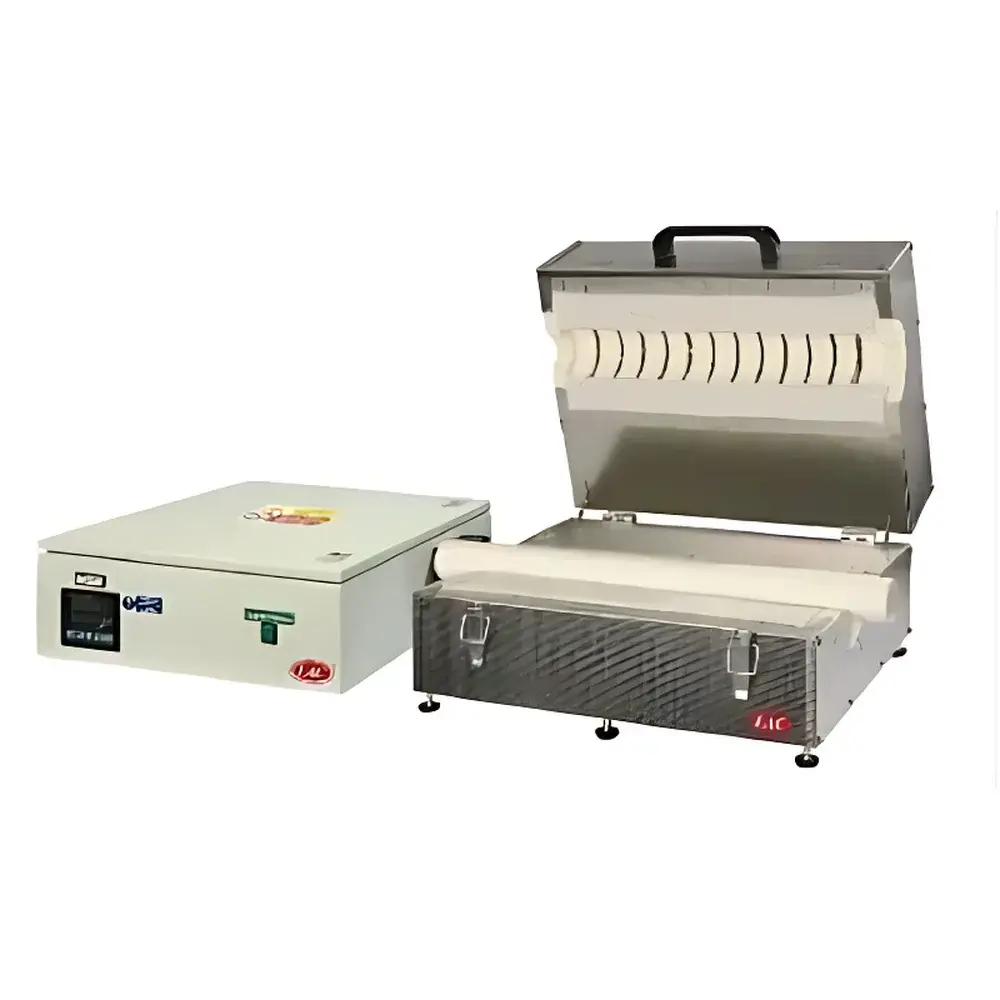
LAC LT Series Laboratory Tube Furnace
| Brand | LAC |
|---|---|
| Origin | Czech Republic |
| Model | LT |
| Type | Horizontal Tube Furnace |
| Heating Zones | Single or Triple (optional for ≥750 mm tube length) |
| Max Temperature | 500 °C / 750 °C (model-dependent) |
| Tube ID | 50 mm / 75 mm / 100 mm |
| External Dimensions (W×H×D) | 300×310×510 mm to 450×450×650 mm |
| Power Input | 3.2–11.5 kW |
| Voltage | 400 V (3-phase) or 230 V (single-phase, model-specific) |
| Weight | 75–95 kg |
| Thermocouple Type | S-type (Pt/Pt–10% Rh) |
| Controller | HT 40 standard |
| Insulation | Modular mineral fiber plates |
| Construction | Frameless stainless steel housing, desktop configuration, hinged top lid |
| Safety | Semiconductor relay, independent wiring board, integrated overtemperature protection |
Overview
The LAC LT Series Laboratory Tube Furnace is a precision-engineered horizontal resistive heating system designed for controlled thermal processing in academic research laboratories, materials science departments, and industrial R&D facilities. Operating on the principle of Joule heating via embedded resistance wire coils housed within high-density mineral insulation grooves, the LT furnace delivers stable, repeatable temperature profiles across its heated zone—critical for applications requiring precise thermal history control, such as annealing, sintering, calcination, and controlled-atmosphere reactions. Its frameless stainless-steel construction ensures structural integrity, corrosion resistance, and long-term dimensional stability under repeated thermal cycling. The hinged upper section enables rapid access to the quartz or ceramic tube without disassembly, while the modular mineral plate insulation minimizes radial heat loss and supports energy-efficient operation with fast ramp rates and low steady-state power consumption.
Key Features
- Frameless 304 stainless-steel enclosure with smooth, weld-free surfaces for ease of cleaning and compliance with ISO 14644 cleanroom-compatible maintenance protocols
- Desktop-integrated design with compact footprint—optimized for benchtop integration in space-constrained labs without compromising thermal performance
- Hinged top-lid mechanism operated via ergonomic handle, allowing full 90° upward rotation for unobstructed tube loading/unloading and visual inspection of heating elements
- Heating elements embedded in machined grooves within segmented mineral fiber insulation modules—ensuring uniform axial temperature distribution and minimizing hot-spot formation
- Standard HT 40 digital controller with PID algorithm, adjustable ramp/soak parameters, and built-in overtemperature cutoff (OTC) at 50 °C above setpoint
- Optional INDUSTRY programmable controller supporting up to 30 multi-step thermal cycles (15 segments per program), real-time clock scheduling, and event-triggered logging
- Semiconductor solid-state relay (SSR) for silent, zero-crossing switching—eliminating electromagnetic interference (EMI) that could affect adjacent analytical instruments (e.g., mass spectrometers, microbalances)
- Independent electrical switchboard compartment isolating mains wiring from furnace chamber—enhancing serviceability and meeting IEC 61010-1 safety requirements for laboratory equipment
Sample Compatibility & Compliance
The LT series accommodates standard high-purity quartz, alumina, or silicon carbide tubes (ID: 50–100 mm; length: 300–1100 mm), with optional vertical mounting stands and mineral-fiber tube packers for improved thermal homogeneity and gas flow management. For inert or reducing atmospheres, the furnace integrates seamlessly with standard gas inlet ports (¼” NPT) compatible with mass flow controllers and gas purification systems. All models comply with CE marking requirements under the EU Machinery Directive 2006/42/EC and Low Voltage Directive 2014/35/EU. The HT 40 and INDUSTRY controllers support configurable audit trails and parameter lockout functions—facilitating alignment with GLP and GMP documentation practices where traceable thermal process records are required (e.g., catalyst activation validation, battery material synthesis).
Software & Data Management
When equipped with the optional INDUSTRY controller and RS-232/RS-485 interface, the LT furnace supports bidirectional communication with Windows-based monitoring software (SW Set). This suite enables real-time temperature graphing, cycle progress tracking, automatic CSV export of time-temperature-pressure logs, and password-protected user role assignment (operator, engineer, administrator). Data files include timestamps, controller firmware version, and hardware identification—supporting 21 CFR Part 11 readiness when paired with validated electronic signature workflows. Optional graphic temperature recorders provide analog backup for critical qualification runs, satisfying dual-recording requirements in regulated environments.
Applications
- Thermal treatment of nanomaterials (e.g., graphene oxide reduction, metal–organic framework activation)
- Controlled oxidation/reduction of thin films and coated substrates
- Preparation of electrode materials for lithium-ion and solid-state batteries
- Calibration of thermocouples and reference standards per ASTM E230/E220
- Atmosphere-controlled synthesis of phosphors, ferrites, and piezoelectric ceramics
- Heat treatment validation studies compliant with ISO 9001 clause 8.5.1 (control of production and service provision)
FAQ
What tube materials are compatible with the LT furnace?
Quartz (up to 1100 °C), high-purity alumina (up to 1600 °C), and silicon carbide (up to 1500 °C) tubes are supported—subject to maximum operating temperature limits of the selected LT model.
Is the furnace suitable for vacuum applications?
Yes—when fitted with vacuum-rated flanges and O-rings, and used with compatible pumping systems; however, vacuum integrity must be verified independently per ISO 2859-1 sampling plans.
Can multiple LT furnaces be networked for synchronized operation?
Via RS-485 daisy-chaining and custom SCADA integration, up to 32 units may share a common master controller for coordinated thermal profiling in multi-stage reaction systems.
Does the INDUSTRY controller meet FDA 21 CFR Part 11 requirements?
The controller provides electronic signature capability, audit trail generation, and user access controls—however, full Part 11 compliance requires site-specific validation including IQ/OQ/PQ documentation and procedural SOPs.
What maintenance intervals are recommended for long-term reliability?
Inspect heating elements and insulation integrity every 500 operational hours; recalibrate S-type thermocouple annually per ISO/IEC 17025 accredited procedures; verify SSR functionality during each preventive maintenance cycle.



