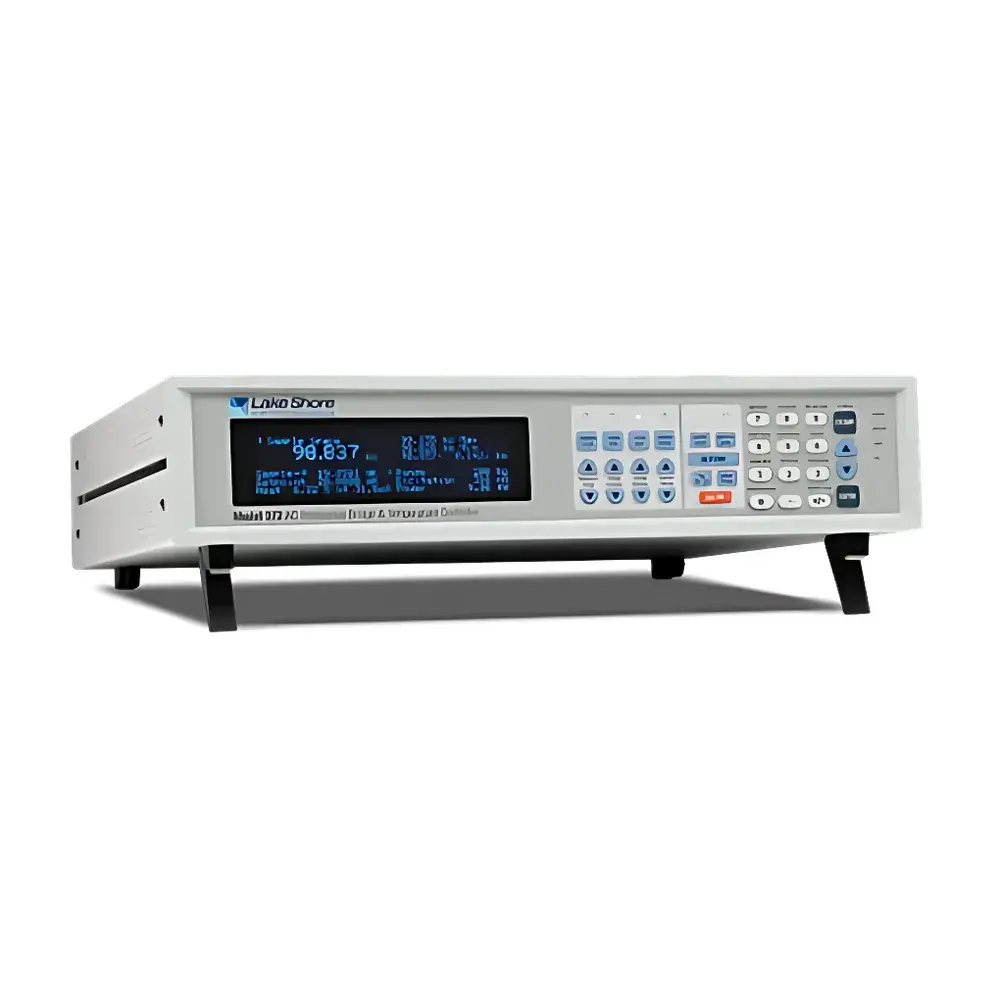
Lake Shore 372 AC Resistance Bridge and Temperature Controller
| Brand | Lake Shore |
|---|---|
| Origin | USA |
| Model | 372 |
| Type | Cryogenic AC Resistance Bridge & Dual-Channel Temperature Controller |
| Application | Sub-100 mK Dilution Refrigerator Thermometry and Sample/Heater Control |
| Compliance | Designed for GLP/GMP-aligned low-temperature physics labs |
Overview
The Lake Shore 372 AC Resistance Bridge and Temperature Controller is a precision metrology-grade instrument engineered specifically for cryogenic thermometry and closed-loop temperature control in ultra-low-temperature (ULT) environments—particularly dilution refrigerators operating below 100 mK. Unlike general-purpose impedance analyzers or DC resistance bridges, the 372 employs a low-power, multi-frequency sinusoidal excitation architecture combined with true 4-wire differential AC measurement to eliminate self-heating artifacts and minimize parasitic thermal loading on delicate quantum devices and sensors. Its core measurement principle relies on synchronous detection of voltage across a known current stimulus, enabling high-resolution determination of sensor resistance with sub-picoampere bias currents and femtowatt-level dissipation. This architecture ensures traceable, reproducible temperature readings from calibrated resistive sensors—including Cernox®, Rox™, germanium, and RhFe—while simultaneously supporting real-time PID regulation of sample and ramp heaters with dual independent control loops.
Key Features
- Ultra-low-noise AC resistance measurement: 22-range resistance span from 2 mΩ to 63.2 MΩ; RMS excitation current programmable from 1 pA to 31.6 mA
- Dual independent heater control channels: Sample heater (up to 10 W into 25 Ω or 50 Ω loads) and ramp heater (10 W, configurable for fast cooldown or controlled warm-up)
- Patented balanced noise-suppression current source: Eliminates ground-loop coupling paths, critical for minimizing Johnson-Nyquist heating in sub-50 mK systems
- Active guard-driven cabling: Reduces stray capacitance in scanner interconnects, preserving measurement integrity across extended cryogenic wiring harnesses
- Galvanic isolation: All measurement inputs, control outputs, and heater circuits are electrically isolated from chassis ground and each other to prevent cross-talk and common-mode interference
- Multi-frequency excitation: Five selectable sine-wave frequencies (9.8 Hz, 11.6 Hz, 13.7 Hz default, 16.2 Hz, 18.2 Hz) optimized to avoid line-frequency harmonics and mechanical resonance in cryostat structures
- Scalable channel architecture: Native single-input design expandable to 16 simultaneous measurement points via optional Lake Shore 3726 16-channel scanner (4 pA typical DC bias) or 3708 8-channel preamplifier/scanner (2 nV/√Hz input noise)
Sample Compatibility & Compliance
The 372 is compatible with all standard negative-temperature-coefficient (NTC) and positive-temperature-coefficient (PTC) resistive cryogenic sensors, including but not limited to Cernox® CX-1050, Rox™ RX-102B-RS (down to 10 mK), germanium RTDs, and RhFe alloys. Sensor calibration curves are stored as user-defined or factory-provided Ω/K or log Ω/K tables with cubic spline interpolation. The system supports up to 25 independent calibration curves, importable via front-panel USB or computer interface. For regulatory compliance, the 372’s deterministic update rate (10 Hz per channel), non-volatile configuration storage, and full audit trail capability—when paired with validated third-party data acquisition software—enable alignment with ISO/IEC 17025, ASTM E220, and USP requirements for temperature-controlled instrumentation in research and development laboratories. Its analog outputs and digital interfaces support integration into GxP-compliant infrastructure where electronic records and signatures are enforced.
Software & Data Management
The 372 provides native RS-232, IEEE-488 (GPIB), and 10/100 Ethernet interfaces for remote command-and-control using SCPI-compliant syntax. It supports continuous streaming of primary sensor resistance, orthogonal (real/imaginary) components, heater output power, PID status variables, and alarm states at user-configurable intervals. Onboard firmware includes advanced signal processing features such as real-time min/max capture, programmable scan dwell times (1–200 s), automatic range hold during transitions, and filter windowing (1–200 s time constant). All settings—including PID parameters, curve definitions, and heater safety limits—are retained in nonvolatile memory. When used with Lake Shore’s CryoSoft™ or third-party LabVIEW/Python drivers, the instrument supports full 21 CFR Part 11 functionality including electronic signatures, role-based access control, and immutable audit logs—essential for quality assurance workflows in federally funded quantum materials research and device characterization facilities.
Applications
The 372 serves as the primary thermometric and thermal actuation platform in quantum computing testbeds, topological insulator studies, superconducting qubit characterization, and scanning tunneling microscopy (STM) cryostats. Its ability to resolve sub-microkelvin temperature fluctuations while injecting less than 1 fW into a 100 kΩ sensor makes it indispensable for measuring thermal transport in mesoscopic devices and validating phonon-limited thermal conductance models. In dilution refrigerator applications, it enables stable operation at base temperatures ≤15 mK using Rox™ sensors, with peak-to-peak stability better than 10 µK at 50 mK under optimal shielding and wiring conditions. The dual-heater architecture facilitates coordinated control of mixing chamber temperature and still-stage thermal load—critical for achieving and maintaining thermal equilibrium during long-duration coherence measurements.
FAQ
What sensor types are supported by the Lake Shore 372?
The 372 supports NTC sensors (e.g., Cernox®, germanium, carbon-glass composites) and PTC sensors (e.g., RhFe, platinum), including Rox™ RX-102B-RS optimized for operation down to 10 mK.
Can the 372 operate without a scanner?
Yes—the base unit includes one dedicated measurement input and one control input; scanners (3726 or 3708) are optional expansion modules for multi-point monitoring.
How does the 372 minimize self-heating during measurement?
Through programmable sub-picoampere excitation currents, active guarding, galvanic isolation, and selectable low-noise frequencies that avoid resonant energy coupling into the sample stage.
Is the 372 compatible with existing Lake Shore cryogenic systems?
Yes—it integrates natively with Lake Shore’s Model 3726 scanner, Model 3708 preamp/scanner, and legacy 3700-series cryogenic controllers via standardized DIN and DB15 connectors.
What safety mechanisms prevent thermal runaway during heater control?
Hardware-enforced protections include startup heater shunt relays, short-circuit detection, compliance voltage limiting, curve-based temperature ceiling enforcement, and configurable input temperature lockouts—all implemented independently of firmware execution.