
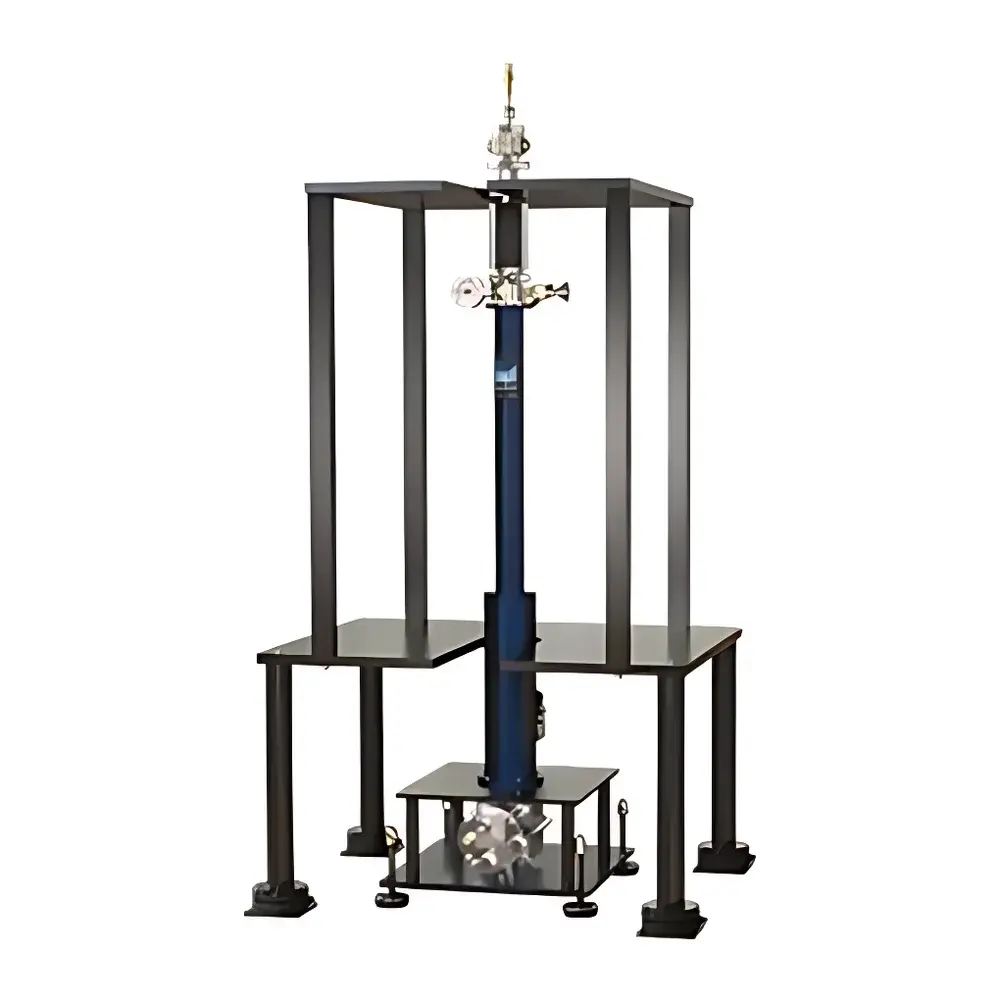
Lake Shore CCS-800 Cryogenic Thermostat for Mössbauer Spectroscopy
| Brand | Lake Shore |
|---|---|
| Origin | USA |
| Manufacturer Status | Authorized Distributor |
| Origin Category | Imported |
| Model | CCS-800 |
| Price | Upon Request |
| Cooling Type | Closed-Cycle Refrigeration |
| Temperature Range | <4.5 K to 300 K |
| Typical Temperature Stability | ±50 mK |
| Sample Environment | Exchange Gas (He) |
| Optical Window | Optional |
| Sample Loading | Top-Access |
| Sample Chamber Inner Diameter | 38 mm |
| Rotatable Sample Stage | Yes |
| Cool-Down Time | 2–2.5 h |
| Cryocooler Mounting | Bottom-Mounted |
| Vibration-Induced Linewidth Broadening | ≤0.01 mm/s (Δv/v) |
| Approximate Height | 142–168 cm |
| Weight | 27.2 kg (cryostat only) |
| Window Block Outer Diameter | 57.2 mm |
| Recommended Cryocooler Maintenance Interval | 13,000 h |
| Sample Exchange Time | ~5 min |
Overview
The Lake Shore CCS-800 Cryogenic Thermostat is a purpose-engineered closed-cycle refrigeration system designed specifically for high-resolution Mössbauer spectroscopy applications. Unlike conventional cryostats that rely on liquid helium or mechanical coolers with high intrinsic vibration signatures, the CCS-800 integrates a low-vibration, bottom-mounted pulse-tube cryocooler and a pneumatically isolated mounting platform to minimize mechanical coupling to the spectrometer. Its core function is to maintain solid-state samples—including irregularly shaped powders, foils, and bulk materials—at stable, precisely controlled temperatures from below 4.5 K up to ambient (300 K), while preserving the narrow natural linewidths essential for quantitative hyperfine interaction analysis. The system operates via static helium exchange gas within a thermally anchored sample chamber, enabling uniform conductive cooling without requiring direct thermal anchoring of the sample to a cold finger—a critical advantage for fragile or geometrically complex specimens.
Key Features
- Helium-free, closed-cycle refrigeration eliminates dependency on liquid cryogens and associated logistical constraints.
- Temperature range spanning <4.5 K to 300 K, with typical stability of ±50 mK over 1-hour intervals under steady-state conditions.
- Top-access sample loading into a 38 mm inner-diameter chamber, enabling rapid insertion and retrieval without disassembly.
- Pneumatically isolated support structure reduces transmission of cryocooler-induced vibrations to sub-10 nm RMS displacement levels—verified by Mössbauer linewidth measurements.
- Rotatable sample stage compatible with angular-dependent measurements (e.g., orientation-dependent quadrupole splitting studies).
- Optional fused silica or sapphire optical windows (57.2 mm OD) for in situ optical excitation or laser-assisted measurements.
- Integrated thermal shielding and optional lead-lined support stand (327 kg total mass) for gamma-ray background suppression in low-count-rate experiments.
Sample Compatibility & Compliance
The CCS-800 accommodates a broad class of solid-state Mössbauer-active materials, including metallic foils (e.g., 57Fe, 119Sn), oxide powders, thin-film heterostructures, and single crystals. Its exchange-gas cooling architecture ensures thermal uniformity across non-planar or low-thermal-conductivity samples without inducing thermal stress or interfacial artifacts. The system conforms to standard laboratory safety practices for cryogenic operation (ANSI/ASHRAE Standard 110) and electromagnetic compatibility (IEC 61326-1). While not certified to ISO/IEC 17025 for calibration traceability, its temperature control architecture supports GLP-compliant data acquisition when paired with NIST-traceable Pt-100 sensors and validated calibration routines.
Software & Data Management
Temperature setpoints, ramp rates, and hold durations are configured via Lake Shore’s CrossLink™ software (Windows-based), which provides real-time monitoring of sensor readings, compressor status, and cooldown progress. The software logs timestamped thermal data at user-selectable intervals (100 ms to 10 s resolution) and exports ASCII-compatible .csv files for post-processing in MATLAB, Python (NumPy/Pandas), or spectral fitting packages such as Recoil or MossWinn. Audit trails—including operator ID, parameter changes, and system alarms—are retained locally and may be exported for FDA 21 CFR Part 11–compliant environments when deployed with networked authentication and electronic signature modules.
Applications
- Quantitative analysis of isomer shift, quadrupole splitting, and magnetic hyperfine fields in paramagnetic, antiferromagnetic, and spin-canted systems.
- Low-temperature phase transition studies (e.g., spin reorientation in hematite, charge ordering in manganites).
- Time-resolved Mössbauer experiments requiring thermal cycling between discrete setpoints (e.g., relaxation kinetics in metastable states).
- Correlative measurements combining Mössbauer spectroscopy with complementary techniques—such as SQUID magnetometry or Raman scattering—via shared cryogenic infrastructure.
- Calibration and validation of theoretical models (e.g., DFT-predicted electric field gradients) using temperature-dependent hyperfine parameters.
FAQ
Does the CCS-800 require liquid nitrogen or liquid helium?
No—it is a fully self-contained closed-cycle system utilizing a pulse-tube cryocooler; no cryogenic liquids are needed for operation.
Can the system be integrated with existing Mössbauer spectrometers from different manufacturers?
Yes—the top-loading geometry, standardized flange interfaces (CF-35 or ISO-KF40), and modular window options ensure compatibility with most commercial spectrometers, including those from WissEl, SEE Co., and IAA NASU.
What is the significance of the reported 0.01 mm/s vibration-induced linewidth broadening?
This value reflects the incremental Doppler velocity uncertainty introduced by mechanical vibration during data acquisition; it is well below the natural linewidth of 57Fe (4.7 × 10⁻⁹ eV ≈ 0.097 mm/s), ensuring minimal degradation of spectral resolution.
Is remote operation supported?
Yes—CrossLink™ software supports TCP/IP communication, enabling integration into centralized lab automation frameworks and unattended overnight runs.
How often does the cryocooler require preventive maintenance?
Lake Shore recommends service every 13,000 operating hours (~1.5 years at continuous use), primarily involving helium gas replenishment and bearing inspection.
Related Products



