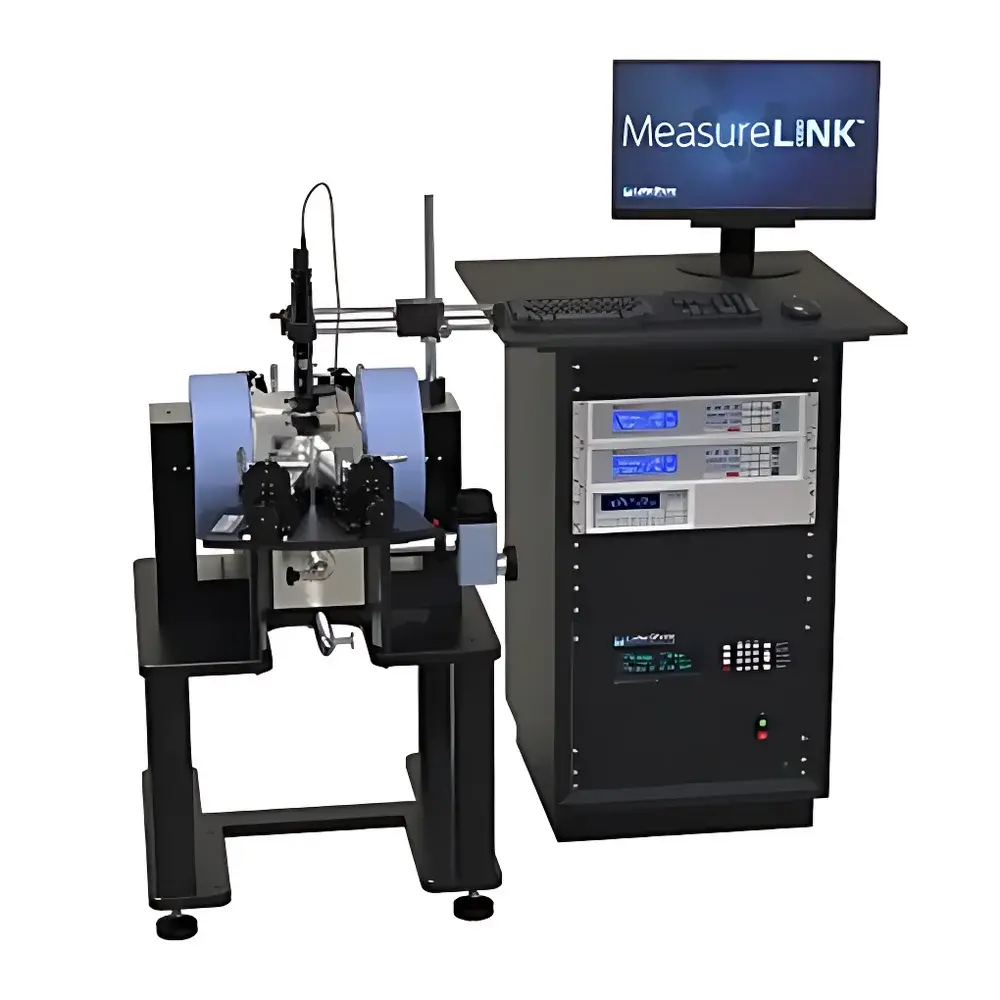
Lake Shore EMPX-H2 Cryogenic Vector Magnet Probe Station
| Brand | Lake Shore |
|---|---|
| Origin | USA |
| Model | EMPX-H2 |
| Temperature Range | 3.2 K to 400 K |
| Magnetic Field | ±0.6 T (horizontal, in-plane) |
| Maximum Sample Diameter | 25.4 mm (1") |
| Magnetic Uniformity | 0.6% over Ø10 mm, 2.6% over Ø25 mm |
| Probe Position Stability | <5 µm across full field sweep |
| Vacuum Base Pressure | <1 × 10⁻⁵ Torr |
| Cooling Method | Continuous-flow cryogen (liquid He or N₂) |
| Sample Rotation | Optional 360° (PS-360-EMPX) |
| Probe Arms | Up to 4 |
| Microwave Frequency Support | DC–67 GHz |
| Electrical Isolation | >100 GΩ |
| Optical Integration | Fiber-coupled electro-optic measurement capability |
Overview
The Lake Shore EMPX-H2 Cryogenic Vector Magnet Probe Station is a purpose-engineered platform for high-precision magneto-transport, spintronic, and microwave characterization of semiconductor devices and quantum materials under controlled low-temperature and in-plane magnetic field conditions. Designed around a high-stability continuous-flow cryostat architecture, the EMPX-H2 integrates a calibrated horizontal electromagnet (±0.6 T) directly into the vacuum space—enabling true vector-field-dependent measurements without thermal cycling interruptions. Its core measurement principle relies on simultaneous, synchronized control of temperature (3.2–400 K), magnetic field magnitude and orientation (via optional 360° sample rotation), and electrical/optical stimulus delivery—making it uniquely suited for studies requiring strict phase coherence, low-noise DC/RF biasing, and time-resolved magnetoresistance or ferromagnetic resonance (ST-FMR) analysis. The system operates within ultra-high vacuum (UHV)-compatible conditions (<1 × 10⁻⁵ Torr at base temperature), minimizing thermal drift and contamination during long-duration experiments typical in quantum Hall effect, anomalous Hall effect, and skyrmion dynamics investigations.
Key Features
- Integrated horizontal electromagnet delivering ±0.6 T (±6 kOe) with closed-loop field control via in-situ Hall sensor—enabling reproducible, hysteresis-compensated field sweeps independent of cryostat cooldown state
- Continuous-flow cooling architecture supporting both liquid helium (base temperature 3.2 K with PS-LT option) and liquid nitrogen (base temperature 4.5 K), with precise temperature regulation from 3.3 K to 400 K
- Optimized 30° probe tilt geometry ensuring full access to 25.4 mm (1″) diameter wafers while maintaining sub-5 µm probe tip positional stability across the entire magnetic field range
- Modular 4-arm probe configuration with DC/RF/microwave (DC–67 GHz) and fiber-optic probe compatibility—each arm thermally anchored to appropriate thermal stages (probe arms <20 K at base temperature)
- Optional PS-360-EMPX 360° motorized sample rotation stage for systematic angular-resolved magnetotransport, anisotropic magnetoresistance (AMR), and planar Hall effect mapping
- Electrical isolation >100 GΩ per probe path, enabling femtoamp-level leakage current measurements critical for gate dielectric and 2D material interface characterization
Sample Compatibility & Compliance
The EMPX-H2 accommodates standard semiconductor substrates up to 51 mm (2″) in diameter, with full electrical and optical probing capability across the central 25.4 mm (1″) region. It supports rigid and flexible samples—including Si, GaAs, InP, sapphire, SiC, and exfoliated or CVD-grown 2D heterostructures—mounted on copper or gold-plated OFHC sample holders with integrated thermal anchoring. All vacuum components comply with ASTM E595 outgassing specifications for UHV applications. The system’s mechanical design meets ISO 14644-1 Class 5 cleanroom handling requirements when operated in controlled environments. For regulated R&D workflows, the EMPX-H2 supports GLP-compliant data traceability when paired with Lake Shore’s CryoSoft™ software and optional 21 CFR Part 11 audit trail modules.
Software & Data Management
Operation is coordinated through Lake Shore’s CryoSoft™ v5.x platform—a Windows-based application providing synchronized control of temperature setpoints, magnetic field ramp rates, probe positioning, and multi-channel source-measure unit (SMU) integration (e.g., Keysight B2900 series). Real-time data acquisition supports up to 16 analog input channels with 24-bit resolution and programmable sampling rates from 1 S/s to 10 kS/s. Export formats include CSV, HDF5, and MATLAB-compatible .mat files. Automated scripting (Python API support via PyVISA) enables custom test sequences for Hall bar geometry calibration, field-cooled vs. zero-field-cooled protocols, and harmonic Hall voltage analysis. All instrument logs—including vacuum pressure, cryogen level, thermal stability metrics, and field calibration history—are timestamped and stored with SHA-256 integrity hashing.
Applications
- Spin-orbit torque (SOT) and spin-transfer torque (STT) switching efficiency quantification in heavy-metal/ferromagnet heterostructures
- Angle-resolved anomalous and spin Hall conductivity mapping in topological insulators and Weyl semimetals
- DC and RF magnetotransport fingerprinting of van der Waals heterostructures (e.g., graphene/hBN/MoTe₂)
- Time-domain ST-FMR spectroscopy for damping parameter extraction and spin pumping validation
- Electro-optic modulation characterization under magnetic field bias for integrated photonic spintronic devices
- Low-temperature CV and IV profiling of advanced gate stacks (high-κ/metal gate) under magnetic perturbation
FAQ
Can the EMPX-H2 apply magnetic field without cooling the system to base temperature?
Yes. The horizontal electromagnet operates independently of the cryostat’s thermal state, allowing field sweeps at any temperature between 3.3 K and 400 K without requiring full cooldown.
Is the 360° sample rotation stage compatible with all temperature setpoints?
Yes—the PS-360-EMPX stage maintains full angular resolution and repeatability across the entire operational temperature range, including at 3.2 K.
What vacuum pumping configuration is standard, and what base pressure is achievable?
The TPS-FRG turbomolecular pump is standard; base pressure reaches <1 × 10⁻⁵ Torr at 3.2 K and remains below 5 × 10⁻⁴ Torr at room temperature.
How is probe thermal anchoring implemented to minimize thermal crosstalk?
Each probe arm mounts to a dedicated thermal stage: DC/RF arms connect to the 4 K shield, microwave arms to the 50 K radiation shield, and fiber-optic feedthroughs are actively temperature-stabilized to reduce thermo-optic drift.
Does Lake Shore provide application support for complex magneto-transport measurement protocols?
Yes—application engineers offer protocol development, calibration services (including Hall probe mapping and field uniformity verification), and on-site installation support aligned with ISO/IEC 17025 laboratory practices.
Related Products