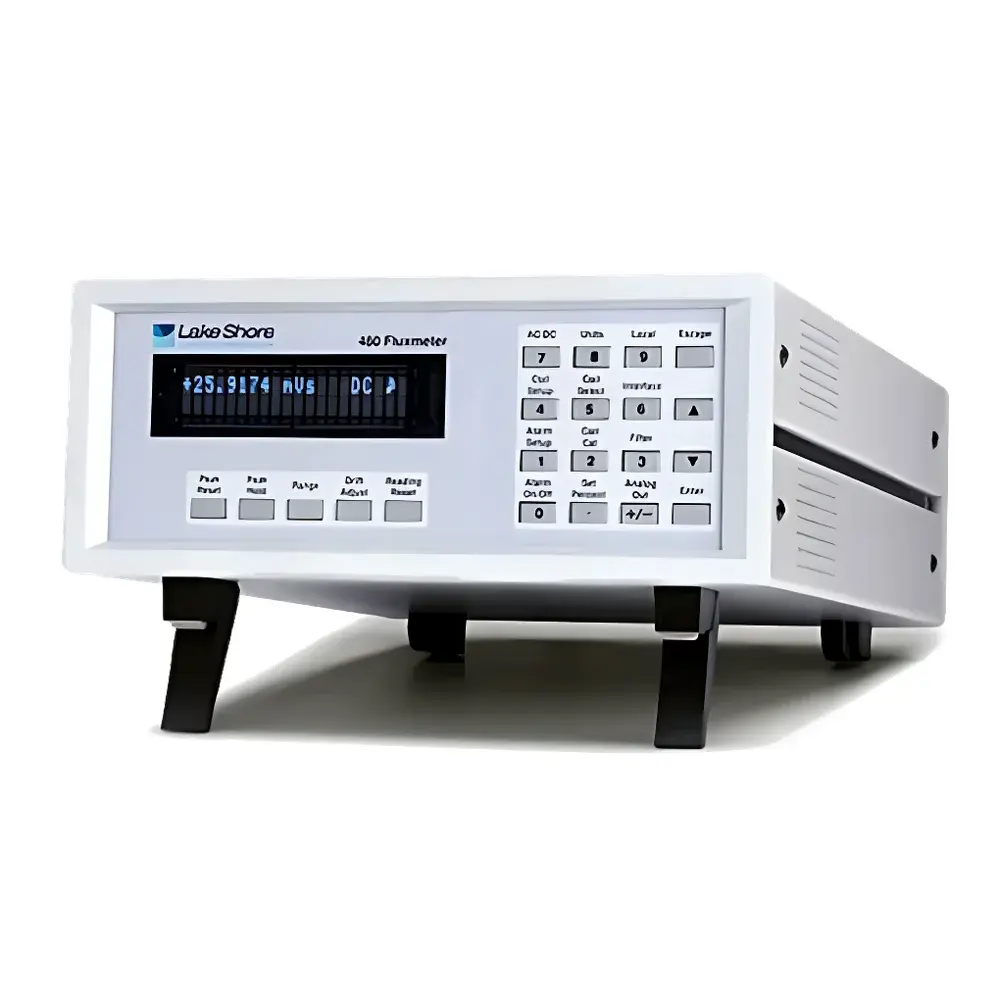
Lake Shore Model 480 Fluxmeter
| Brand | Lake Shore |
|---|---|
| Origin | USA |
| Model | 480 |
| Interface | IEEE-488 (GPIB) & RS-232 |
| Input Channels | 1 |
| DC Resolution | 5¾ digits |
| AC Frequency Response | 2 Hz to 50 kHz |
| Max Input Voltage | 100 V (abs), 60 V (operational) |
| Input Impedance Options | 10 kΩ / 100 kΩ |
| DC Integration Capacitance | 1 µF (nominal) |
| AC Integration Capacitance | 0.1 µF (nominal) |
| DC Drift | ±1 µVs/min @ 300 mVs range (100 kΩ, constant-temp environment) |
| DC Accuracy | ±0.25% of reading + ±10 µVs offset |
| AC Accuracy | ±1% rdg ±10 µVs (10–10 kHz sine), ±5% rdg ±10 µVs (2–50 kHz sine) |
| Peak Capture Speed | Full-scale response <10 µs |
| Storage | Up to 10 coil calibration profiles |
| Display | 2-line × 20-character vacuum fluorescent display (VFD), 5 rdg/s update rate |
Overview
The Lake Shore Model 480 Fluxmeter is a high-stability, dual-mode integrating fluxmeter engineered for precision measurement of magnetic flux change (dΦ/dt) in both DC and AC regimes. Based on low-drift analog integrator architecture with active drift compensation, the instrument converts induced voltage from search coils—whether custom-wound or commercially supplied—into quantifiable magnetic flux linkage (in Wb·N or Mx·N), enabling direct derivation of magnetic flux density (B) and field strength (H) when used with calibrated sensing coils. Its design meets the stringent stability and repeatability requirements of industrial magnet qualification, materials characterization laboratories, and R&D environments where traceable, low-noise magnetic measurements are critical. Unlike digital-only solutions, the Model 480 retains analog integration fidelity while incorporating intelligent digital control—ensuring compatibility with legacy coil systems and adherence to metrological best practices for magnetic flux metrology.
Key Features
- 5¾-digit DC resolution with selectable input impedances (10 kΩ or 100 kΩ) and four auto-ranging DC scales (300 mVs to 3 mVs)
- Real-time automatic drift compensation algorithm operating continuously during idle periods—eliminating manual zeroing without compromising integration integrity
- Sub-10 µs peak capture capability optimized for fast-rise magnetizing pulses, supporting simultaneous positive/negative peak detection from single events
- Wide AC frequency response (2 Hz – 50 kHz) with dedicated AC mode, enabling quantitative field measurements using standard search coils without requiring lock-in amplifiers
- Dual interface support: IEEE-488 (GPIB) and RS-232 serial, with 30 readings/second data streaming capability for automated test systems
- Onboard storage for up to 10 user-defined coil configurations—including area-turn product (A·N), resistance, and calibration constants—enabling rapid probe switching without recalibration
- Integrated audible alarm and TTL-compatible relay outputs for pass/fail decision logic in production sorting applications
- Front-panel vacuum fluorescent display (2 × 20 characters) with real-time unit scaling (Wb·N, T, G, %, etc.) and programmable multiplier prefixes (p, n, µ, m, k, M, G)
Sample Compatibility & Compliance
The Model 480 is fully compatible with industry-standard search coils—including Helmholtz pairs, solenoidal probes, and custom-wound fixtures—from Lake Shore and third-party manufacturers. Each connected probe may embed calibration data in its connector EEPROM; the instrument automatically loads coil-specific parameters upon detection, ensuring measurement traceability per ISO/IEC 17025 requirements. The device supports ASTM A977 (standard test method for magnetic properties of permanent magnets) and IEC 60404-5 (methods for measurement of magnetic properties of permanent magnet materials). Its analog integrator design complies with fundamental principles outlined in NIST SP 250-75 (Magnetic Measurement Standards) and supports GLP/GMP audit trails when integrated with validated LabVIEW or Python-based acquisition software. Input protection circuitry ensures safe operation up to 100 V absolute maximum—critical during capacitor-discharge magnetization events.
Software & Data Management
The Model 480 interfaces seamlessly with standard SCPI-compliant instrumentation control frameworks. Lake Shore provides native drivers for LabVIEW, MATLAB, and Python (PyVISA), enabling full remote configuration, synchronous data logging, and trigger synchronization with external pulse generators or motion controllers. All measurements include timestamping and metadata tagging (coil ID, range, filter setting, units). When deployed in regulated environments, the instrument supports 21 CFR Part 11-compliant workflows through third-party electronic lab notebook (ELN) platforms that enforce user authentication, audit trail generation, and electronic signature capture. Raw flux integral data exports in CSV or TDMS format, preserving full 5¾-digit resolution for post-processing and uncertainty analysis per GUM (JCGM 100:2008).
Applications
- Magnet Sorting & QC: High-throughput classification of sintered NdFeB, SmCo, and ferrite magnets using fixed-coil fixtures and foot-switch reset for hands-free operation
- BH Loop Acquisition: Integration with electromagnet power supplies and Hall sensor feedback systems to construct minor and major hysteresis loops under controlled dH/dt conditions
- Pulse Magnetization Verification: Real-time monitoring of charge/discharge transients in capacitor banks, validating peak field delivery and coil integrity
- Material Characterization: Low-drift DC integration for determining remanence (Br) and coercivity (Hc) of thin films and bulk samples via flip-coil or extraction methods
- AC Field Mapping: Scanning measurements across motor stators, transformer cores, or MRI shimming arrays using calibrated planar search coils and XYZ translation stages
- Calibration Laboratory Use: As a transfer standard for calibrating secondary fluxmeters, search coils, and Hall-effect gaussmeters per ISO/IEC 17025 accreditation criteria
FAQ
What coil calibration data does the Model 480 require?
It requires the effective area-turn product (A·N, in m²·turns or cm²·turns), coil resistance, and optional temperature coefficient. These values are stored per coil ID and applied automatically during measurement.
Can the Model 480 measure AC fields without external signal conditioning?
Yes—its built-in AC mode supports direct connection of passive search coils across 2 Hz–50 kHz. No preamplifier or lock-in stage is needed for moderate-amplitude fields (>10 µT RMS at 1 kHz).
How does the automatic drift compensation affect measurement accuracy?
The algorithm operates only during idle intervals and does not interfere with active integration. It reduces long-term drift to ≤±1 µVs/min at full scale, enabling >10-minute stable integrations without manual intervention.
Is the Model 480 suitable for cryogenic magnet testing?
Yes—when paired with cryo-compatible search coils (e.g., NbTi-wound or fiber-optic coupled probes), it maintains performance down to 4 K. Input protection remains active, and thermal EMF effects are minimized by differential input architecture.
Does Lake Shore provide NIST-traceable calibration certificates?
Yes—each instrument ships with a certificate of calibration traceable to NIST Standard Reference Materials (SRMs) 2500 series, including uncertainty budgets per ISO/IEC 17025 Annex A. Recalibration services are available annually or per internal quality schedule.