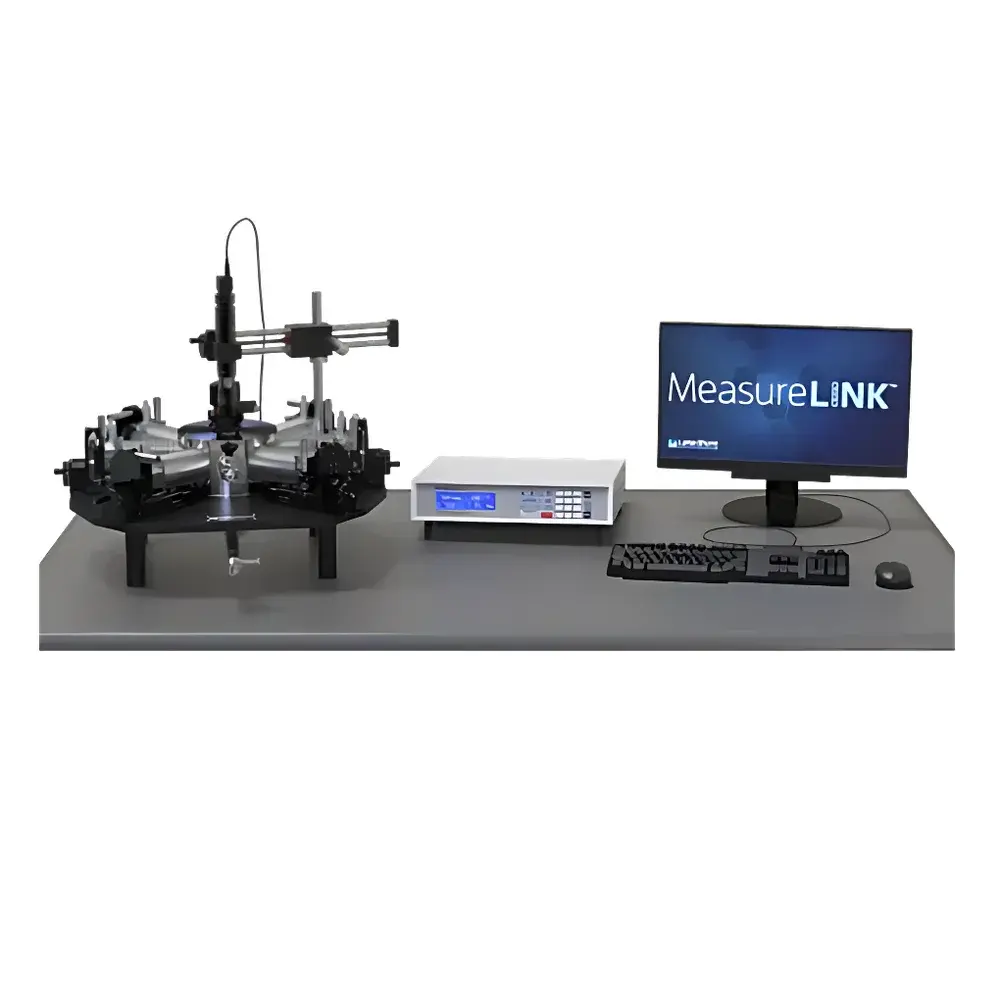
Lake Shore PS-100 Economical Desktop Cryogenic Probe Station
| Brand | Lake Shore |
|---|---|
| Origin | USA |
| Model | PS-100 |
| Temperature Range | 4.2 K to 475 K (standard), down to 3.2 K with PS-LT option |
| Sample Diameter | up to 32 mm (1.25 in) |
| Vacuum Base Pressure | <1 × 10⁻⁵ Torr |
| Vibration | <300 nm (standard), <30 nm with PS-PVIS option |
| Probe Arms | up to 4 |
| Cooling Method | Continuous-flow liquid helium or liquid nitrogen |
| Thermal Stability | ±15 mK typical at 4.4–100 K (liquid helium) |
| Electrical Isolation | >100 GΩ |
| RF/Microwave Capability | DC–67 GHz (with optional microwave probes) |
| Optical Access | Fiber-optic probe compatibility for electro-optical measurements |
| Drop-in Area | 25.4 mm diameter circular zone |
| Thermal Sinking | Probe arms actively cooled to <35 K at base temperature |
| Control System | Compatible with Lake Shore Model 336 Temperature Controller |
Overview
The Lake Shore PS-100 Economical Desktop Cryogenic Probe Station is a compact, high-stability cryogenic measurement platform engineered for precision DC, low-frequency AC, and RF characterization of semiconductor devices, quantum materials, and nanoscale electronic structures. Based on continuous-flow cryogenics and a dual-stage thermal architecture—comprising independently controlled sample stage, radiation shield, and actively cooled probe arms—the PS-100 implements a robust thermal management strategy that minimizes parasitic heat load on the device under test (DUT). Its core operational principle relies on conductive and radiative thermal isolation, enabled by multi-layer radiation shielding, high-efficiency copper thermal links, and vacuum-integrated cold finger design. The system operates across a wide temperature range from 4.2 K (with liquid helium) or 77 K (with liquid nitrogen) up to 475 K, supporting both fundamental low-temperature physics research and applied device validation under thermally variable conditions. Designed for rapid deployment and laboratory scalability, the PS-100 meets the practical constraints of academic labs and early-stage R&D groups requiring metrologically sound cryogenic probing without infrastructure-intensive dilution refrigerators or closed-cycle cryocoolers.
Key Features
- Wide operational temperature range: 4.2 K to 475 K standard; extendable to 3.2 K using the optional PS-LT low-temperature module
- Compact desktop footprint (≤0.7 m² floor space) with integrated vacuum chamber and cryogenic plumbing interfaces
- High positional accuracy via micrometer-driven XYZ translation stages with sub-micron repeatability and <300 nm RMS vibration (standard), reducible to <30 nm with PS-PVIS active vibration isolation
- Four-arm TTPX-style probe configuration supporting simultaneous four-point probe (4PP), Kelvin sensing, and differential measurements
- Electrically isolated probe arms with >100 GΩ insulation resistance—optimized for ultra-low leakage current (<1 fA) DC measurements
- RF/microwave readiness: compatible with Lake Shore’s DC–67 GHz coaxial and ground-signal-ground (GSG) probes for on-wafer S-parameter characterization
- Optical integration capability: fiber-optic feedthroughs support electro-optical correlation studies (e.g., photoluminescence under bias, cryo-PL mapping)
- Modular upgrade path: field-installable options include superconducting ring magnets (up to 0.19 T), backside optical access, and high-temperature extension kits
Sample Compatibility & Compliance
The PS-100 accommodates planar samples up to 32 mm in diameter and ≤5 mm in thickness, with standardized mounting via kinematic pins and vacuum-compatible clamping. Its sample stage features gold-plated OFHC copper construction for optimal thermal conductivity and low outgassing. All internal surfaces are electropolished stainless steel or oxygen-free copper, meeting ASTM F1198 (Standard Practice for Cleaning and Preparing Stainless Steel Surfaces for Use in Ultra-High Vacuum Systems). The system achieves ultimate vacuum pressures below 1 × 10⁻⁵ Torr at base temperature—fully compliant with ISO 20483 (vacuum integrity requirements for cryogenic instrumentation) and suitable for long-duration experiments under GLP-compliant environmental monitoring. While not certified for FDA 21 CFR Part 11, the PS-100 supports traceable temperature logging when paired with Lake Shore’s 336 Temperature Controller (which provides audit-trail-capable data export and NIST-traceable calibration reporting).
Software & Data Management
The PS-100 operates as a hardware platform with full interoperability with Lake Shore’s CrossLink™ software suite and third-party instrument control environments (LabVIEW, Python via PyVISA, MATLAB Instrument Control Toolbox). Temperature setpoints, ramp rates, and thermal soak dwell times are programmable through the Model 336 controller’s front panel or remote interface (Ethernet, GPIB, RS-232). Real-time temperature readouts from up to six calibrated sensors—including sample stage, radiation shield, and individual probe arm thermometers—are timestamped and logged at user-defined intervals (10 ms to 10 s resolution). Data files conform to IEEE 488.2 SCPI command structure and export in CSV/ASCII format for post-processing in Origin, Igor Pro, or Python-based analysis pipelines. For regulated environments, optional firmware upgrades enable electronic signature support and secure user-access levels aligned with ALCOA+ data integrity principles.
Applications
- Transport property mapping of 2D materials (graphene, TMDCs) and topological insulators via four-point probe resistivity and Hall effect measurements
- Cryogenic parametric testing of GaN HEMTs, SiC MOSFETs, and superconducting qubit test structures
- Low-noise amplifier (LNA) and cryo-CMOS circuit validation at sub-10 K operating points
- In situ magneto-transport studies using the optional annular magnet (0.19 T max, persistent mode)
- Electro-optical coupling experiments combining DC biasing with fiber-coupled laser excitation and single-photon detection
- Process development and failure analysis for MEMS/NEMS devices requiring thermal cycling under probe contact
FAQ
What cooling media does the PS-100 require?
The PS-100 is designed for continuous-flow operation using either liquid helium (for 4.2–10 K range) or liquid nitrogen (for 77–300 K range). No cryocooler or compressor is required.
Can I perform RF measurements up to 67 GHz without external modifications?
Yes—when equipped with Lake Shore’s calibrated microwave probe options and appropriate SMA or V-connectors, the PS-100 maintains impedance integrity and signal fidelity up to 67 GHz, provided proper grounding and RF shielding protocols are followed.
Is the PS-100 compatible with automated wafer probers?
No—the PS-100 is a manual probe station intended for discrete sample testing. It does not integrate with robotic XYθ wafer handlers or auto-alignment vision systems.
How is thermal crosstalk between probe arms and sample minimized?
Each probe arm is thermally anchored to the radiation shield stage (not the sample stage), and its tip is actively cooled to <35 K at base temperature via direct conduction—reducing thermal gradient-induced drift during extended DC measurements.
Does the PS-100 support bake-out procedures?
Yes—the vacuum chamber is rated for 120 °C bake-out per ASTM E595, enabling water vapor desorption and achieving ultra-high vacuum performance after initial installation or maintenance.
Related Products