
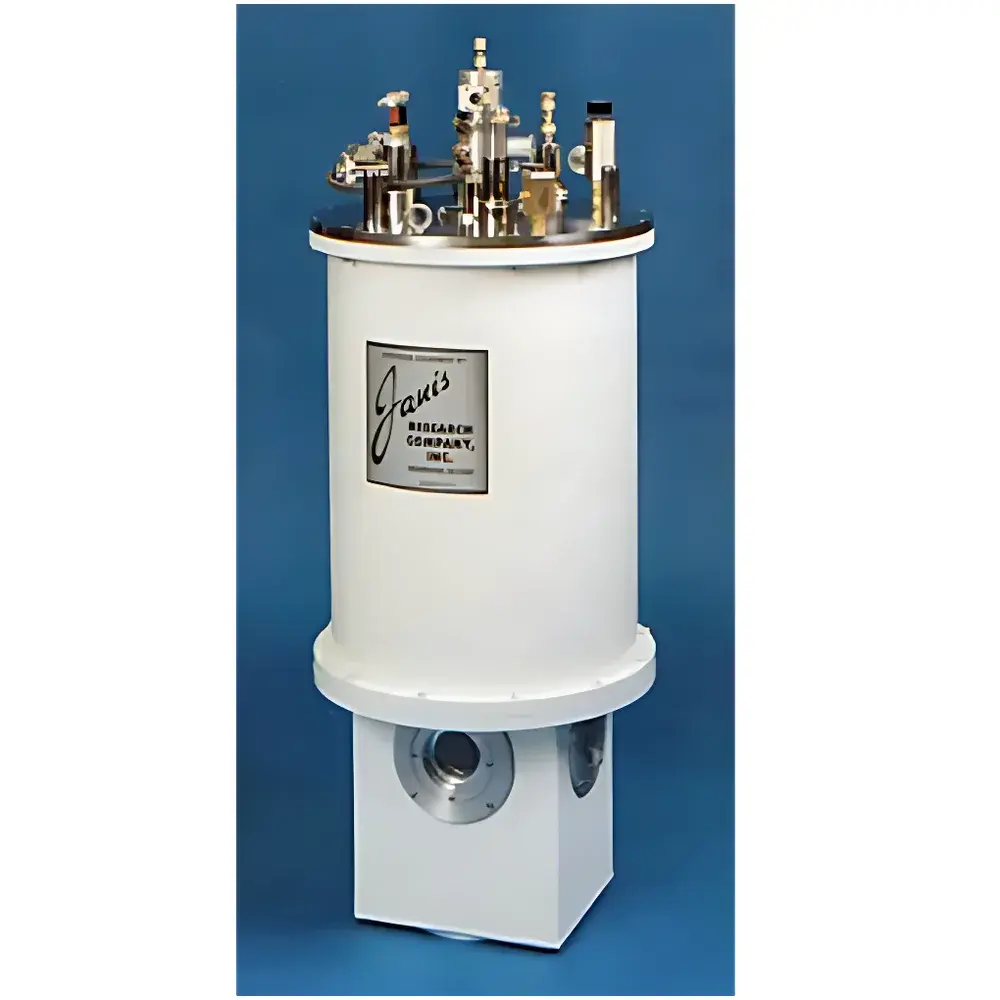
Lake Shore SuperOptiMag Wet Superconducting Magnet System
| Brand | Lake Shore |
|---|---|
| Origin | USA |
| Manufacturer Type | Authorized Distributor |
| Product Origin | Imported |
| Model | SuperOptiMag |
| Price | Upon Request |
| Magnetic Field Strength | 5–7 T (up to 8 T with Lambda cryocooler) |
| Temperature Range | 1.5 K to 325 K |
| Sample Environment | Continuous-flow cryogen or high-vacuum |
| Optical Access | Bottom, side, and top windows (strain-relieved options available) |
| Field Orientation | Horizontal or vertical |
| Bore Diameter | 0.75 in to 1.25 in |
| Field Homogeneity | ±0.5% over standard sample volume |
| Static Hold Time | ~130 hours (SOM-2 with 1-inch bore, f/2–f/2.5) |
Overview
The Lake Shore SuperOptiMag (SOM) Wet Superconducting Magnet System is an engineered platform for high-field, low-temperature magneto-optical and magneto-transport characterization. Designed around a split-pair superconducting magnet, the system enables precise control of magnetic field orientation—horizontal or vertical—while maintaining optical access across multiple axes. Its core architecture integrates a vacuum-insulated cryostat with optically transparent sapphire or fused silica windows, allowing collimated light transmission through the sample region under fields up to 8 T. The system operates on continuous-flow liquid helium or nitrogen, or optionally in high-vacuum mode, supporting temperature ranges from 1.5 K (with He-3 or dilution refrigerator integration) to 325 K. Unlike conventional cryomagnets, the SOM series prioritizes experimental flexibility: its modular window configuration—including bottom-mounted square/rectangular apertures (SOM-2), side-mounted quadruple ports, and strain-relieved cold-window mounts—minimizes optical aberration and enables polarization-sensitive measurements such as Faraday rotation, magneto-reflectance, and magneto-photoluminescence. The system’s mechanical design accommodates in-situ sample exchange via a dedicated transfer stage, decoupled from the main magnet cryostat to preserve thermal stability during operation.
Key Features
- Split-pair superconducting magnet delivering stable, persistent fields of 5–7 T (extendable to 8 T using an integrated Lambda cryocooler)
- Multi-axis optical access: bottom, side (4 ports), and optional top windows; all configurable for transmission, reflection, or oblique-angle illumination
- Strain-relieved cold-window mounting available to minimize birefringence and wavefront distortion in polarized-light experiments
- Continuous-flow or high-vacuum sample environment compatible with powders, liquids, thin films, and irregularly shaped specimens
- Motorized X-Y positioning stage inside the high-field region for sub-millimeter sample alignment
- Dedicated sample transfer mechanism enabling rapid sample exchange without warming the magnet or compromising base temperature
- Modular insert options including rotating stages, high-vacuum inserts, He-3 refrigeration inserts, and dilution refrigerator integration for sub-1.5 K operation
Sample Compatibility & Compliance
The SuperOptiMag supports heterogeneous sample geometries and environmental requirements. Its cylindrical vacuum shroud (standard on SOM-2) ensures compatibility with ultra-high vacuum (UHV) systems (<10⁻⁹ mbar), while the optional side-loading configuration permits insertion of fragile or pre-aligned samples without breaking vacuum. All optical windows meet ASTM F2736 specifications for cryogenic optical transmission and are certified for long-term thermal cycling between 1.5 K and 325 K. The system complies with ISO 14001 environmental management standards for cryogen usage and adheres to IEC 61000-6-3 for electromagnetic emissions. For regulated laboratory environments, optional audit-trail-enabled software modules support 21 CFR Part 11 compliance in GMP/GLP workflows when paired with Lake Shore’s M81 or M91 measurement electronics.
Software & Data Management
Control and data acquisition are managed via Lake Shore’s proprietary CryoSoft™ platform, which provides synchronized coordination of field ramping, temperature stabilization, optical stage positioning, and external instrumentation (e.g., spectrometers, lock-in amplifiers). The software supports script-based experiment sequencing, real-time parameter logging at up to 100 Hz, and export to HDF5 or ASCII formats for downstream analysis in Python, MATLAB, or Igor Pro. Optional integration with LabVIEW drivers and SCPI command sets enables full automation within existing metrology frameworks. All measurement metadata—including field setpoint, temperature drift, window transmission history, and cryogen level—are time-stamped and stored with cryptographic integrity for traceability.
Applications
The SuperOptiMag serves advanced research domains requiring concurrent high magnetic fields, cryogenic temperatures, and optical interrogation. Primary use cases include: magneto-optical Kerr effect (MOKE) microscopy; Faraday rotation spectroscopy in quantum materials; magneto-FTIR studies of phonon splitting in correlated oxides; optical detection of nuclear magnetic resonance (ODNMR); and Hall-effect mapping under variable field orientation. Its high spatial homogeneity (±0.5% over 1 cm³) and field stability (<10 ppm/hour) make it suitable for quantitative studies of spin textures, skyrmion lattices, and topological insulator surface states. The system is routinely deployed in national laboratories, university condensed matter physics groups, and industrial R&D centers developing next-generation spintronic and quantum sensing devices.
FAQ
What is the minimum achievable base temperature with the standard SOM-2 configuration?
The standard continuous-flow SOM-2 achieves ≤1.5 K using pumped liquid helium; sub-1.5 K operation requires integration with a He-3 or dilution refrigerator insert.
Can the system be upgraded to support UHV-compatible sample manipulation?
Yes—side-loading inserts with UHV-rated linear and rotary motion feedthroughs are available as factory-installed options.
Is field homogeneity tunable across the sample volume?
Homogeneity is fixed by magnet geometry and shim configuration; however, custom shimming packages can improve uniformity to ±0.01% over defined volumes upon request.
Are optical windows anti-reflection coated for specific wavelength ranges?
Standard windows include broadband AR coatings (250–2500 nm); custom coatings (e.g., UV-enhanced or IR-optimized) are available per application requirement.
Does Lake Shore provide application support for magneto-optical experiment design?
Yes—application engineers offer pre-installation beam path modeling, optical alignment verification, and protocol development for techniques including MOKE, Faraday rotation, and magneto-PL.



