
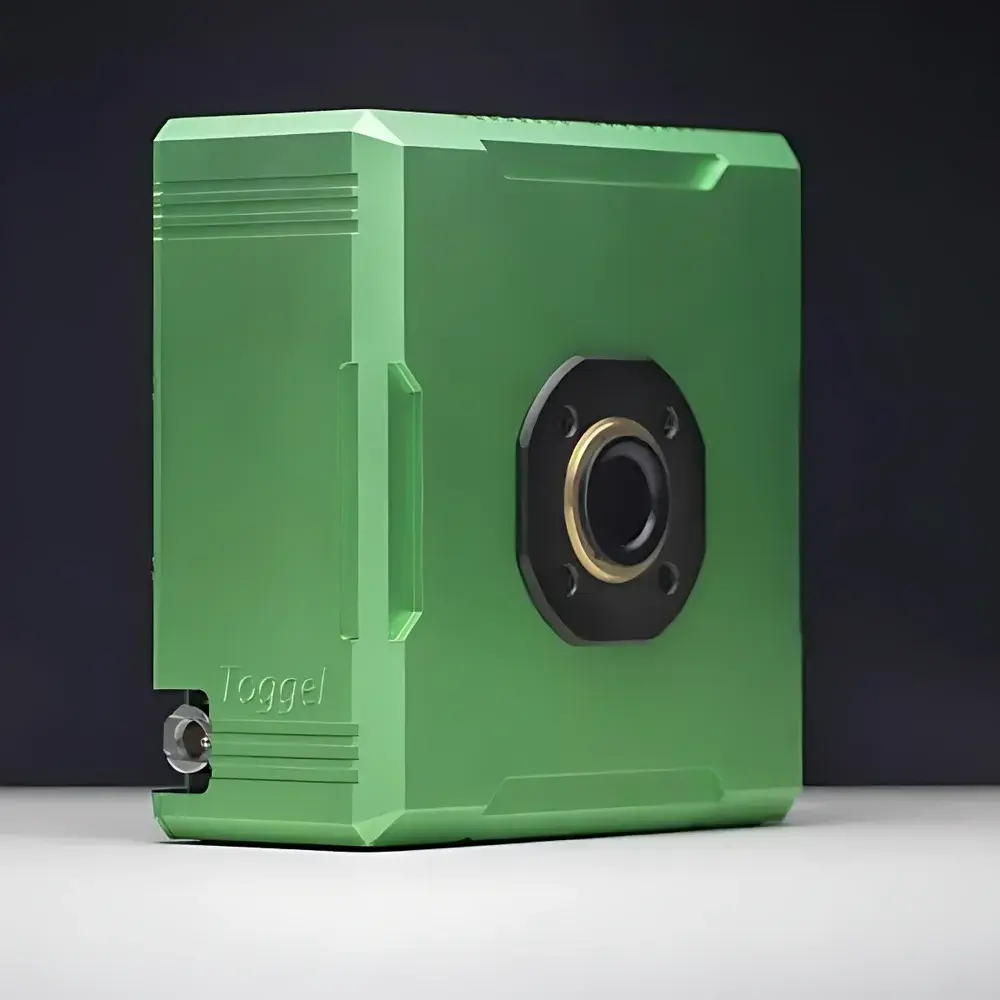
Lambert Instrument Toggel Next-Generation Frequency-Domain Fluorescence Lifetime Imaging (FLIM) Camera
| Brand | Lambert Instrument |
|---|---|
| Model | Toggel |
| Type | Frequency-Domain FLIM Camera |
| Detection Principle | Modulated Illumination + Phase-Sensitive Demodulation |
| Pixel Format | EMCCD or sCMOS Sensor (Configurable) |
| Temporal Resolution | <100 ps Phase Precision |
| Lifetime Range | 0.1 ns – 20 ns |
| Modulation Frequency | 10–80 MHz (Selectable) |
| Interface | USB 3.2 Gen 2 / Camera Link HS |
| Software Platform | LIFA v5.x (with ImageJ/Fiji Plugin Support) |
| Compliance | CE, RoHS, FDA 21 CFR Part 11 Ready (Audit Trail & Electronic Signature Optional) |
| Dimensions | 120 × 120 × 95 mm |
| Weight | 1.4 kg |
Overview
The Lambert Instrument Toggel is a next-generation frequency-domain fluorescence lifetime imaging (FLIM) camera engineered for high-sensitivity, quantitative functional imaging in live biological systems. Unlike time-domain approaches relying on pulsed lasers and time-correlated single-photon counting (TCSPC), the Toggel implements phase-modulation fluorometry—illuminating samples with sinusoidally modulated light (10–80 MHz) and measuring the phase shift and demodulation depth of emitted fluorescence relative to excitation. This architecture enables acquisition of full-lifetime maps from a single modulated image frame (siFLIM), delivering photon-efficient, high-temporal-fidelity data without scanning or repetitive acquisitions. Designed for integration into widefield, spinning-disk confocal, and TIRF microscopy platforms, the Toggel maintains optical throughput while preserving sub-nanosecond lifetime resolution—critical for detecting subtle conformational changes, molecular interactions (e.g., FRET), ion dynamics (Ca²⁺, cAMP), and microenvironmental variations (pH, viscosity, oxygenation).
Key Features
- Single-image FLIM (siFLIM) capability: Full lifetime decay parameters extracted from one camera exposure per modulation frequency—enabling real-time monitoring of dynamic processes such as second-messenger signaling.
- High quantum efficiency detection: Optimized for 400–750 nm spectral range; compatible with EMCCD or scientific CMOS sensors depending on application requirements (low-light vs. speed trade-off).
- Multi-frequency modulation support: Adjustable RF carrier frequencies (10–80 MHz) allow optimization for fluorophore lifetime ranges and signal-to-noise ratio across diverse probes (e.g., GFP derivatives, organic dyes, quantum dots).
- Modular hardware interface: Standard C-mount and M42 camera port compatibility ensures seamless integration into OEM and custom-built microscope systems—including Yokogawa CSU-X1, VTInfinity, and standard widefield/TIRF setups.
- Real-time phase/demodulation computation: On-board FPGA processing reduces host CPU load and supports streaming analysis at up to 30 fps (full ROI, 512×512) with simultaneous lifetime, amplitude, and intensity rendering.
- Calibration-ready architecture: Includes built-in reference channel for system-level phase drift correction and lifetime stability monitoring over extended acquisition sessions.
Sample Compatibility & Compliance
The Toggel supports live-cell, tissue-section, and bacterial preparations under physiological conditions. It is routinely deployed in studies involving genetically encoded biosensors (e.g., Epac-based cAMP reporters), FRET pairs (CFP/YFP, GFP/RFP), and environmentally sensitive dyes (e.g., Bodipy, Rhodamine B). Its non-scanning, camera-based design minimizes phototoxicity and enables long-term timelapse FLIM without mechanical drift. From a regulatory standpoint, the LIFA software suite supports GLP/GMP-aligned workflows: audit trails, user access controls, electronic signatures, and raw-data immutability—fully compliant with FDA 21 CFR Part 11 when configured with secure authentication and encrypted storage. All hardware meets CE marking requirements for electromagnetic compatibility (EN 61326-1) and safety (EN 61010-1), and conforms to ISO 13485 principles for research-use-only instrumentation.
Software & Data Management
The Toggel operates exclusively with Lambert’s LIFA v5.x software—a modular, scriptable platform supporting both GUI-driven acquisition and Python-based automation via native API. LIFA provides real-time lifetime histogramming, pixel-wise bi-exponential fitting (χ² minimization), and export of calibrated lifetime maps (.tiff, .h5, .nrrd) with embedded metadata (modulation frequency, phase offset, instrument response function). Integrated ImageJ/Fiji plugins enable post-acquisition stitching, colocalization with structural channels (e.g., DIC, transmitted light), and batch analysis across multi-position screening experiments. Raw phase/demodulation datasets are stored in vendor-neutral HDF5 format, ensuring long-term reproducibility and third-party tool interoperability (e.g., MATLAB, Python scikit-image, Napari). Data provenance—including acquisition timestamp, environmental sensor logs (optional temperature/humidity), and calibration history—is preserved automatically.
Applications
- Live-cell signaling dynamics: Quantitative tracking of cAMP, Ca²⁺, or kinase activity using lifetime-encoded biosensors—capturing transient oscillations (~2.5 s periodicity) undetectable by intensity-based methods.
- FRET efficiency mapping: Spatially resolved donor-acceptor interaction analysis in single cells, including heterogeneous populations (e.g., mixed GFP-tagRFP Bacillus subtilis strains differentiated by lifetime bimodality).
- TIRF-FLIM: Nanoscale proximity sensing at the plasma membrane—measuring integrin-mediated focal adhesion lifetime changes within the evanescent field (~100 nm depth).
- High-throughput FLIM screening: Multi-position acquisition across 96-/384-well plates for fluorescent protein characterization, drug-induced conformational shifts, or metabolic profiling.
- Photostability assessment: Monitoring chromophore degradation kinetics via lifetime shortening during prolonged illumination—critical for optimizing imaging protocols in super-resolution or long-term timelapse.
FAQ
What lifetime range can the Toggel resolve?
The system achieves reliable lifetime quantification between 0.1 ns and 20 ns, with optimal precision in the 0.5–10 ns range typical of common fluorescent proteins and organic dyes.
Is the Toggel compatible with pulsed laser sources?
No—it is designed exclusively for frequency-domain operation using continuous-wave modulated LEDs or lasers; time-domain TCSPC integration is not supported.
Can I perform global lifetime fitting across multiple images?
Yes—LIFA v5.x includes constrained global analysis tools that share decay parameters across ROIs or time points, improving statistical robustness for low-photon datasets.
Does the system require external synchronization with the microscope stage or light source?
Synchronization is optional but recommended for multi-position or multi-wavelength FLIM; the Toggel provides TTL I/O for hardware triggering and external clock locking.
How is calibration performed for absolute lifetime accuracy?
A two-point calibration using reference standards (e.g., fluorescein in basic buffer, rhodamine B in ethanol) corrects for system IRF and phase offset; LIFA automates this workflow with traceable uncertainty reporting.




