
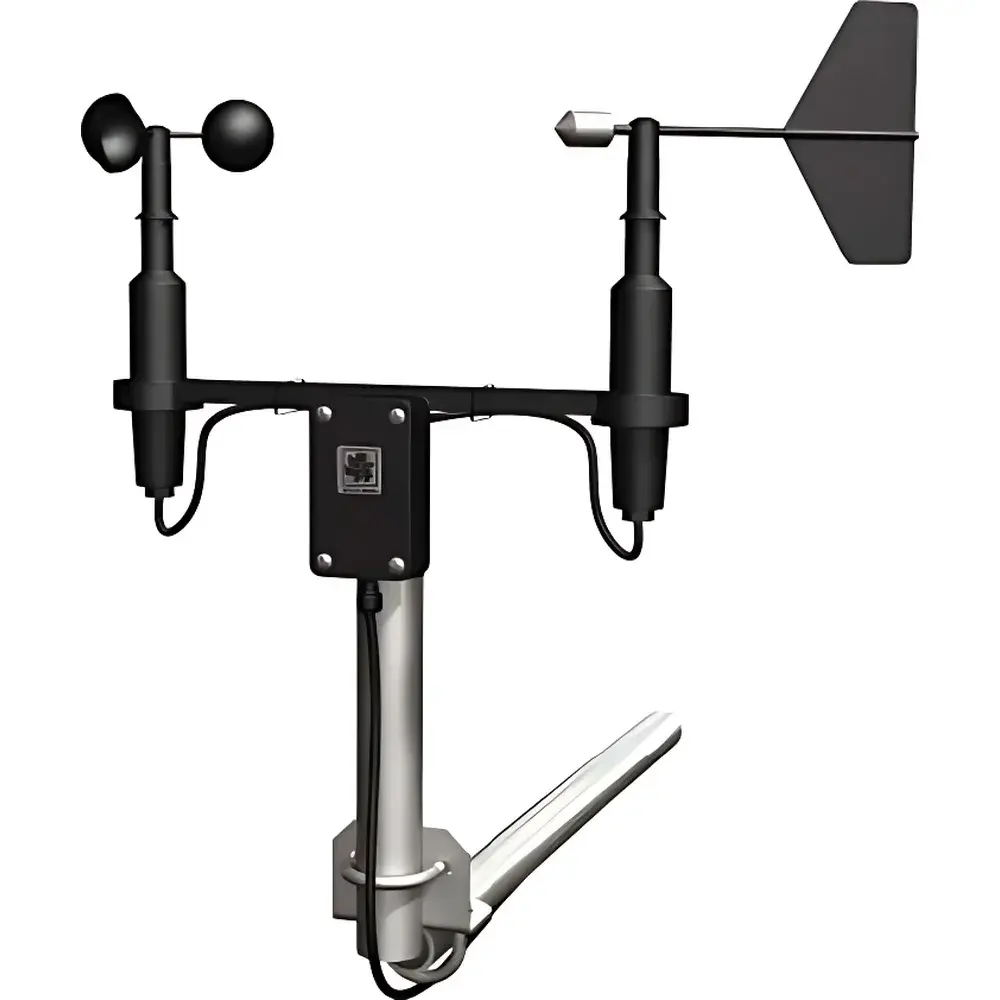
Lambrecht Model 346 Portable Ultrasonic Anemometer & Wind Vane System
| Brand | Lambrecht |
|---|---|
| Origin | Germany |
| Model | 346 |
| Sensor Type | Ultrasonic (3D wind vector) |
| Display | Integrated handheld LCD unit |
| Data Logging | Internal SD card storage |
| Power Supply | Rechargeable Li-ion battery (≥12 h continuous operation) |
| Compliance | IP67 enclosure rating |
| Operating Temperature | −30 °C to +50 °C |
| Communication Interface | USB 2.0, RS-232 optional |
| Software | Lambrecht WindLog Pro v4.x (Windows/macOS) with GLP-compliant audit trail and CSV/NetCDF export |
Overview
The Lambrecht Model 346 Portable Ultrasonic Anemometer & Wind Vane System is a field-deployable, self-contained meteorological instrument engineered for high-fidelity measurement of three-dimensional wind velocity vectors (u, v, w) and horizontal wind direction in unattended or mobile environmental monitoring applications. Unlike cup-and-vane mechanical anemometers, the Model 346 employs time-of-flight ultrasonic transit-time differential measurement across orthogonal transducer pairs—eliminating moving parts, mechanical wear, and inertia-related lag. This principle enables sub-second temporal resolution, true zero-wind detection, and immunity to icing or particulate fouling under harsh ambient conditions. Designed for rapid deployment in transient field campaigns—including site surveys, environmental impact assessments, microclimate studies, and emergency response meteorology—the system integrates sensor, display, data logger, and power into a single ergonomic handheld unit weighing <1.8 kg. Its modular architecture supports both standalone operation and integration into larger observational networks via serial or USB interface.
Key Features
- Ultrasonic 3-axis wind measurement with ±0.05 m/s threshold sensitivity and ±2% full-scale accuracy (calibrated per IEC 61000-4-3 and ISO 16614-2)
- Integrated digital compass and tilt-compensated azimuth calculation for directional accuracy ≤±2° (static), ≤±3° (dynamic)
- Ruggedized IP67-rated magnesium alloy housing, tested to MIL-STD-810G for shock, vibration, and salt fog exposure
- Onboard 8 GB SD card supporting configurable logging intervals (1 s to 60 min), with automatic file rotation and timestamping (UTC/GMT)
- Real-time graphical display showing vector magnitude, direction rose, gust factor (10-s peak), and thermal comfort indices (WBGT optional)
- Battery life ≥12 hours at 1 Hz sampling; hot-swappable Li-ion packs with state-of-charge indicator and low-power sleep mode
Sample Compatibility & Compliance
The Model 346 is validated for use across terrestrial, marine, and aviation-adjacent environments—including coastal zones, forest canopies, urban boundary layers, and offshore platforms. It meets EN 13030:2021 for portable anemometers and conforms to WMO Guide to Meteorological Instruments and Methods of Observation (CIMO Guide, Chapter 12). All firmware and calibration certificates are traceable to PTB (Physikalisch-Technische Bundesanstalt) standards. Data output complies with CF Standard Names (Climate and Forecast Metadata Conventions) and supports interoperability with EPA AQS, EEA AirBase, and ICOS metadata schemas. The system satisfies audit requirements under ISO/IEC 17025:2017 for accredited environmental laboratories and includes electronic signature capability aligned with FDA 21 CFR Part 11 for regulated field studies.
Software & Data Management
WindLog Pro v4.x provides end-to-end data lifecycle management: real-time telemetry visualization, post-processing spectral analysis (FFT-based turbulence intensity and integral length scale estimation), and automated report generation (PDF/HTML). The software enforces role-based access control, cryptographic hash verification of raw binary logs, and immutable audit trails recording user actions, parameter changes, and calibration events. Export formats include time-stamped CSV (UTF-8), NetCDF-4 (with CF-1.8 attributes), and XML metadata bundles compliant with OGC SensorML 2.0. Batch processing supports gap-filling using linear interpolation or Mann–Kendall trend-aware algorithms. All calibration coefficients are embedded in firmware and digitally signed; recalibration intervals are tracked automatically with configurable email alerts.
Applications
- Short-term microclimate characterization for ecological field research (e.g., eddy covariance pre-survey, habitat wind exposure mapping)
- Pre-construction wind resource assessment for distributed renewable energy projects (small-scale wind turbines, solar farm layout optimization)
- Emergency air dispersion modeling support during HAZMAT incidents or wildfire smoke tracking
- Validation of numerical weather prediction (NWP) model outputs at mesoscale grid points
- Maritime safety compliance checks on vessel decks, port terminals, and offshore crane operations
- Educational atmospheric science labs requiring NIST-traceable, hands-on instrumentation with reproducible pedagogical workflows
FAQ
What is the minimum detectable wind speed and how is zero-wind stability ensured?
The Model 346 achieves a theoretical zero-wind resolution of 0.01 m/s via dual-transducer cross-correlation and temperature-compensated transit-time averaging. Stability is maintained through internal reference oscillators and real-time acoustic path diagnostics.
Does the system require periodic recalibration, and what documentation accompanies each unit?
A factory calibration certificate (traceable to PTB) is supplied with every unit. Recalibration is recommended every 24 months under normal field use or after exposure to >50 m/s gusts; Lambrecht-certified service centers perform full-axis sensitivity verification and pressure/temperature cross-talk correction.
Can WindLog Pro generate reports compliant with ISO 14001 environmental management audits?
Yes—customizable templates include mandatory fields for instrument ID, operator credentials, location metadata (WGS84), environmental context tags, and uncertainty budgets calculated per GUM (JCGM 100:2008).
Is the SD card data format compatible with Python-based analysis pipelines (e.g., Pandas, Xarray)?
Raw binary logs are convertible to NetCDF-4 via WindLog Pro CLI tools; open-source Python libraries (lambrechtio) provide direct read/write support for time-series arrays, coordinate variables, and ancillary metadata.
How does the system handle condensation or salt deposition on transducers during maritime deployment?
Transducer faces feature hydrophobic nanocoating (contact angle >110°) and active self-cleaning via pulsed ultrasonic excitation at standby intervals—validated per IEC 60529 salt mist test protocol.
Related Products







