
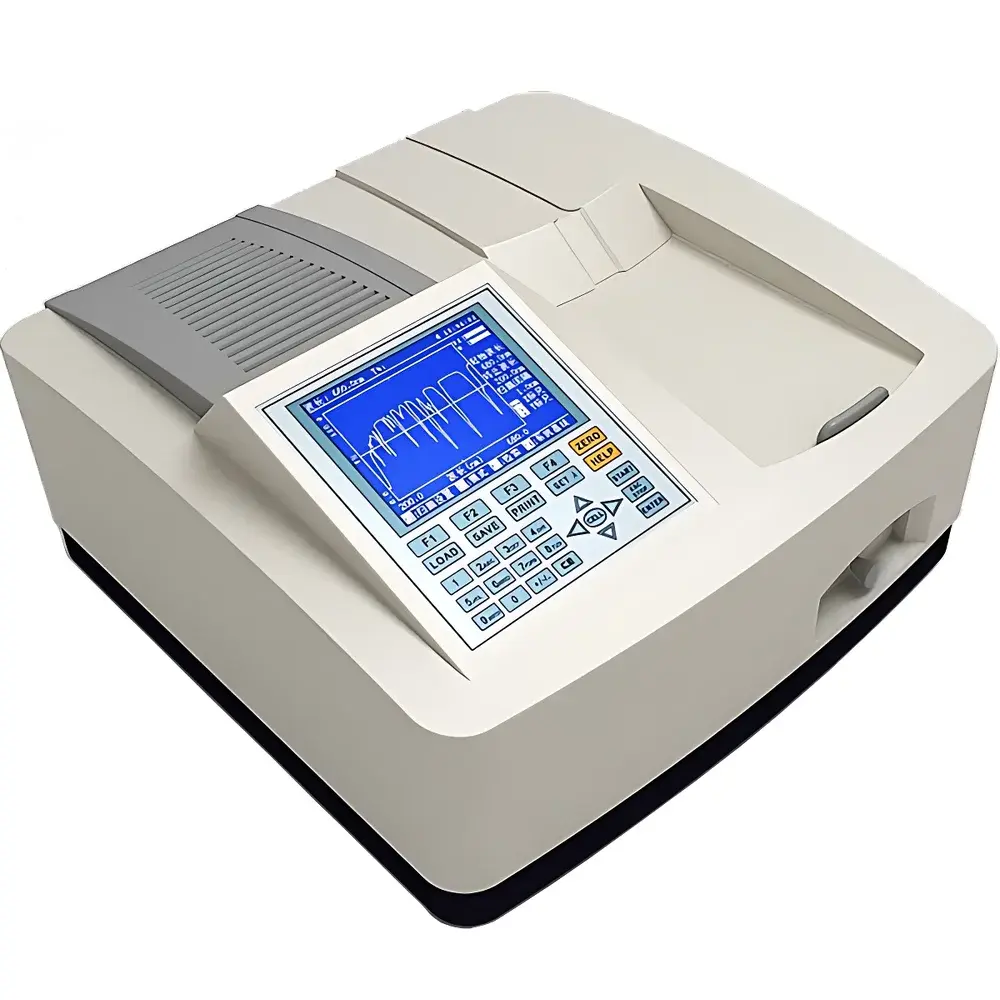
Lamda-280 Series UV-Vis Spectrophotometer by Betop Scientific
| Brand | Betop Scientific |
|---|---|
| Origin | Guangdong, China |
| Manufacturer Type | Direct Manufacturer |
| Model | Lamda-280R / 280RS / 280D / 280DS |
| Detector Type | Photodiode Array (PDA) |
| Wavelength Range | 190–1100 nm |
| Automation Level | Automatic Wavelength Selection |
| Spectral Bandwidth | 1.8 nm (fixed) |
| Wavelength Accuracy | ±0.1 nm at 656.1 nm |
| Wavelength Repeatability | ≤0.1 nm |
| Stray Light | ≤0.03% T at 220 nm and 360 nm |
Overview
The Lamda-280 Series UV-Vis Spectrophotometer is a high-performance benchtop instrument engineered for precision molecular absorbance measurements across the ultraviolet, visible, and near-infrared spectral regions (190–1100 nm). Based on either a dual-beam optical architecture (Lamda-280D/DS models) or a ratio-monitoring pseudo-dual-beam design (Lamda-280R/RS models), it delivers exceptional baseline stability and minimizes drift induced by source intensity fluctuations or environmental thermal shifts. The system employs a Czerny-Turner monochromator with a holographic grating and a high-density photodiode array detector, enabling rapid spectral acquisition without mechanical scanning of the detector. This architecture supports both high-resolution spectral profiling and high-throughput quantitative analysis—critical for compliance-driven workflows in pharmaceutical QC, academic research, and environmental monitoring laboratories.
Key Features
- Dual-beam (280D/DS) and pseudo-dual-beam (280R/RS) optical configurations ensure real-time reference compensation and long-term measurement reproducibility
- Adjustable spectral bandwidth (0.5–5 nm, including fixed 1.8 nm option) enables method-specific resolution tuning per pharmacopeial or regulatory requirements (e.g., USP & EP)
- Wavelength accuracy of ±0.1 nm at the deuterium emission line (656.1 nm) and ≤0.1 nm repeatability support traceable calibration protocols
- Stray light performance ≤0.03% T at 220 nm and 360 nm meets stringent sensitivity demands for low-absorbance biological samples and high-concentration industrial formulations
- Large sample compartment accommodates cuvettes from 5 mm to 100 mm pathlength, plus optional accessories including temperature-controlled holders, fiber-optic probes, and solid-sample reflectance stages
- Integrated 7-inch graphical LCD display with intuitive icon-based navigation and real-time spectrum visualization eliminates dependency on external PCs for routine operation
- Long-life, plug-and-play deuterium lamp with flange-mount design requires no post-replacement optical alignment—reducing downtime and technician dependency
- Onboard data retention with non-volatile memory preserves spectra and measurement logs during power interruption
Sample Compatibility & Compliance
The Lamda-280 Series supports liquid, solution-based, and semi-solid samples in standard quartz, glass, or plastic cuvettes. Its optical design and stray light suppression enable reliable quantification of nucleic acids (A260/A280 ratios), proteins (Bradford/Lowry/BCA), enzyme kinetics, and colored impurities in APIs and excipients. The instrument complies with core principles outlined in ISO 17025 for testing laboratories, and its operational parameters align with key sections of USP , EP 2.2.25, and ASTM E275 for spectrophotometric performance verification. When operated with validated PC software and audit-trail-enabled settings, the system supports GLP and GMP environments requiring 21 CFR Part 11-compliant electronic records.
Software & Data Management
The included Betop UV-Scan PC software provides full remote control, spectral acquisition, kinetic modeling, multi-point calibration, and report generation with customizable templates. Data export formats include CSV, TXT, and JCAMP-DX for interoperability with LIMS and third-party analytical platforms (e.g., MATLAB, Origin, ChemDraw). Software features include automatic peak detection, baseline correction algorithms (linear, polynomial, rolling ball), derivative spectroscopy, and user-defined method storage with password-protected access levels. All instrument events—including wavelength changes, lamp status, calibration actions, and file saves—are timestamped and logged for audit readiness.
Applications
- Pharmaceutical quality control: assay validation, dissolution testing, excipient interference screening, and stability-indicating assays per ICH Q5C
- Life sciences: DNA/RNA quantification, protein purity assessment, ligand-binding studies, and cell culture supernatant analysis
- Environmental testing: nitrate/nitrite, phosphate, heavy metal chelates (e.g., Fe-phenanthroline), and organic pollutant detection (e.g., phenols, PAHs)
- Chemical R&D: reaction monitoring, molar absorptivity determination, and equilibrium constant calculation
- Food & beverage: color index measurement (e.g., AOAC methods), antioxidant capacity (FRAP/DPPH), and adulterant screening
- Academic teaching labs: Beer-Lambert law verification, spectral deconvolution exercises, and method development projects
FAQ
What is the difference between the Lamda-280R/RS and Lamda-280D/DS models?
The R/RS variants use a single-beam architecture with real-time reference beam ratio monitoring, offering cost-effective stability for routine QC. The D/DS models implement true dual-beam optics with simultaneous sample/reference beam detection, delivering superior drift resistance for extended kinetic or temperature-variable experiments.
Does the instrument support compliance with pharmacopeial standards?
Yes—its wavelength accuracy, stray light performance, and bandwidth options meet minimum specifications defined in USP , EP 2.2.25, and JP 17 for UV-Vis instrumentation used in pharmaceutical analysis.
Can the Lamda-280 be integrated into a networked laboratory environment?
Yes—the USB interface and UV-Scan software support centralized deployment via LAN-connected PCs. Audit trail logs, user permissions, and electronic signature capabilities can be configured to align with internal SOPs for regulated operations.
Is calibration traceable to NIST or other national standards?
Instrument factory calibration uses NIST-traceable holmium oxide and didymium filters. End users may perform verification using certified reference materials compliant with ISO/IEC 17025 calibration hierarchies.
What maintenance is required beyond lamp replacement?
No routine optical alignment is needed. Recommended preventive maintenance includes quarterly cleaning of the sample compartment and optical window, annual verification of wavelength and photometric accuracy, and biannual inspection of cuvette holder alignment per manufacturer guidelines.






