
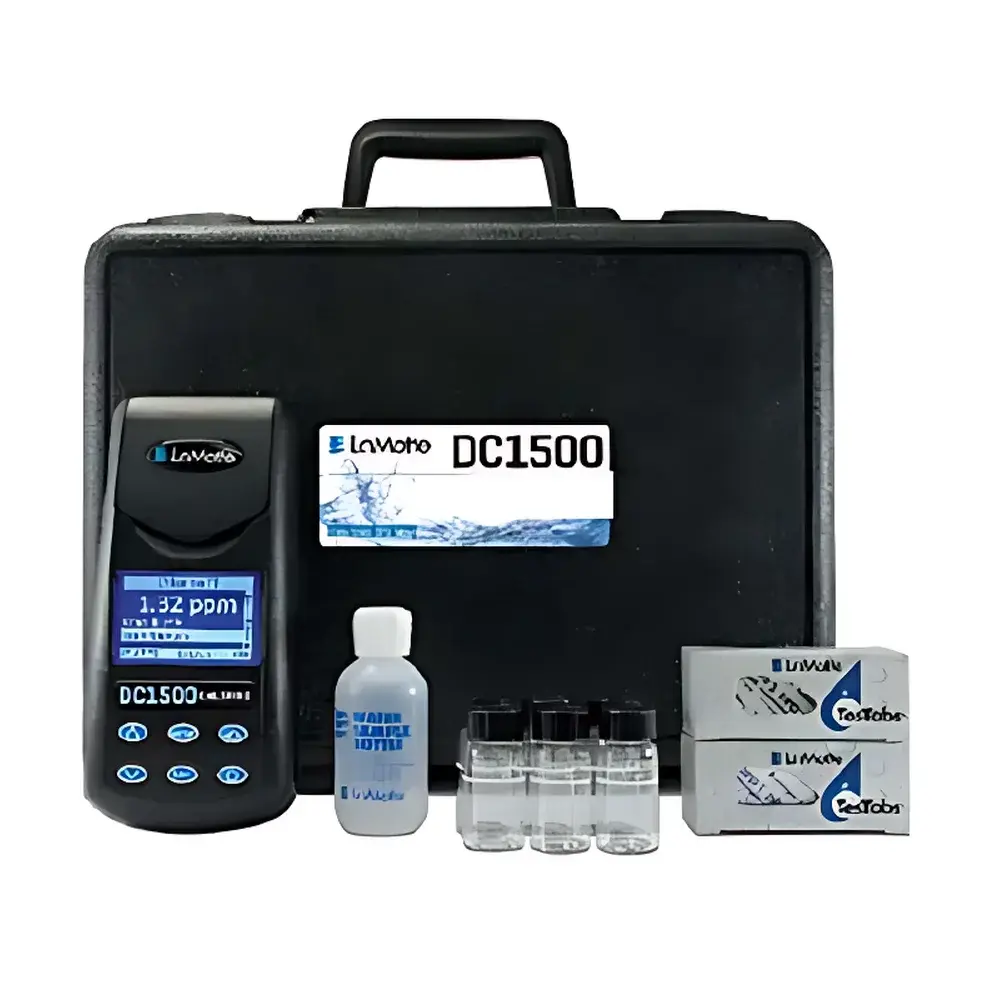
Lamotte DC1500-DD Disinfectant Analyzer
| Brand | Lamotte |
|---|---|
| Origin | USA |
| Model | DC1500-DD |
| Detection Parameters | Free Chlorine & Total Chlorine (0.00–4.00 mg/L), Chlorine Dioxide (0.00–8.00 mg/L), Ozone (Low Range: 0.00–0.40 mg/L |
| High Range | 0.00–2.50 mg/L) |
| Display | 160 × 100 backlit LCD, 20 × 6 character graphic display |
| Wavelength Accuracy | ±2% FS |
| Bandwidth | 10 nm |
| Light Source | LED with integrated narrow-band interference filter |
| Detector | Silicon photodiode |
| Sample Cell | 25 mm diameter round-bottom cuvette |
| Power | Rechargeable lithium-ion battery (3.7 V, 2.5 × 75 mm, 1.7 oz), AC adapter, or USB bus power |
| Battery Life | Up to 380 tests (backlight on) or 1000 tests (backlight off) |
| Auto-off | Disabled, 5, 10, or 50 minutes |
| IP Rating | IP67 |
| Certifications | CE |
| Interface | Mini-USB |
| Languages | English, Spanish, French, Portuguese, Italian, Chinese, Japanese |
| Dimensions (Shipping) | 17 × 16 × 9 in |
| Weight (Shipping) | 8 lb |
Overview
The Lamotte DC1500-DD Disinfectant Analyzer is a portable, laboratory-grade spectrophotometric instrument engineered for precise, field-deployable quantification of three critical water disinfectants: free and total chlorine, chlorine dioxide, and ozone. Utilizing fixed-wavelength absorbance measurement at optimized optical bands—enabled by high-stability LEDs and precision 10 nm bandwidth interference filters—the analyzer applies standardized colorimetric chemistry to deliver trace-level concentration data compliant with EPA Method 334.0 (chlorine), Standard Methods 4500-Cl G (DPD method), and ASTM D1253 (ozone). Designed for operational continuity across variable environmental conditions, its ruggedized housing meets IP67 ingress protection standards, ensuring reliable performance during routine municipal distribution monitoring, wastewater effluent verification, swimming pool management, and drinking water treatment validation.
Key Features
- Triple-analyte capability: Simultaneous support for chlorine (free/total), chlorine dioxide, and ozone across dual-range ozone measurement (0.00–0.40 mg/L and 0.00–2.50 mg/L)
- Integrated optical architecture: Factory-calibrated LED light source paired with silicon photodiode detector and narrow-band interference filter for minimal spectral drift and high inter-instrument reproducibility
- Field-ready power system: Rechargeable lithium-ion battery (3.7 V) enabling up to 380 measurements with backlight active; compatible with AC adapter, USB bus power, and optional automotive charger
- Robust mechanical design: IP67-rated enclosure resistant to dust, immersion up to 1 m for 30 minutes, and mechanical shock per MIL-STD-810G guidelines
- Intuitive human interface: 160 × 100 pixel backlit LCD with 20 × 6 character graphical display; multilingual menu navigation (English, Spanish, French, Portuguese, Italian, Chinese, Japanese)
- Comprehensive data handling: Mini-USB port for firmware updates, calibration file transfer, and raw absorbance export; supports optional PC-based software for audit-trail-enabled data logging
Sample Compatibility & Compliance
The DC1500-DD accepts standard 25 mm diameter round-bottom glass or plastic cuvettes, accommodating both Lamotte’s proprietary tablet-based reagent kits and third-party chemistries validated against APHA/AWWA/WEF Standard Methods. Its measurement protocols align with regulatory frameworks including U.S. EPA Drinking Water Standards (40 CFR Part 141), WHO Guidelines for Drinking-water Quality (4th ed.), and ISO 7888:2012 (chlorine determination). For regulated environments, the instrument supports GLP-compliant operation through user-defined calibration intervals, operator ID tagging, and timestamped result storage. While not inherently 21 CFR Part 11 compliant out-of-box, audit-ready data export enables integration into validated LIMS workflows when paired with appropriate metadata governance policies.
Software & Data Management
Data capture occurs natively within the device memory, storing up to 1000 test records with date/time stamp, operator ID, method name, and measured absorbance values. The Mini-USB interface permits bidirectional communication: users may upload updated calibration curves, download results in CSV format, or install firmware revisions. Optional Lamotte Insight™ Software (v3.2+) provides extended functionality—including statistical trend analysis, QC charting (X-bar/R), customizable report generation, and electronic signature support for QA/QC documentation. All exported files retain embedded metadata required for internal quality audits and external regulatory review.
Applications
- Municipal drinking water treatment plants: Residual disinfectant verification at entry points, distribution nodes, and consumer taps
- Wastewater reclamation facilities: Post-disinfection residual monitoring prior to environmental discharge or reuse
- Healthcare facility water systems: Legionella control program support via continuous chlorine dioxide or ozone dosing validation
- Recreational water venues: Daily compliance testing for swimming pools, spas, and interactive fountains per CDC Model Aquatic Health Code
- Food & beverage processing: Sanitizer concentration verification in CIP rinse cycles and surface contact water lines
- Emergency response & field deployment: Rapid assessment during natural disasters or infrastructure failures where lab access is unavailable
FAQ
What reagents are required for chlorine dioxide measurement?
Lamotte’s Method 10122 (chlorine dioxide tablet kit) is recommended; it employs the chlorophenol red method and is compatible with the DC1500-DD’s 365 nm optical channel.
Can the instrument store calibration curves for multiple reagent lots?
Yes—up to five independent calibration sets may be stored onboard, each assignable to specific lot numbers and expiration dates.
Is the battery replaceable by the end user?
The lithium-ion cell is field-replaceable using Lamotte P/N BATT-DC1500; no soldering or specialized tools are required.
Does the device support custom wavelength programming?
No—optical channels are fixed at factory-set wavelengths (e.g., 530 nm for chlorine, 365 nm for ClO₂, 254 nm for ozone) to ensure regulatory method fidelity.
How often should the optical path be cleaned?
Wipe the cuvette chamber window with lint-free tissue and isopropyl alcohol after every 50 measurements or whenever visible residue is present; avoid abrasive cleaners.







