
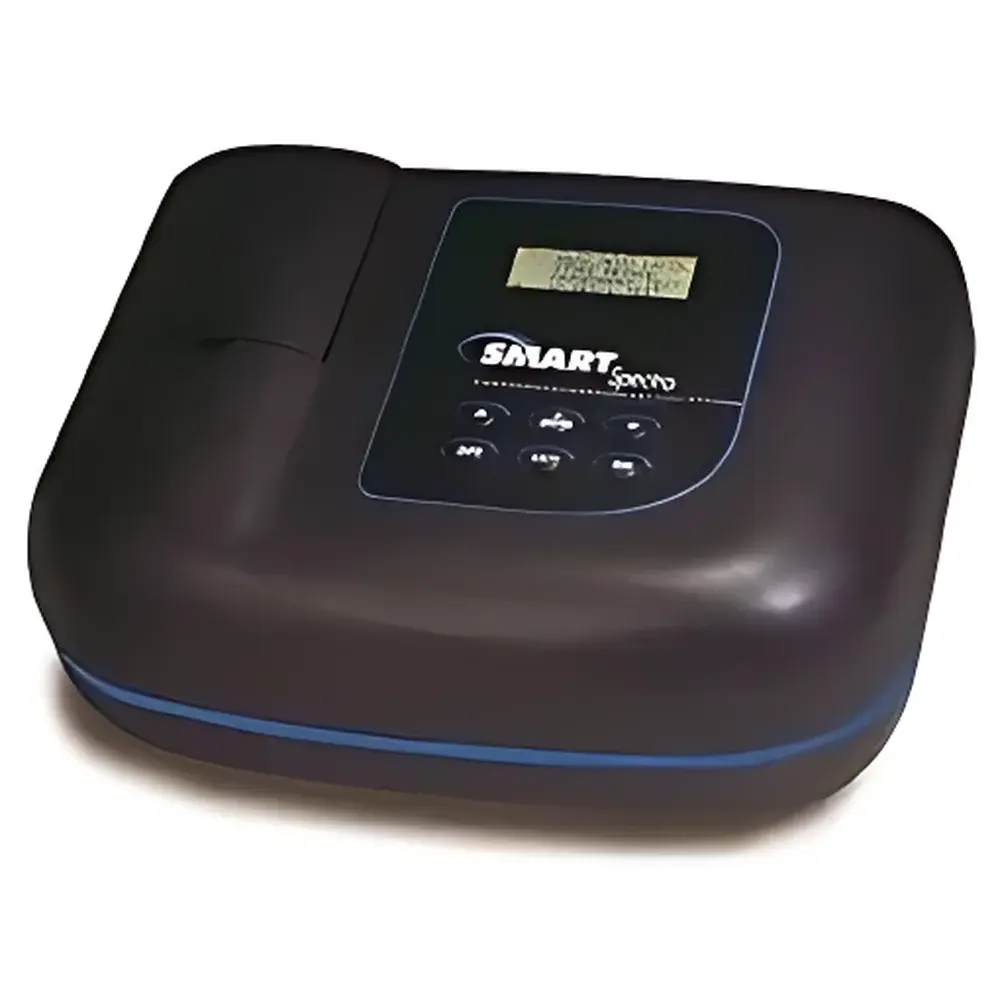
Lamotte SMART Spectro Multi-Parameter Water Quality Analyzer
| Brand | Lamotte |
|---|---|
| Origin | USA |
| Model | SMART Spectro |
| Instrument Type | Laboratory Water Quality Analyzer |
| Wavelength Range | 350–1000 nm |
| Wavelength Accuracy | ±1 nm |
| Wavelength Resolution | 1 nm |
| Bandwidth (FWHM) | 5 nm |
| Photometric Range | 0–125%T, –0.1–2.5 A |
| Absorbance Accuracy | ±0.005 A |
| Optical Noise | <0.001 A at 0 A |
| Drift | ±0.002 A/hr @ 500 nm |
| Stray Light | <0.5% T |
| Grating Density | 1200 lines/mm |
| Optical Design | Modified Ebert monochromator |
| Light Source | Quartz-halogen lamp (≥1000 h lifetime) |
| Detector | Silicon photodiode |
| Cuvette Compatibility | 10 mm square, 25 mm round, COD vials, flow-through cell (optional) |
| Display & Interface | Menu-driven LCD with scroll navigation |
| Data Output | RS-232 serial port |
| Power Supply | 115/230 V AC or rechargeable battery |
| Built-in Diagnostics | Yes |
| Preprogrammed Methods | >80 |
| User-Defined Methods | Up to 25 |
| Measurement Modes | Absorbance (A), Transmittance (%T), Concentration (mg/L, ppm, etc.) |
Overview
The Lamotte SMART Spectro Multi-Parameter Water Quality Analyzer is a benchtop spectrophotometer engineered for precision, reproducibility, and operational efficiency in environmental and regulatory laboratory settings. It operates on the principle of single-beam absorbance spectroscopy across a broad visible-to-near-UV spectral range (350–1000 nm), enabling quantitative analysis of water quality parameters via colorimetric and enzymatic reactions. Its modified Ebert monochromator architecture—featuring a high-density 1200 lines/mm holographic grating—delivers consistent wavelength selection, low stray light (<0.5% T), and high photometric stability (drift ≤ ±0.002 A/hr at 500 nm). Designed for compliance-critical workflows, the instrument supports method traceability, user-accessible calibration verification, and audit-ready operation under GLP and ISO/IEC 17025-aligned practices.
Key Features
- Automated wavelength scanning and positioning driven by internal grating control—eliminates manual alignment and reduces operator-induced variability.
- High-fidelity optical performance: ±1 nm wavelength accuracy, 1 nm resolution, and <0.002 A optical noise at 2 A—ensuring reliable detection of low-concentration analytes (e.g., nitrate, phosphate, silica).
- Intuitive menu-driven interface with customizable test sequencing—enables rapid access to the most frequently used methods without navigating hierarchical submenus.
- Dual power operation: AC mains (115/230 V) or integrated rechargeable battery—ideal for mobile labs, field-deployed QA/QC stations, or backup continuity during outages.
- Comprehensive cuvette support: accommodates standard 10 mm square cells, 25 mm round cells, EPA-compliant COD vials, and optional flow-through cells for continuous monitoring integration.
- Built-in self-diagnostics—including lamp intensity monitoring, detector linearity checks, and grating position validation—facilitates routine instrument qualification per laboratory SOPs.
Sample Compatibility & Compliance
The SMART Spectro is validated for use with over 80 preprogrammed EPA, APHA, ASTM, and ISO-standardized water testing methods—including but not limited to nitrate (as N), orthophosphate (as PO₄), ammonia (as N), chlorine residual, iron, manganese, hardness, and total alkalinity. Each preloaded method includes calibrated curves, reagent-specific wavelength assignments, and concentration unit conversion logic. The system accepts user-defined calibrations (up to 25), allowing adaptation to proprietary assays or non-standard matrices (e.g., brackish effluent, digester supernatant). All measurement data—including date/time stamps, operator ID, wavelength, and raw absorbance values—are timestamped and exportable via RS-232, supporting traceability requirements under 21 CFR Part 11 when paired with compliant LIMS or ELN systems.
Software & Data Management
Data acquisition and reporting are streamlined through native RS-232 serial output, compatible with standard terminal emulators or third-party laboratory informatics platforms. While the SMART Spectro does not include onboard data storage or graphical plotting, its deterministic ASCII-based output protocol enables seamless integration into automated data logging systems. Each measurement record contains instrument ID, method name, selected wavelength, %T/A/concentration value, and calibration status flag—providing sufficient metadata for audit trails. The included user manual documents full calibration procedures, wavelength verification protocols using NIST-traceable holmium oxide filters, and preventive maintenance schedules aligned with ISO 9001 and ISO/IEC 17025 clause 6.4 requirements.
Applications
- Regulatory compliance testing for drinking water (US EPA Method 353.2, 365.2), wastewater (EPA 4500-Cl G, 4500-P F), and surface water monitoring programs.
- Process control in municipal water treatment plants—real-time verification of coagulant dosing, disinfection efficacy, and filtration performance.
- Environmental research laboratories conducting nutrient cycling studies, eutrophication assessments, and contaminant fate modeling.
- Educational institutions requiring robust, serviceable instrumentation for undergraduate analytical chemistry and environmental science curricula.
- Third-party testing labs performing contract analyses under ISO/IEC 17025 accreditation—where instrument stability, method transparency, and operator accountability are mandatory.
FAQ
Does the SMART Spectro support GLP-compliant data integrity?
Yes—when operated with documented calibration logs, user access controls, and external timestamped data capture, it fulfills core GLP principles for instrument qualification and result traceability.
Can I validate wavelength accuracy in-house?
Yes—the instrument’s optical design allows verification using NIST-traceable holmium oxide or didymium filters at certified reference wavelengths (e.g., 360.9, 418.5, 536.2 nm).
Is method validation required before using a preprogrammed test?
Per ISO/IEC 17025, laboratories must verify method applicability to their specific matrix and personnel competency—even for manufacturer-preloaded protocols.
What maintenance is recommended for long-term photometric stability?
Quarterly lamp intensity checks, annual grating alignment verification (via factory service), and biannual cleaning of cuvette holder optics using lint-free, solvent-grade wipes.
How is stray light performance verified?
By measuring absorbance of a certified neutral density filter at 2 A nominal value and confirming observed deviation remains within ±0.002 A tolerance.
Related Products







