
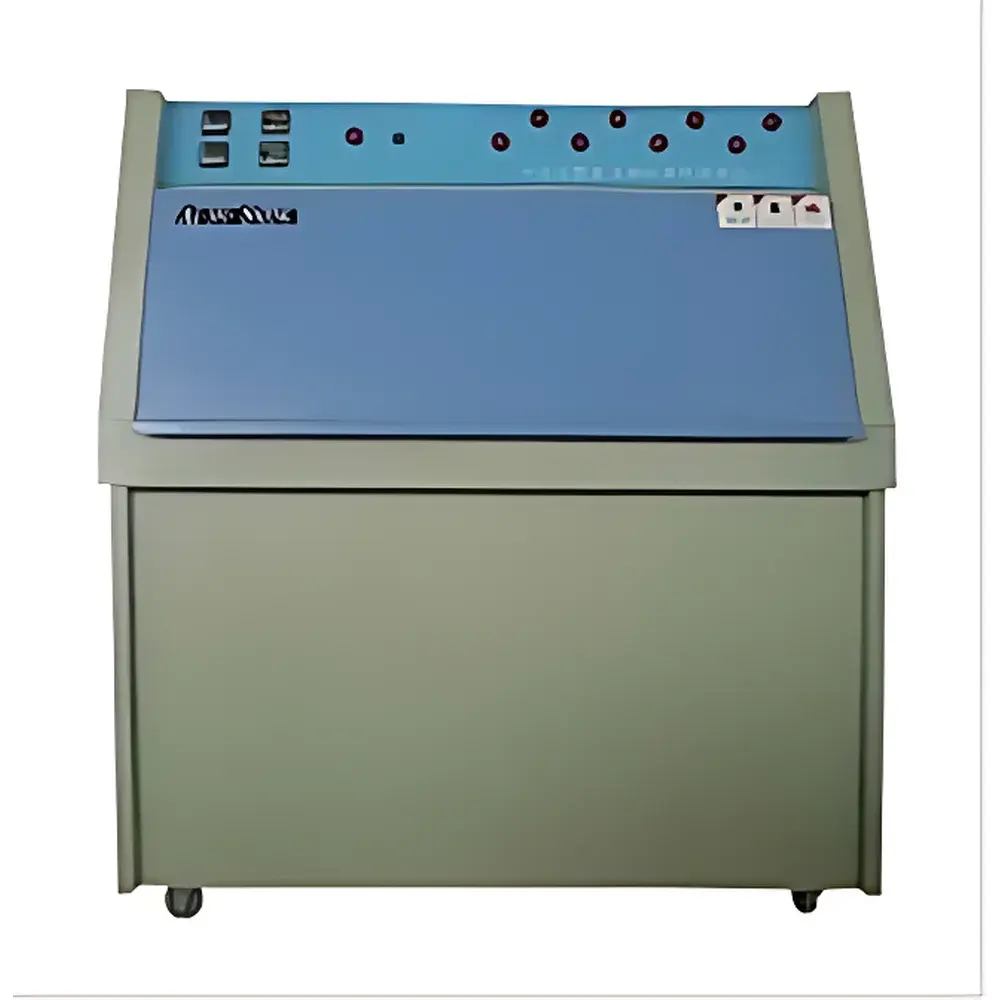
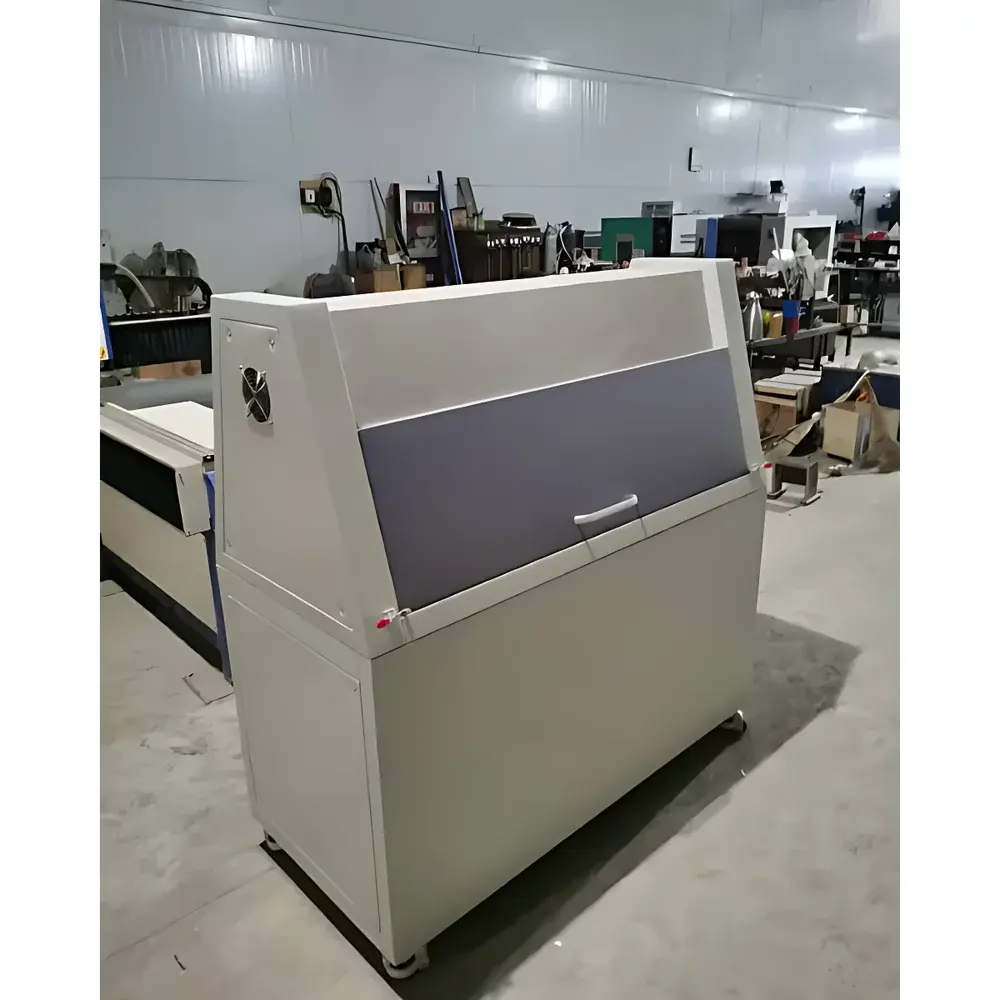
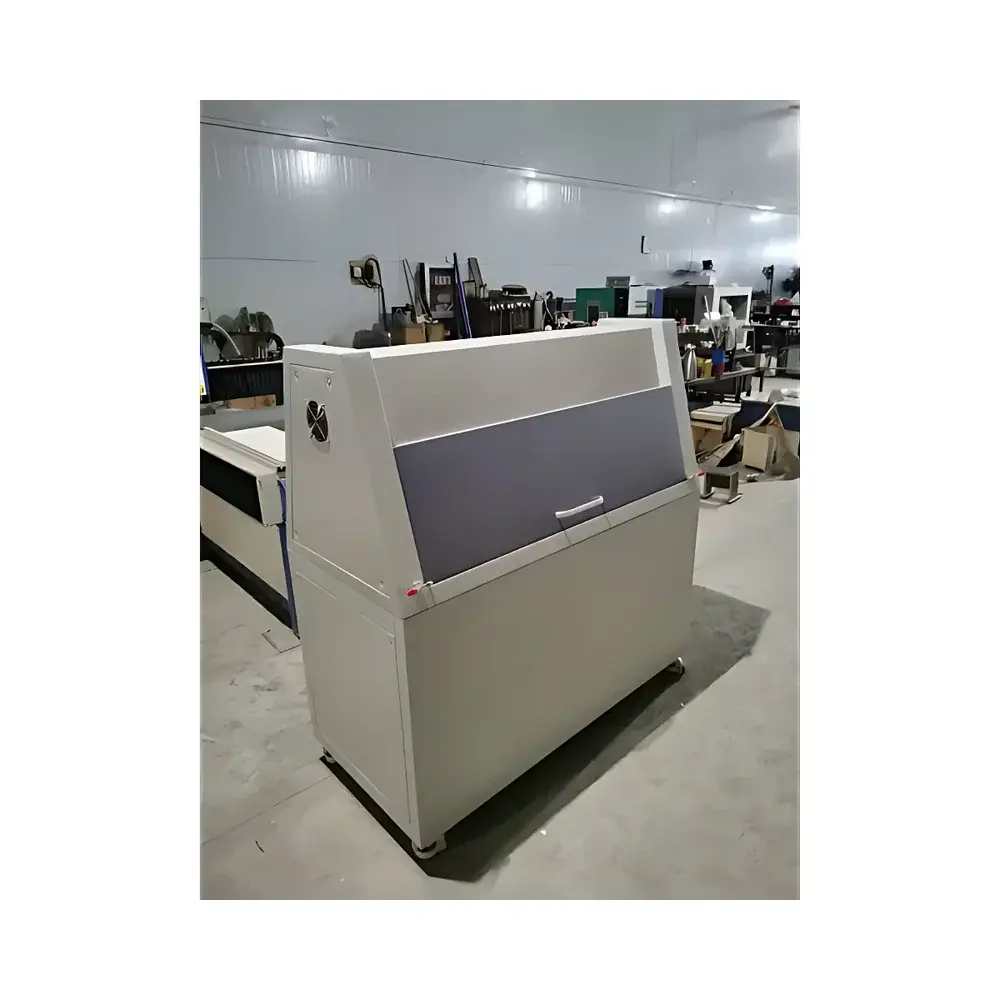
Langbo ZN-P UV Aging Test Chamber
| Brand | Langbo |
|---|---|
| Origin | Jiangsu, China |
| Manufacturer Type | Authorized Distributor |
| Country of Origin | China |
| Model | ZN-P |
| Price | USD 10,800 (FOB Jiangsu) |
| Humidity Range | 90–98% RH |
| UV Lamp Power | 4 kW |
| Irradiance Range | 0.55 W/m² (at 340 nm, typical calibration point) |
| Exposure Time | 1–9999 h |
| Illuminated Chamber Temperature Range | RT+10°C to 70°C |
| Black Panel Temperature Range | 45–65°C |
| UV Wavelength | 315–400 nm (UV-A), optional 280–315 nm (UV-B) |
| Internal Chamber Dimensions (L×W×H) | 450 × 1170 × 500 mm |
| Effective UV Irradiation Area | 900 × 210 mm |
| Specimen Tray Capacity | Accommodates standard samples of 75 × 150 mm or 75 × 300 mm (custom sizes available upon specification) |
| Condensation Water Depth | 25 mm (automatically maintained) |
| Temperature Uniformity | ±2°C |
| Temperature Stability | ±0.5°C |
| Humidity Uniformity | ±2% RH |
| Humidity Stability | ±2% RH |
Overview
The Langbo ZN-P UV Aging Test Chamber is an engineered environmental simulation system designed to accelerate photodegradation and weathering effects on polymeric materials, coatings, textiles, automotive components, and architectural finishes under controlled ultraviolet radiation, temperature, and humidity conditions. It operates on the principle of artificial UV exposure using fluorescent UV lamps—specifically calibrated for UV-A (315–400 nm) spectral output, with optional UV-B (280–315 nm) lamp configurations—to replicate critical solar spectral regions responsible for polymer chain scission, pigment fading, and surface embrittlement. Unlike broad-spectrum xenon arc systems, this chamber provides high-intensity, spectrally stable UV irradiation with precise black panel temperature control and programmable condensation cycles—enabling reproducible, ISO 4892-3 and ASTM G154-compliant accelerated aging protocols.
Key Features
- High-stability UV-A fluorescent lamp array (4 kW total power), with calibrated irradiance output at 0.55 W/m² @ 340 nm—traceable to NIST-traceable reference sensors
- Dual-zone thermal control: independent regulation of chamber air temperature (RT+10°C to 70°C) and black panel temperature (45–65°C) via thermocouple feedback and PID logic
- Programmable condensation cycle with automatic water level maintenance at 25 mm depth in the specimen tray reservoir—simulating nocturnal dew formation per ASTM D4329
- Uniform irradiation field over 900 × 210 mm effective area, validated per ISO 4892-3 Annex B for spatial irradiance homogeneity
- Robust stainless-steel interior chamber (450 × 1170 × 500 mm L×W×H) with quartz glass UV-transmissive viewing window and insulated double-wall construction
- Microprocessor-based controller with real-time logging, password-protected parameter locking, and event-triggered alarm outputs (over-temperature, lamp failure, low water)
Sample Compatibility & Compliance
The ZN-P accommodates standard flat-panel specimens measuring 75 × 150 mm or 75 × 300 mm, mounted vertically on a rotating sample rack (optional) or static fixture. Custom fixtures are available for 3D parts, foams, or flexible substrates upon engineering review. All operational parameters—including irradiance setpoint, exposure duration, condensation interval, and thermal ramp profiles—are configurable to meet test requirements defined in ISO 4892-3, ASTM G154, SAE J2020, and GB/T 14522. The system supports GLP-aligned operation: audit trails, user access levels, and electronic signature-capable data export (CSV/Excel) ensure traceability for regulated quality assurance workflows. While not FDA 21 CFR Part 11-certified out-of-box, its data logging architecture is compatible with third-party validation packages for pharmaceutical packaging stability studies.
Software & Data Management
The integrated controller features a 7-inch TFT-LCD touchscreen interface with multilingual support (English, German, Japanese, Chinese). Real-time graphs display black panel temperature, chamber humidity, cumulative UV dose (J/m²), and elapsed exposure time. Historical data is stored internally for ≥30 days and exportable via USB port. Optional Ethernet connectivity enables remote monitoring through Modbus TCP or HTTP API integration into centralized lab management systems (e.g., LabVantage, STARLIMS). All logged parameters include timestamps, operator ID, and system status flags—facilitating root-cause analysis during failure investigations or regulatory audits.
Applications
- Accelerated UV resistance validation of automotive exterior plastics (PP, ABS, PC), clearcoats, and headlamp lenses
- Weathering performance assessment of architectural sealants, PVC siding, and roofing membranes per ASTM D4798
- Photostability screening of organic pigments, textile dyes, and inkjet-printed signage materials
- Quality conformance testing for ISO 9001-certified manufacturing lines producing outdoor consumer goods
- Comparative degradation kinetics studies in academic polymer science laboratories
FAQ
What UV spectral bands does the ZN-P support?
The standard configuration delivers UV-A radiation (315–400 nm); UV-B lamps (280–315 nm) are available as a factory-installed option.
Is irradiance calibration included with delivery?
Yes—a NIST-traceable UV radiometer certificate is supplied, and users may perform routine verification using the built-in sensor port.
Can the chamber operate unattended for extended cycles?
Yes; it supports continuous operation up to 9999 hours with automatic safety cutoffs for thermal excursions, lamp burnout, or water depletion.
Does the system meet international standards for material weathering?
It fully complies with the equipment requirements of ISO 4892-3 and ASTM G154 for fluorescent UV exposure apparatuses.
What maintenance intervals are recommended?
UV lamps require replacement every 1600–2000 operating hours; chamber gaskets and water reservoir filters should be inspected quarterly.



