
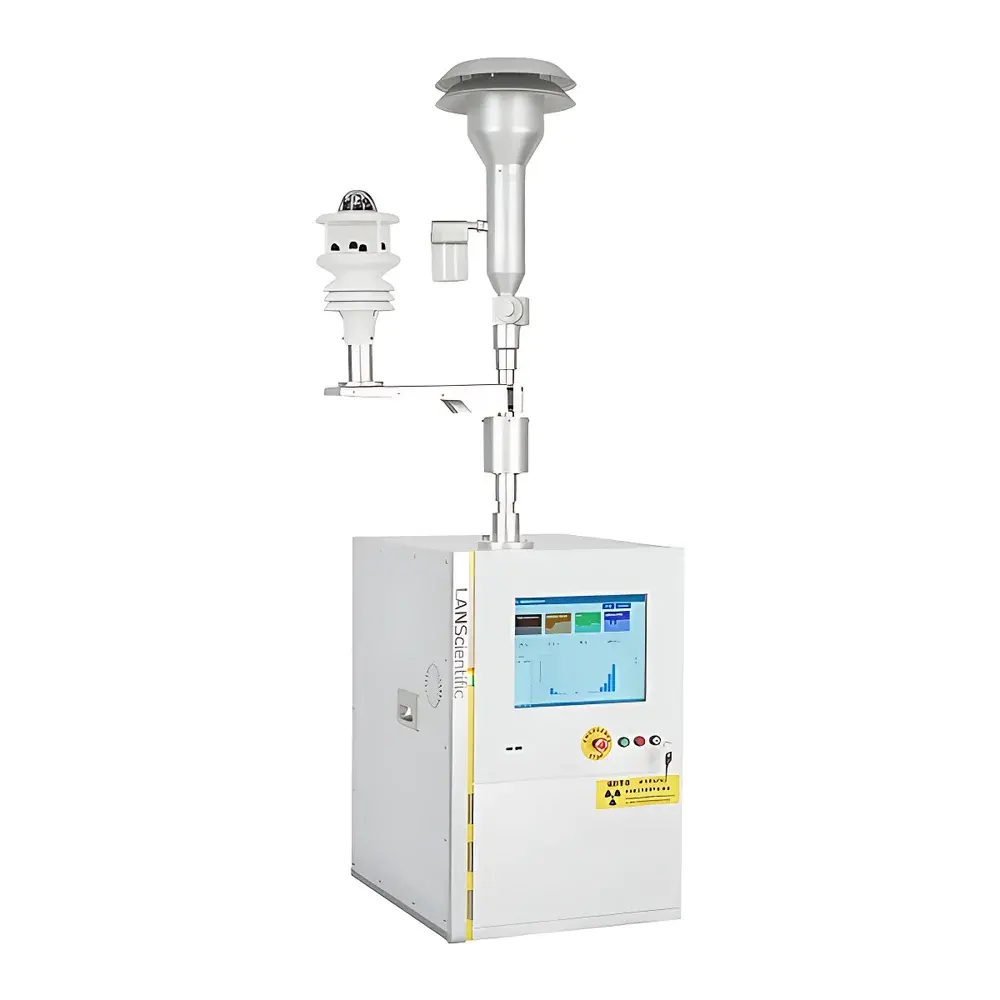
LANScientific AOA 200 Atmospheric Heavy Metal Online Analyzer
| Brand | LANScientific |
|---|---|
| Origin | Jiangsu, China |
| Manufacturer Type | Manufacturer |
| Product Category | Atmospheric Heavy Metal Analyzer |
| Model | AOA 200 |
| Measurement Principle | X-ray Fluorescence (XRF) Spectrometry combined with β-ray Absorption and Automated Airborne Particulate Enrichment |
| Measurement Range | Heavy Metals: 0–100 µg/m³ |
| PM₂.₅/PM₁₀ Mass Concentration | 0–10 mg/m³ |
| Detection Limits | Heavy Metals: sub-ng/m³ level (1-hour sampling at 16.7 L/min) |
| Particulate Matter | <1 µg/m³ (24-hour average) |
| Filter Cartridge Lifetime | ~30 days under continuous hourly sampling mode |
| Operating Temperature | −40 °C to +50 °C |
| Operating Humidity | 0–90 %RH (non-condensing) |
| Ambient Pressure Range | 86–116 kPa |
Overview
The LANScientific AOA 200 Atmospheric Heavy Metal Online Analyzer is an integrated, field-deployable continuous emission monitoring system engineered for real-time, unattended quantification of trace heavy metals and particulate mass concentration in ambient air. It operates on the fundamental principles of energy-dispersive X-ray fluorescence (ED-XRF) spectroscopy—where incident X-rays excite characteristic secondary emissions from target elements—and synergistically couples this with β-ray absorption for simultaneous gravimetric PM measurement. The instrument features an automated, time-resolved particulate enrichment module that deposits airborne aerosols onto a moving filter tape at programmable intervals (e.g., hourly), enabling sequential, non-destructive elemental analysis without sample digestion or chemical reagents. Designed in full alignment with U.S. EPA Method IO-3.3 (“Determination of Metals in Ambient Air Using X-Ray Fluorescence Spectrometry”), the AOA 200 delivers regulatory-grade data suitable for compliance reporting, source apportionment studies, and long-term trend analysis across urban, industrial, and background monitoring networks.
Key Features
- Multi-parameter co-detection: Simultaneous quantification of elemental concentrations (Pb, Cd, Cr, As, Ni, Zn, Cu, Mn, Fe, etc.) and PM mass loading on a single filter substrate.
- Ultra-low detection capability: Achieves sub-nanogram-per-cubic-meter detection limits for key toxic metals under standard 1-hour sampling (16.7 L/min flow rate), validated per ISO 8518 and ASTM D6784-22 protocols.
- Automated spectral calibration: Integrated dual-axis (energy & intensity) auto-calibration routine with user-configurable frequency; includes embedded radioactive internal reference source (e.g., 109Cd) for real-time drift correction and QC flagging.
- Radiation safety certified: Fully shielded X-ray tube housing and interlocked beam path ensure zero detectable radiation leakage (<0.1 µSv/h at 5 cm), compliant with IEC 61000-6-4 and national Class II radiation device regulations.
- Modular mechanical architecture: 19-inch rack-mountable chassis (4U height) compatible with mobile monitoring platforms (e.g., van-mounted stations) and fixed-site air quality monitoring cabinets.
- Robust environmental tolerance: Operational reliability verified across −40 °C to +50 °C ambient temperature and up to 90 %RH (non-condensing), with pressure-compensated flow control across 86–116 kPa.
Sample Compatibility & Compliance
The AOA 200 accepts standard 47-mm or 50-mm diameter quartz or Teflon-coated glass fiber filter substrates, supporting both gravimetric PM analysis and subsequent XRF interrogation without sample transfer. Its measurement methodology satisfies key international regulatory frameworks including U.S. EPA IO-3.3, EU Directive 2004/107/EC (arsenic, cadmium, lead, nickel), and China’s HJ 93-2013 and HJ 657-2013 standards for ambient air heavy metal monitoring. Data integrity meets GLP-aligned audit requirements: all raw spectra, calibration logs, filter position timestamps, and environmental metadata are timestamped, digitally signed, and stored with immutable file attributes—enabling full traceability for QA/QC review and regulatory submission.
Software & Data Management
The embedded Linux-based firmware supports local data visualization via a 7-inch capacitive touchscreen interface and exports structured CSV/NetCDF files via USB or Ethernet. Remote operation and diagnostics are enabled through secure SSH/TLS connections. The optional LANScientific CloudLink™ platform provides centralized fleet management, automatic alarm escalation (SMS/email) upon threshold violation or hardware fault, and configurable data routing to third-party environmental information systems (EIS) via MQTT or RESTful API. All data transmission adheres to TLS 1.2+ encryption, and audit trails—including user login history, parameter changes, and calibration events—are retained for ≥18 months to satisfy FDA 21 CFR Part 11 and ISO/IEC 17025 documentation requirements.
Applications
- Industrial fence-line monitoring at non-ferrous smelters, steel mills, and battery recycling facilities.
- Urban traffic corridor surveillance for brake-wear and tire-abrasion derived metals (Cu, Sb, Ba, Zn).
- Source identification and receptor modeling in multi-pollutant epidemiological studies.
- Early-warning deployment near hazardous waste sites or legacy contamination zones.
- Mobile mapping campaigns using vehicle-integrated units for spatially resolved hotspot detection.
- Regulatory enforcement support during ambient air quality investigations and permit compliance verification.
FAQ
Does the AOA 200 require periodic laboratory validation or reference material checks?
Yes—while the built-in internal standard and auto-calibration reduce frequency, annual verification using NIST-traceable aerosol reference materials (e.g., SRM 2783) is recommended per ISO/IEC 17025 Clause 7.7.
Can the instrument quantify mercury (Hg) or volatile species like methylmercury?
No—Hg vapor is not captured efficiently on standard filter media and requires cold-vapor atomic fluorescence (CVAFS) or thermal desorption-GC/MS techniques. The AOA 200 measures only filter-retained particulate-bound elements.
What maintenance intervals are required beyond filter replacement?
Annual preventive maintenance includes X-ray tube output verification, β-source activity check, flow sensor recalibration, and optical path cleaning—documented in the onboard service log with technician digital signature.
Is the system compatible with existing air quality network infrastructure (e.g., TEOM, BAM, SO2 analyzers)?
Yes—its Modbus RTU (RS485) and TCP/IP interfaces allow seamless integration into SCADA and central data acquisition systems used by national monitoring networks.
How is data integrity ensured during power interruption or communication loss?
All measurements are buffered in non-volatile flash memory (≥72 hours capacity); upon recovery, unsent data packets are transmitted with original timestamps and sequence IDs to prevent duplication or gaps.
Related Products







