
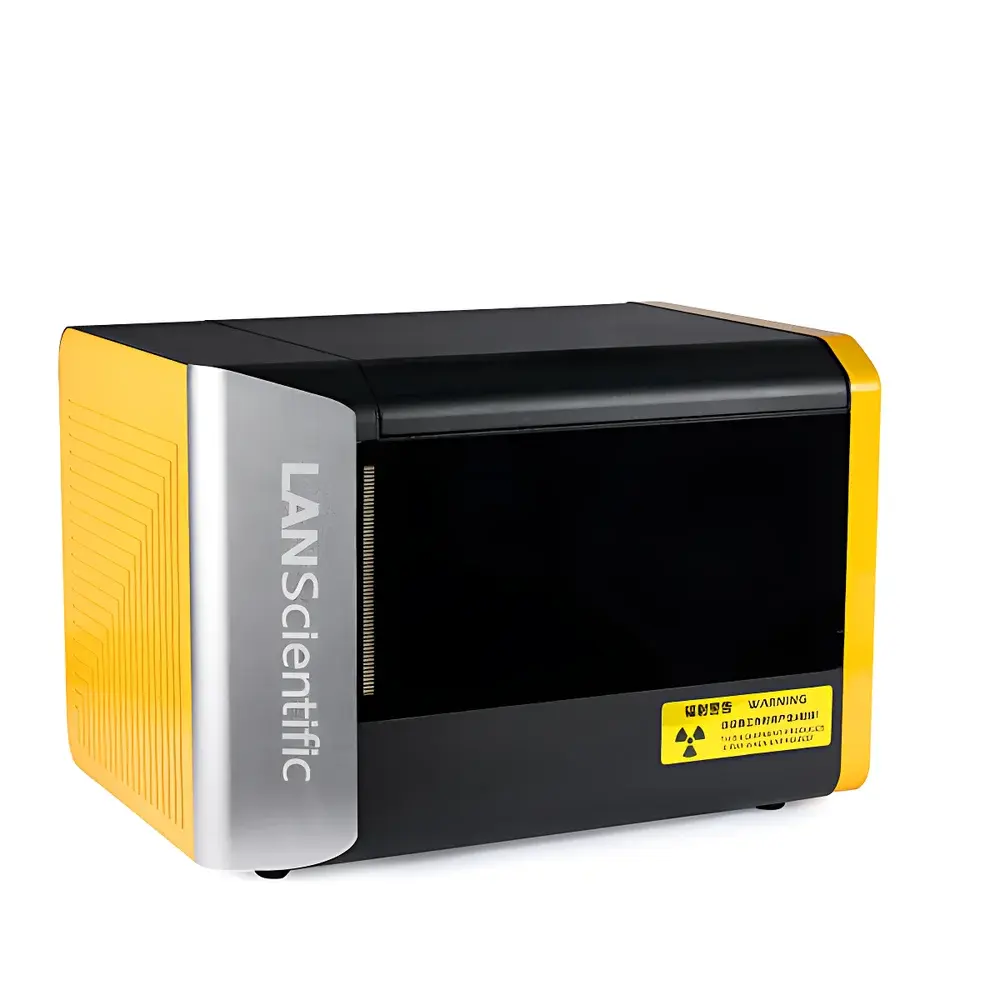
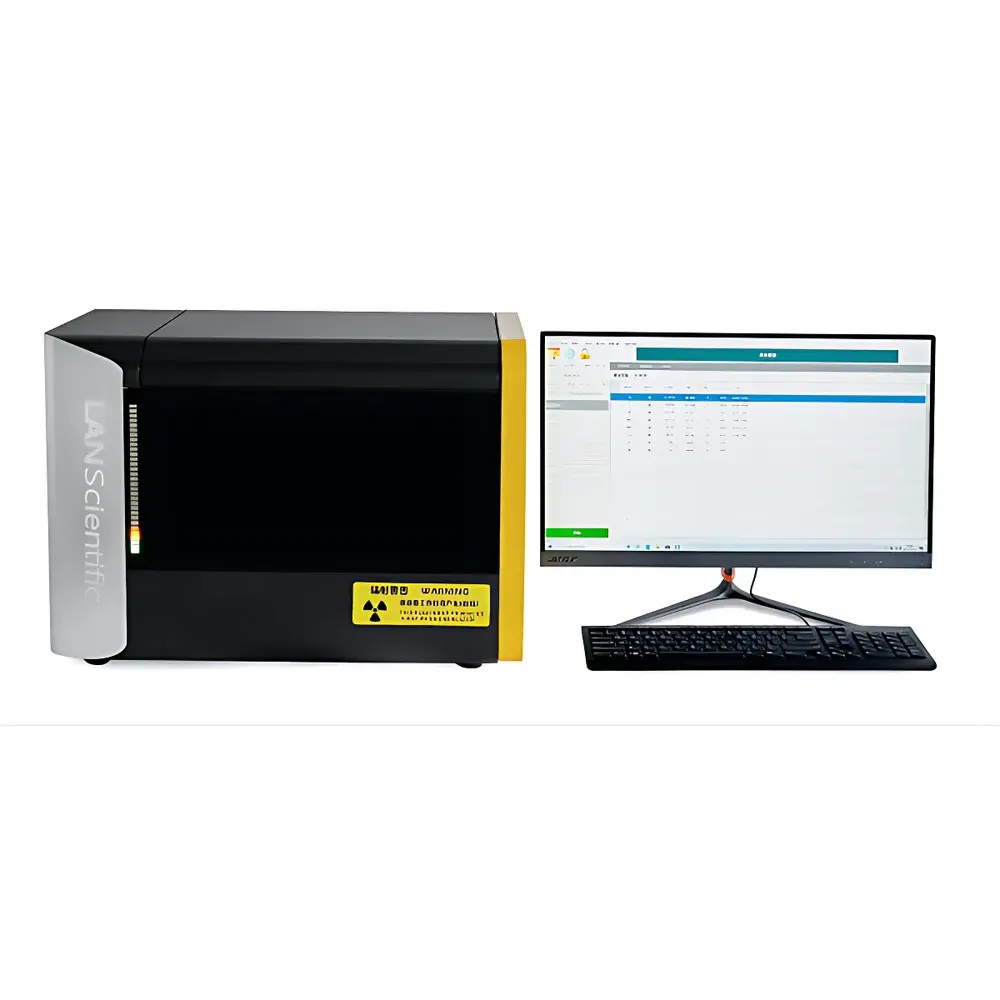
LANScientific ScopeX Desktop Energy Dispersive X-Ray Fluorescence Spectrometer for Manganese-Iron Alloy Composition Analysis
| Brand | LANScientific |
|---|---|
| Origin | Jiangsu, China |
| Manufacturer Type | Direct Manufacturer |
| Origin Category | Domestic |
| Model | ScopeX Mn-Fe Alloy Analyzer |
| Form Factor | Benchtop |
| Instrument Type | Conventional ED-XRF |
| Application Scope | General-Purpose |
| Elemental Range | Na (11) to U (92) |
| Detection Limit | 1 ppm (for selected elements under optimized conditions) |
| Energy Resolution | <125 eV at Mn Kα (5.89 keV) |
| Repeatability | ≤0.1% RSD (for major alloying elements at ≥1 wt%) |
| Detector | Peltier-cooled Silicon Drift Detector (SDD) |
Overview
The LANScientific ScopeX Desktop Energy Dispersive X-Ray Fluorescence (ED-XRF) Spectrometer is an industrial-grade benchtop analyzer engineered for precise, non-destructive elemental composition analysis of manganese-iron (Mn-Fe) alloys and related ferrous materials. Based on fundamental X-ray fluorescence physics, the instrument irradiates a sample with high-stability primary X-rays, inducing inner-shell ionization in constituent atoms. As outer-shell electrons transition to fill vacancies—primarily in the K or L shells—they emit characteristic secondary X-ray photons whose energies are uniquely tied to atomic number (Z). These spectral signatures enable qualitative identification and quantitative determination of elements from sodium (Na, Z=11) to uranium (U, Z=92), independent of chemical bonding state. The ScopeX system integrates a high-brightness microfocus X-ray tube, a high-resolution silicon drift detector (SDD), and intelligent vacuum control to optimize excitation efficiency—particularly for light elements such as Mg, Al, Si, P, and S—while maintaining robust performance for heavy transition metals including Cr, Ni, Mo, Mn, and Fe.
Key Features
- Non-destructive analysis: No sample digestion, coating, or physical alteration required; preserves structural integrity and functional utility of tested components.
- Peltier-cooled SDD detector: Eliminates dependence on liquid nitrogen, ensuring stable spectral resolution (<125 eV at Mn Kα) and long-term operational reliability with minimal maintenance overhead.
- Intelligent vacuum system: Automatically engages during light-element measurement (e.g., Mg–S), enabling detection limits down to 1 ppm for key alloy constituents under optimized geometry and counting time.
- Multi-aperture collimation: Four motorized collimators (5 mm, 3 mm, 1 mm, and 0.5 mm) enable spatially resolved analysis and improved signal-to-background ratio for heterogeneous or coated samples.
- Automated filter selection: Eight-position programmable filter wheel allows dynamic optimization of excitation spectrum for specific element groups (e.g., Rh filter for mid-Z elements, Al filter for light elements).
- Full-metal radiation-shielded enclosure: Compliant with GB18871-2002 and GBZ115-2002 national radiation safety standards; features interlocked door sensors and hardware-enforced beam cutoff.
Sample Compatibility & Compliance
The ScopeX accommodates solid, powdered, pressed pellet, thin-film, and liquid samples—including irregularly shaped metal ingots, rolled sheets, wire segments, and electroplated substrates—within its enlarged sample chamber (Ø100 mm × H70 mm). Its modular sample stage supports custom fixtures for standardized positioning per ASTM E1621 (Standard Guide for XRF Analysis of Metals) and ISO 21043 (XRF — General requirements for wavelength-dispersive and energy-dispersive instruments). Data acquisition and reporting workflows support GLP/GMP traceability: audit trails, user access levels, electronic signatures, and 21 CFR Part 11–compliant data integrity controls are implemented via optional software modules. All calibration standards are traceable to NIM (National Institute of Metrology, China) certified reference materials.
Software & Data Management
The proprietary ScopeX Analysis Suite provides full-spectrum acquisition, peak deconvolution using fundamental parameter (FP) and empirical calibration models, matrix correction (e.g., alpha correction for Fe–Mn interferences), and statistical process control (SPC) charting. Reports are exportable in customizable Excel (.xlsx), PDF, and CSV formats—including embedded spectra, elemental maps (with optional motorized XY stage), company logos, and metadata fields (operator ID, timestamp, instrument serial number, calibration certificate ID). Data transfer options include USB 3.0, Wi-Fi 5 (802.11ac), and Bluetooth 5.0, enabling integration into centralized LIMS environments via OPC UA or RESTful API interfaces.
Applications
The ScopeX spectrometer delivers reliable quantification across metallurgical QA/QC workflows: rapid grade verification of Mn-Fe ferroalloys (e.g., FeMn75, FeMn65), incoming raw material screening (ore concentrates, slag, sinter), coating thickness and composition analysis (e.g., Zn–Ni, Cr–Fe plating), and regulatory compliance testing for restricted substances (RoHS, ELV, REACH). It is widely deployed in foundries, steel service centers, precious metal refineries, cement additive labs, and polymer compounders where multi-element bulk analysis of solids and powders must meet ISO/IEC 17025 method validation requirements.
FAQ
What elements can the ScopeX detect in Mn-Fe alloys?
It detects all elements from Na (Z=11) to U (Z=92), with validated quantification for Mn, Fe, Si, P, S, Cr, Ni, Mo, Cu, Al, Ti, V, Co, and Nb in ferroalloy matrices.
Is vacuum required for every measurement?
Vacuum is automatically engaged only when analyzing elements below calcium (Z≤20); atmospheric mode suffices for Fe, Mn, Cr, Ni, and heavier elements.
Can the instrument analyze coated or layered samples?
Yes—using variable collimation, multi-layer FP modeling, and optional depth-profiling protocols based on take-off angle variation.
Does the system support regulatory reporting for ISO/IEC 17025 or FDA audits?
With enabled audit trail and electronic signature modules, it meets documentation and data integrity requirements for accredited testing laboratories.
What maintenance is required beyond routine calibration checks?
Annual detector resolution verification, X-ray tube output stability assessment, and mechanical alignment validation—no consumables or cryogens required.
Related Products






