
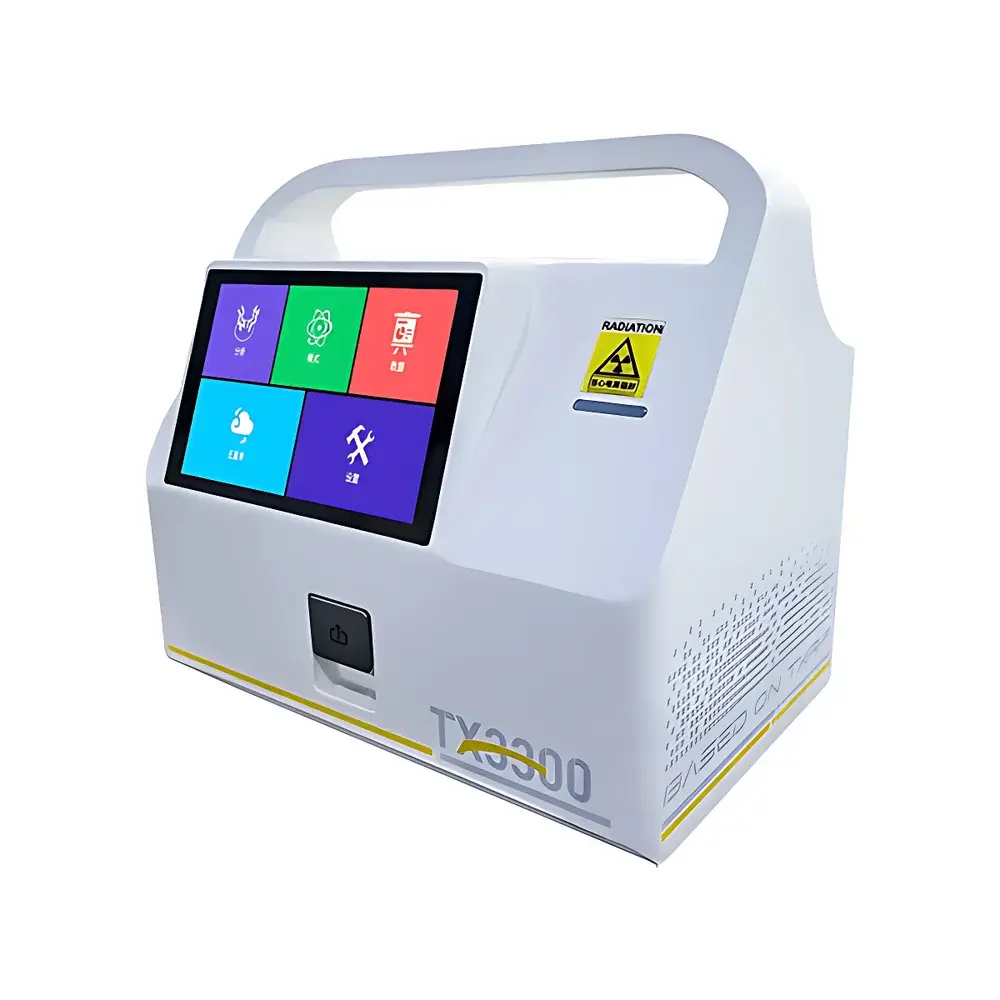
LANScientific TX3300 Portable Total Reflection X-Ray Fluorescence Spectrometer
| Brand | LANScientific |
|---|---|
| Origin | Jiangsu, China |
| Manufacturer Type | Direct Manufacturer |
| Product Line | TX3300 Series |
| Instrument Type | Total Reflection X-Ray Fluorescence (TXRF) |
| Application Form Factor | Handheld / Portable |
| Elemental Range | Mg (12) to U (92) |
| Detection Limit | 20 pg/mL (ppb) in liquid matrix |
| Sample Consumption | ≤ 10 µL per analysis |
| Detector | 20 mm² Silicon Drift Detector (SDD) |
| Industry Focus | Energy & Chemicals |
| Compliance Context | Designed for GLP-compliant trace metal quantification in regulated environmental and industrial labs |
Overview
The LANScientific TX3300 is a field-deployable, benchtop-compatible total reflection X-ray fluorescence (TXRF) spectrometer engineered for ultra-trace elemental quantification in demanding analytical environments. Unlike conventional energy-dispersive XRF (ED-XRF), the TX3300 leverages the physical principle of total external reflection—where a monochromatic X-ray beam strikes a flat, polished quartz carrier at an incident angle below the critical angle (~0.1°)—to confine excitation within a nanometer-thin evanescent wave layer. This geometry suppresses bremsstrahlung background by >10⁴× compared to standard ED-XRF, enabling detection limits as low as 20 pg/mL (ppb) for elements from magnesium (Z=12) to uranium (Z=92). Its compact optical architecture integrates a high-stability microfocus X-ray tube, precision goniometric stage, and a large-area (20 mm²) silicon drift detector (SDD) with Peltier cooling—ensuring high count-rate capability (>500,000 cps) and excellent energy resolution (<145 eV at Mn Kα). The system operates without vacuum or helium purge, making it suitable for rapid on-site deployment in environmental monitoring, fuel quality assurance, and raw material screening.
Key Features
- Field-ready portability: Weighing <3.8 kg with integrated battery support, the TX3300 meets IEC 60529 IP54 rating for dust and splash resistance—enabling operation in outdoor sampling sites, refinery perimeters, or production floors.
- Minimal sample requirement: Quantitative analysis requires only 1–10 µL of liquid, digested suspension, or homogenized solid extract—reducing digestion reagent consumption and eliminating need for hazardous acids (e.g., HF, aqua regia) in many protocols.
- Multi-element capability: Simultaneous quantification of up to 30 elements—including Cr, Pb, As, Cd, Hg, Ni, Co, and V—within a single 120-second acquisition, with built-in spectral deconvolution algorithms for overlapping L- and K-line peaks.
- Radiation safety by design: TXRF geometry inherently confines primary beam path and secondary fluorescence within a shielded chamber; measured dose rate at 5 cm from housing is <0.5 µSv/h—well below IEC 61010-1 Class I limits for operator exposure.
- Thermal and mechanical stability: Active temperature stabilization of detector and X-ray tube ensures <±0.02 keV channel drift over 8-hour continuous operation—critical for long-term calibration retention in uncontrolled ambient conditions.
Sample Compatibility & Compliance
The TX3300 accepts aqueous solutions, acid-digested extracts (e.g., EPA Method 200.8), colloidal suspensions, thin-film deposits, and filter-captured particulates—provided samples are deposited uniformly onto certified quartz carriers (10 × 10 mm, surface roughness <0.5 nm RMS). It supports standardized workflows aligned with ISO 17294-2 (water analysis), ASTM D7721 (biofuel metals), and USP / (elemental impurities in pharmaceuticals). Data integrity complies with FDA 21 CFR Part 11 requirements via audit-trail-enabled software, electronic signatures, and role-based user access control. All calibration curves are traceable to NIST SRM 2783 (air particulate matter) and ERM®-CA482 (aqueous multi-element standards).
Software & Data Management
Controlled via LANScientific’s TRAX™ v4.2 software suite, the TX3300 delivers fully automated acquisition, peak fitting (using fundamental parameter + empirical correction models), and report generation in PDF/XLSX formats. The software includes embedded QC tools: drift correction using internal reference lines (e.g., Rh Kα from tube anode), blank subtraction routines, and statistical process control (SPC) charts for routine monitoring. Raw spectral data (.trf binary format) and metadata (sample ID, operator, timestamp, instrument parameters) are stored in SQLite databases with optional encryption and network backup to NAS or LIMS via secure FTP/SFTP. Remote diagnostics and firmware updates are supported over Ethernet or Wi-Fi (WPA3-secured).
Applications
- Energy & Petrochemicals: Monitoring trace metals (Na, V, Ni, Fe) in crude oil fractions, biodiesel (EN 14214), and hydrogenation catalysts to predict fouling and catalyst deactivation.
- Environmental Field Analysis: On-site quantification of heavy metals in soil leachates (TCLP/SPLP extracts), airborne PM2.5 filters, and wastewater effluents—reducing turnaround time from days to minutes.
- Food Safety & Agriculture: Screening for toxic elements (As, Cd, Pb) in rice flour, infant formula, and irrigation water per EU Commission Regulation (EU) No 2023/915.
- Pharmaceutical Manufacturing: Verification of elemental impurities in active pharmaceutical ingredients (APIs) and excipients against ICH Q3D thresholds.
- Materials Science: Surface contamination mapping of semiconductor wafers and battery electrode slurries prior to coating—detecting Na, Al, Fe contaminants at sub-ppb levels on Si substrates.
FAQ
Does the TX3300 require vacuum or helium purging for light element analysis?
No. The TXRF geometry and SDD detector enable reliable Mg–Al quantification in air atmosphere without gas purge—eliminating consumables and maintenance associated with vacuum pumps or He tanks.
Can the instrument be calibrated using in-house standards?
Yes. TRAX™ supports custom calibration curves generated from user-prepared standards (e.g., serial dilutions in 1% HNO₃), with matrix-matching options for complex samples such as brines or organic solvents.
Is spectral interference correction available for overlapping transitions (e.g., Pb Mα and Sb Kα)?
Yes. The software applies iterative least-squares fitting with constrained peak shape parameters and library-based interference coefficients derived from NIST X-ray database (XCOM).





