
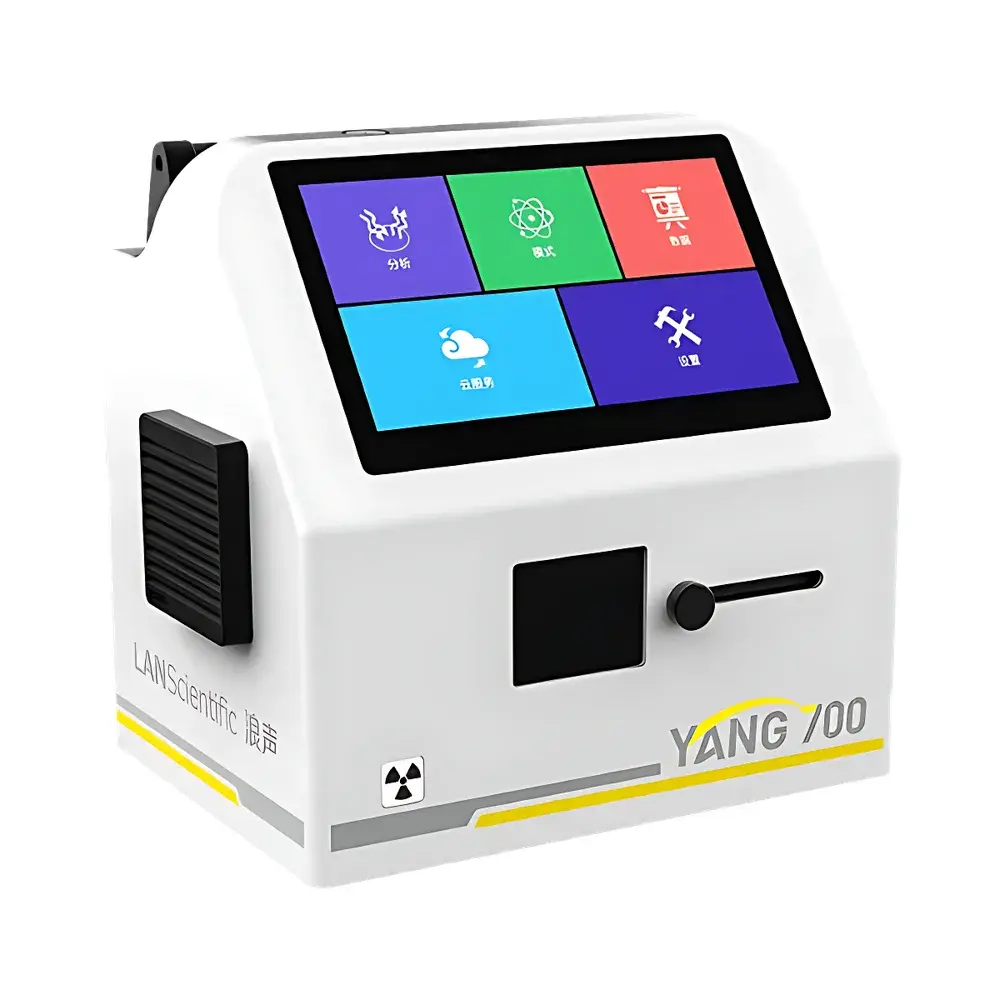
LANScientific YANG 700 Portable ppb-Level Trace X-Ray Fluorescence Spectrometer
| Brand | LANScientific |
|---|---|
| Origin | Jiangsu, China |
| Manufacturer Type | OEM Manufacturer |
| Country of Origin | China |
| Model | YANG 700 |
| Pricing | Upon Request |
Overview
The LANScientific YANG 700 is a field-deployable, benchtop-compatible single-wavelength X-ray fluorescence (XRF) spectrometer engineered for trace-level elemental quantification down to parts-per-trillion (ppt) and sub-ppb detection limits in solid, liquid, and suspended particulate matrices. Unlike conventional energy-dispersive XRF (ED-XRF) systems, the YANG 700 employs wavelength-dispersive detection architecture with a multi-faceted continuously bent crystal (CBC) monochromator—optimized to suppress Compton and Rayleigh scattering while maximizing peak-to-background ratio for target emission lines. This optical configuration enables high spectral resolution (<10 eV at Mn Kα), significantly enhancing sensitivity for low-Z and mid-Z elements (Na–Pb) under ambient or minimally shielded conditions. The instrument operates on the principle of primary X-ray excitation (via micro-focus Pd anode tube), followed by Bragg diffraction of characteristic fluorescent radiation through the CBC crystal and subsequent detection using a high-purity silicon drift detector (SDD). Its compact monolithic chassis integrates vacuum-pump-free operation for air-path analysis and optional He purge for light-element enhancement (F–Na), making it suitable for both controlled laboratory environments and unconditioned field deployments.
Key Features
- Trace-level detection capability: Sub-ppb (≤0.1 ng/g) limits of detection (LOD) for heavy metals including Cr, Pb, Cd, Hg, As, Ni, Cu, Zn—validated per ASTM E1621 and ISO 21043 guidelines
- Single-wavelength dispersive optics: Continuously bent crystal monochromator with automated angular calibration ensures long-term spectral stability and reproducibility (RSD <2.5% at 10× LOD)
- Ruggedized portable design: IP54-rated enclosure; shock-absorbing chassis; operating temperature range −10 °C to +50 °C; vibration-tolerant optical alignment
- Multi-matrix compatibility: Direct analysis of solids (powders, filters, soils), liquids (aqueous solutions, digests), and suspensions without digestion—supports ASTM D6919 and EPA Method 6200 workflows
- Integrated safety architecture: Automatic beam shutter, real-time dose monitoring, interlocked sample chamber, and compliance with IEC 61010-1 and GB/T 18268.1
- Embedded ARM-based control system with Linux OS: Onboard data processing, spectral deconvolution, and matrix correction algorithms (fundamental parameters + empirical calibration)
Sample Compatibility & Compliance
The YANG 700 accepts standard 32-mm diameter sample cups (polypropylene, Mylar, or quartz), filter membranes (0.45 µm polycarbonate), and solid slugs (up to 20 mm thickness). It supports certified reference materials (CRMs) from NIST, BAM, and JCSDA for method validation. Regulatory alignment includes full traceability to ISO/IEC 17025:2017 analytical competence requirements, support for GLP-compliant audit trails (user log, method versioning, raw spectrum archiving), and optional 21 CFR Part 11–compliant electronic signature modules. All firmware and calibration files are digitally signed and checksum-verified to ensure data integrity across field-to-lab data migration.
Software & Data Management
The instrument runs LANScientific’s SpectraLink v3.2 software suite, featuring dual-mode operation: standalone touchscreen interface (Android-based UI) and remote PC control via Ethernet/Wi-Fi. Key capabilities include dynamic background subtraction, iterative fundamental parameter modeling, and customizable reporting templates aligned with ISO 11843-7 (detection capability estimation). Data export supports CSV, .dx, and .rpt formats compatible with LIMS integration (HL7, ASTM E1461). The companion mobile application (iOS/Android) enables real-time spectrum preview, geotagged sample logging, offline method recall, and encrypted cloud synchronization via TLS 1.3–secured endpoints. All spectral metadata—including tube voltage/current, acquisition time, crystal position, and environmental sensor logs (T/RH)—are embedded in each measurement file.
Applications
- Environmental monitoring: In-situ screening of contaminated soils, sediments, and water extracts for regulated metals (e.g., EPA Region 10 priority pollutants)
- Materials quality control: Rapid verification of RoHS-compliant coatings, solder alloys, and recycled polymer batches
- Geochemical surveying: Field-based lithogeochemistry for exploration mapping (e.g., Au pathfinder elements: As, Sb, Bi)
- Pharmaceutical excipient testing: Quantitative verification of catalyst residues (Pd, Pt) and elemental impurities per ICH Q3D
- Forensic trace evidence: Non-destructive analysis of gunshot residue particles, paint chips, and glass fragments
FAQ
Does the YANG 700 require external cooling or vacuum pumps?
No—the SDD detector uses thermoelectric (Peltier) cooling, and the optical path operates under ambient air or optional He flush; no mechanical vacuum pumps or liquid nitrogen are required.
Can the instrument be calibrated against international CRMs?
Yes—factory calibration includes NIST SRM 2710a (Montana Soil), BAM BCR-723 (Waste Incineration Ash), and custom user-defined standards with uncertainty propagation reporting.
Is spectral data export compliant with laboratory information management systems (LIMS)?
Yes—CSV and ASTM E1382-compliant ASCII exports include full metadata; optional OPC UA and REST API modules enable bidirectional LIMS integration.
What is the typical measurement time for sub-ppb detection?
Acquisition times range from 60 s (screening mode) to 600 s (quantitative mode), depending on matrix complexity and required LOD; auto-time optimization is available per element.
How is instrument performance verified during routine use?
Built-in daily verification uses a proprietary multi-element check source; results are logged and compared against baseline spectra stored in the secure audit trail database.





