
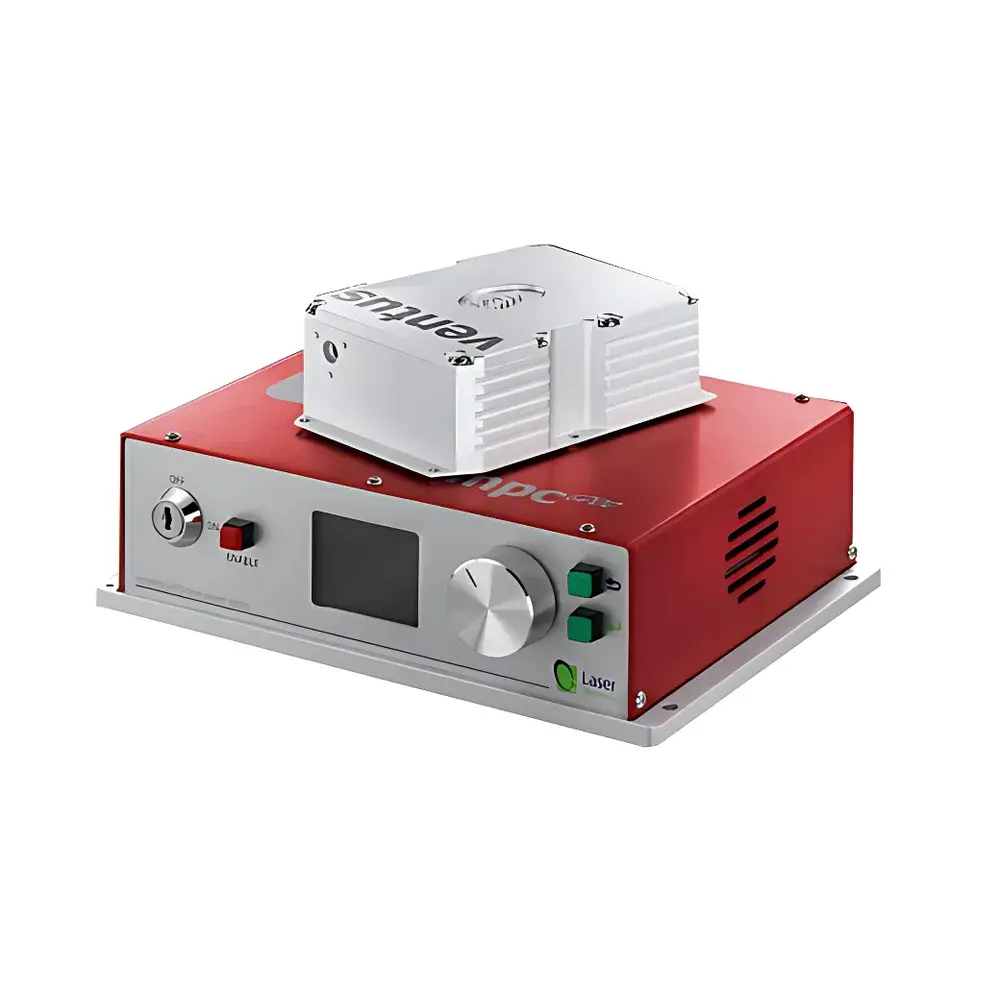
Laser Quantum Ventus Series High-Performance Scientific Laser Systems
| Brand | Laser Quantum |
|---|---|
| Origin | United Kingdom |
| Model | Ventus |
| Wavelength Options | 473 nm, 532 nm, 561 nm, 660 nm, 671 nm, and Ventus Solo (532 nm) |
| Output Power Range | 50 mW to 1.5 W |
| Beam Diameter | 1.5 mm ± 0.1 mm |
| Spatial Mode | TEM₀₀ |
| Beam Ellipticity | < 1:1.2 |
| Spectral Bandwidth | < 10 GHz to < 40 GHz (model-dependent) |
| Beam Divergence | < 0.6 mrad (typ.) |
| M² Factor | < 1.2 (typ.) |
| Power Stability | < 0.4 % RMS (typ.) |
| Beam Pointing Stability | < 10 µrad/°C |
| Intensity Noise | < 0.15 % RMS (1 Hz–100 MHz) |
| Polarization Ratio | > 100:1 (vertical) |
| Coherence Length | ~7.5 mm to ~75 mm (model-dependent) |
| Operating Temperature | 15 °C to 40 °C |
| Warm-up Time | ≤ 10 min |
Overview
The Laser Quantum Ventus Series represents a class of high-stability, diode-pumped solid-state (DPSS) continuous-wave (CW) lasers engineered for demanding scientific applications requiring precise wavelength selection, exceptional beam quality, and long-term operational reliability. Unlike free-electron lasers—which are large-scale accelerator-based systems not represented in the Ventus product line—the Ventus lasers utilize robust crystalline gain media (e.g., Nd:YVO₄, LBO, BBO) with intracavity frequency-doubling or direct-emission architectures to deliver narrow-linewidth, diffraction-limited output across six discrete wavelengths: 473 nm (blue), 532 nm (green), 561 nm (cyan), 660 nm (red), 671 nm (deep red), and the single-wavelength Ventus Solo variant at 532 nm. Each model is designed around a monolithic, hermetically sealed optical cavity with active thermal stabilization, enabling sub-milliradian pointing stability and rms power fluctuations below 0.4 %—critical parameters for quantitative spectroscopy, interferometric imaging, and optogenetic stimulation protocols requiring photostability over hours.
Key Features
- Compact, rack-mountable enclosure (19″ form factor) with integrated cooling and EMI shielding for integration into multi-instrument laboratories.
- TEM₀₀ spatial mode with M² < 1.2 and ellipticity < 1:1.2 ensures optimal coupling into single-mode fibers and high-numerical-aperture microscope objectives.
- Active power regulation via internal photodiode feedback loop maintains output within ±0.4 % RMS over 8-hour continuous operation.
- Remote control interface supporting USB 2.0, RS-232, and Ethernet (TCP/IP) protocols compliant with SCPI command syntax for automated experiment sequencing.
- Rigorous mechanical qualification including drop testing (IEC 60068-2-32) and vibration endurance (5–500 Hz, 0.15 g²/Hz PSD) confirms suitability for mobile labs and shared-core facilities.
- Factory-aligned, maintenance-free optical path with no user-accessible alignment screws—designed for GLP/GMP environments where traceability and minimal intervention are required.
Sample Compatibility & Compliance
The Ventus Series is compatible with standard optical tables, inverted and confocal microscopes (e.g., Zeiss LSM, Nikon A1R, Leica SP8), Raman spectrometers (Horiba LabRAM, Renishaw inVia), and optical trapping platforms (e.g., Thorlabs G201, Lumicks C-Trap). All units comply with IEC 60825-1:2014 Class 3B laser safety requirements and carry CE, UKCA, and FDA 21 CFR 1040.10/1040.11 certifications. Optical outputs meet ISO 11146-1:2019 beam parameter measurement standards. For regulated biophotonics workflows—including clinical ophthalmic imaging or FDA-submitted DNA sequencing assays—the system supports audit-trail-enabled software logging (via optional Laser Quantum Control Suite) aligned with 21 CFR Part 11 electronic record requirements when deployed with validated IT infrastructure.
Software & Data Management
Laser Quantum provides the cross-platform Ventus Control Software (Windows/macOS/Linux), offering real-time monitoring of output power, temperature, diode current, and interlock status. The application supports script-driven power ramping, TTL-gated modulation (up to 100 kHz), and synchronized triggering with external DAQ systems (NI PXI, Keysight U1000 series). Logged data exports in CSV and HDF5 formats include timestamps referenced to UTC-synced system clocks. API access via Python SDK (lq_ventus) enables integration into custom acquisition pipelines—for example, correlating laser power drift with Raman peak intensity variance during long-duration spectral mapping. Firmware updates are digitally signed and verified prior to installation, ensuring integrity in validated laboratory environments.
Applications
- Raman spectroscopy: High-brightness 532 nm and 660 nm sources enable rapid acquisition of fingerprint-region spectra from biological tissues and nanomaterials with signal-to-noise ratios exceeding 10⁴:1 (at 1 s integration).
- Fluorescence and confocal microscopy: 473 nm and 561 nm variants excite common fluorophores (e.g., DAPI, FITC, mCherry) with minimal photobleaching due to low-intensity noise (<0.15 % RMS, 1 Hz–100 MHz).
- Optogenetics: Precise 532 nm and 561 nm irradiance control (±1 % setpoint accuracy) supports reproducible ChR2/Halo activation kinetics across in vitro neuronal cultures and zebrafish preparations.
- Particle image velocimetry (PIV): 532 nm Ventus models deliver >1 W CW output with <0.6 mrad divergence—ideal for illuminating large-field-of-view seeding planes in turbulent flow characterization per ASTM D7545-21.
- Ti:sapphire laser pumping: The Ventus 532 Solo (750 mW, <10 GHz bandwidth) serves as a stable, low-noise pump source for ultrafast oscillator systems requiring <0.5 % power jitter to sustain mode-locking stability.
- Ophthalmic diagnostics: 671 nm configuration meets ANSI Z136.1 limits for retinal exposure while enabling non-invasive fundus imaging and adaptive optics wavefront sensing.
FAQ
Is the Ventus Series based on free-electron laser technology?
No. The Ventus lasers are diode-pumped solid-state (DPSS) systems. Free-electron lasers are large-scale accelerator facilities—not commercially deployable instruments—and are not part of the Ventus product family.
What is the typical coherence length for the Ventus 532 nm model?
The standard Ventus 532 nm offers a coherence length of approximately 25 mm; the Ventus Solo variant extends this to ~75 mm due to its narrower spectral bandwidth (~10 GHz).
Can Ventus lasers be integrated into automated manufacturing inspection systems?
Yes. With industrial-grade Ethernet and RS-232 interfaces, deterministic latency (<5 ms command response), and conformal coating on PCBs, Ventus units are qualified for use in ISO 13849-1 PLd-rated optical metrology stations.
Does Laser Quantum provide calibration certificates traceable to NPL or NIST?
Yes. Each unit ships with a factory calibration report traceable to UK’s National Physical Laboratory (NPL) for power, wavelength, and beam diameter—available optionally with ISO/IEC 17025 accreditation upon request.
How is thermal management handled during extended 24/7 operation?
Ventus employs a dual-stage thermoelectric cooler (TEC) with PID-controlled feedback and redundant thermal cutoffs. Internal temperature gradients are maintained within ±0.1 °C, enabling stable performance across ambient shifts from 15 °C to 40 °C without recalibration.




