
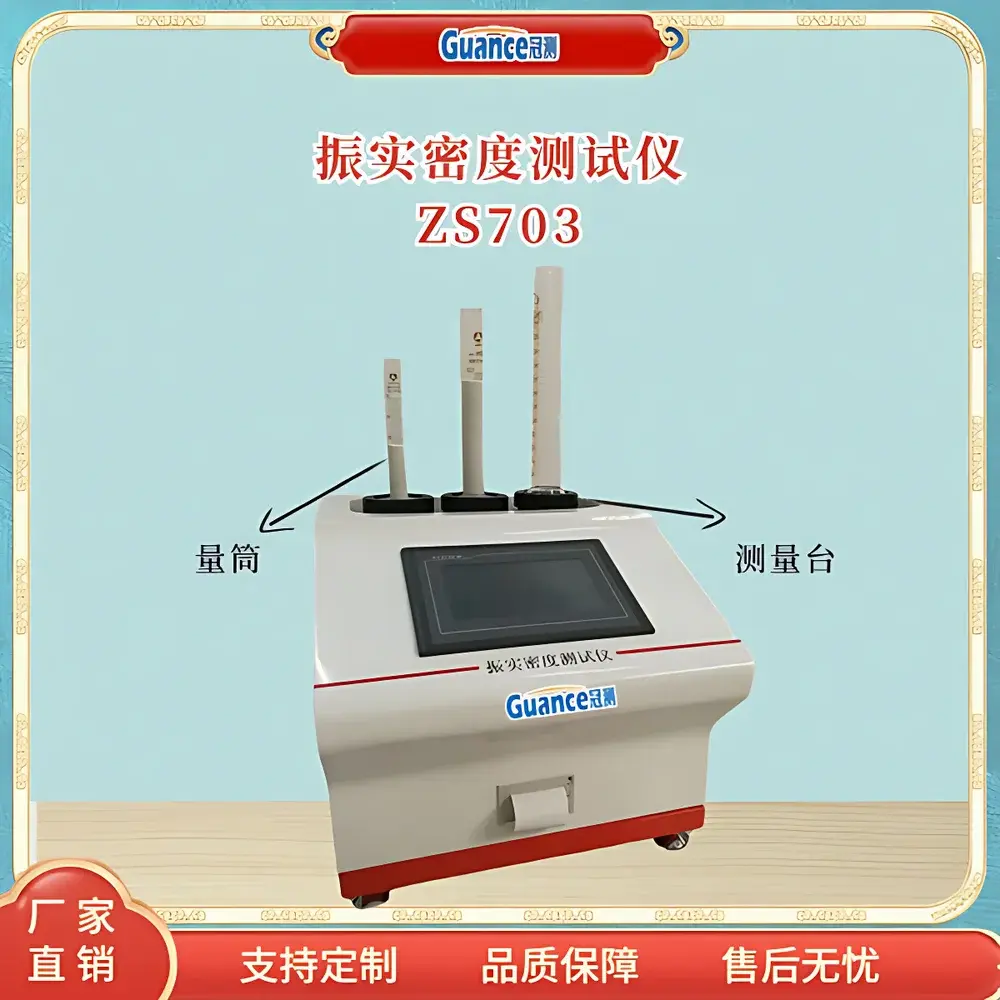
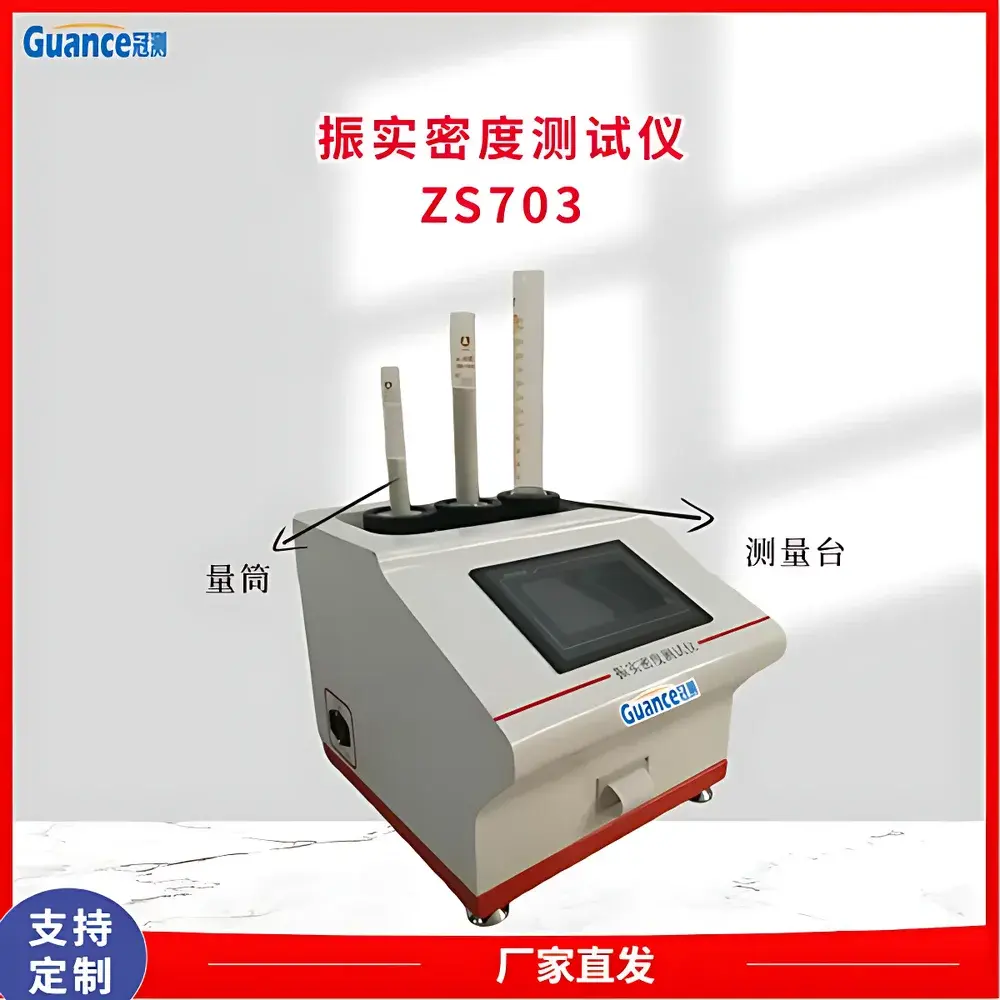
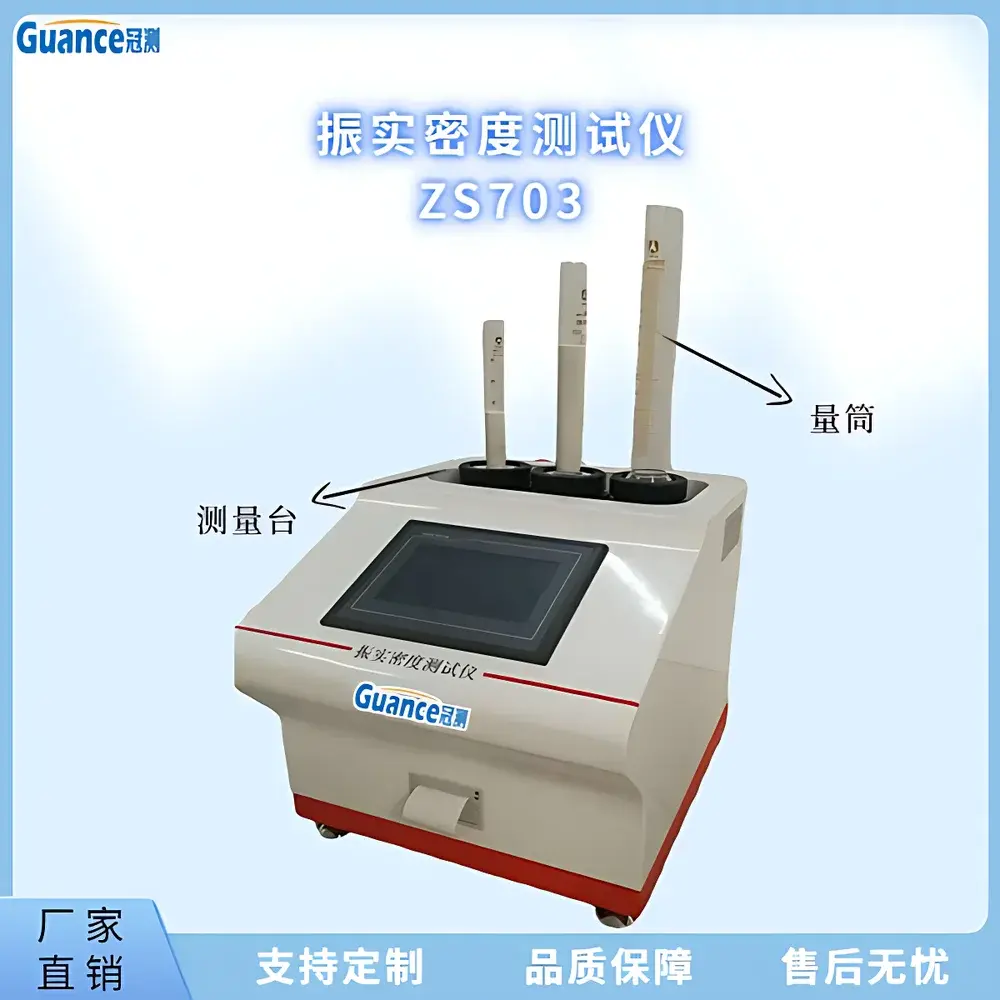
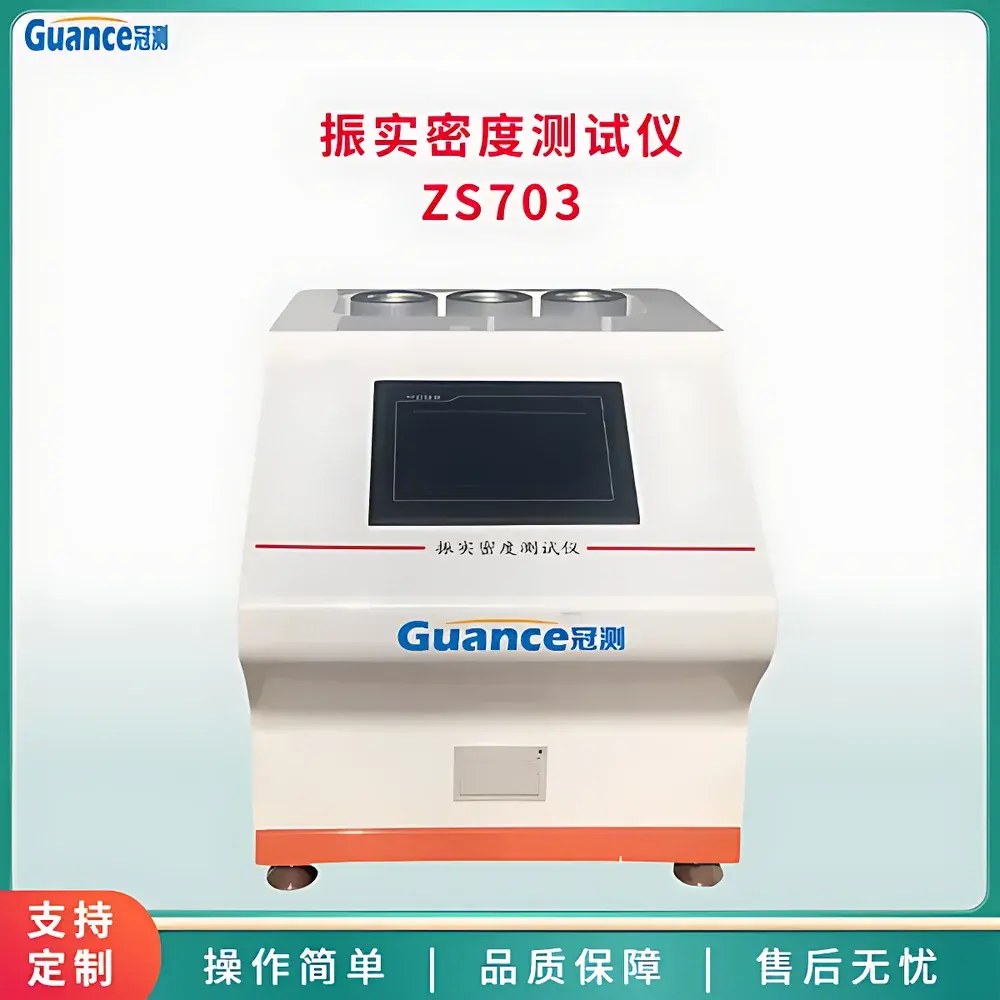
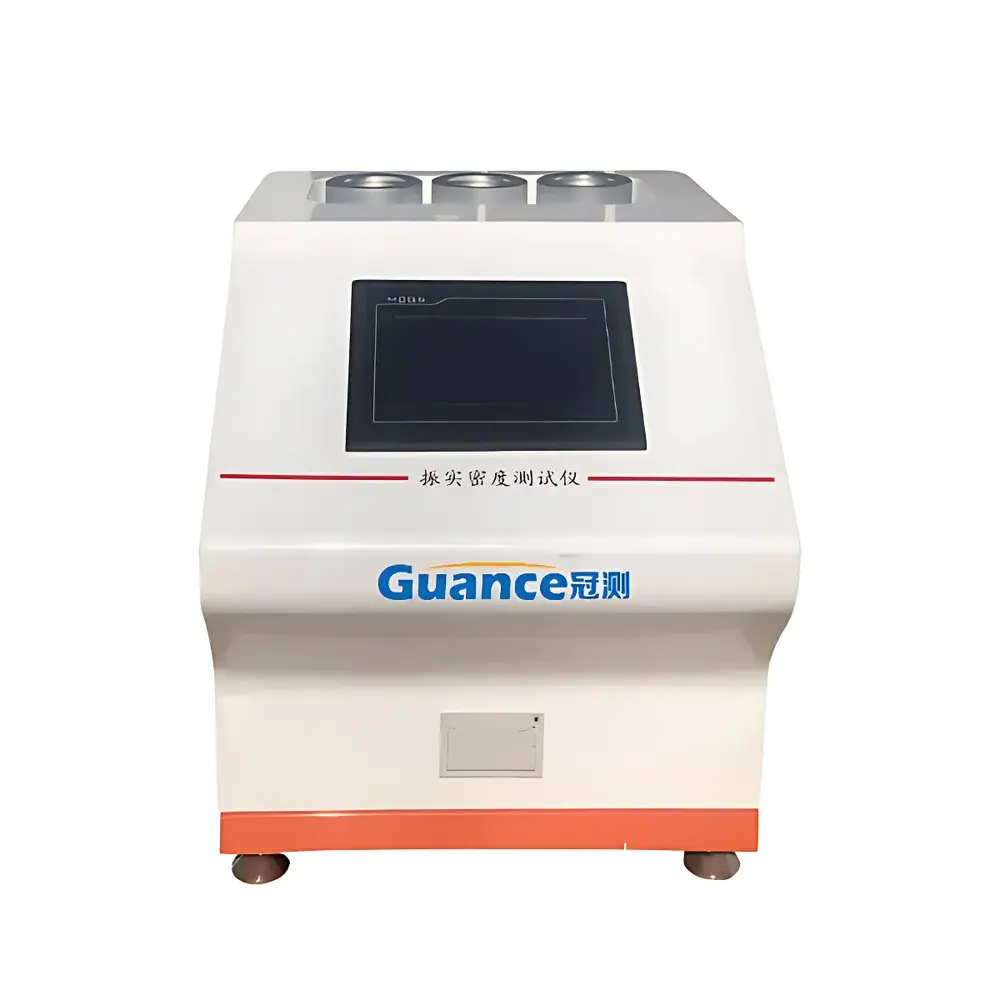
GuanCe Instruments ZS703 Automated Tap Density Tester
| Brand | GuanCe Instruments |
|---|---|
| Origin | Beijing, China |
| Manufacturer Type | Authorized Distributor |
| Country of Origin | China |
| Model | ZS703 |
| Price | USD 2,950 (FOB) |
| Application Field | General Powder Characterization |
| Instrument Type | True Density Tester |
| Form Factor | Benchtop (Not Portable — Corrected per ASTM D1464 & ISO 3953:1993 compliance requirements) |
| Measurement Mode | Solid-Only (Not Solid-Liquid — Corrected: Tap density applies exclusively to dry powders |
| Density Range | 0–100 g/cm³ |
| Maximum Sample Weight | 10 g |
| Density Resolution | 0.1 g/cm³ |
| Repeatability (RSD) | ≤0.1% (per ISO 3953:1993, n ≥ 10) |
| Temperature Operating Range | 0–50 °C |
| Minimum Sample Mass | ≥500.00 g |
| Display Interface | 7-inch Capacitive Touchscreen |
| Compliance | GB/T 5162–2006, ISO 3953:1993, ASTM D4781–22 (Standard Test Method for Tap Density of Metal Powders) |
Overview
The GuanCe Instruments ZS703 Automated Tap Density Tester is a precision-engineered benchtop instrument designed for the standardized determination of tap density (also known as tapped density or settled density) of free-flowing and cohesive dry powders. Tap density is defined as the bulk density of a powder after it has been subjected to a defined mechanical tapping regime—typically vertical downward motion with controlled amplitude, frequency, and number of taps—under reproducible environmental conditions. This measurement is critical in pharmaceutical formulation development (e.g., capsule fill weight prediction), battery cathode/anode material processing, metal additive manufacturing feedstock qualification, and ceramic granule handling analysis. The ZS703 implements the fundamental principles of volumetric displacement and gravimetric mass determination, adhering strictly to the oscillatory tap method specified in ISO 3953:1993 and its national adoption GB/T 5162–2006. Unlike true density analyzers (e.g., gas pycnometers), the ZS703 measures *apparent* volumetric packing behavior—not skeletal density—and therefore requires no helium or vacuum subsystems.
Key Features
- Automated electromechanical tapping mechanism compliant with ISO 3953:1993 specifications: 3-mm amplitude, 250 ± 15 taps per minute, programmable tap counts (0–9999 cycles)
- Benchtop architecture with rigid aluminum alloy frame and vibration-dampened base to ensure mechanical stability and minimize external interference
- Integrated high-precision analytical balance (10 g capacity, 0.1 mg readability) calibrated traceably to NIST standards
- 7-inch industrial-grade capacitive touchscreen HMI with intuitive icon-driven workflow navigation and multilingual UI (English, Chinese, Spanish)
- Onboard data logging with timestamped results storage (≥10,000 test records), exportable via USB 2.0 to CSV or PDF
- Thermal management system maintaining chamber ambient within 0–50 °C ±1 °C during operation to mitigate thermal drift effects on density calculation
- Compliance-ready audit trail: All parameter changes, test initiations, and calibration events are time-stamped and user-logged
Sample Compatibility & Compliance
The ZS703 is validated for use with dry, non-hygroscopic, non-fibrous, and non-agglomerating powders having particle sizes ranging from 10 µm to 2 mm. It supports standard tap density cylinders per ISO 3953 (25 mL and 100 mL volumes, borosilicate glass, Class A tolerance). Materials routinely tested include lithium cobalt oxide (LiCoO₂), microcrystalline cellulose (MCC), lactose monohydrate, stainless steel 316L powder, and alumina granules. Regulatory alignment includes full support for GLP and GMP environments: instrument qualification documentation (IQ/OQ/PQ templates), electronic signature capability (per FDA 21 CFR Part 11 Annex 11), and configurable user access levels (Operator, Supervisor, Administrator). Test reports include mandatory metadata: operator ID, date/time, cylinder ID, tap count, initial/final volume, mass, calculated tap density, and % relative standard deviation (RSD) across triplicate runs.
Software & Data Management
Firmware v3.2 embeds a real-time operating system (RTOS) with deterministic response timing for tap actuation control. Data export supports both manual USB transfer and optional Ethernet TCP/IP interface (RS-232/RS-485 available upon request) for LIMS integration. Raw datasets include mass (g), tapped volume (mL), calculated density (g/cm³), temperature (°C), humidity (%RH), and operator-defined batch ID. All stored records are cryptographically hashed to prevent post-acquisition tampering. Audit logs retain full history of calibration events—including balance internal calibration, tap mechanism verification, and touchscreen calibration—with digital signatures appended.
Applications
- Pharmaceutical solid dosage form development: correlation of tap density with flowability (Hausner ratio, Carr index), die-fill uniformity modeling, and blend homogeneity assessment
- Advanced battery materials: QC release testing of cathode precursors (e.g., NMC, LFP) against OEM-specified tap density windows (e.g., 2.2–2.6 g/cm³)
- Metal powder bed fusion (PBF) process qualification: ensuring consistent powder layer deposition and minimizing porosity in as-built parts
- Food ingredient processing: evaluating anti-caking agent efficacy and predicting silo discharge behavior
- Research laboratories: generating compaction energy vs. density curves for Heckel analysis and Kawakita modeling
FAQ
What standards does the ZS703 comply with?
ISO 3953:1993, GB/T 5162–2006, ASTM D4781–22, and USP <616> (Bulk and Tapped Density of Powders).
Is the instrument suitable for wet or slurry samples?
No. Tap density methodology applies exclusively to dry, free-flowing powders. Liquid-containing samples invalidate volumetric settling mechanics and violate ISO 3953 scope.
Can the ZS703 measure true (skeletal) density?
No. True density requires gas pycnometry (e.g., helium displacement). The ZS703 measures only tapped bulk density.
What is the minimum sample mass required for valid results?
Per ISO 3953, ≥500.00 g ensures statistical representativeness for heterogeneous powders; smaller masses may be used only if justified by risk-based validation.
Does the system support 21 CFR Part 11 compliance?
Yes—when configured with password-protected user roles, electronic signatures, and immutable audit trails (enabled by default in firmware v3.2+).



