
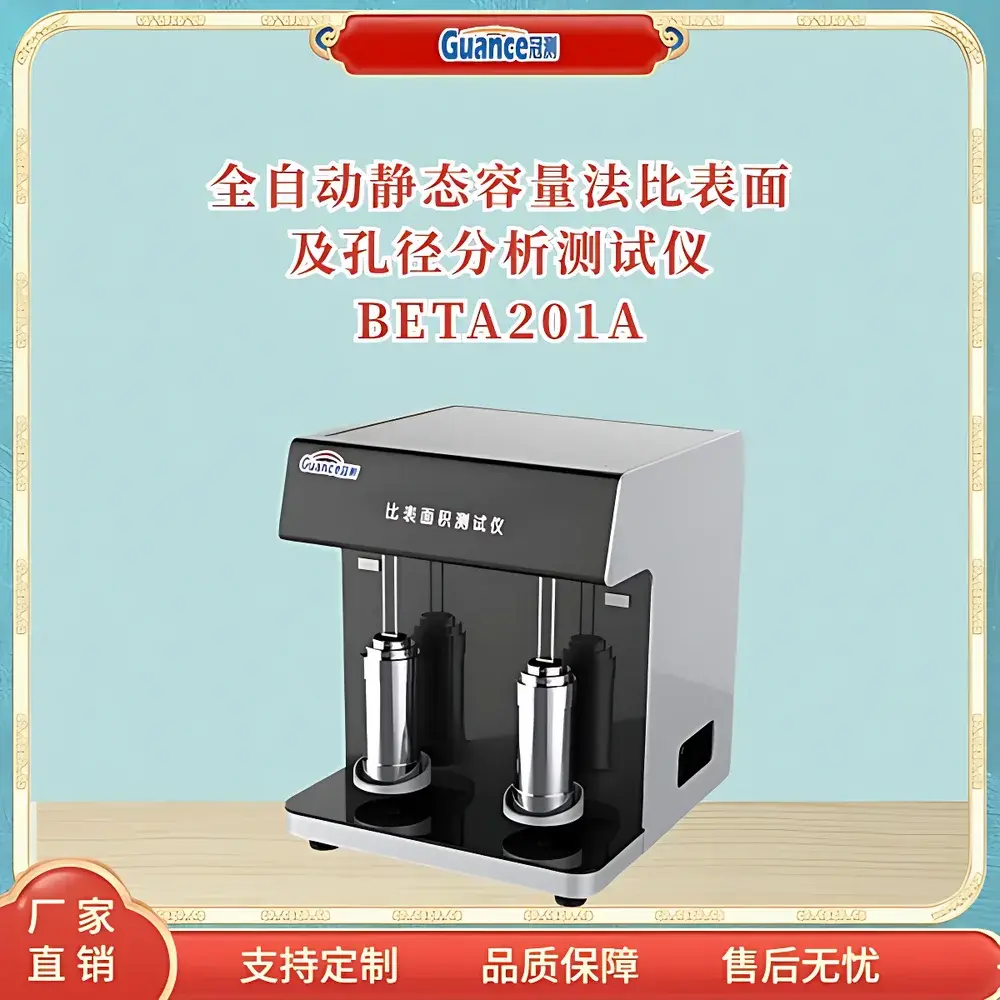
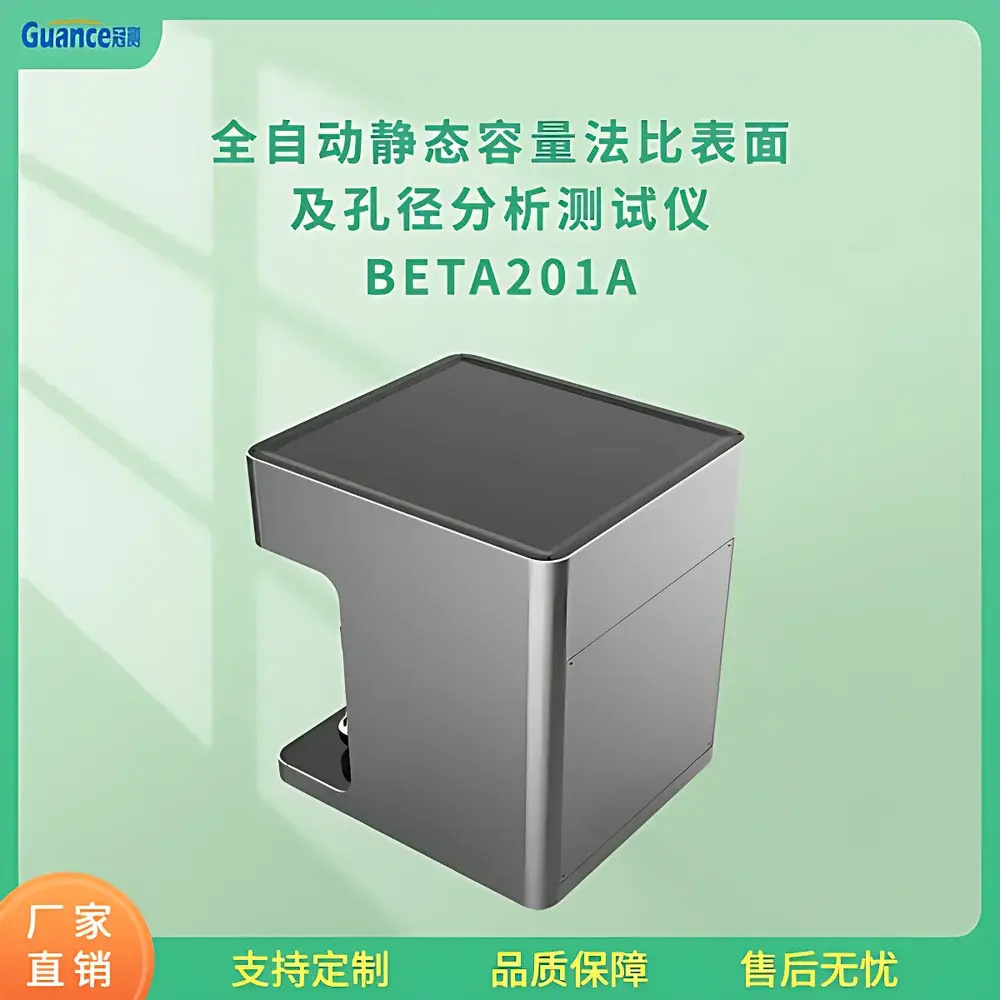
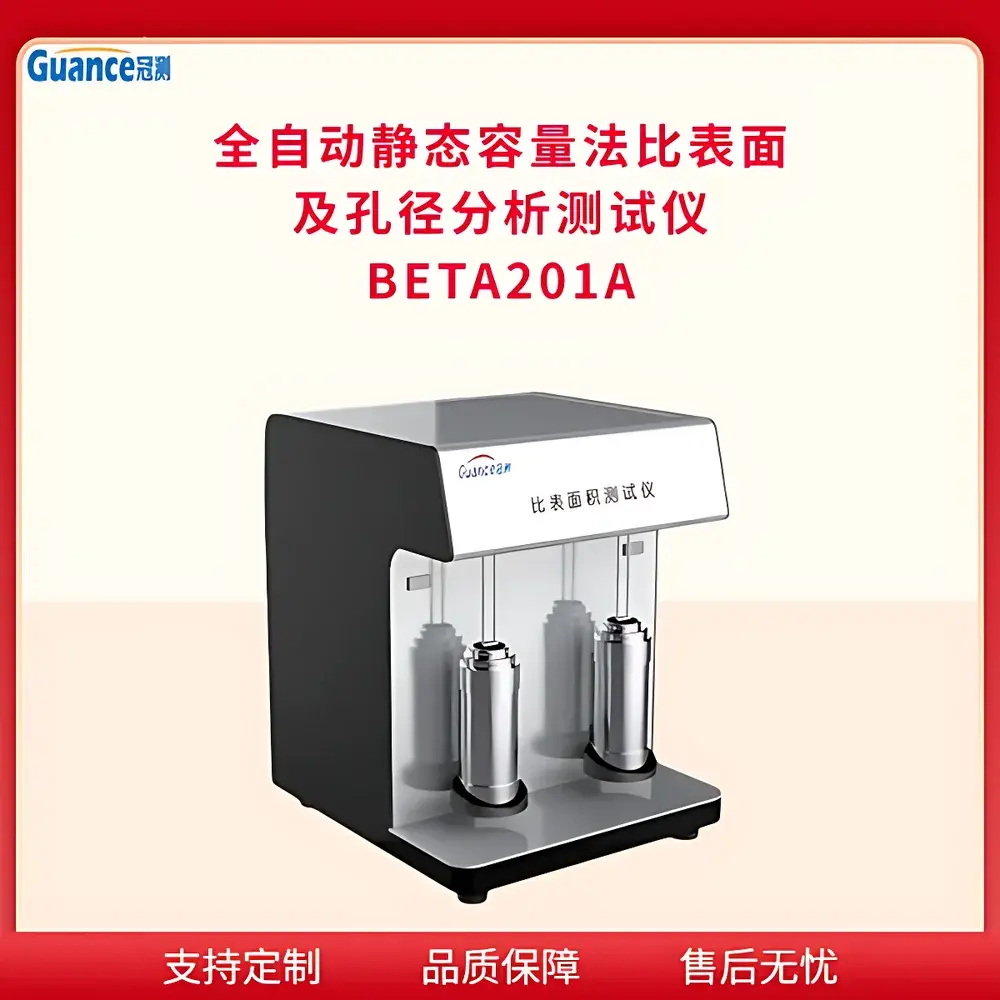
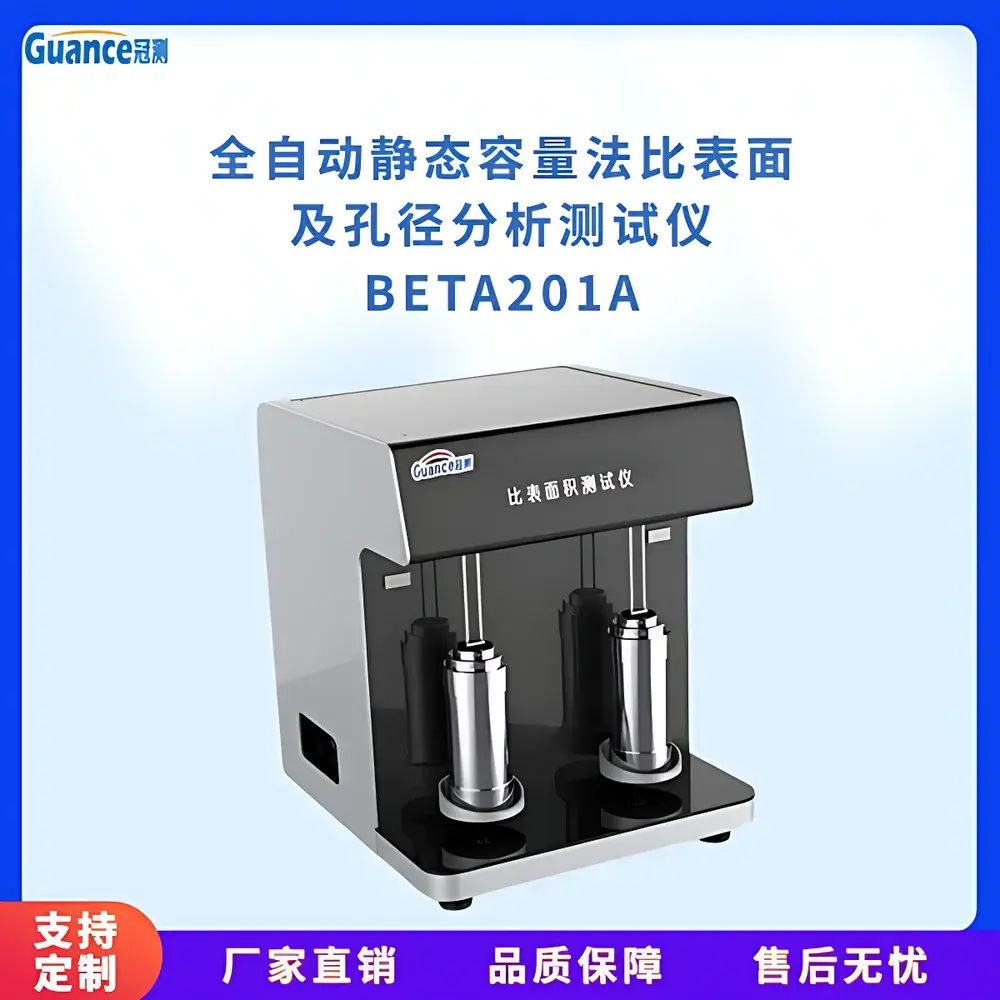
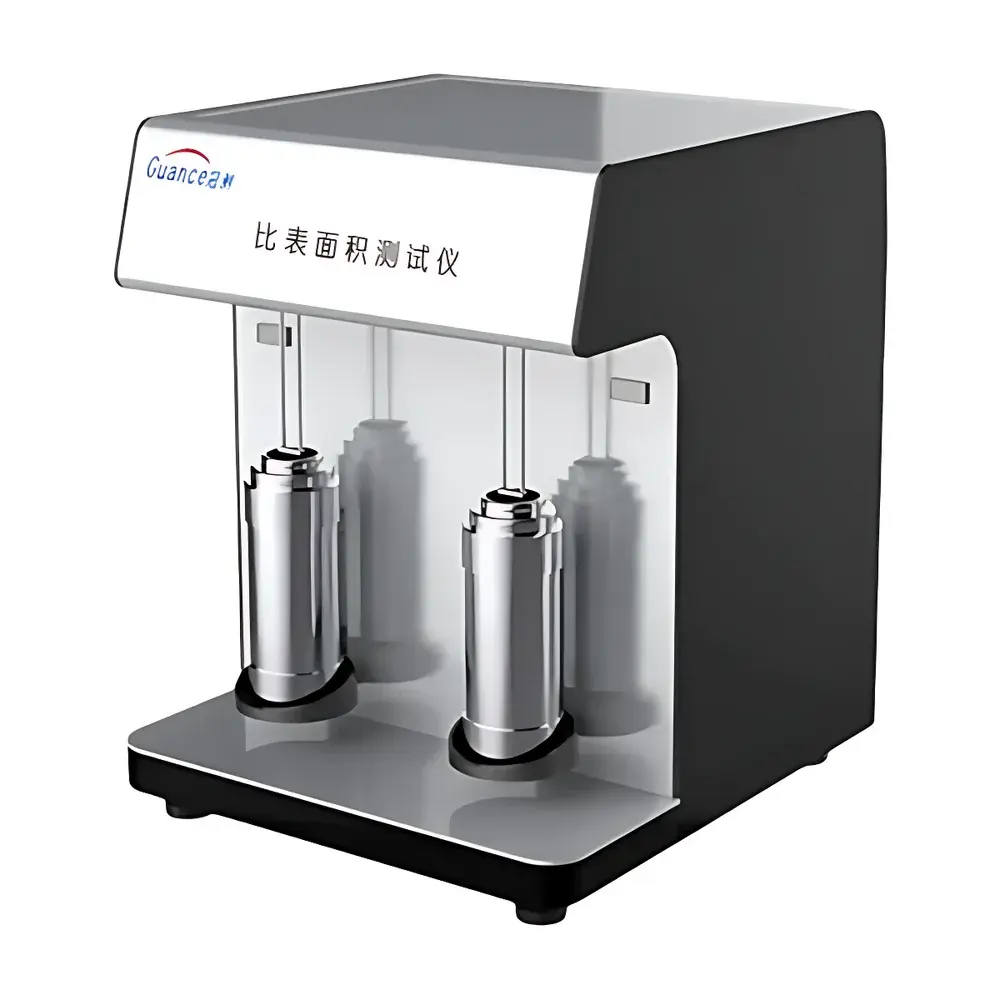
GuanCe Instruments BETA201A.2 Multi-Functional Specific Surface Area and Pore Size Analyzer
| Brand | GuanCe Instruments |
|---|---|
| Origin | Beijing, China |
| Manufacturer Type | Authorized Distributor |
| Product Category | Domestic |
| Model | BETA201A.2 |
| Instrument Type | Specific Surface Area and Pore Size Analyzer |
| Measurement Principle | Static Volumetric Method (with Dynamic Mode Support) |
| Analysis Stations | 1 |
| Surface Area Range | 0.0001 m²/g (Kr adsorption) to unlimited |
| Pressure Range | 0–133 kPa |
| Repeatability | < ±1% (per ASTM D3663 and ISO 9277) |
| P/P₀ Resolution | Down to 1×10⁻⁷ |
| Vacuum Base Pressure | ≤1×10⁻⁸ Torr (with optional turbomolecular pump) |
| Adsorption Gases | N₂, Ar, Kr, CO₂, NH₃, H₂, CO, O₂, CH₄, C₄H₁₀ (non-corrosive only) |
| Analysis Time | ~25 min for surface area (N₂), ~3.5 h for full pore size distribution (N₂, 77 K) |
| Sample Temperature Control | Liquid nitrogen isothermal jacket with 70-h autonomous operation (optional auto-refill system) |
Overview
The GuanCe Instruments BETA201A.2 is a research-grade specific surface area and pore size analyzer engineered for precision gas adsorption analysis under controlled static volumetric conditions. It operates on the fundamental principles of BET theory (Brunauer–Emmett–Teller), Langmuir modeling, and non-local density functional theory (NLDFT) or quenched solid density functional theory (QSDFT) for pore size distribution quantification. Designed for laboratories requiring high reproducibility in characterizing heterogeneous solid surfaces, the BETA201A.2 delivers traceable, standards-compliant results across diverse material classes — from battery cathode materials and catalytic supports to geological samples and pharmaceutical excipients. Its dual-sensor architecture enables concurrent measurement of absolute pressure (P₀) and sample adsorption isotherms, eliminating drift-related uncertainty in relative pressure (P/P₀) calculation. The instrument meets core requirements for GLP-compliant testing environments and supports audit-ready data handling per FDA 21 CFR Part 11 when configured with appropriate software controls.
Key Features
- Single-station static volumetric configuration optimized for high-accuracy monolayer capacity determination and micropore/mesopore characterization.
- Ultra-high vacuum system featuring all-stainless-steel piping, metal-sealed joints, silver-plated internal surfaces, and dual-layer vacuum shielding — achieving base pressures ≤1×10⁻⁸ Torr (with optional molecular pump).
- Dual high-stability capacitance manometers: one dedicated to real-time P₀ monitoring (0–10 Torr range, ±0.1% full-scale accuracy), the other for sample isotherm acquisition (0–1000 Torr, 24-bit AD resolution).
- Integrated thermal management: liquid nitrogen isothermal jacket with 70-hour hold time; optional auto-refill system enables unattended multi-day runs.
- Intelligent vacuum sequencing — automatic pump start/stop logic reduces acoustic noise by >60% and extends pump service life without compromising degassing efficacy.
- Patented dual-path valve manifold: separates degas and analysis gas pathways to prevent cross-contamination during sample transfer; enables in-situ heating and analysis without re-exposure to ambient atmosphere.
- No manual controls on instrument panel — fully computer-driven operation via Ethernet or USB interface, supporting remote diagnostics and centralized multi-unit control through standard network routers.
Sample Compatibility & Compliance
The BETA201A.2 accommodates powders (e.g., activated carbon, zeolites, MOFs), granular catalysts, pressed pellets, fibers, thin films, and low-density aerogels — provided samples are thermally stable under vacuum and inert to selected adsorbates. It complies with international standards including ISO 9277 (BET surface area), ISO 15901-2 (pore size distribution by gas adsorption), ASTM D3663 (carbon black surface area), and ASTM D4641 (activated carbon micropore volume). All vacuum and pressure calibrations are traceable to NIST-certified references. The system supports full audit trails, electronic signatures, and user-access-level permissions when operated with validated software modules meeting GLP and GMP documentation requirements.
Software & Data Management
The embedded analytical suite supports both English and Chinese GUIs, with bilingual report generation (PDF/Excel export). It includes over 30 preconfigured test protocols aligned with common industrial and academic use cases, while permitting custom method development for proprietary materials. Raw isotherm data (up to 1000 pressure points per run) is stored with full metadata: timestamp, operator ID, calibration logs, vacuum history, and environmental parameters. Software features include isotherm overlay comparison (cross-sample, cross-time, cross-gas), automatic baseline correction, t-plot and αs-method micropore analysis, and DFT/QSDFT kernel selection based on adsorbent chemistry. Data integrity safeguards include automatic power-fail recovery, encrypted database backups, and configurable retention policies compliant with 21 CFR Part 11 Annex 11 expectations.
Applications
- Quality control of lithium-ion battery electrode materials (LiCoO₂, NMC, Si anodes) for surface oxidation state correlation.
- Pore structure validation of FCC catalysts and fluid cracking additives per refinery specifications.
- Characterization of medical-grade mesoporous silica carriers for drug loading efficiency prediction.
- Surface area trending in cementitious systems to assess hydration kinetics and pozzolanic reactivity.
- Adsorption isotherm benchmarking for CO₂ capture sorbents (Mg-MOF-74, amine-grafted SBA-15) using CO₂ at 273 K.
- Surface heterogeneity mapping of graphene oxide derivatives via Kr adsorption at 77 K for sub-0.5 m²/g ultra-low-area quantification.
FAQ
Does the BETA201A.2 support helium-free calibration?
Yes — it uses nitrogen as the primary adsorbate and relies on in-situ P₀ referencing; no helium pycnometry or dead-volume calibration is required.
Can the system perform argon adsorption at 87 K for narrow-pore carbons?
Yes — the temperature-controlled bath accommodates alternative cryogens; Ar @ 87 K analysis is fully supported with appropriate isotherm models.
Is the vacuum system compatible with UHV-compatible sample preparation workflows?
With the optional turbomolecular pump upgrade and bake-out capability, the system achieves UHV readiness (<1×10⁻⁹ Torr) suitable for surface science pre-characterization.
How does the instrument handle moisture-sensitive samples during degassing?
Programmable ramp-and-hold degas profiles (0–400 °C, 0.1 °C resolution) combined with real-time pressure monitoring allow gentle, contamination-free activation under dynamic vacuum.
What regulatory documentation is provided for validation purposes?
Factory acceptance test (FAT) reports, metrology certificates for pressure sensors and temperature probes, IQ/OQ templates, and 21 CFR Part 11 readiness assessment documentation are supplied upon request.
Related Products



