
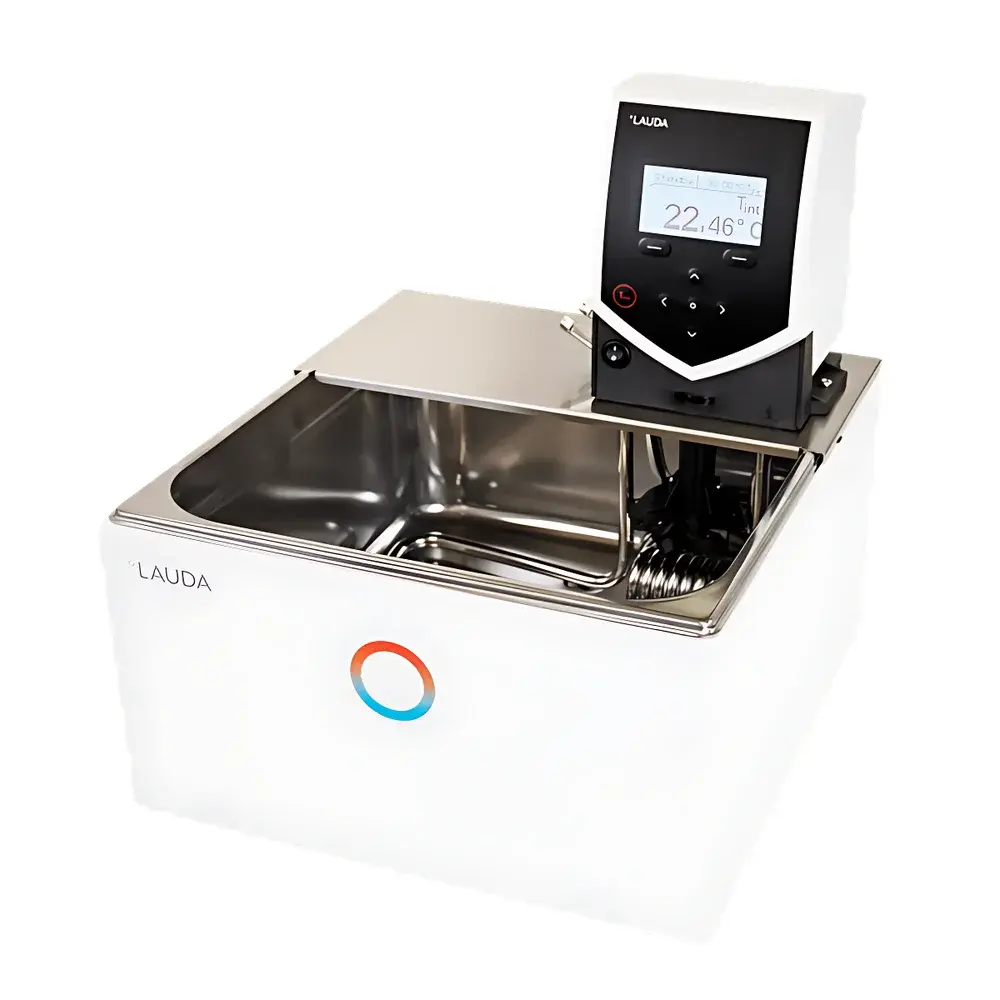
LAUDA ECO E 10 G Precision High-Temperature Circulating Bath (20–200 °C, ±0.01 °C Stability)
| Brand | LAUDA |
|---|---|
| Origin | Germany |
| Model | ECO E 10 G |
| Bath Volume | 11 L |
| Temperature Range | 20–200 °C |
| Temperature Stability | ±0.01 °C |
| Circulation | Internal & External |
| Pump Flow Adjustment | 6-Step Variable |
| Safety Class | III (Flammable & Non-Flammable Liquids) |
| Display | ECO Gold Color TFT Touchscreen |
| Interface | Standard USB Port (Expandable via Optional Modules) |
| Max. Heating Power | 2.0 kW |
| Max. Power Consumption | 2.1 kW |
| Electrical Supply | 230 V, 50/60 Hz |
| Bath Opening | 300 × 190 mm |
| Dimensions (W×D×H) | 331 × 361 × 376 mm |
| Drain Valve | Integrated Rear Stainless-Steel Drain Cock |
Overview
The LAUDA ECO E 10 G is a high-precision, heating-only circulating bath engineered for demanding laboratory applications requiring stable thermal control across an extended temperature range—from ambient (20 °C) up to 200 °C. Designed and manufactured in Germany, it employs a robust stainless-steel bath vessel rated for continuous operation at elevated temperatures, making it suitable for use with high-boiling-point heat transfer fluids such as Therm 250. Its core thermal regulation architecture integrates a Pt100 resistance thermometer with digital PID feedback control, delivering exceptional temperature stability of ±0.01 °C under steady-state conditions. Unlike basic immersion heaters, the ECO E 10 G features a dual-mode circulation system—enabling both internal recirculation within the bath and external flow through user-connected apparatus—thereby supporting precise temperature conditioning of external reactors, viscometers, spectroscopic cells, or chromatographic columns. The unit complies with IEC 61010-1 safety standards and carries Safety Class III certification, permitting safe operation with flammable media when used in accordance with manufacturer-specified protocols and ventilation requirements.
Key Features
- Precision temperature control with ±0.01 °C stability over the full 20–200 °C operating range
- ECO Gold color TFT touchscreen interface with intuitive menu navigation and real-time parameter visualization
- 6-step adjustable circulation pump (0–22 L/min), optimized for low-noise, high-reproducibility fluid delivery
- Integrated rear-mounted stainless-steel drain cock for rapid, spill-free replacement of heat transfer fluid
- Standard cooling coil pre-installed—enabling future integration with external chillers for hybrid temperature control
- Overtemperature protection with independent, user-configurable limit setting (separate from operational setpoint)
- Safety Class III construction: double-insulated heating elements, grounded stainless-steel bath, and thermal cut-off redundancy
- USB port for firmware updates and optional interface module expansion (e.g., RS232, Ethernet, analog I/O)
Sample Compatibility & Compliance
The ECO E 10 G accommodates a wide range of heat transfer media—including water, silicone oils, glycol/water mixtures, and synthetic heat transfer fluids—provided they remain chemically compatible with stainless steel (AISI 316) and fluoropolymer seals. Its 11 L bath volume and 300 × 190 mm opening support standard laboratory glassware (e.g., 1 L jacketed reactors, rotary evaporator condensers) and modular accessories such as bath covers and pump adapters. The device conforms to ISO/IEC 17025-relevant environmental control requirements for calibration laboratories and meets essential requirements of the EU Machinery Directive 2006/42/EC and Low Voltage Directive 2014/35/EU. For regulated environments, its programmable controller supports audit-trail-capable operation when paired with optional Libus or Command controllers compliant with FDA 21 CFR Part 11 data integrity guidelines.
Software & Data Management
While the ECO E 10 G operates autonomously via its onboard ECO Gold controller, it supports seamless integration into centralized lab infrastructure. The standard USB interface enables local firmware upgrades and configuration backup. Optional Pt100/Libus modules allow connection to external PLCs or SCADA systems for synchronized multi-device thermal management. When equipped with the Command controller, users gain access to time-based ramp-soak profiles, remote start/stop commands, and real-time logging of temperature, pump speed, and error states. All logged data are timestamped and exportable in CSV format—facilitating GLP/GMP-aligned record retention and traceability without proprietary software dependencies.
Applications
- Calibration of thermometers, RTDs, and thermocouples in metrology labs
- Thermal conditioning of samples prior to rheological, viscometric, or DSC analysis
- Temperature stabilization of optical components in spectroscopy and interferometry setups
- Heating and circulation support for jacketed reactors in synthetic chemistry workflows
- Pre-conditioning of polymer melts and high-viscosity fluids for extrusion or injection molding trials
- Long-duration stability testing of electronic components under controlled thermal stress
FAQ
Can the ECO E 10 G be used with flammable heat transfer fluids?
Yes—its Safety Class III rating certifies suitability for flammable liquids when operated with appropriate ventilation, grounding, and adherence to LAUDA’s specified fluid compatibility list.
Is external cooling capability built-in?
The unit includes a factory-installed cooling coil; however, an external chiller must be connected separately to enable active cooling below ambient.
Does the device support automated temperature ramping?
Standalone ramping is not available on the base controller; however, programmable ramp-soak sequences are fully supported via the optional Command controller or Libus interface modules.
What is the maximum allowable viscosity of compatible heat transfer fluids?
The integrated pump maintains stable flow up to 500 mPa·s at 200 °C; for fluids exceeding this value, external booster pumps are recommended.
How is traceability ensured for GLP-compliant operations?
When configured with the Command controller and enabled audit-trail mode, all parameter changes, setpoint adjustments, and alarm events are time-stamped and stored internally for export and archival.



